Mass at Saint John the Baptist, Winfield
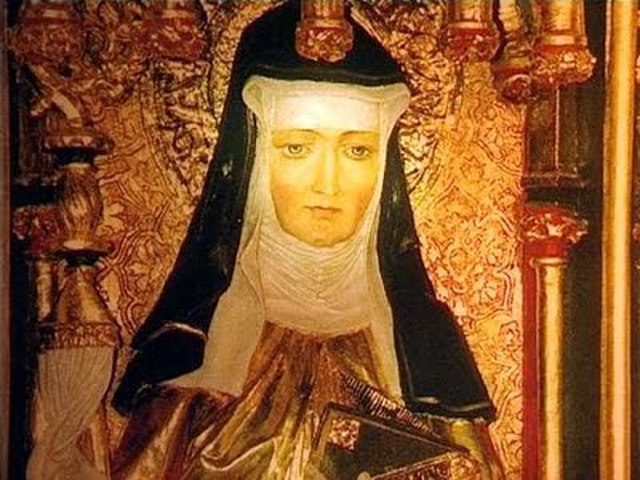
I love that the Church celebrates women who were intellectual, influential, and beautiful, which is why I chose to celebrate this optional memorial today. Today is the (optional) memorial of Saint Hildegard of Bingen, a twelfth century German Benedictine nun and Doctor of the Church who has recently become one of my favorite saints. She was a writer, music composer, philosopher, mystic, cook, medical doctor of sorts, and Benedictine abbess. Clearly she was a very busy woman!
She was very sick in her childhood, and so her parents promised her to God for her healing. At age 8, she was placed in the care of a Benedictine nun, Blessed Jutta. She was taught to read and sing the psalms. Her holiness of life attracted her to many people, and at a young age, she began having mystical visions. At age 18, she was professed a nun and eventually elected abbess when Sister Jutta died. She went on to found monasteries at Bingen and Eibingen, which she felt was at divine command.
Although she never had formal education and did not know how to write, she amassed great knowledge of the faith, music, natural science, herbs, and medicinal arts. Her insights and learning were attributed to visions, which were faithfully transcribed by confreres of her spiritual director. Hildegard became famous throughout Europe and people would travel to see her. The works that were transcribed from her visions included commentaries on the Gospels, the Athanasian Creed, and the Rule of Saint Benedict, in addition to Lives of the Saints and a medical work on the well-being of the body.
As a person who loves to cook, I am thrilled that we have some of her recipes. Last year on her feast day, I made her “Cookies of Joy,” which are a crisp spice cookie not unlike gingerbread. I did, indeed, experience joy when I ate them! Her recipes, by and large, were written to include healthy ingredients (at least as that was understood in the twelfth century), but also to give delight.
And in that delight, Hildegard encourages us to sing. She was a musician and she wrote: “Don’t let yourself forget that God’s grace rewards not only those who never slip, but also those who bend and fall. So sing! The song of rejoicing softens hard hearts. It makes tears of godly sorrow flow from them. Singing summons the Holy Spirit. Happy praises offered in simplicity and love lead the faithful to complete harmony, without discord. Don’t stop singing.”
After her death, she was strongly revered. She became a saint, and in 2012, Pope Benedict XVI, of blessed memory, declared her to be a Doctor of the Church, one of just four women and just 35 saints to be given that title. Pope Benedict XVI called Hildegard, “perennially relevant” and “an authentic teacher of theology and a profound scholar of natural science and music.”
Saint Hildegard of Bingen, pray for us!
You must be logged in to post a comment.