Category: The Church Year

  • Tuesday of the Seventh Week of Easter

    Tuesday of the Seventh Week of Easter

    Today’s readings

    Today’s first reading and Gospel present a kind of wrap-up to the lives of St. Paul and Jesus, respectively. They both have completed the mission for which they had been sent, and both are now giving the mission back to God who would continue it as He alone saw fit. Paul’s mission had been one of conversion, beginning with his own, and then reaching out to the Gentiles he met traveling far and wide. Now he did not know what would happen to him, only that the Holy Spirit kept telling him it was to be an end filled with hardship, from which Paul refused to shrink.

    Jesus, one with the Father from the beginning, had come from the Father and was now going back to the Father. He brought God’s love to bear on the aberrations of sin and death and had drawn disciples into the mission to continue the work. It could not continue unless he returned to the Father and sent the Holy Spirit upon them. Doing that has brought the Gospel into every nation and into the lives of millions. He too faced an end filled with hardship, from which he refused to shrink.

    We disciples will come to our own ends as well. Will we too be able to give the mission back to the Father, confident that we’ve done it as best we could, and confident that it would be continued as God saw fit? Have our days sometimes been filled with hardship, and if so, have we also refused to shrink from it? We disciples are part of the mission that God has in the world. We take it for a time and will eventually have to hand it back over. Please God, may we all be able to do so with confidence that God’s will has been done in us!

  • The Ascension of the Lord

    The Ascension of the Lord

    Today’s readings

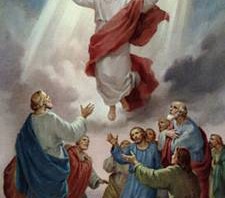
    For the early Apostles and disciples, today’s feast had to be a kind of “now what?” experience for them. Think about what they’ve been through. Their Lord had been betrayed by one of their friends, he had been through a farce of a trial and put to death in a horrible, ignoble way, they had been hiding in fear thinking they might be next, they had questioned what they were supposed to do without their Lord, and then they witness the Resurrection: Christ walks among them for a time, appearing to them and making himself known. They had seen redemption of a way of life they almost had abandoned, and now, on this feast of the Ascension, their Lord is leaving them again. In our first reading from the Acts of the Apostles, you can almost feel the amazement and desperation they are experiencing as they stare up into the heavens, incredulous that their Lord is gone, again.

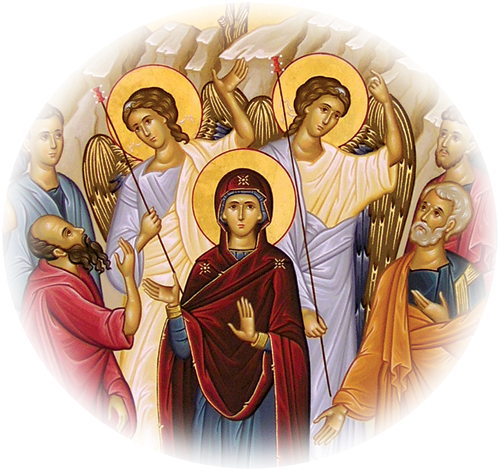
    So once again, God sends two messengers, two men in white garments, to set them straight. God had sent two men in dazzling garments to the women at the tomb on the day of the Resurrection as well. That time, the men reassured the women that the Lord had not been moved or stolen, but had risen from the dead. This time, the men appear to the Apostles, assuring them that the Lord would return in the same way as he had just departed from their sight. Both times, it was the same kind of messengers, with the same kind of hopeful message. Go forward, don’t worry, God is in control.

    One of the great themes of Catholic theology is the idea of “already, and not yet.” Basically, that means that we disciples of Christ already have a share in the life of God and the promise of heaven, but we are not yet there. So we who believe in Jesus and live our faith every day have the hope of heaven before us, even if we are not home yet. And this hope isn’t just some “iffy” kind of thing: it’s not “I hope I’ll go to heaven one day.” No, it’s the promise that because of the salvation we have in Christ, we who are faithful will one day live and reign with him. This gives us hope in the midst of the sorrows that we experience in this world.

    Another great theme of Catholic theology is that our God is transcendent, but also immanent. Transcendent means that our God is higher than the heavens, more lofty than our thoughts and dreams, beyond anything we can imagine. Whatever we say about God, like “God is love” or “God is good” – those things only begin to scratch the surface of who God is, because God is transcendent beyond anything our limited words can describe. But our God is also immanent. God is not some far off entity that has brought the world into existence and set the events of our lives in motion and then drops back to observe things from afar. No, our God is one who walks among us and knows our sorrow and our pain and celebrates our joy. Saint Augustine said that God is nearer to us than we are to ourselves. Our God may indeed be mysterious and beyond us, but he is also the one we can reach out and touch. If that weren’t so, the Eucharist would be pretty meaningless.

    As you can see, Catholic theology is generally speaking not exclusive. We are not either already sharing in the promise or not yet sharing in it, but we are “already and not yet.” Our God is not either transcendent or immanent, but both transcendent and immanent. These two great theological themes come to a kind of crossroads here on this feast of the Ascension.

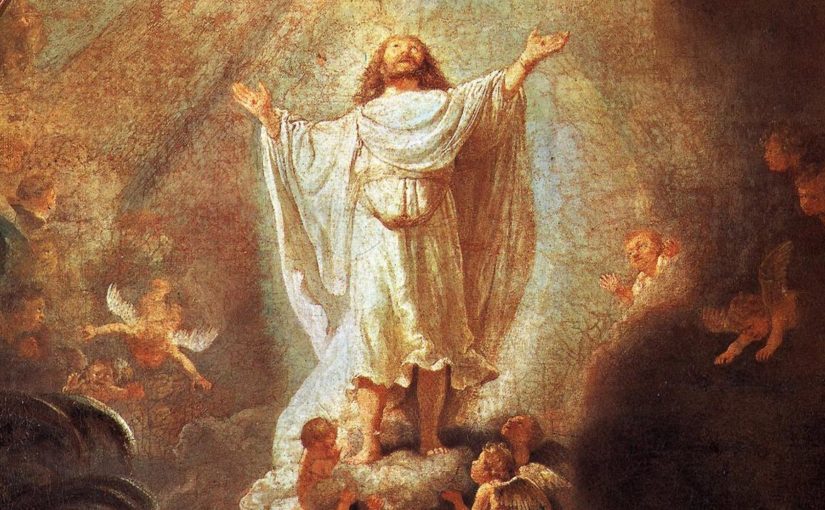
    Today, as Christ ascends into heaven, our share in the life of God and the promise of heaven is sealed. We have hope of eternal life because our Lord has gone before us to prepare a place for us. If he had not gone, we could never have shared in this life. So, although Jesus has left the apostles yet again, they can rejoice because they know that the promise is coming to fulfillment. We do not possess it yet, because we are not home yet, but we share in it already, because Christ is our promise.

    Today, as Christ ascends into heaven, he once again, with the Father, is transcendent, because we, along with the Apostles, can no longer see him. But he remains immanent by his promise to be with us always. Again, I will quote St. Augustine who said of Christ that “He did not leave heaven when he came down to us; nor did he withdraw from us when he went up again into heaven. The fact that he was in heaven even while he was on earth is borne out by his own statement: No one has ever ascended into heaven except the one who descended from heaven, the Son of Man, who is in heaven.” St. Augustine teaches that the notion of time is that everything is present to God all at once. This explains how our celebration of the Eucharist in a few minutes brings us to Calvary at the moment when Jesus gave his life for us. And it explains how Jesus can ascend into heaven and yet remain among us. Time is a limitation for us humans, but not for God who created time in the first place.

    All of this theology can be heady stuff, but what it boils down to is this: because Jesus died, rose from the dead, and ascended into heaven, we now have the hope of heaven and of sharing in the very life of God. Even though we do not possess heaven yet, we know that it belongs to all who have faith in Christ and live that faith every day. And even though we do not see Jesus walking among us, he is still absolutely present among us and promises to be with us forever. The preface to the Eucharistic prayer which I will sing in a few minutes makes this very clear; it says:

    Mediator between God and man,
    judge of the world and Lord of hosts,
    he ascended not to distance himself from our lowly state
    but that we, his members, might be confident of following
    where he, our Head and Founder, has gone before.

    Jesus, having explained the Scriptures to his Apostles yet again, tells them “You are witnesses of these things.” And so they don’t have the luxury of just standing there, staring up into the sky for hours, dejected and crushed because the One who had been their hope had disappeared. No, as the Gospel tells us today, they “returned to Jerusalem with great joy, and they were continually in the temple praising God.” They are witnesses, “clothed with power from on high,” and they must be filled with the hope and joy of the resurrection and ascension of the Lord.

    We disciples are witnesses of these things too. We must witness to a world filled with violence and oppression and sadness that our God promises life without end for all those who believe in him. And we have that hope already, even though not yet. We must witness to a world languishing in the vapidity of relativism and individualism and New Age Oprah and Dr. Phil philosophy that it is Jesus Christ, the Lord of All, who is one with us in heaven, and present among us on earth, who fulfills our hopes and longings and will never leave us. We must be witnesses to all these things, living with great joy, continually praising God because Christ’s ascension is our exaltation. We too might hear those men in dazzling white garments speak God’s words of hope to us: go forward, don’t worry, God is in control.
  • The Ascension of the Lord – Alternate

    The Ascension of the Lord – Alternate

    Today’s readings

    “You are witnesses of these things.”

    That is what Jesus tells the disciples at the close of today’s Gospel reading. He is just about to ascend to the Father, and so he takes care to make sure that the disciples are ready for the mission. They are the ones who will have to testify to the death and resurrection of Christ, and to preach forgiveness of sins in his name to every person on earth.

    And we can see that the disciples did indeed take up this mission. If that were not true, we would not be here right now. The Word has been proclaimed, the sacraments have been handed down, and we have benefitted from it.

    And so now we are the witnesses of these things. We may not have seen the events unfold in front of us, but we have seen them in the Liturgy, and we believe that our celebration of the Liturgy is not some simple re-enactment of the events of our salvation, but in a very real sense is a participation in the death and resurrection of Christ in our own day.

    We are the witnesses now. And people have to see us preaching with the way that we live our lives. We have to preach it by going to Mass faithfully, by keeping the commandments, by being people of integrity and fairness at our jobs or in our schools, by reaching out to those who are poor, needy and marginalized, by giving ourselves to others whenever, wherever, and however we can.

    We are witnesses of these things. The question is, will others witness Christ in us?

  • Thursday of the Sixth Week of Easter

    Thursday of the Sixth Week of Easter

    Today’s readings

    “You will weep and mourn, while the world rejoices;
    you will grieve, but your grief will become joy.” 

    Jesus continues to prepare his disciples for his not being among them in the flesh. He knows that his death, resurrect and Ascension were all part of the plan, and he wants the disciples to be prepared so that their grief does not overwhelm the mission. He knows that they will indeed grieve, after all, he was fully human in that way too. He grieved over the death of Lazarus and grieved over the needs of the people he ministered to. He knew that sadness was to be expected and please note carefully that he did NOT tell them not to grieve: “You WILL weep and mourn, while the world rejoices; you WILL grieve…” So he does not, as our modern society would, tell them to get over it and get back to work. He knows that grief is healthy and necessary. 

    But he also gives them hope. Because we Christians do not grieve as if we have no hope. He knows that salvation is the plan, and that death is no longer the end of the story. Their grief would indeed become joy. And joy isn’t the same thing as saying they would always be happy. But just because people grieve doesn’t mean they are not experiencing joy. Because joy is a condition that is not regulated by external circumstances. Joy comes from knowing that God is in control and that salvation is ours. 

    Joy ultimately comes from the Holy Spirit, the Advocate that Jesus knew for certain he would be sending once he returned to the Father. The Spirit’s presence in our lives gives us a joy that the world and all its grief cannot ever take away. We too look forward to these events as we prepare for our annual celebrations of the Ascension and Pentecost. We may indeed be subject to grief in this life, in many forms. But we have been given the gift of the Spirit, we know that God is in control and that salvation is ours. 

    We may indeed weep and mourn while the world rejoices; we may grieve, but our grief will certainly become joy. 

  • The Sixth Sunday of Easter: Hope

    The Sixth Sunday of Easter: Hope

    Today’s readings

    Virtues are those habits and dispositions that lead us to what is good (CCC 1804). There are generally a couple of different kinds of virtues: human virtues (like prudence and justice) and theological virtues (like faith, hope and charity). I bring these up because I believe our readings today revolve around the theological virtue of hope. Hope is the virtue that recognizes our desire for happiness in this life and the next, which is an aspiration placed in our hearts by God himself (CCC 1818). This virtue of hope causes us to “desire the kingdom of heaven and eternal life as our happiness, placing our trust in Christ’s promises and relying not on our own strength, but on the help of the grace of the Holy Spirit” (CCC 1817).

    Hope is that virtue that gets us through the difficulties of this life with a view toward what is to come. It’s the light at the end of the tunnel, and not the light of an oncoming train! Hope is so necessary in every moment of history, in every society and in every person’s life. Hope holds fast to the belief that we are travellers in this world, that we are not home yet, and that the best is yet to come. In these Easter days particularly, the Resurrection is our hope, testifying that we have the invitation to life eternal, and the abiding presence of our God who made us for himself.

    Our second reading today is, and has been through the season of Easter, from the book of Revelation. This revelation to John and his community was meant to foster hope among a people who were being persecuted. Because they believed in Christ, they were being expelled from the synagogues, and then, because they had no other religious affiliation, they were being forced by the Romans to worship their pagan gods or face death. They definitely needed hope! To them, John prophesies of the new heavenly Jerusalem, the Holy City, which would need no light from the sun or stars or even lamps, because its light was the light of Christ himself. Indeed, the very City was Christ, and all of the community could hope for the day when they would be caught up in it and all would be made right.

    Our Gospel today, even though we are in the season of Easter, finds us before Jesus’ death. John’s Gospel always portrays Jesus as being in charge: he does not have an agony in the garden, but willingly lays down his life for us. So in this reading, fully aware that he is about to give his life, he seeks to give hope to his disciples who will surely grieve his loss and be filled with despair and even fear for their own lives. So in order to prepare them, he offers them peace, and the abiding presence of the Advocate, the Holy Spirit, who will remind them of Jesus’ words and help them to integrate all that he has taught them. In many ways, absent this hope, we would not have Christianity today.

    So hope was necessary for the first disciples, hope was necessary for the early Christian community, but it is also necessary for us today. Think of the many ways that our society beats us down. We can point to war, terrorism and unrest in so many parts of the world, and even in our own cities. We can look at traditional values degraded and open hostility to anything remotely Christian. We can also find distress in our own families, at our places of work, and in our schools. We may even be dejected by our own sinfulness, and the many ways that the world seems to take us away from God and family and community. We need that same abiding hope that the early community found in Christ and in John’s vision.

    And we have it. Every time we gather here for the celebration of Mass, for the proclamation of the Word and the saving sacrifice of the Eucharist, we can see that this world is not all there is. We can see that God is with us, in good times and in bad. We can see that he is leading us to our true heavenly homeland, where all will be made right, and every sadness put to an end.

    Saint Teresa of Avila wrote, “Hope, O my soul, hope. You know neither the day nor the hour. Watch carefully, for everything passes quickly, even though your impatience makes doubtful what is certain, and turns a very short time into a long one. Dream that the more you struggle, the more you prove the love that you bear your God, and the more you will rejoice one day with your Beloved, in a happiness and rapture that can never end” (Excl. 15:3 cf. CCC 1821).

    And so we Christians press on as an Easter people, confident in God’s promises and filled with his abiding presence. We shed light on a world that can be dark at times, and we beckon all the world to receive the peace that can only come from our Risen Lord.

  • Thursday of the Fifth Week of Easter

    Thursday of the Fifth Week of Easter

    Today’s readings

    I love it when engaged couples pick this reading for their weddings. Not just because it’s sentimental, all talking about love and everything. I like it because of the way it talks about love. Because it would be easy enough to say that if we just love each other a little more, everything will be fine.

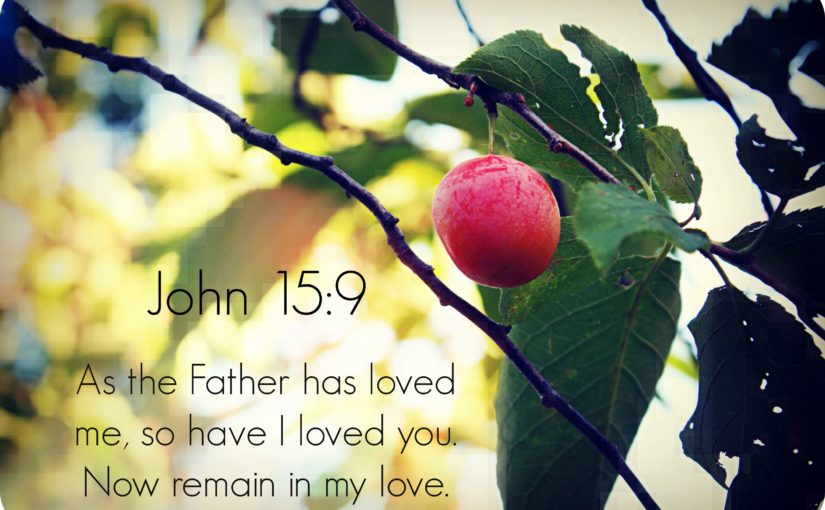
    But Jesus reminds us that this is not how love works. And that sentiment is not at all what he had in mind when he said “Remain in my love.” The word “remain” here is a translation of the Greek word meno, which is a word that connotes an abiding presence, a rootedness at one’s core. “Remain” is too passive a word, kind of like sitting around and doing nothing, all covered with the love of God. I think the better translation would be “live and breathe always in my love.”

    And that’s what Jesus goes on to say. “If you keep my commandments, you will remain in my love, just as I have kept my Father’s commandments and remain in his love.” So this remaining in Jesus’ love involves keeping his commandments. Do you remember what those commandments were? Well, they revolve around love. In Matthew’s Gospel, when the scholar of the law asks which of the commandments was the greatest, Jesus said, “You shall love the Lord, your God, with all your heart, with all your soul, and with all your mind. This is the greatest and the first commandment. The second is like it: You shall love your neighbor as yourself.” (Matthew 22:37-39)

    Putting God and neighbor first in the same way as Jesus did for us is what this kind of love entails. And note carefully that the way Jesus put us first was by laying down his life on the cross. Remaining in Jesus’ love, the command he gives us today, involves loving others in a sacrificial way, putting aside our own interests and ambitions at times, dying to self, so that we can give life to others.

    But this is not to make ourselves martyrs or even grumpy Christians. This love leads to true joy, because in many ways it takes away the worry of having to think about ourselves. “I have told you this so that my joy might be in you and your joy might be complete.” And so it is with great joy that we remain in Christ’s love; loving others as he has loved us – sacrificially and unconditionally. And with this great love, as the Psalmist says, we “Proclaim God’s marvelous deeds to all the nations.”

  • Tuesday of the Fifth Week of Easter

    Tuesday of the Fifth Week of Easter

    Today’s readings

    Some of you might be thinking Saint Paul was a typical man. He’s almost stoned to death and left, in fact, for dead, and he gets up and enters the city like nothing was wrong. I don’t know about you, but if I barely weathered the storm of people throwing rocks at me and leaving me for dead, I might think twice about how I handled my ministry. That’s nothing to be proud of, but I think that’s part of fallen human nature. How blessed we are to have the saints, like Saint Paul, to give example of how to weather the storm and live the faith and preach the word. Indeed, if it weren’t for the grace-filled tenacity of those saintly apostles, we would very likely not have the joy of our faith today.

    But contrast the storminess of Paul’s stoning with the wonderful words of encouragement and consolation we have in today’s Gospel reading: “Peace I leave with you; my peace I give to you. Not as the world gives do I give it to you. Do not let your hearts be troubled or afraid.” We can think of all sorts of situations in which these words would be welcome. We have all experienced health problems in ourselves or in those close to us, job difficulties, family problems, and so many more. How wonderfully consoling it is to know that in the midst of the many storms we daily face, our Savior is there: offering us peace.

    But the peace Jesus offers us in this reading is a bit different from what we might expect. It’s not the mere absence of conflict, nor is it any kind of placating peace the world might offer us. This peace is a genuine one, a peace that comes from the inside out, a peace that calms our troubled minds and hearts even if it does not remove the storm.

    God knows that we walk through storms every day. He experienced that first-hand in the person of Jesus as he walked our walk in his earthly life. He knows our joys and our pains, and reaches out to us in every one of them with his abiding presence and his loving embrace. He was there for Saint Paul when he was being stoned, and he is there for us too. His presence abides in us through the Church, through the holy people God has put in our lives, through his presence in our moments of prayer and reflection, and in so many ways we could never count them all. This peace from the inside out is one that our God longs for us to know, whether we are traversing calm waters or braving a vicious storm.

    We pray, then, for the grace to find peace in our daily lives, the peace that comes from Jesus himself.

  • The Fifth Sunday of Easter: I Love You Period!

    The Fifth Sunday of Easter: I Love You Period!

    Today’s readings

    One of the most exciting lines in today’s Liturgy of the Word comes in the second reading: “The One who sat on the throne said, ‘Behold, I make all things new.’” The book of Revelation is all about the persecution of the early Christians, and it looks forward to the day when God would put all that persecution to an end. People were dying for the faith, being forced to give it up or be cast out of the synagogues. That left them open to the persecution of the Romans who demanded that they take up the worship of their pagan gods or face death. They were a people looking for newness, healing, and re-creation. So it is with great hope, then, that John reports what is heard in his vision: “Behold, I make all things new.”

    There is a clamor for newness, I think, in every age and society. We are a people who could use some re-creation even today. Look at the way our own faith is received. The voices of death have such a foothold that they have many faithful Catholics believing that babies can be aborted in favor of personal choice. Sunday family worship takes a further back seat to soccer games, baseball, and other activities, as if worshipping God were just one possible choice for the many ways people could spend the Lord’s day. Rudeness and hurtful language are used in every forum, and we call it entitlement. Prayer is not welcome in almost any public location, for fear that someone might be offended by our religiosity. Concern for the poor and needy, and a longing for peace and justice are bracketed in favor of capital gain. And that is to say nothing of those Christians in the Middle East, especially Syria, who face danger and death for living their faith. We Christians today are persecuted just as surely as the early Christians, whether we pay for it with our lives or not. We Christians today are in need of hearing those great words: “Behold, I make all things new.”

    The good news is that as an Easter people, we can already see the newness that is God’s re-creation of our world. We know the story of our salvation: This world was steeped in sin and we are a people who, though created and blessed by our God, time after time and age after age turned away from our God. Every generation turned away in ways more brazen than the last. We are the heirs of that fickle behavior and we can all attest that our sins have led us down those same paths time after time in our own lives. But God, who would be justified in letting us live in the hell we seemed to prefer, could not live without us. So he sent his only Son into our world. He was born as one of us and walked among us, living the same life as ours in all things but sin. He reached out to us and preached the new life of the Gospel. And in the end, he died our death, the death we so richly deserved for our sins. And not letting that death have the last word in our existence, he rose to a new life that lasts forever. He did all that motivated by the only thing that could ever explain away our fickle sinfulness, and that motivation is love.

    I give you a new commandment: love one another.
    As I have loved you, so you also should love one another.
    This is how all will know that you are my disciples,
    if you have love for one another.

    The love that Jesus is talking about here is not some kind of emotional infatuation that fades as quickly as it grows. It is not a love that says “I will love you if…” Perhaps you have heard it yourself: “I will love you if you remain faithful to me.” “I will love you if you are successful in school.” “I will love you if you meet all my own selfish expectations.” “I will love you if you ignore my imperfections.” “I will love you if you become more perfect.” But the kind of love that says “I will love you if…” is not love at all. If God loved us if… we would be dead in our sins and there would be no reason to gather in this holy place day after day. If God loved us if… we would have nothing to look forward to in the life to come.

    No, God does not love us if… God loves us period. As we know, God is love. God is love itself, love in all its perfection. Love cannot be experienced in a vacuum, so God created us to love him and for him to love us. We are the creation of God’s love and God cannot not love us! The kind of love Jesus is talking about in today’s Gospel can only be summed up by the cross and resurrection. Jesus takes our sinfulness and brokenness upon himself, and stretches out his arms to die the death we deserve for our unfaithfulness. It wasn’t nails that held him to that cross, it was love, and we are totally undeserving of it. Even greater then, is the gift of the Resurrection in which we see that, because of love, death and sin have lost their sting. They no longer have the last word in our existence, because our God who is love itself has recreated the world in love.

    And with this great act of sacrifice that restores us to grace, Jesus also gives those who would be his disciples a commandment: Love one another. Which sounds like an easy enough thing to do. But the second line of that commandment gives us pause and reminds us that our love can’t just be a nice feeling. He says to us: “As I have loved you, so you also should love one another.” And we know how he has loved us, don’t we? Whenever we forget, all we have to do is look at the nearest crucifix. Our love must be sacrificial. Our love must be unconditional. Our love cannot be “I will love you if…” but instead, “I love you period.” Our love must be a love that re-creates the world in the image of God’s own love.

    We live in a world that is broken and dark and evil at times. But our God has not abandoned us. Taking our death upon himself, he has risen triumphant over it. In spite of our unfaithfulness, he has re-created us all in his love. So now we disciples must continue his work of re-creation and love the world into a new existence.

    “Behold, I make all things new.”

  • Thursday of the Fourth Week of Easter 

    Thursday of the Fourth Week of Easter 

    Today’s readings

    Today’s readings are full of messengers. In the first reading, Paul is a messenger bringing news of the real meaning of the ancient Scriptures in light of the death and resurrection of Jesus. And he speaks of another messenger, John the Baptist, who paved the way for the coming of Jesus by preaching a baptism of repentance. In the Gospel, Jesus points out that a messenger is never greater than the one who sent him, and that those messengers sent by Christ should be accepted as Christ, since Jesus himself was sent by the Father. Accepting the messenger is accepting Jesus is accepting God the Father.

    The word messenger goes back to old French and Latin words for “send” and is closely tied to the word “mission.” The messenger is truly on a mission from the one who sent him. When you think of it, all of us disciples are messengers on a mission. We all have been charged with the mission of proclaiming the Gospel and witnessing to Christ. We do that in our own ways; sometimes, as St. Francis would say, we use words. But often we do not. Most often our witness depends on how well we live our mission, the message that we send comes in the things we do and the way we live. As my father used to say, “actions speak louder than words.”

    And so we come to this place to be nourished for our mission. We hear the words of Scripture that gives us the message to preach and receive the Eucharist that gives us strength for the journey. People will come to know Christ as they come to know us. We pray that our message might be a good one, a message that compels everyone we meet to turn to our God. Because the mission, the message that we have is better than anything on earth. As the Psalmist says, “For ever I will sing the goodness of the Lord.”

  • Thursday of the Third Week of Easter 

    Thursday of the Third Week of Easter 

    Today’s readings

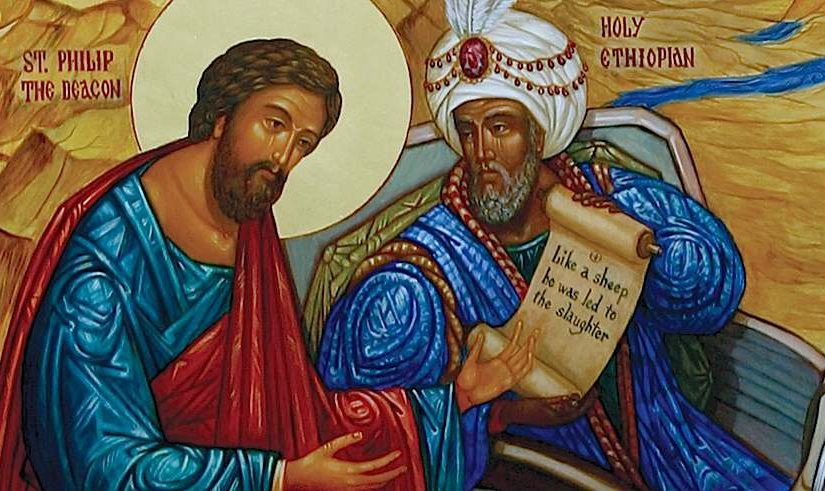
    I don’t believe in coincidences. Being in the right place at the right time isn’t usually a coincidence. Far more often than we realize, it’s the work of the Holy Spirit. Certainly that is the case in today’s first reading. How else would we explain an angel directing Philip to be on a road at the very same time as the Ethiopian eunuch passed by, reading a passage from the prophet Isaiah that referred to Jesus? Seizing the moment, Philip proclaims Jesus to him in a way that was powerful enough and moving enough that, on seeing some water as they continued on the journey, the eunuch begged to be baptized.

    The same is true for those who were fortunate enough to hear Jesus proclaim the Bread of Life discourse that we’ve been reading in our Gospel readings these past days. Having been fed by a few loaves and fishes when they were physically hungry, they now come to find Jesus who longs to fill them up not just physically but also, and more importantly, spiritually. Their hunger put them in the right place at the right time. 

    What I think is important for us to get today is that we are always in the right place at the right time, spiritually speaking. Wherever we find ourselves is the place that we are directed by the Holy Spirit to find God. Wherever we are right now is the place where the Holy Spirit wants us to find God and to proclaim God. That might be in the midst of peace, or chaos, or any situation. We never know how God may feed us in those situations. Because we never know when there will be someone like an Ethiopian eunuch there, aching to be filled with Christ’s presence and called to a new life. 

    It is no coincidence that we are where we are, when we are. The Spirit always calls on us to find our God and proclaim him as Lord in every moment and every situation.