Category: The Church Year

  • Monday of the Twenty-ninth Week of Ordinary Time

    Monday of the Twenty-ninth Week of Ordinary Time

    Today’s readings

    There are two things: the promise, and the response.

    The promise has echoed down through the ages.  God called Abraham and promised descendants as numerous as the sands on the sea shore or the stars in the sky.  Through Moses, God made known his intent to bring his people out of slavery and into the promised land.  Through Zechariah, the father of John the Baptist, who speaks in today’s Psalm, God announces that he will make good on his promise to send a Messiah to his people.  And through Jesus Christ, the fulfillment of all the promises, we have the promise of salvation and eternal life in the Kingdom of Heaven.  From Abraham to us today, the promise has echoed, and still echoes, in the Church and in the world, down through the ages.  There is the promise.

    The response has always taken many different forms.  One would think the response would be complete adoration, obedience, and devotion to our God who keeps his promises.  But sometimes the response has been arrogance, thinking that anything good that happens is the result of our own feeble efforts, like the foolish rich man in today’s Gospel.  Sometimes the response has been entitlement, as if we were actually worthy of grace, and due the gifts that come our way.  Sometimes the response has been apathy or disinterest, not even taking the time to notice the graces and blessings that come to us.  Sometimes the response has been outright rejection – refusing the gift and ignoring the Giver.  Sometimes we have been very unworthy and unappreciative of the promise.

    But there is still the promise.  And there is always time for a different, better, more appropriate response.

  • The Twenty-ninth Sunday of Ordinary Time: Connecting with God and the Power of Prayer

    The Twenty-ninth Sunday of Ordinary Time: Connecting with God and the Power of Prayer

    Today’s readings

    This weekend we continue our preaching series at St. Mary Immaculate called “A Crash Course in Catholicism.”  The purpose of the course is to address some core beliefs and practices of Catholics to help people, especially those who have left the practice of the faith or struggle with some of the basics of the faith, get back on track with their faith life.  But we can all benefit from hearing more about the basics of our faith.  Today we are addressing the fundamental ideas of what prayer is, and how we connect with God.

    Before I start on that topic of prayer, I want to invite all of you who are interested in digging it to this topic a bit deeper, all of you who might have questions about prayer, to come to a 30-minute discussion that will be led by members of our team.  That will take place in the small meeting room right after Mass.  If you didn’t come to the discussion last week, you’re welcome to come this week.

    Prayer is one of the most important elements of the Christian life, of the life of a disciple, and yet it is also, I think, one of the most difficult to master. Still, it’s something that we work at every day of our lives, and the working it out should be one of our greatest joys. In today’s Liturgy of the Word, we have just one element of prayer, and that is the element of persistence in prayer.

    Now I’m going to be real careful here. Lots of people give some lousy advice about prayer.  You’ve heard it, I’m sure: if you just pray hard enough and long enough, everything will eventually work out all right.  I’m not going to tell you that, because things often don’t work out perfectly, at least not how we would see a perfect resolution, no matter how much we pray, and they almost never work out the way we’d like them to. So why even bother praying? Well, hang in there, we’ll get to that.

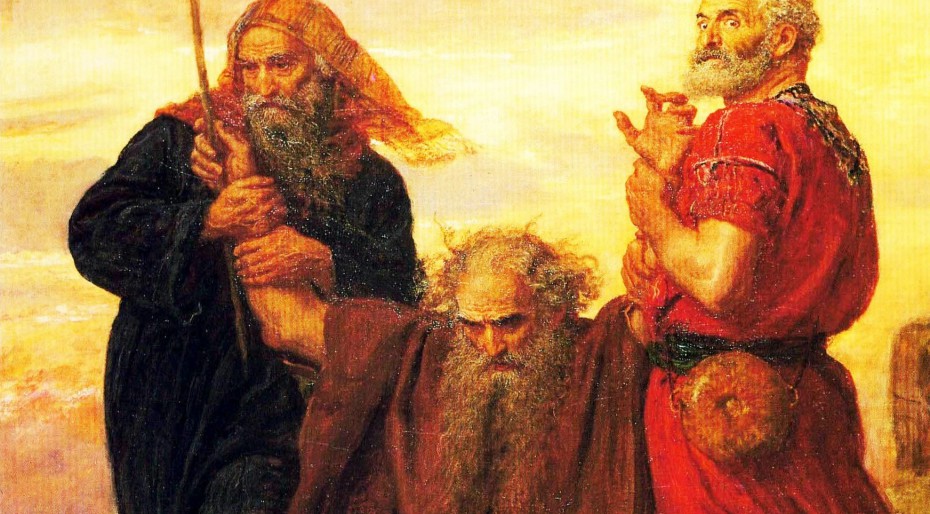
    We have a wonderful image of prayer in our first reading. I invite you to raise your arms with me if you’re able, and leave them raised until you can’t any more. This is what Moses had to do to keep the Hebrew army in a winning position against Amelek and his warriors. The minute Moses lowered his hands to rest, things went ill for the Hebrews, but as long as his hands were raised, things went okay.  Sometimes it’s hard to be persistent in prayer. Sometimes you get tired. Maybe your arms are not yet weary, but they might soon get there.

    I can think of a few times in my life when I’ve grown weary of praying. One of them was in my late thirties when I was trying, once again, and once and for all, to figure out what God wanted me to do with my life. I prayed and prayed and prayed, and it didn’t seem like God was answering at all. I finally grew weary of prayer and told God that he should give me a big challenge and whatever it was, I would do it. Then one day, the day of the Easter Vigil that year, I got a letter in the mail from a friend and it made everything crystal clear. Six months later I was in seminary.

    Sometimes in our weariness we have to let go of what we think we would like God to do for us and just let God be God. Because praying isn’t supposed to be comprised of telling God what to do. Praying never ever changes God, but prayer frequently changes us.  

    But how are your arms doing? Are you weary yet? Well if so, you’re in good company. Moses found that to really be persistent in prayer, he needed friends – Aaron and Hur – to hold him up. That’s true for all of us, I think. There comes a point when we need to admit that we need friends to hold us in prayer, to take some of the burden of prayer when persistence has become difficult. If you haven’t already, you can put your arms down now.

    Then what are we to make of the gospel reading? I mean, are we really supposed to think that God is an unjust judge who has no respect for anyone? Obviously not. I think that we’re supposed to see in this little parable that if even an unjust judge – one who neither fears God nor respects any person – if even that judge will eventually give in to the widow pleading for just judgment, well then how much more will our God who is infinitely just and doesn’t just respect us but loves us beyond all imagining, how much more will he pour out his blessings of justice on all of us?

    Which isn’t to say that he will definitely answer our prayers the way we want them answered. Those persistent prayers will be answered in God’s way, in God’s time. He may say “no” or he may even allow something like an illness or some other disappointment. We may have to bear the burden of disease or the sadness of grieve the death of a loved one. But in all of that, God will be with us. He may heal us in other ways, that we might come to know God’s love in the midst of our burdens.

    When we persist in prayer, sometimes the change that happens is not the situation, but ourselves. We may grow in grace in some way that we would not otherwise experience or even expect. We may grow in our capacity to love, or in our awareness of the needs of others, or in our ability to be steadfast in the midst of chaos. All of these give honor and glory to God, which after all, brothers and sisters, is our ultimate purpose in life.

    So let’s get back to that question that I asked at the beginning of the homily. Why even bother praying if we’re not going to get what we want? I think we pray for three reasons. First, we pray to grow in our relationship with God who is our friend. As in any relationship, we open ourselves up to conversation, watching for God’s response, listenting, and accepting God’s will and his desire that we grow in love for him.

    Second, I think we pray because God genuinely cares about us. If we are to grow in love, we have to know that he is open to us and desires that we communicate our needs, our hopes, our fears, our deepest longings to him. It’s not that he doesn’t know these things already, but the process of expressing them in prayer helps us to know those needs in deeper ways and helps us to be aware of God’s action in our lives.

    Third, I think we pray because that’s how we grow in holiness. The more that we bind ourselves to God by receiving his mercy and grace and knowing his love for us in prayer, the more we become new people, new creations.

    At the end of the Gospel today, our Lord asks, “But when the Son of Man comes, will he find faith on earth?” That’s an incredibly important question. So often it seems like the world, or even our lives, have gone horribly wrong. We may be upset about our country’s values, or the decisions of those who govern us, or the seemingly constant wave of crime, terrorism, or natural disaster. But it’s important that we remember that we can’t stop praying about these things. We always have to be people of faith. We have to persist in our prayer, even if we don’t see things changing as quickly as we would like. The Psalmist reminds us today that “Our help is from the Lord, who made heaven and earth.” Every prayer may not be answered in our time and in the way that we’d like. But by persisting in prayer, we will eventually and always become something better.

    So it’s easy for me to tell you how to persist in prayer.  But one of the biggest questions I often get in confession is “Father, I’m trying to pray more consistently, but I just can’t get it going.  Can you help me?”  And it understand the issue.  As I mentioned, I’ve struggled in my prayer life just like everyone else.  Prayer is something we have to keep working on throughout our lives if we are to be people of faith.  

    I usually give people some advice that has helped me.  First of all, try to find a time that works for you to pray.  Don’t keep forcing yourself to pray more at the end of the day if you keep falling asleep during that time; maybe try first thing in the morning, or break it up and do a little throughout the day.  In my pre-seminary days, I used to put prayer on my to-do list, and keep a little devotional book in my desk drawer.  And try different types of prayer.  If the way you’re praying isn’t working, mix it up and try something else for a while.  It’s good to keep different types of prayer in your “prayer toolbox” because different situations, different seasons in our lives all require different kinds of prayer.  Remember that prayer consists of different things: adoration, contemplating our Lord’s Blessed Presence; contrition, asking God for his mercy and forgiveness of our sins; thanksgiving, remembering God’s gifts to us and expressing our gratitude; and supplication, giving ourselves, our lives, our families, our vocations to God for his greater glory.  All these kinds of prayers are necessary for a rich connection with God.

    It’s important to realize that if you’re having difficulty with prayer, you should still stay with it.  Just like Moses, and the widow in the Gospel parable.  Many saints tell us of dryness in their prayer life, and all of them say that key to overcoming it is to persist in it anyway and trust in God.

    But sometimes people have difficulty even expressing themselves to God.  So let’s try a little prayer experience…
  • Saints John de Brébeuf and Isaac Jogues, Priests, and Companions, Martyrs/Make a Difference Day

    Saints John de Brébeuf and Isaac Jogues, Priests, and Companions, Martyrs/Make a Difference Day

    Today’s readings

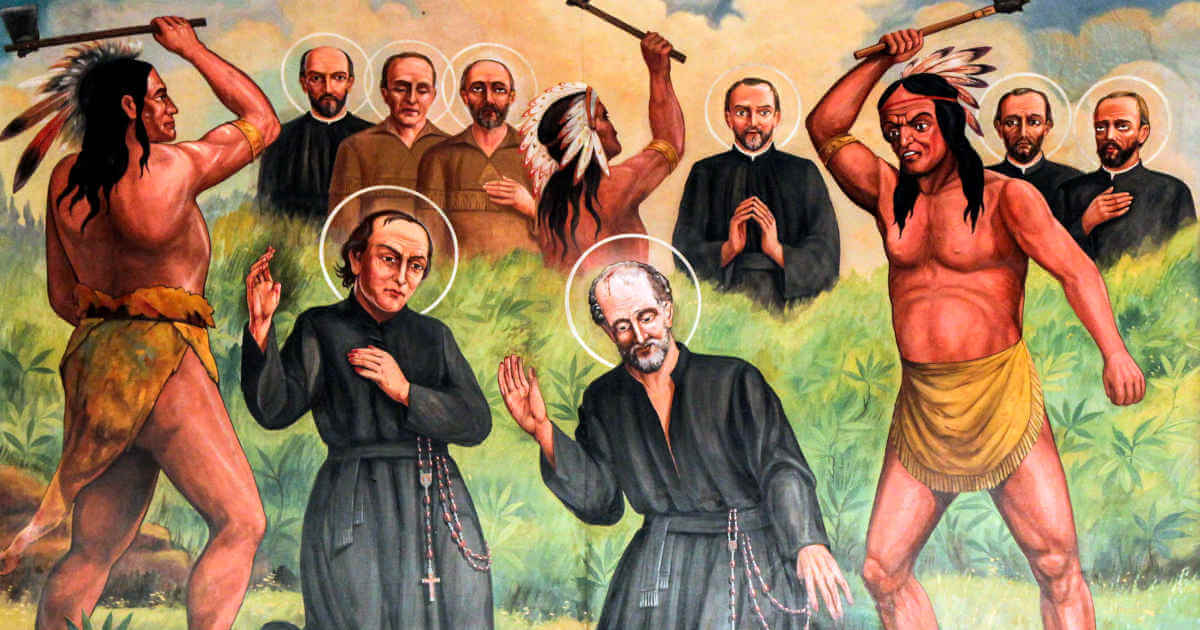
    St. Isaac and St. John were among eight missionaries who worked among the Huron and Iroquois Indians in the New World in the seventeenth century. They were devoted to their work and were accomplishing many conversions. The conversions, though, were not welcomed by the tribes, and eventually St. Isaac was captured and imprisoned by the Iroquois for months. He was moved from village to village and was tortured and beaten all along the way. Eventually he was able to escape and return to France. But zeal for his mission compelled him to return, and to resume his work among the Indians when a peace treaty was signed in 1646. His belief that the peace treaty would be observed turned out to be false hope, and he was captured by a Mohawk war party and beheaded.

    St. John worked among the Iroquois and ministered to them amid a smallpox epidemic. As a scholastic Jesuit, he was able to compose a catechism and write a dictionary in the Huron language, which made possible many conversions. He was eventually captured, tortured and killed by the Iroquois.

    Anything worthwhile costs us something, and that’s especially true of our faith.  If we are serious about it, if we love God and want to be caught up in his life, we’re going to have to pay for it in some way.  Saints Isaac, John, and their companions make that clear.  One of the biggest costs to us, I think, is our comfort zone.  To really live the faith, we have to get out of that comfort and do what God wants of us.  In the Gospel, Jesus was telling his disciples that they would have to give witness to him.  And they understood that that would cost them something – perhaps cost them their lives.

    We disciples are also going to have to pay some price for living our faith.  Probably not something as drastic as being tortured and beheaded, but something fairly costly for us.  For us today, perhaps that cost is giving up a beautiful fall Saturday to clean church pews, or trim a neighbor’s hedges, or sing songs at a nursing home, or any of the myriad of projects we are planning today.

    Today, on our Make a Difference Day, we give strong witness to our faith in our work. As we come together to pack meals at Feed My Starving Children, spend time in adoration praying for our community, or clean up our parish grounds, our presence and concern may be the way God is using us to get someone’s attention and see his presence in her or his life. Living our faith is always going to cost us something and that something is likely to be status or popularity, or at least the wondering glance from people who aren’t ready to accept the faith.  But the volumes that we speak by living our faith anyway might just lay the groundwork for conversion and become a conduit of grace.  We are told that we don’t have to hammer out all the words we want to say; that the Holy Spirit will give us eloquence that we can only dream of.  And it’s true, if we trust God, if we live our faith when it’s popular or unpopular, we will have the Spirit and the words.  God only knows what can be accomplished in those grace-filled moments!  I pray that you see Christ everywhere as you witness today.

  • The Twenty-eighth Sunday of Ordinary Time: Our God Heals|Our God Saves

    The Twenty-eighth Sunday of Ordinary Time: Our God Heals|Our God Saves

    Today’s readings

    Today we begin our “Crash Course in Catholicism.”  It’s our hope that through this four-Sunday series of homilies, those who are seeking answers from the Church and those who are wanting to get back to the practice of the faith can find some help in sorting out the obstacles they have been encountering.  For all of us, I think, these four Sundays will give us some important pieces to add to our “faith tool box,” ideas and concepts that will help us when life takes a turn we don’t expect or appreciate, or when people ask us questions we find hard to answer.  As we begin this series, I’d ask you to keep this endeavor in prayer.  And as we begin each of the homilies for these four weeks, I invite you to pray that Jesus would open all of our hearts and minds to accept the faith more fully.

    Today’s readings give us the opportunity to discuss two very important concepts: healing and salvation.  These things, honestly, are the whole reason Jesus came to us, the whole reason he left his heavenly throne, took on our flesh, and died on the cross.  These readings are really Good News!

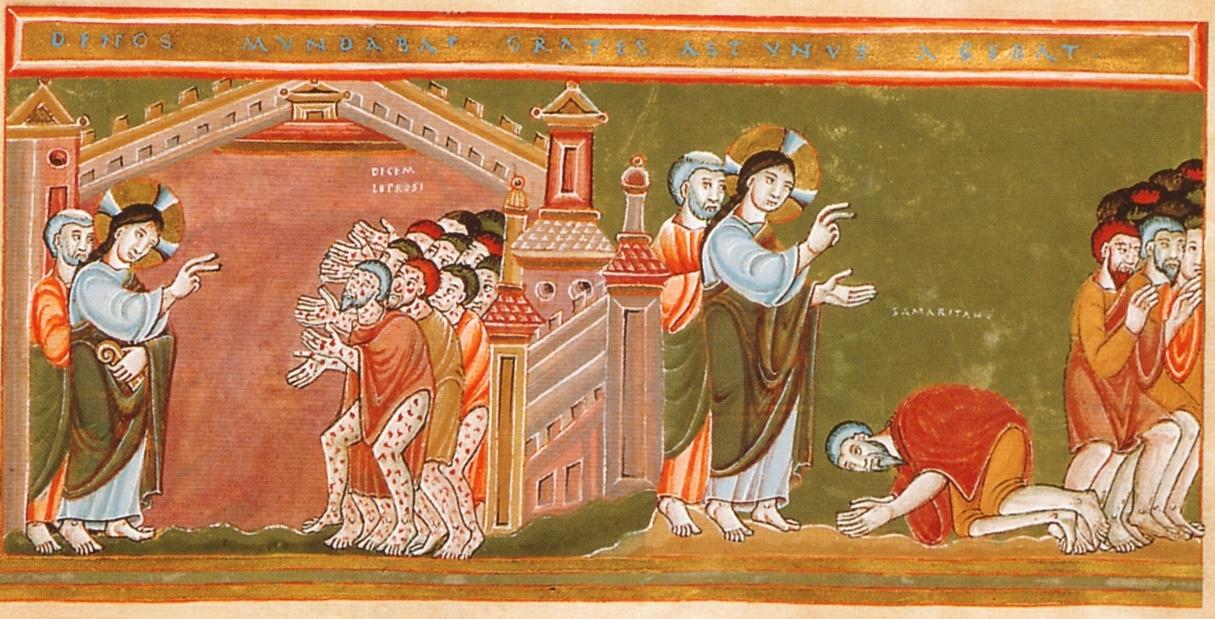
    A lot of energy gets expended around the concept of gratitude when this Gospel reading is discussed, and it’s easy to see why that is – just one of the lepers came back and expressed his gratitude.  But I think he also might have been the only one who was really healed.  Here’s why I think that:  For Jesus, the physical ailment wasn’t usually the most important thing he wanted to heal.  Usually, he was looking for interior healing, almost a kind of healing of the person from the inside out.  So yes, the lepers who came to him were in need of physical healing.  “Leprosy” was the name given to all kinds of skin diseases – but only some were really Hansen’s disease, our modern name for leprosy.  The rest were various types of skin eruptions and rashes. When the skin became diseased, people called it leprosy, and the victim suffered exclusion from the community (cf. Lv. 13-14) and became ritually unclean.

    So Jesus sends the ten of them off to show themselves to the priests.  When they heard that, it had to be confusing.  The priests are the ones who would have to certify them healed so that they could participate in worship again, but since they hadn’t yet been healed, they had to grumble a bit about being put off to someone else.  Except that on the way they were cleansed (notice carefully that it doesn’t say they were healed).  When that happened, they couldn’t possibly mistake the grace they had been given, but nine of them took it no further than that.  Only just the one returned to give thanks, a sign that he had indeed been healed in body, mind and spirit.

    For us then, we need to know that not every healing takes place in the way we would expect, or even in the way we think is best.  God gives us grace according to his purpose and the kind of healing he gives us could well be something we wouldn’t exactly choose.  Perhaps we have found ourselves healed when:

    • A person who loves us tells us a hard truth we need to hear about ourselves.
    • We experience, in a long relationship, opportunities for growth in generosity, forgiveness, patience and humor.
    • Parenting teaches us to give our lives for another in frequent doses of our time, energies, hopes and tears.
    • We suffer a broken relationship, go for counsel and the guidance we receive gives us hope for our future.
    • We seek help for an addiction and the group members offer us wisdom, support and helping hands when we fall and support us “one day at a time.”
    • We suffer the death of a loved one and family and friends are there to grieve with us and eventually there is light at the end of the tunnel.

    What is important to get here is that faith is the key to all of this.  Our faith has to have us open to whatever God intends for us.  Our faith has to give us the ability to cry out to God in our need.  Our faith has to make us ready for whatever healing God intends for us.  That’s not easy: that’s why they call it a “leap of faith,” and sometimes it is just that.  Notice the words that Jesus speaks to the Samaritan leper at the end of the reading: “Go your way, your faith has saved you.”  God can do a lot for us, but it is our own act of faith that helps us to see God’s hand in our lives and cooperate with his grace.

    I think that’s a good turning point for our second concept, and that is salvation.  Many of us have probably been asked by friends or even strangers who are Evangelical Christians, “Are you saved?” and “Have you accepted Jesus as your personal Lord and Savior.”  So let’s be clear about the answers: Are we saved?  Of course the answer is “Yes” — no ifs, ands or buts.  As I said at the beginning of my homily, this was the reason God sent His Son Jesus into the world.  Salvation is the gift won for us in the life, death and resurrection of Jesus.  When we unite our lives to His in Baptism, we are saved.

    But what does this even mean?  What are we saved from?  The answer to that is sin and death.  These are the things that separate us, have always separated us, from real happiness with God.  It was the effect of Adam and Eve doing what God told them not to in the beginning, and ever since, it has caused all of us to desire things that are not God, things that, while they seem nice, can never give us real happiness.  This is what causes the human condition by which we so often end up doing the very things we don’t want to do, and because of which we are not able to do the things we want to do.  That is the basic effect of sin, which leads to the breakdown in all kinds of relationships — between fellow human beings, our connection with creation, our relationship with God, and even with ourselves.  Left to our own human devices we can do nothing about these breakdowns of relationships.  That choice in the beginning, which we call original sin, unleashed a torrent of sin and death with us at one side, and God on the other.  There was no way for us to cross it.  But God didn’t create us for death, so in an amazing act of love, he sent his own divine Son, who took on our flesh and paid the price for our sins.  By dying on the cross, that cross became the bridge for us to cross that torrential river of sin and death, and come to our God, to the place he has prepared for us, to the real happiness for which we were created.  That is the essence of our faith.

    This is why Saint Paul says to Saint Timothy in our second reading today: “Remember Jesus Christ, raised from the dead.  I bear witness to Him so that you may obtain the salvation that is in Christ Jesus.  If we die with him, we shall also live with him in eternal glory.”  We proclaim boldly that there is a remedy for death, and it is Jesus Christ.  We profess that there absolutely is a Savior, and He is Jesus Christ.  

    So have you been saved?  Well, absolutely.  But have you accepted Jesus as your personal Lord and Savior?  That’s more of an individual question.  That process began at your baptism, when either you, or your parents and godparents, accepted that sacrament which makes you part of the Body of Christ.  At your Confirmation, you reaffirmed that by accepting the gift of the Holy Spirit, which leads you to salvation.  And every time you receive the Holy Eucharist, you become what you receive, by incorporating the Body, Blood, Soul and Divinity of Christ into your own being.  

    But it’s easy to do those sacramental things and not have them really change us.  So there is that challenge to really accept that sacramental grace and really accept the salvation God offers us in Christ.  Catholicism is an experiential faith, a living relationship with Christ.  A Catholic is not a person who merely accumulates intellectual knowledge about God nor simply fulfills tradition and the letter of the law.  Pope Benedict and Pope Francis have repeatedly emphasized that Catholic Christianity is an encounter with Jesus.  That encounter happens all through our lives as we pray and grow in our faith.  This encounter with Jesus is the subject of our prayer life, and we will talk more about that in next week’s homily.

    In the meantime, what answer should you give to the Evangelical who asks you if you have accepted Jesus as your personal Lord and Savior?  My suggestion would be very simply: “Yes, I have.  Every day.”

  • Thursday of the Twenty-sixth Week of Ordinary Time

    Thursday of the Twenty-sixth Week of Ordinary Time

    Today’s readings

    I want to begin my homily by reminding you of the words we heard in our first reading from Nehemiah:

    He read out of the book from daybreak till midday,
    in the presence of the men, the women,
    and those children old enough to understand;
    and all the people listened attentively to the book of the law.

    So I hope you won’t mind if I preach from daybreak to midday!

    Today’s readings remind us that we are always in the “school” of the faith.  We don’t ever graduate from that school, until, of course, that great day, when we stand before our Lord to be judged, relying on his mercy and on our relationship with him, which is always a gift.  Those who unite themselves to our Lord in faith throughout their lives, those who continue to study the Scriptures and see them fulfilled in our hearing, they have the promise of eternal life in the Kingdom of God.

    Saint Jerome, whose feast we celebrated earlier this week, underlined this for us.  He said that ignorance of the Scriptures is ignorance of Christ, because for all of us who did not live in the same time as Jesus, we rely on the Scriptures not just to tell us who Christ was, but also to have a relationship with him, remembering that Jesus is always present in the proclamation of the Word of God.

    We see two Scriptural moments in today’s Liturgy of the Word.  First, the Word is proclaimed.  Second, that Word has an effect on its hearers.  So first, the Word is proclaimed.  In the first reading, Ezra the priest reads from the scroll from daybreak to midday, in the presence of the men, the women, and those children old enough to understand.  It was quite the proclamation, and also included a kind of homily, apparently, since the reading tells us that Ezra provided an interpretation.

    The second Scriptural moment is the Word’s effect on its hearers.  For Ezra, the Word produced a very emotional response.  The people bowed down in the presence of the Word, and began to weep.  The weeping is presumably because, hearing the Word, they realized how far they were from keeping its commandments.  I think we might have that same reaction sometimes.  Nehemiah then instructs them not to weep, but instead to rejoice and celebrate, because the proclamation of the Word on this holy day was an occasion for great joy.

    And so today, as we hear the word of God, we too have to let those words have effect on us.  We are sent out as Jesus sent the disciples, with little but his own instruction.  That’s enough, and if we are faithful, we will see the word of God have an effect in every place we bring it.  Praise God for his powerful, effective Word.

  • The Twenty-sixth Sunday of Ordinary Time

    The Twenty-sixth Sunday of Ordinary Time

    Today’s readings

    The past two weekends, we have had the first reading come from the book of the prophet Amos.  I love Amos.  He doesn’t mince words, and you can usually tell what he’s getting at right away.  Today, though, I think it’s a little harder to understand what he means.  The line that jumps out at me is the line, “Improvising to the music of the harp, like David, they devise their own accompaniment.”  It almost sounds like a good thing.  David, of course, was known to be a wonderful musician, so it seems like a good thing that they are able to devise their own accompaniments, right?

    But listen to that line again: “Improvising to the music of the harp, like David, they devise their own accompaniment.” Again, it almost sounds like a good thing, but it isn’t at all. David could devise his own accompaniment, because he was singing those Psalms with the voice of God. But if everyone in our choir devised their own accompaniment, we’d have a cacophony. So here Amos is making the point that devising their own accompaniment meant that they listened to what they wanted to hear, they sang the song they wanted to sing, without any thought as to what was right.  They did whatever they wanted to do, because it seemed like God was blessing them.  It’s kind of like the expression, “she dances to her own music.” It’s not a compliment at all.

    The rich man in today’s Gospel devised his own accompaniment too. He ignored poor Lazarus every single day of his life. He knew Lazarus’s need, and maybe he even thought he’d get around to helping Lazarus one day. Or maybe he thought, “What good can I do, I’m just one person?” Perhaps he thought, “If I give him something to eat, he’ll just be coming around looking for something to eat tomorrow.” He probably came up with all kinds of excuses about why he couldn’t help Lazarus right here and right now. He was devising his own accompaniment.

    And we all know the story about the rich man. Someday becomes never. It’s eventually too late: poor Lazarus dies and goes to be with Father Abraham. But in an ironic twist of fate, the rich man also dies, and it seems like right around the same time. But it seems that Lazarus and the rich man end up in different places, doesn’t it? The rich man learns that devising one’s own accompaniment does not help one to sing a hymn of praise to the Lord, and his choice in life becomes his choice in the life to come. If one doesn’t choose to praise God in life, one won’t have that option in the life to come. Devising our own accompaniment comes with drastic consequences.

    Even in death, the rich man is devising his own accompaniment.  Even now, he does not see Lazarus as anything more than a messenger to do his own bidding.  “Father Abraham,” he cries out, “have pity on me.  Send Lazarus to dip the tip of his finger in water and cool my tongue, for I am suffering torment in these flames.”  When he learns that’s not possible, he tries another tack: “Then I beg you, father, send him to my father’s house, for I have five brothers, so that he may warn them, lest they too come to this place of torment.”  He never sees Lazarus as a brother, and that’s why they’re in different places.  That’s why there is that great chasm that Father Abraham talked about between them – the rich man built it himself!  Devising our own accompaniment means that we separate ourselves from the community, we literally excommunicate ourselves.

    One of the principles of Catholic social teaching is solidarity with the poor and needy.  This was a topic that the prophets, like Amos, preached about all the time. Solidarity with the poor is the teaching that says we need to be one with our brothers and sisters, and not ignore their presence among us. I became very aware of this as I walked around downtown Chicago one time. I had come with some money to give to the poor. But on the train ride home, I realized that I had just quickly given some of them some money, and never really looked at any of them. They were my brothers and sisters, and I didn’t take the time to look them in the eye. Solidarity calls me – calls all of us – to do just that. We have to step out of that universe that we have set in motion around us and realize that Christ is present in each person God puts in our path, particularly and especially in the person who is in need. We have to step out of our own cacophony where we have devised our own accompaniments and step into the symphony that God has set in motion. 

    God knows about this principle of solidarity. Because God holds it so dear, he sent his only Son to take on flesh – our flesh – so that he could live in solidarity with us – all of us who are poor and needy in our sins. He shared in all of our joys and sorrows, and reaffirmed that human life was good. Life was made good at creation and remains good to this day. But if God could take on flesh in solidarity with us, then we must take on the burdens of our brothers and sisters and live in solidarity with them.  We must abandon our own accompaniments and sing the song of our brothers and sisters in need.

    In our second reading today, St. Paul tells us to “pursue righteousness, devotion, faith, love, patience, and gentleness. Compete well for the faith. Lay hold of eternal life, to which you were called when you made the noble confession in the presence of many witnesses.” We have to be serious about living our faith and proclaiming the Gospel in everything that we do. In solidarity with all of our brothers and sisters, we must sing to God’s own accompaniment and join in the wonderful symphony that is the heavenly worship.

  • The Twenty-third Sunday of Ordinary Time

    The Twenty-third Sunday of Ordinary Time

    Today’s readings

    Jesus tells us some things about discipleship today that, quite honestly, I think might make a person think twice about becoming a disciple.  The first two come right at the beginning of the gospel reading: “If anyone comes to me without hating his father and mother, wife and children, brothers and sisters, and even his own life, he cannot be my disciple.  Whoever does not carry his own cross and come after me cannot be my disciple.”  And then, right at the end, he says: “Anyone of you who does not renounce all his possessions cannot be my disciple.”  He’s pretty clear: if we’re not willing to do these things, then we cannot be his disciples.

    How does that make you feel? Are you willing to literally hate those closest to you for the sake of the Gospel?  Would you take up your cross, knowing what happened to him when he did it, and come after him?  Think of the things that you have that you love: are you willing to renounce them in order to follow Christ?  Today’s Gospel is incredibly challenging, to say the least.  Maybe I should say it’s incredibly unsettling.  We might find ourselves totally willing to be Jesus’ followers, but at what cost?

    And that’s the point of the parables he tells.  Who is going to build a building without first calculating how much it would cost to build it to be certain there is adequate funding?  Most of us have probably passed by some commercial buildings that started going up, only to be later abandoned, or that took quite a bit of time to build, possibly because the funding dried up.  So we’re not unfamiliar with the metaphor here.  Or if you were a military leader going into battle, wouldn’t you estimate what the adversary is bringing to the battle to be sure that you can be victorious?  Bringing it down a notch, think of a coach scouting out the other team to see how they play.

    In any of these situations, it is absolutely necessary to calculate the cost.  Not to do so would be foolish.  The same is true of discipleship.  There is a cost to discipleship.  Those first disciples, almost without exception, paid for it at the cost of their lives.  Preaching in the name of Jesus was a dangerous thing to do, but they calculated the cost and realized it was worth it, and they did die.  Praise God for their faithfulness to the mission despite the cost; had they not been faithful we might not have the faith.

    For us modern disciples, should we choose to follow him, there will be a cost too.  We might not have to pay for it with our lives.  But there will be a cross to bear.  We might have relationships that get in the way.  We might have things that we own that tie us too closely to the world and get in the way of our relationship with Christ. Those will have to go.  That is the cost for us, and today we’re being asked if we are willing to pay it.

    So how far do we take this? Do we really have to hate our families? Do we have to sell everything we own? Do we have to take up the cross in such a way that we become doormats for those whose views are different from ours? How much of the cost do we ourselves really need to pay?

    We certainly know that Jesus – who loved his mother and father very much – did not mean that we were to alienate ourselves from our families.  But there may be relationships in our lives that are obstacles to the Gospel. Maybe we’d gossip less if we didn’t hang out with people who brought that out of us.  That would certainly help us to be better disciples.  Maybe we’re in friendships or casual relationships that lead us to drink too much, or see the wrong kind of movies, or that draw us away from the healthy relationships we have.  Those relationships have to end if we are to follow Christ more fully. Anything that gets in the way of our relationship with God and our ability to follow him in whatever way he’s called us has to go right now.  Ruthlessly put an end to it now, because otherwise we give up the life to which we are called, the life that is better than even these things that we might enjoy very much.

    Today we are being asked to take a stand against abortion.  This is particularly urgent now, especially since our state has enacted laws that support abortion up to the moment of birth.  The way that we protect, or choose not to protect, the most vulnerable among us – the unborn – says a lot about who we are and how we live the Gospel.  We have to be willing to take a stand, no matter the cost, because the cost to our society from the loss of so many souls is just too great.

    What can you do?  Our wonderful Reverence for Life Committee is joining with others in our area to observe the 40 Days for Life.  Our parish’s day is October 12th.  We are asking everyone to take one hour to come to the Planned Parenthood facility in Aurora and pray.  Just one hour.  You can make a huge difference and even save a life.  There are blue cards in the pews right now.  We ask that you fill out the top of the card and tear it off, then put it in the collection basket in a few minutes.  One hour and you could save a life.  That’s a great way for us to live the Gospel.

    Our Liturgy of the Word today reminds us that following the Gospel on our own terms is not possible. The call to discipleship is one that calls us to step out of our comfort zone, leave behind whatever ties us to the world and separates us from God, and follow our Savior wherever he leads us. So if our only sacrifice for the sake of the Kingdom of God is maybe getting out of bed and coming to Church on Sunday, then Jesus is telling us today that’s not enough.  It is a good start, but we have to reflect with wisdom on those things that are getting in the way, because it’s time we gave them up.

    As we present our gifts today, God gives us the gift of wisdom.  How we live our lives this week will be the test of the way we’ve put that gift into action.  And don’t forget to drop the top of the blue card in the collection basket.

  • Labor Day

    Labor Day

    Readings: Genesis 1:26-2:3 | Psalm 90 | 1 Thessalonians 4:1b-2, 9-12 | Matthew 6:31-34

    Today, we’ve gathered to celebrate and bless human labor.  Human labor is a cornerstone of our society and our world, dating all the way back to the creation of the world, as today’s first reading shows us.  Indeed, our labor is a participation in the ongoing creation of the world, and is one of the strongest ways that we can be in communion with our Creator God.  We know that, at the completion of the creation of the world and everything in it, God sanctified the whole of it through rest.  That’s an important point that I think we maybe don’t get the way we should.

    Today is an opportunity to take a step back and look at our working and our resting.  We know that we don’t get enough rest.  We are sleep deprived, we take working vacations, we very often don’t take all the vacation we’re allotted, and some don’t take a vacation at all.  Even our children are so over-scheduled that they are sleep deprived as they go from one activity to the next, day after day.  And so our lives are out of balance and I think, very often, we don’t do our best work when we’re working.

    Jesus tells us in today’s Gospel that this kind of thing is just crazy.  Worrying about work isn’t going to add a single moment to our lifespan.  In fact, it will more likely reduce them.  We are told very clearly: “Do not worry about tomorrow; tomorrow will take care of itself.  Sufficient for a day is its own evil.”  By “evil” here, Jesus doesn’t mean something sinister and dark, but just the daily worries and misfortunes that we deal with all the time.

    We are certainly required to work hard and always give the best that we have to our employers or employees.  That’s a matter of justice.  We are also required to provide for our families and maintain a home for our loved ones.  That’s a matter or charity.  Work is sacred and always has been, because, as the Genesis reading today shows us, work was instituted by God who told us to fill the earth and subdue it, having dominion over every living thing.  We work because it is a sharing in what we were created for, the very imitation of God.But there is that matter of balance.  And we do have to step back and realize that God did indeed sanctify the whole of creation by blessing it with that seventh day, with that day of rest.  And so we do our spiritual lives no favors when we ignore the commandment to observe the Sabbath through rest and worship.  So much of our lives is consumed in labor; may we never fail to sanctify that labor by observing rest and worship.

  • The Twenty-second Sunday of Ordinary Time

    The Twenty-second Sunday of Ordinary Time

    Today’s readings

    You’ve heard of the deadly sins. They are those sins that can really get at us time and time again in our lives and turn us away from God. They are things like lust, gluttony, greed, sloth, wrath, envy, and pride. But for each of those deadly sins, there is also a life-giving virtue. Today, our readings focus on humility, which is the life-giving virtue that is the antidote to pride. Of the seven deadly sins, pride is usually considered to be the original and the most serious of the sins. Pride was the sin that caused the angel Lucifer to fall from grace. Pride was the sin that caused our first parents to reach for the forbidden fruit that was beyond them, all in an attempt to know everything God does. A good examination of conscience would probably convince all of us that we suffer from pride from time to time, and sometimes even pervasively, in our own lives. It’s what causes us to compare ourselves to others, to try to solve all our problems in ways that don’t include God, to be angry when everything does not go the way we would have it. Pride is the deadly sin that often-times is the gateway to other sins like judging others, self-righteousness, and sarcasm. Pride, as the saying goes, and as Lucifer found out, doth indeed go before the fall, and when that happens in a person’s life, if it doesn’t break them in a way that convinces them of their need for God, will very often send them into a tailspin of despair. Pride is a particularly ugly thing.

    Humility, then, can be the answer to that particularly pernicious sin.  The wisdom writer Sirach, in our first reading, advises us to conduct our affairs with humility: “Humble yourself the more, the greater you are,  and you will find favor with God.”  But when we think about humility, maybe we associate that with a kind of “wimpiness.” When you think about humble people, perhaps you imagine breast-beating, pious souls who allow themselves to be the doormats for the more aggressive and ambitious.  Humble people, we tend to think, don’t buck the system, they just say their prayers, accept whatever life throws at them, and, when they are inflicted with pain and suffering, they just “offer it up.” (Not that offering up our sufferings is a bad thing, mind you.)

    But Jesus described himself as “humble of heart,” and I dare say we wouldn’t think of him as such a pushover.  He, of all people, took every occasion to buck the system and chastise the rich and powerful.  He never just let things go or avoided confrontation.  Confrontation was at the core of what he came to do.  But he was indeed humble, humbling himself to become human like the rest of us, when he could easily have clung to his glory as God.  He was strong enough to call us all, in the strongest of terms, to examine our lives and reform our attitudes, but humble enough to die for our sins.

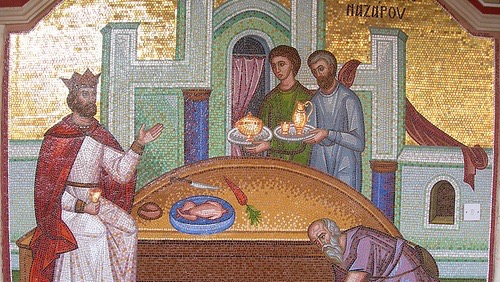
    And so it is this humble Jesus who speaks up and challenges his hearers to adopt lives of humility in today’s gospel reading.  One wonders why the “leading Pharisee” even invited Jesus to the banquet.  If we’ve been paying attention to the story so far, we know that the Pharisee had ulterior motives; he was certainly looking to catch Jesus in an embarrassing situation.  But Jesus isn’t playing along with all that.  In fact, one can certainly taste the disgust he has for what he sees going on at the banquet.

    In our day, banquets are usually put together with thoughtfulness and with a mind toward making one’s guests feel comfortable.  If you’ve been involved in a wedding, you know that the hosts try to seat people with those of like mind, with people who might have common experiences.  It’s enough to drive a host to distraction, sometimes, because it is such hard work. But in Jesus’ day, the customs were even more rigid.  People were seated in terms of their importance, and at this banquet, Jesus watched people try to assert how important they were by the places they took at table.  This was all an exercise in pride, and it seems that Jesus was repulsed by it.  So he tells them the parable that exhorts them to humble themselves and take the lowest place instead: far better to be asked to come to a more important place than to be sent down to a lower place and face embarrassment.

    But there was another aspect of pride taking place here as well.  The “leading Pharisee” had obviously invited people who were important enough to repay the favor some day – with one obvious exception – Jesus was decidedly not in a position to do so, at least not in this life.  So he tells his host a parable also, exhorting him to humble himself and invite not those who are in a position to repay his generosity, but instead he should invite “he poor, the crippled, the lame, the blind” – and know that because they cannot repay him, he would be repaid at the banquet of the righteous in heaven.

    We don’t know how the guests or the host responded to Jesus’ exhortation to practice humility.  We do, however, know that Jesus modeled it in his own life.  Indeed, he was not asking them to do something he was unwilling to do himself.  When he said, “For every one who exalts himself will be humbled, but the one who humbles himself will be exalted” he was in a way foreshadowing what would happen to him.  Humbling himself to take up our cross – our cross – he would be exalted in the glory of the resurrection.

    The good news is that glory can be ours too, if we would humble ourselves and lay down our lives for others.  If we stop treating the people in our lives as stepping-stones to something better, we might reach something better than we can find on our own.  If we humble ourselves to feed the poor and needy, to reach out to the marginalized and forgotten, we might be more open to the grace our Lord has in store for us in the kingdom of heaven.

    For everyone who exalts himself will be humbled,
    but the one who humbles himself will be exalted.

  • The Twenty-first Sunday of Ordinary Time

    The Twenty-first Sunday of Ordinary Time

    Today’s readings

    In my first priestly assignment, at Saint Raphael in Naperville, there was a huge football program for elementary school kids called Saint Raphael Football.  It was not just a team, but a league, and lots of surrounding churches had teams in the league.  You couldn’t live in Naperville and not have heard of Saint Raphael Football. So once in a while, in a social setting, someone would ask me what church I was from, and I’d tell them, Saint Raphael.  And they would say to me, “Oh yes, we go there, our son is in that football league.” I always wanted to tell them, “How nice. By the way, we also celebrate the Eucharist there.”  Maybe I should have.  Today’s gospel reading makes me think I should.

    We – as a society – have it all wrong.  Our priorities are all messed up.  I think we’re in real danger, now more than ever, and today’s Liturgy of the Word is a wake-up call for us to get it right.  We live in a society that has not just lost its moral compass, but has actually taken pains to bury it away and never look at it.  Everyone seems to think that something is okay if it works for them in their current circumstance, regardless of how it affects others, regardless of how it affects even them in the long-run.  That’s why you turn on the news and hear about shootings everywhere, and that’s why we have politicians vying with one another to see who can support abortion in the strongest possible sense.  As Saint Theresa of Calcutta once said, “And if we can accept that a mother can kill her own child, how can we tell other people not to kill one another?”  In many alarming ways, our moral compass has been buried for so long that we hardly know what it looks like anymore.  

    So this homily is probably going to come off sounding kind of harsh to some of you, but if I don’t say what I have to say, I’m not doing my job as your priest.  And I know, really I know, most of you get this.  So please indulge me; if this doesn’t apply to you, please pray for someone who needs to hear it, because you know someone who does.

    When Jesus is asked whether only a few will be saved, he deflects the question.  His answer indicates that it’s not the number of those who will be saved – that’s not the issue.  The issue is that some people think they will be saved because they call themselves Christian, or religious, or spiritual, or whatever.  It’s kind of like the people I talked to who considered themselves practicing Catholics simply because their children played in a football league that was marginally affiliated with us.

    Jesus says that’s not how it works.  We have to strive to enter the narrow gate.  So what does that mean?  For Jesus, entering eternity through the narrow gate means not just calling yourself religious; that would be a pretty wide gate.  It certainly wouldn’t mean saying that you’re basically a good person, since that criterion is pretty subjective, and so widely misunderstood. The narrow gate means actually practicing the faith: taking time for prayer and worship, receiving the Eucharist for strength, living the gospel, reaching out to the needy, showing love to your neighbor.  It means making one’s faith the first priority, loving God first, worshipping first, loving others first.  Because “some are last who will be first, and some are first who will be last.”

    And I’ll be the first to tell you that it’s hard to do that.  Saint Paul says today that we have to strengthen our drooping hands and weak knees; Jesus says that many will attempt to enter that narrow gate but won’t be strong enough to do it.  That narrow gate of love is hard to enter: it takes effort, it takes grace; it takes strength, and we can only get that grace and strength in one place, and that place is the Church.  That’s why Jesus gives us the Church: to strengthen us for eternal life.

    That’s not the best news, however, because so many people these days settle for simply calling themselves religious, or being “spiritual” – whatever that means.  They’ll play football on the team, but won’t make an effort to come to Church to receive the strength they need to live this life and to enter eternal life.  It is here, in the Eucharist, freely given by our gracious Lord, that we receive the strength we need to love, the strength necessary to live our faith and be united with our God.  It is here, in the proclamation of the Word, that we find instruction to live as disciples and are more and more conformed into the image of Christ.  But it’s hard to get to Church because Billy has a soccer game, or Sally has a dance recital, or because Mom and Dad just want to sleep in after a really trying week.

    But those decisions, friends, have eternal consequences.  So let me be clear: God is more important than soccer, or football, or cheer, or whatever sport you’re playing; God is more important than the dance recital, and as for sleeping in on Sunday, well, as my grandfather used to say, you can sleep when you’re dead.  And it’s not like it’s an either/or proposition: people don’t have to choose between soccer and Mass or dance and Mass or even sleeping and Mass.  Certainly not in our section of the world.  This parish has Mass nine Masses on Saturday evening and all day Sunday, in three languages, all the way from 4pm on Saturday to 6pm on Sunday.  If those don’t work, there are a bunch of parishes within a short driving distance that have other schedules.  There’s probably a church within a few driving minutes of every football or soccer field in the area; I know a lot of families choose to take that option when schedules are hectic.

    The point is, we make time for what’s important to us.  And eternal life is the only thing that we have of lasting importance. So we have to build up the strength to get through that narrow gate one day.  We’ve got to worship God with consistency; we have to live the gospel with consistency.

    We’re not going to be able to say one day: “We ate and drank in your company and you taught in our streets and we played football on your team.”  We can’t just call ourselves Catholic; we have to live our faith.  We have to worship and pray; we have to reach out to the needy, stand up for truth and justice, make a real effort to love even when it’s not convenient to love, or even when the person who faces us is not as loveable as we’d like.

    All of this requires commitment and effort and real work from all of us. We have to strive to enter through that narrow gate, because we don’t want to ever hear those bone-chilling words from today’s Gospel, “I do not know where you are from. Depart from me, you evildoers!” The good news is we don’t ever have to hear those words: all we have to do is nourish our relationship with Jesus that will give us strength to enter the narrow gate.  After all, the narrow gate is love, and the love of God in Jesus is more than enough to get us through it.