Category: The Church Year

  • Advent Penance Service

    Advent Penance Service

    Today’s readings: Isaiah 30:19-21, 23-36 | Psalm 27 | Matthew 5:13-16

    During this time of year, there’s a lot more darkness than I’m sure most of us would like to see. The daylight fades very fast, and there’s a lot of cold and cloudy days. And so, as joyful as this season is supposed to be, it can be so hard for many people. And then there’s the thought of another year coming to an end: some people look back on the year, and they lament what could have been, or what actually has been. And we could probably do without all the news of war, crime and terrorism here and abroad. So if we feel a little dark right now, we’re not alone.

    But the struggle between light and darkness is what Advent is all about. The season of Advent recognizes the darkness of the world – the physical darkness, sure, but more than that the darkness of a world steeped in sin, a world marred by war and terrorism, an economy decimated by greed, peacefulness wounded by hatred, crime and dangers of all sorts. This season of Advent also recognizes the darkness of our own lives – sin that has not been confessed, relationships broken by self-interest, personal growth tabled by laziness and fear.

    In Advent, God meets all that darkness head-on. We don’t cower in the darkness; neither do we try to cover over the light. Instead we put the lamp on a lampstand and shine the light into every dark corner of our lives and our world. Isaiah prophesies about this Advent of light: “The light of the moon will be like that of the sun, and the light of the sun will be seven times greater [like the light of seven days].” This is a light that changes everything. It doesn’t just expose what’s imperfect and cause shame, instead it burns the light of God’s salvation into everything and everyone it illumines, making all things new.

    Our Church makes the light present in many ways – indeed, it is the whole purpose of the Church to shine a bright beacon of hope into a dark and lonely world. We do that symbolically with the progressive lighting of the Advent wreath which represents the world becoming lighter and lighter as we approach the birthday of our Savior. But the Church doesn’t leave it simply in the realm of symbol or theory. We are here tonight to take on that darkness and shine the light of Christ into every murky corner of our lives. The Sacrament of Penance reconciles us with those we have wronged, reconciles us with the Church, and reconciles us most importantly with our God. The darkness of broken relationships is completely banished with the Church’s words of absolution. Just like the Advent calendars we’ve all had reveal more and more with every door we open, so the Sacrament of Penance brings Christ to fuller view within us whenever we let the light of that sacrament illumine our darkness.

    And so that’s why we’re here tonight. We receive the light by being open to it and accepting it, tonight in a sacramental way. Tonight, as we did at our baptism, we reject the darkness of sin and we “look east” as the hymn says, to accept the light of Christ which would dawn in our hearts. Tonight we lay before our God everything that is broken in us, we hold up all of our darkness to be illumined by the light of God’s healing mercy.

    Tonight, our sacrament disperses the gloomy clouds of our sin and disperses the dark shadows of death that lurk within us. The darkness in and around us is no match for the light of Christ. As we approach Christmas, that light is ever nearer. Jesus is, as the Gospel of John tells us, “the light that shines in the darkness, and the darkness has not overcome it.”

  • Monday of the Fourth Week of Advent: O Root of Jesse

    Monday of the Fourth Week of Advent: O Root of Jesse

    Today’s readings 

    In these late days of Advent, we pray the “O Antiphons.” These antiphons are the various titles of Jesus as found in Scripture. Today’s antiphon is “O Root of Jesse” and it is found as the antiphon for the Canticle of Mary in Vespers: “O Flower of Jesse’s stem, you have been raised up as a sign for all peoples; kings stand silent in your presence; the nations bow down in worship before you. Come, let nothing keep you from coming to our aid.”

    Zechariah in today’s Gospel certainly knew what it was like to stand silent in the presence of the Root of Jesse. Having been promised a son by an angel of the Lord – what one might consider a very trustworthy source – his disbelief moved him to silence in God’s presence. Here is a man who, one would think, should know better. But maybe his years of childlessness have led him to accept a life that was not God’s will. Certainly we could not blame him if the angel’s message was a bit unbelievable; we who have the benefit of so much science would probably be a little harder on the angel than Zechariah was. 

    When you’re accustomed to living without hope, any sign of hope can be met with an awful lot of skepticism. Would Elizabeth and Zechariah ever give birth to a child? How would that even be possible? Would God save the world from the darkness of sin and death? Why would he even want to? Can God be born here among us, giving us rootedness and a solid foundation for our lives? Why would he even care?

    Better to be silent than to voice our lack of faith and hope. Then, in the stillness of our hearts and souls, maybe God can give rootedness to our scattered lives, bring hope to a world grown dark in sin and crime and war and too much death. Today’s Gospel has God bringing hope to a elderly, childless couple. God forbid that we would doubt that he could bring hope to us too. 

    We pray today: Come, Lord Jesus, come root of Jesse, give rootedness to our lives that are sometimes adrift in despair or apathy, give hope to a world grown cold in darkness and disappointment, give life to a people burdened by sin and death. Come, let us stand silent as we await the dawning of your hope in our lives, let nothing keep you from coming to our aid. Come, Lord Jesus, come quickly and do not delay! 

  • The Fourth Sunday of Advent

    The Fourth Sunday of Advent

    Today’s readings
    #christmasnd

    What has captured my imagination as I’ve prayed this Advent is how we have been given this wonderful gift. This gift eclipses anything we’ll ever be given, anything we will ever earn, anything that will ever cross our meandering path in life. Today, the readings call that gift Emmanuel – God with us. I think sometimes we forget how wonderful this is. That the infinite all-powerful awesome God, who is not in need of anything or anyone for His self-worth, that He would choose to come to earth and take the flesh of his creatures, this is a truth too wonderful to even imagine. But not only that, this God took on our imperfections so completely that he paid the price for our many sins, both individually and as a society. He died the death we deserve for our waywardness, and then he rose from the dead in the Resurrection that assures us access to eternal life, if we will but love and follow him. No gift on earth is like this one!

    The most important thing that we can know about this Gift is that it isn’t just for us. It is for us, but never only for us. We are meant to share it. Because we have been loved by God who is Love itself, with a love so complete and sacrificial and permanent, then we have to be willing to love that way too. The people God puts in our lives: our family, our friends, our coworkers, our neighbors – all of them deserve to be loved in this same way too, and it’s up to us to be conduits of that love to others.

    So we have to be on the lookout for ways to do that. Think about it: those of us who are here all the time could well, and often do, get our noses out of joint at this time of year. We put in all the effort to get here every week, so maybe the lack of parking and the packed seats inconvenience us to the point of irritation. But what if it didn’t?

    What if, instead, we used this as an opportunity to put the discipleship we’ve been learning about all year long into practice? What if we chose to see Jesus in all of them, to be aware of Emmanuel – God with us – in such a way that we did everything we could to make their first time with us, or their first time in a long time, a memorable one? What if we as a parish decided that a loving relationship with our God was so glorious, so important, that we didn’t want anyone to go without one? What if, as a community, we decided there is nothing we won’t do to make those who visit us on Christmas irresistibly attracted to our community, so that when they’re here they think, “Those people at Notre Dame know something I don’t, and I have to find out what it is”? Well, that’s what I’d like us to try and do this Christmas.

    I liken it to the whole way Jesus came into the world. We all know the story, don’t we? The whole world was on the move, headed to their native places to be counted for the census, and there wasn’t an inn anywhere that would take Mary and Joseph, and the coming Christ Child in. But one innkeeper made some room out back and gave the newborn King the best he could offer. We absolutely know that Christ is in our brothers and sisters, so how on earth can we turn them away? As Saint Benedict teaches his monks, “Let all guests be received as Christ.”

    And so I’m going to make some suggestions for things that we can all do to make people feel welcome, to help them to know that there is a joy here in our community that has to be shared. First, make some room. I know we all want to get here first for a good parking spot. But if you can walk here, would you consider doing that, just to make a spot for a visitor? I can remember when my family would try to get to Mass as soon as possible to stake out a good seat, and I’d see so many people with coats over whole sections of a pew like they were lawn chairs on parking spaces in the city! We all want to have room, but if you can move in a little and let some other folks sit with you, would you consider being a bit uncomfortable so that someone can be welcome?

    Lots of times people will come here and won’t know where they’re going. We all want to get to Mass on time, but if you see someone looking puzzled, would you consider taking a moment to ask if you could help them? If they’re looking for the bathroom, would you go out of your way just this once to walk them there so they don’t get lost in the crowds coming in on a busy day? Again, as intent as we are to get to our seats, if you notice someone coming in who needs some help walking, could you offer them your arm, or hold the door open?

    We all like to see our friends and the people we know at Mass. It’s a comfort to us. So it might take a little concerted effort, but would you consider smiling at someone you’ve never seen before, perhaps introducing yourself and telling them what you like about Notre Dame? Because it just takes a tiny little gesture, or a little inconvenience for us, to make a huge difference. What if every person who walked through the door on Christmas Eve or Christmas had a life-changing experience because of the way that we treated them? We can do that, and I really think that we should. Would you all be willing to do a little something extra to make someone know God’s love in an awesome way? I’m counting on all of you to do that. If every Guest is received as Christ, then as Saint Benedict also said, we will all go together one day to eternal life!

  • Friday of the Third Week of Advent

    Friday of the Third Week of Advent

    Today’s readings
    Mass for the school children.

    I can’t believe it but Christmas is only just nine days away now! I know everyone is so busy writing letters to Santa, being good so they don’t get on the “naughty” list, wrapping Christmas presents for their parents, and baking cookies for Father Pat! But before we do all that, our Church asks us to take a minute and remember what it is that we’re about to celebrate.

    And what we’re about to celebrate is pretty special. God loved the world so very much that he sent his own Son to live among us and bring us closer to him, and to take upon himself the punishment for all our many sins. God would rather die than live without us, and so he did. But death doesn’t have any power over us because Jesus rose from the dead. And all of this wonderful mystery begins in just nine days, or at least that day a couple of thousand years ago.

    And we know the story: An angel came to Mary to tell her that she would give birth to a son by the power of the Holy Spirit. Because she was faithful, she said “yes” to God’s plan for her, and because she said “yes,” our world and our lives have been different – better, more hopeful – ever since! Jesus grew to be a man who was both mighty in his power to save us, and a wise prophet who helped us to learn about God and his kingdom.

    And this reminds us of the two stories we heard in our readings today. Isaiah was a prophet who pleaded with the people to change their lives. He saw they were doing all sorts of things that made them think they were right with God, but they were really only doing it for show. They still ruined the Sabbath day by leaving worship and going back to all the evil things they were doing, especially taking advantage of the poor. So Isaiah was pleading with them to worship rightly and live what they believed. That would eventually prepare them for the coming of a Messiah, an anointed one who would lead the people to God’s promise.

    John the Baptist was also a prophet and led the people to repentance so that they could recognize God and be open to the gift God was giving them in Jesus. Just like Jesus, he was blessed by God and led by the Holy Spirit. All that he did and said prepared the people for the coming of Jesus, the Anointed One who would lead us all to God’s promise.

    Isaiah was a prophet of the Old Testament, and John the Baptist of the New Testament. The fact that their stories are so similar to the stories about what Jesus came to do tells us that God has been preparing his people all along to be saved. He was getting them ready to recognize the way that Jesus was born among us.

    And so, when we look on our mangers and see Jesus laying in there, we know that he came for a very specific reason. God sent him to be one of us, because it is only by being one of us that God could really save us. Jesus took on a body, just like all of us, and he experienced the same kinds of pain and sadness that we all experience from time to time. He even went so far as to die, just like we all do at some point in our lives, so that he could know what it was to be just like us. When we look at the wood of the manger, we know that one day, Jesus will die on the wood of the Cross. When we celebrate Jesus’ birthday, we know that we will eventually remember his death and celebrate his Resurrection.

    So today, we take a minute in all our busy Christmas preparations and shopping and wrapping and cookie making (I like chocolate, by the way…) – we take a minute and pause, and think about baby Jesus, and know that by becoming one of us, everything was changed, everything was better. We thank God for loving us so much that he became one of us and gave us a gift better than anything we could ever ask for, better than any of the brightly-wrapped gifts we will receive in nine days, the gift of eternal life with God forever one day.

  • Saint Lucy, Virgin Martyr

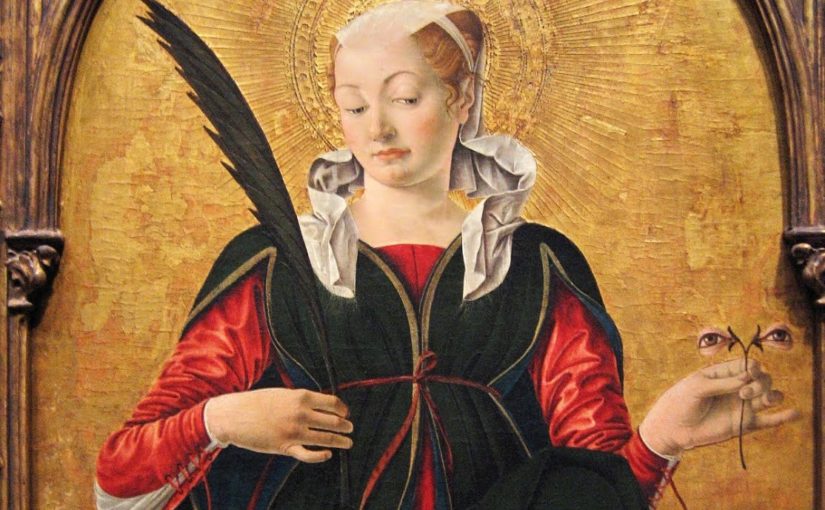
    Saint Lucy, Virgin Martyr

    Today’s readings

    In every age, young people have the difficult task of remaining pure. Some ignore the task, but some take it up at great personal cost. This was true of Saint Lucy, who desired to remain pure because of her commitment to Christ. She was born of noble parents in Sicily around the year 283. Her father died early in her life, and so she was dependent on her mother. She consecrated her virginity to God and sought to renounce worldly possessions in favor of caring for the poor. Her mother, after suffering from a hemorrhage for several years, decided to make a pilgrimage to Catania, to see the relics of St. Agatha. She was indeed cured of her disease, and in her joy consented to Lucy’s desire to give greatly to the poor.

    But that generosity, probably mixed with frustration over her commitment to virginity before marriage, was viewed with great skepticism by her unworthy suitor, who denounced her as a Christian to the Governor of Sicily. She was condemned to a life of prostitution, but prayer rendered her immovable and she could not be dragged off to the house of ill repute! At that point, logs were piled around her and a fire was set, which had no effect on her at all. She was finally put to death with a sword and suffered martyrdom for her dedication to Christ.

    As one of the prominent figures of Advent, St. Lucy points the way to the coming Christ. The details of her story have been disputed, however the point of the story is not to provide a historical record, but rather a spiritual record. Her commitment to Christ provided a rich and unobstructed pathway for the entrance of her Lord into her heart.

    We too have challenges along the way to Christ. We might not be called to give our lives rather than forsake our virginity or even our belief in Christ, but we are called to lay down our lives to cover the rough places in the road so that others can come to find Him. Along the way, we are encouraged by great saints like Agatha and Lucy. Every single one of them points us in the right direction: to Christ our God who comes to be incarnate among us in every age.

  • Our Lady of Guadalupe

    Our Lady of Guadalupe

    Today’s readings

    Appropriately enough, I think, we celebrate a second of Mary’s feasts in the space of just four days.  During Advent, we naturally turn our hearts in gratitude to Mary for her fiat that made possible our world’s salvation.  Last week we celebrated the Immaculate Conception of Mary; today we celebrate a quite different feast, Our Lady of Guadalupe.  We celebrate Our Lady of Guadalupe in part because she is the patroness of all the Americas, and so once again, a special patron for us.

    A Native American author of the sixteenth century describes the story of our Lady of Guadalupe in today’s Office of Readings.  He tells us of another Native American named Juan Diego, who was on his way from his home to worship on the hill of Tepeyac.  There he heard someone calling to him from the top of the hill.  When he got to the top of the hill, he saw a woman whose clothing shone like the sun.  She told him that it was her desire that a church be erected on the hill so that all could worship her son Jesus.  She sent him to the local bishop to plead that cause.

    The bishop didn’t believe Juan Diego’s story and sent him away.  He returned to the hilltop to find the radiant Lady once again, and she told him to tell the bishop that she, the ever virgin holy Mary, Mother of God, sent him.  Again the bishop did not believe, telling him that unless he had a miraculous sign, he would not believe the story.

    At that point Juan Diego’s uncle became quite ill.  Juan then set out for the local church to have a priest come to anoint his uncle.  He purposely took a route around the hill at Tepeyac to avoid seeing the Lady and being detained, since the need for a priest was urgent.  But of course, she met him at the side of the hill and spoke to him again.  She assured him that his uncle had already been cured and sent him up the hilltop to find flowers of various kinds.  He got to the top of the hill to find many Castilian roses growing there, which was odd for that time of the winter.  He cut them and carried them down the hill in his tilma, a kind of mantle that he wore for warmth.  She sent him to the bishop bearing the miraculous flowers as proof.

    He went confidently to the bishop and informed him that the Lady had fulfilled his request for a sign.  He opened up his tilma, the flowers fell to the ground, but the great miracle was that the inside of the tilma revealed the image of the ever virgin Mary, mother of God, in the same manner as Juan had seen her on the hill.   The bishop built the church, and devotion to Our Lady of Guadalupe, as she had referred to herself, has grown ever since.  You can still see the tilma, still bearing the image of Mary, at the shrine in Guadalupe today.

    During Advent we are blessed to have the saints point the way to Jesus.  None of them does this more faithfully than his very own mother, and so we are blessed to celebrate her feast today.  May Mary our mother and the mother of God, lead us one day to her Son, our Lord Jesus Christ.

  • The Third Sunday of Advent: The Anointing of the Sick at Mass

    The Third Sunday of Advent: The Anointing of the Sick at Mass

    Today’s readings
    #anointingofthesick

    Today’s readings and liturgy call us to rejoice.  That’s the reason for the rose-colored vestments and the more joyful tone of today’s readings.  This is called Gaudete Sunday: gaudete being Latin for “rejoice,” the first word of today’s introit or proper entrance antiphon which says: “Rejoice in the Lord always; again I say, rejoice.  Indeed the Lord is near.” The Church takes that antiphon from the words of the second reading today.

    We can especially rejoice in the healing presence of our God. Healing is, in fact, a sure way that we know that Christ is present. Jesus said as much in our Gospel today when he addressed the followers of Saint John the Baptist:

    Go and tell John what you hear and see:
    the blind regain their sight,
    the lame walk,
    lepers are cleansed,
    the deaf hear,
    the dead are raised,
    and the poor have the good news proclaimed to them.

    Those who lived in and around Jesus in those days had to be amazed at all they were seeing. Indeed, many of them were moved to conversion of heart and rejoiced in all they were seeing.

    I think, though, that it can be hard to rejoice when we are suffering from illness or injury. Sometimes when we’re sick, it can even be hard to pray or find God in anything. A wise person once told me that you have to make sure that you’re praying when you’re well, because when you’re sick, it can be hard to pray. But it those times of illness or injury, that’s when you need to rely on God the most. If you have been praying when you’re well, then that relationship is going to be something you can lean on when you need healing.

    Indeed sometimes, for us, healing is a little harder to see. We may have been dealing with a persistent, chronic, or even terminal health condition for years. Or maybe we have been at the side of a loved one who has been ill and for whom we have prayed long and hard, but have seen no healing. If that’s where we are right now, Jesus’ words are still our hope. Because healing comes in all sorts of ways, according to what Jesus sees that we need most. That might come in the form of something other than physical healing: perhaps the healing of relationships, or the conversion of our hearts. In every case, though, Christ promises to be with us through it all if we turn to him in our hearts. And he keeps his promises, giving us grace that sees us through whatever stormy waters we are wading.

    And so we gather in faith today to express the prayers of our hearts, asking for God’s mercy, praying prayers, perhaps, that we haven’t been able to utter for some reason or another.  We gather today to place ourselves in God’s hands and experience his healing, in whatever way is best for us.  The Apostle Saint James tells us that we should turn to the Church in time of illness, calling on the priests to anoint the sick in the name of the Lord, knowing that God desires healing, and that the prayer of faith will save the sick and raise them up, forgiving them their sins.

    The Church has the Sacrament of Anointing of the Sick because of who Jesus was and because of what he came to do among us.  Jesus was that suffering servant from the book of Isaiah’s prophecy, the One who took on our illnesses and bore our infirmities.  He was spurned and avoided, oppressed and condemned, all the while giving his life as an offering for sin, justifying many, and bearing their guilt.  God always knew the frailty of human flesh, but when he decided to come to his people, he did not avoid that frailty; instead he took it on and assumed all of its effects.  This is why we treat the sick with dignity: our frailty was good enough for our God, and we know that the sick are very close to our Lord in their suffering, because he suffered too.

    So today if you are sick in any way – body, mind, or spirit, – if you suffer from addiction, chronic pain, or emotional anguish – I invite you to approach the sacrament of the Anointing of the Sick after this homily. The Church teaches that this sacrament is not to be saved only for the moment of death. No, we are to approach it when we are seriously ill, or before surgery, and yes, in the hour of death. If we have been anointed before, we can be anointed again if necessary, even in the same illness, if it has been some time or especially if the illness has progressed. In this sacrament, we pray for healing in body, mind, or spirit, in whatever way God judges to be best for us, and we trust in his sacramental grace and presence with us in our suffering.

    Just a procedural note: During the ritual of anointing we will ask those who are to be anointed to stand, and I will impose hands over all of you at one time for a few moments in silence. Then, when it comes time for the anointing, we will come to those who are not ambulatory and are seated in the front of church. Those of you not seated in front will come forward as for Holy Communion, and we will anoint you in the center aisle.

    Today we rejoice because our Lord is near.  We light that third, rose-colored candle on our Advent wreath and we see there’s not many candles left until the feast of the reason for our rejoicing.  We rejoice, too, that we can come to him for help and sustenance and companionship on the journey to healing. We look forward to celebrating the Incarnation, perhaps the greatest and best of the mysteries of faith.  That God himself, who is higher than the heavens and greater than all the stars of the universe, would humble himself to be born among us, robing himself with our frail flesh, in order to save us from our sins, heal our brokenness, and make his home among us for all eternity – that is a mystery so great it cannot fail to cause us to rejoice!  Indeed that very presence of God gives hope even in our most difficult moments – THE LORD IS NEAR!

    These final days of Advent call us to prepare more intensely for the Lord’s birth.  They call us to clamor for his Incarnation, waiting with hope and expectation in a world that can sometimes be dark and scary.  These days call us to be people of hope, courageously rejoicing that the Lord is near!  Come, Lord Jesus!  Come quickly and do not delay!

  • Friday of the Second Week of Advent

    Friday of the Second Week of Advent

    Today’s readings

    One of the great obstacles to the spiritual life is when we come to believe that we ourselves have all the answers. When that happens, we may often hold to relative truth, even if we wouldn’t say that we do.   Or perhaps we insist on acting according to our opinions, instead of acting on consciences formed by Truth. You’ve heard it before, when having a conversation about a moral issue. People might say, “well I think…” whatever, as if that were the gold standard of morality and truth.

    It’s cold comfort to see, in our gospel reading this morning, that we aren’t alone. Jesus’ generation was much the same. John the Baptist came across too strict, and Jesus came across like a drunkard and a partier. But the real problem was that they both proclaimed the truth; Jesus, obviously even stronger than John. But the crowds dismissed them both, because both required them to change their lives and their ways of thinking. If John and Jesus were right, then they weren’t, and that was unsettling.

    It’s unsettling for us too, but we have the benefit of centuries of Church teaching to help us. And so we are called to leave behind our own opinions and think with the grace of Truth. It’s time that we considered that perhaps our own point of view isn’t the be-all and end-all of wisdom. Advent is about dispersing the darkness with the light of Christ, and the light of his Truth. The psalmist said it best: “Those who follow you, Lord, will have the light of life.”

  • The Immaculate Conception of the Blessed Virgin Mary 

    The Immaculate Conception of the Blessed Virgin Mary 

    #blessedvirginmary
    Today’s readings

    Blessed Pope Pius IX instituted the solemnity of the Immaculate Conception of the Blessed Virgin Mary on December 8, 1854, when he proclaimed as truth the dogma that our Lady was conceived free from the stain of original sin. This had been a traditional belief since about the eighth century, and had been celebrated as a feast first in the East, and later in the West.

    This feast celebrates the belief that God loved the world so much that he sent his only Son to be our Savior, and gave to him a human mother who was chosen before the world began to be holy and blameless in his sight. This feast is a sign for us of the nearness of our salvation; that the plan God had for us before the world ever took shape was finally coming to fruition. How appropriate it is, then, that we celebrate the Immaculate Conception during Advent, when we recount the unfolding of salvation through the Incarnation of Christ.

    The readings chosen for this day paint the picture. In the reading from Genesis, we have the story of the fall. The man and the woman had eaten of the fruit of the tree that God had forbidden them to eat. Because of this, they were ashamed and covered over their nakedness. God noticed that, and asked about it. He found they had discovered the forbidden tree because otherwise they would not have the idea that their natural state was shameful.

    Thus begins the pattern of sin and deliverance that cycles all through the scriptures. God extends a way to salvation to his people, the people reject it and go their own way. God forgives, and extends a new way to salvation. Thank God he never gets tired of pursuing humankind and offering salvation, or we would be in dire straits. It all comes to perfection in the event we celebrate today. Salvation was always God’s plan for us and he won’t rest until that plan comes to perfection. That is why St. Paul tells the Ephesians, and us, today: “He chose us in him, before the foundation of the world, to be holy and without blemish before him. In love he destined us for adoption to himself through Jesus Christ…”

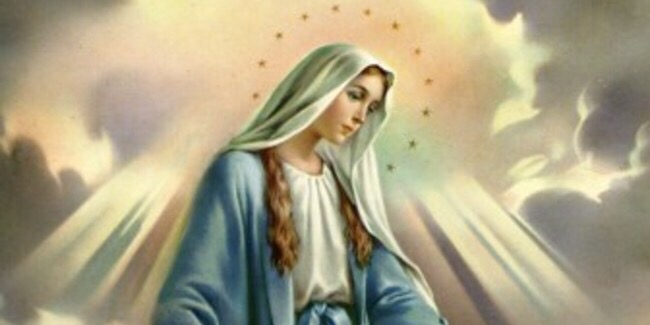
    And so, in these Advent days, we await the unfolding of the plan for salvation that began at the very dawn of the world in all its wonder. God always intended to provide an incredible way for his people to return to him, and that was by taking flesh and walking among us as a man. He began this by preparing for his birth through the Immaculate Virgin Mary – never stained by sin, because the one who conquered sin and death had already delivered her from sin. He was then ready to be born into our midst and to take on our form. With Mary’s fiat in today’s Gospel, God enters our world in the most intimate way possible, by becoming vulnerable, taking our flesh as one like us. Mary’s lived faith – possible because of her Immaculate Conception – makes possible our own lives of faith and our journeys to God.

    Our celebration today has special meaning for us. Because Mary was conceived without sin, we can see that sin was never intended to rule us. Because God selected Mary from the beginning, we can see that we were chosen before we were ever in our mother’s womb. Because Mary received salvific grace from the moment of her conception, we can catch a glimpse of what is to come for all of us one day. Mary’s deliverance from sin and death was made possible by the death and resurrection of her Son Jesus, who deeply desires that we all be delivered in that way too.

    Pray for us, O holy Mother of God, that we may be made worthy of the promises of Christ. Amen.

  • The Immaculate Conception of the Blessed Virgin Mary 

    The Immaculate Conception of the Blessed Virgin Mary 

    School Mass
    #blessedvirginmary
    Today’s readings

    I think we’re so blessed that we get to come to church and celebrate so many of Mary’s feasts. Today is a very special feast because Mary, Our Lady of the Immaculate Conception, is the patroness of the United States of America, and so she is very special to us.

    I think today’s readings can be a little confusing. The Gospel makes it sound like this day is about the conception of Jesus, but it isn’t. We celebrate the conception of Jesus nine months before he was born, so that would be March 25th. We call that day the Annunciation, because that was the day the Angel Gabriel came to announce to Mary that she would have a baby, but we’ll talk more about that in a minute. Today we celebrate the conception of Mary, nine months before her birthday, so if you do the math on that one, her birthday is September 8th, just a few months ago. This day celebrates that Mary was free from sin from the very beginning, the only person other than Jesus to be born without sin.
    The other confusing reading is the first one. Why do we go all the way to the beginning of creation when we’re talking about Mary today? Well, I think the reason is that Mary solved a problem that began all the way at the beginning. And that problem was sin. From the very beginning, we human beings have been tempted to sin. Adam and Eve ate the fruit of the forbidden tree in the Garden of Eden, and people have been committing sin ever since. Again and again, God broke in to history, leading people back to him, giving them prophets to show them the way, and again and again, people turned away from God. And we continue that today. Again and again, we are tempted and we sin and we turn away from God. Eve represented our fall into sin.
    But God didn’t want that to be the way things ended up for us. So he sent his Son to become one of us. God knew that in order for Jesus to be born among us, his mother was going to have to be pretty special. So before Mary was ever in her mother’s womb, God chose her to be his Son’s mother. He made her free from sin so that no stain of sin would ever touch his Son.
    Because Mary was so special, she loved God very much. So when the angel came and told her she would have a baby by the power of the Holy Spirit, she said yes to God’s plan. I don’t know if she really understood what was going to happen, I don’t know if she really knew how this wonderful event would take place, and she probably didn’t fully understood what would happen to Jesus in his life, but she said yes anyway. We call that her fiat, her “yes” to God’s plan for her. She took a big leap of faith that day, and we have been blessed ever since.
    This is all very good news. But there is even more good news: because Mary was so special to God, she shows us how special we are to God. As we celebrate God’s love for Mary today, we also celebrate his love for us. Mary got to hold her Savior – the One God promised us – in her own arms. When those of us who are old enough come to Communion today, we will be able to hold our Savior – the One God promised us – in the palm of our hand. Mary’s life was brightened when Jesus was born. Our lives will be brightened too, this coming Christmas, and every time we make room in our hearts for Jesus.
    Pray for us, O holy Mother of God, that we may be made worthy of the promises of Christ. Amen.