Category: Preaching, Homiletics & Scripture

  • Thursday of the Fifteenth Week of Ordinary Time

    Thursday of the Fifteenth Week of Ordinary Time

    Today’s readings

    Today’s Scripture readings have some “sound bytes” that I have found most meaningful in my prayer life.  Isaiah’s profession of faith today says, “For it is you who have accomplished all we have done.”  What a beautiful thing for us to remember.  This one statement, if we integrate it into our prayer life, will keep us from both false humility and excessive pride.  Because we have no right, when we are called by God to do something, to say, “Oh no, I could never do that.”  That might be absolutely correct, but it’s still completely meaningless.  If God calls us, he will make miracles happen from our willingness to follow.  For it is he who has accomplished all we have done.

    And we have no right to be puffed up and call attention to ourselves, and say, “Now look how wonderful I am.”  Because the really good things that we do we could never possibly do on our own: whether that’s becoming a priest and preaching the Word, or becoming a parent and raising children, or whatever our vocation consists of.  That we are willing is cause enough for celebration, but let’s not forget to celebrate the miracle that happens when God does what he needs to do in us.  For it is he who has accomplished all we have done.

    And the three verses in our Gospel reading are verses that have long stuck with me.  I have an old Bible in my office that my aunt gave me when I was probably in high school, so like a million years ago!  That Bible has these verses outlined in ink because I went back to them so often.  We all go through trials sometimes, but we can never give ourselves to despair because our Lord is so willing to help us shoulder the burden, and longs to give us the rest we all need to recuperate from the world’s trials.  All we need to do is to come to him for that rest, and to be willing to take up the burdens he offers us, knowing that we will never shoulder them alone.  For it is he who has accomplished all we have done.

  • Saint Kateri Tekakwitha, Virgin

    Saint Kateri Tekakwitha, Virgin

    Today’s readings

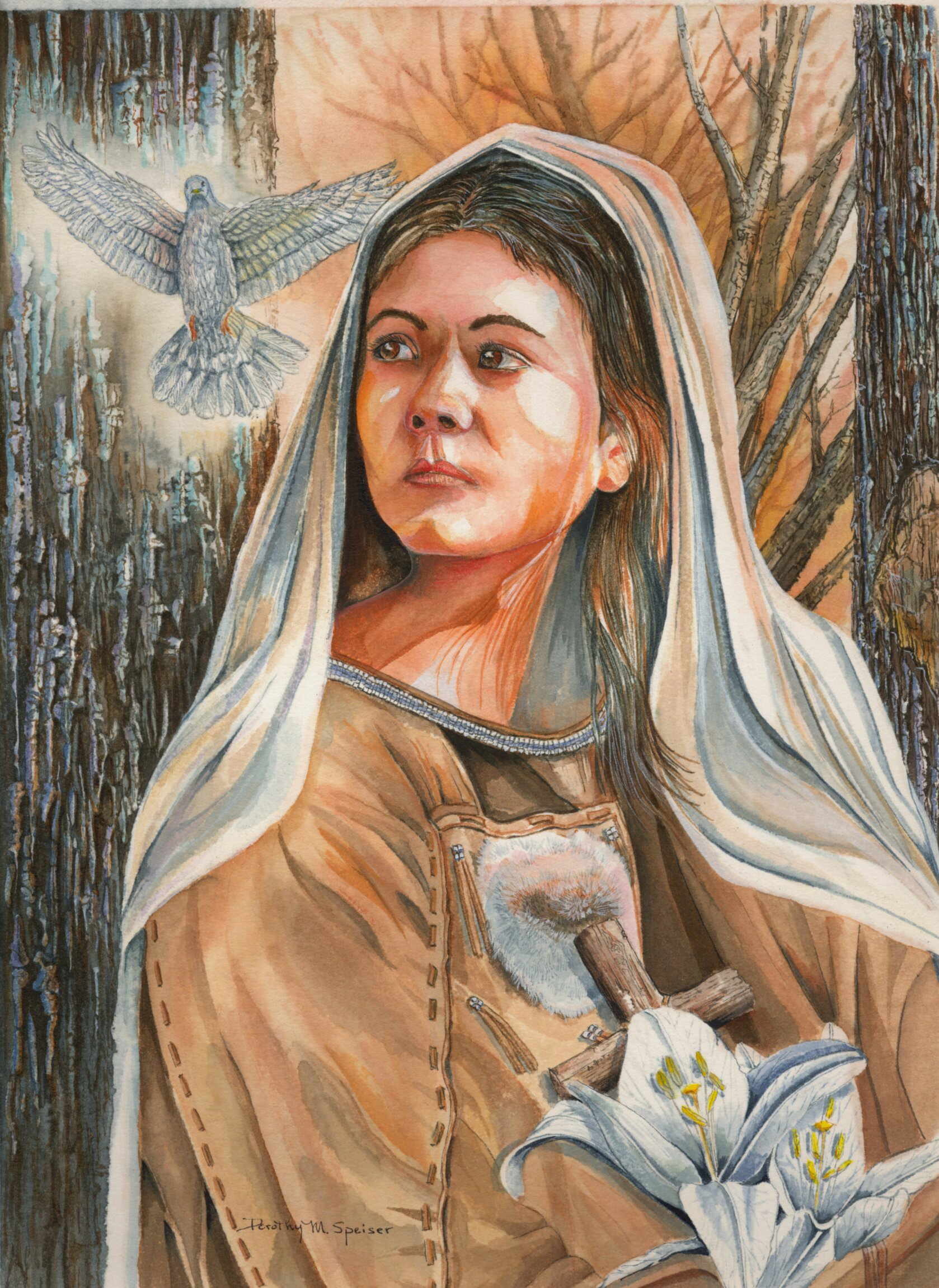
    Saint Kateri Tekakwitha was born in 1656 to a Christian Algonquin woman.  Her parents died in a smallpox epidemic – which left Kateri herself disfigured and half blind – when she was just four years old.  She went to live with her uncle who succeeded her own father as chief of the clan.  Her uncle hated the missionaries who, because of the Mohawks’ treaty with France, were required to be present in the region.  Kateri, however, was moved by their words.  She refused to marry a Mohawk brave, and at age 19, was baptized on Easter Sunday.  At age 23, she took a vow of virginity.

    Kateri’s life was one of extreme penance and fasting.  This she took upon herself as a penance for the eventual conversion of her nation.  Kateri said: “I am not my own; I have given myself to Jesus.  He must be my only love.  The state of helpless poverty that may befall me if I do not marry does not frighten me.  All I need is a little food and a few pieces of clothing.  With the work of my hands I shall always earn what is necessary and what is left over I’ll give to my relatives and to the poor.  If I should become sick and unable to work, then I shall be like the Lord on the cross.  He will have mercy on me and help me, I am sure.”

    Saint Kateri was beatified in 1980 and canonized in 2012.  Our call to personal holiness might not be as radical as hers was.  But we are called to embrace the cross and follow Christ wherever he leads us, and we may well be called upon to sacrifice whatever is comfortable in our lives to do it.

  • The Fifteenth Sunday of Ordinary Time

    The Fifteenth Sunday of Ordinary Time

    Today’s readings

    Many of us have planted gardens, and maybe you’ve put in some plants this year.  That was really Father Steve’s thing, and my allergies kind of get in the way of all that, so I’m not doing that this year, but I have in the past.  But I’m always astounded when I’ve planted some seeds.  Here is this tiny, dead-looking thing: how can it ever give life to a large plant?  But that’s just what happens, isn’t it?  We carefully plant the seeds and then care for them – giving them water and keeping out the weeds and feeding them on occasion – and just about always they give life, flowers or vegetables for our table.  It’s a way to experience the miracle of life, that something can die and then give life and sustenance to the living.  What a beautiful little model of salvation the seed is!

    But if you’ve carefully planted seeds in rows at any point, you might wonder a bit about the methods used in today’s gospel reading.  Seed is scattered willy-nilly and a lot of it seems to be wasted.  But the original hearers of the parable would have understood what Jesus was saying.  It was a method used at that time: seed would be scattered, and then the soil would be tilled thus planting the seeds.  And so they would have understood that sometimes the seed falls in places the farmer didn’t intend, and those seeds don’t come to life, or if they do, it’s not for long, and it’s no big deal.

    So Jesus explains the parable for his disciples and for us.  The seed is the seed of faith.  God scatters it with wild abandon, pouring it out freely that his chosen ones – which obviously includes you and me – would come to know him.  Sometimes it works: we receive the seed of faith, it’s watered in the sacrament of baptism, fed with the Eucharist and the other sacraments, and we make of ourselves fertile ground, letting it come up and grow and give life to the world.  But sometimes, of course it doesn’t work out that way.

    The seed might fall in a place where the faith is not nourished and Christ is not known.  Maybe it’s a foreign land without benefit of missionaries, but it could even be a little closer to home.  Perhaps the seed falls on those whose turbulent lives can’t give the seed any roots: they receive the word of God with joy, but the trials and tribulations of daily living upset everything and the faith never really sinks in.  Or, maybe it falls on us embroiled as we are with the cares of the world.  The “weeds” of our living are improper relationships, too much time playing video games or surfing the wrong places of the internet, watching too much television, wasting time on passing things.  There is so much that can distract us from our faith, and too often, we are not as diligent about weeding the gardens of our souls the way we should be.

    We, dear brothers and sisters in Christ, are called to be rich, fertile ground to give life to the faith planted in our hearts.  That means that we must keep ourselves fresh by renewing the waters of baptism in our hearts.  We must feed that seed of faith by dedicating ourselves to the Eucharist and coming to Mass all the time, whether it’s convenient or not.  We must weed out the distractions of our lives and give that seed of faith room to grow.  We must shine the brilliant sunlight of God’s love on that faith by living the Gospel and reaching out in love to brothers and sisters who are in need.

    We are the ones who have been called to yield “a hundred or sixty or thirtyfold.”  The seed of faith comes in the form of something that might look dead – Christ’s saving action on the cross.  When we water and feed and weed and let the light shine on that faith, we can give life to the world around us and give witness that the world’s death is no match for the salvation we have in Christ.

  • Saint Benedict, Abbot, Father of Western Monasticism

    Saint Benedict, Abbot, Father of Western Monasticism

    Today’s readings

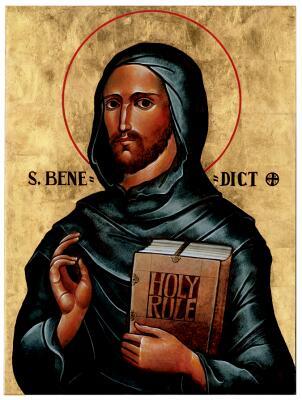
    It is with great fondness that I observe this feast of St. Benedict the abbot, and father of western monasticism.  My Benedictine roots stem from my college days at Benedictine University in Lisle (then called Illinois Benedictine College), and I have a deep fondness for the monks of St. Procopius Abbey, who staffed the college, and in whose monastery I made my Priesthood retreat before I was ordained.  Every now and then I go there for a few days of prayer, which helps me to be ready for whatever ministry is bringing my way.  The motto Saint Benedict chose for his order was “Ora et Labora” – Prayer and Work — and for me it is a constant reminder of the balance we are called to have in life.

    A wonderful source of inspiration to me while I was working in the corporate world, and still today, is reading from The Rule of St. Benedict, which is a great reflection on the balance we are called to in life.  It was also one of the most groundbreaking works of spirituality and monastic rule at that time.  It remains a spiritual classic today.  Recently, I read a quote from the rule that spoke of something the abbot of a monastery should bear in mind.  My reflection on it got me to thinking it was also extremely wise counsel for pastors of parishes, and even fathers – and mothers – of families.  It’s from the second chapter of the rule and it goes like this:

    Above all, the abbot should not bear greater solicitude for things that are passing, earthly, and perishable, thereby ignoring or paying little attention to the salvation of the souls entrusted to him. Instead, may he always note that he has undertaken the governance of souls, for which, moreover, an account will have to be rendered. And if perhaps he pleads as an excuse a lack of wealth, then he should remember what is written: ‘First seek the kingdom of God and his justice, and all these things will be added unto you’ (Mt 6:33), and again: ‘Nothing is lacking to those who fear him’ (Ps 34:10).

    This is the same kind of advice Jesus gave to his Apostles in the Gospel reading today, and also the kind of advice that Hosea was telling Israel it should have been following all along.  For the Apostles, they were to preach the Gospel and proclaim the Kingdom, and do everything they could to bring many souls with them.  For the Israelites, Hosea was telling them that they have been forgiven for their many past iniquities, so now would be a good time to stay on the straight path that the Lord sets forth for them.  It’s good advice for all of us.  Earthly things are always passing; things of the Spirit endure forever.  Seek first the kingdom, proclaim the kingdom, witness to the Gospel, and, as Saint Benedict also wrote, “And may he bring us all together to life everlasting!” (RB 72)

  • Thursday of the Fourteenth Week of Ordinary Time

    Thursday of the Fourteenth Week of Ordinary Time

    Today’s readings

    Today’s Gospel is an impetus for the third Luminous Mystery of the Rosary: the proclamation of the Kingdom of God with its call to repentance.  Jesus charges his Apostles to go out and proclaim that the Kingdom is at hand, with all its accompanying signs and wonders.  We have to understand that this is the Church’s main job in every time and place.  We are now the ones who have to proclaim the Kingdom of God and call people to repentance by the witness of our lives.

    We are now the ones called to drive out demons, cure the sick, and all the rest.  We do this by being Christ’s presence in a world that is sorely in need of it.  We drive out demons by casting the glorious light of Christ into every dark corner.  We cure the sick by reaching out to those who are ill, looking in on them, caring for them, bringing the Eucharist to them.

    We also have to understand, though, that sometimes our efforts won’t prove fruitful.  Sometimes our peace won’t be received because the other person is not peaceful.  All we can do is do our best, offer Christ, and move on if that’s not accepted.  And we have to trust that God will give us everything we need on our journey.

  • Tuesday of the Fourteenth Week of Ordinary Time

    Tuesday of the Fourteenth Week of Ordinary Time

    Today’s readings

    Today’s Gospel underlines the failure of the Jewish leaders of the time.  Jesus was casting out demons from many people, which was what they were supposed to do but could not.  So instead of checking what was lacking in their faith, they accuse Jesus of being in league with the devil.  Jesus sees the vast number of people who long for spiritual care but are not getting it, and laments the lack of laborers for the harvest.

    The lack of laborers for the harvest is a real issue, now as much as then.  The needs aren’t different: people need to know God loves for them and is present to them; they need to see the value of living a Christian life.  It’s up to all of us disciples to make that life real and attractive, so that they can come to know the Lord.  You might be the Jesus that someone needs to see today.  You might be the laborer God is sending into some situation today.  Don’t be afraid to follow the Master of the harvest!

  • Monday of the Fourteenth Week of Ordinary Time

    Monday of the Fourteenth Week of Ordinary Time

    Today’s readings

    I love the words of the Psalmist today: “The Lord is gracious and merciful.”

    These are words that are easy for us to pray when things are going well, but maybe not so much when we’re going through rough times.  It seems like the psalmist is going through some very good times, but we have no way of knowing that.  The only key to the great hymn of praise the psalmist is singing is that he is reflecting on the wonder of creation and the mighty deeds God does in the world.  The psalmist sees wonders not just in his own place but everywhere.  He says, “The LORD is good to all and compassionate toward all his works.”  Every part of creation has been blessed by God’s goodness.  Because of this, God is to be praised not just now, but “forever and ever” and by “generation after generation.”

    This fits in very nicely with Hosea’s prophecy in our first reading today.  Preaching to the Israelites in exile, he proclaims that God will change the relationship between Israel and the Lord.  That new relationship would be a spousal relationship between God and his people, in which the spouses are partners in the ongoing work of creation.  God will give Israel the ability to be faithful to God, and for His part, God will remember His faithfulness forever.  God’s great mercy and compassion are seen with abundance in the Gospel reading.  Jesus rewards the faithfulness of Jairus and the woman with the hemorrhage with miraculous healings.  Key to all of these wonderful events, in all three readings, is that God who has created us is committed to re-creating us in His love and faithfulness.

    So as we approach the Eucharist today and reflect on all the mighty and wonderful things God does in our midst, may we too sing the Psalmist’s song.  May we all praise God’s name forever and ever, and proclaim his might to generation after generation.

  • The Fourteenth Sunday of Ordinary Time

    The Fourteenth Sunday of Ordinary Time

    Today’s readings

    So we’re finally in Ordinary Time on a Sunday.  We’ve travelled through Lent in which we have been called to repentance, and through Easter during which we have been made new people.  We are now here in Ordinary Time when we are called to figure out how to live as a people redeemed and made new.  During these days of Ordinary Time, we get the tools we need to live the life of discipleship.

    So, looking at our Liturgy of the Word today, our tool for discipleship seems to be humility.  I know what you’re thinking: “Well, no thanks, actually.  I may just leave that particular tool in the toolbox.”  Because being a person of humility in our culture can be seen as something of a character flaw.  For decades, maybe even longer, our society has encouraged us to toot our own horn, to look out for number one.  “Believe in yourself” has been the mantra of Oprah and Doctor Phil and all those other so-called gurus.  But we have to remember that we have not been breathed into existence in the image of Oprah or Doctor Phil.  We have been created in the image and likeness of God, and so we need to emulate our God as closely as we can.

    So what does our God look like?  Well, Zechariah gives us a pretty clear portrait today:  “See, your king shall come to you; a just savior is he, meek, and riding on an ass, on a colt, the foal of an ass.”  So our Savior was prophesied to be meek and just, and far from coming into the city riding on a mighty horse of a king, he comes in on a donkey, the beast of burden employed by the poor.  And that’s just how Jesus was, wasn’t he?  This kind of reminds me of Pope Francis.  He could ride into town in any kind of pope-mobile he wanted, but he chose a second hand car.  Pope Francis is encouraging is all to live as Jesus did, and Jesus was a model of humility.

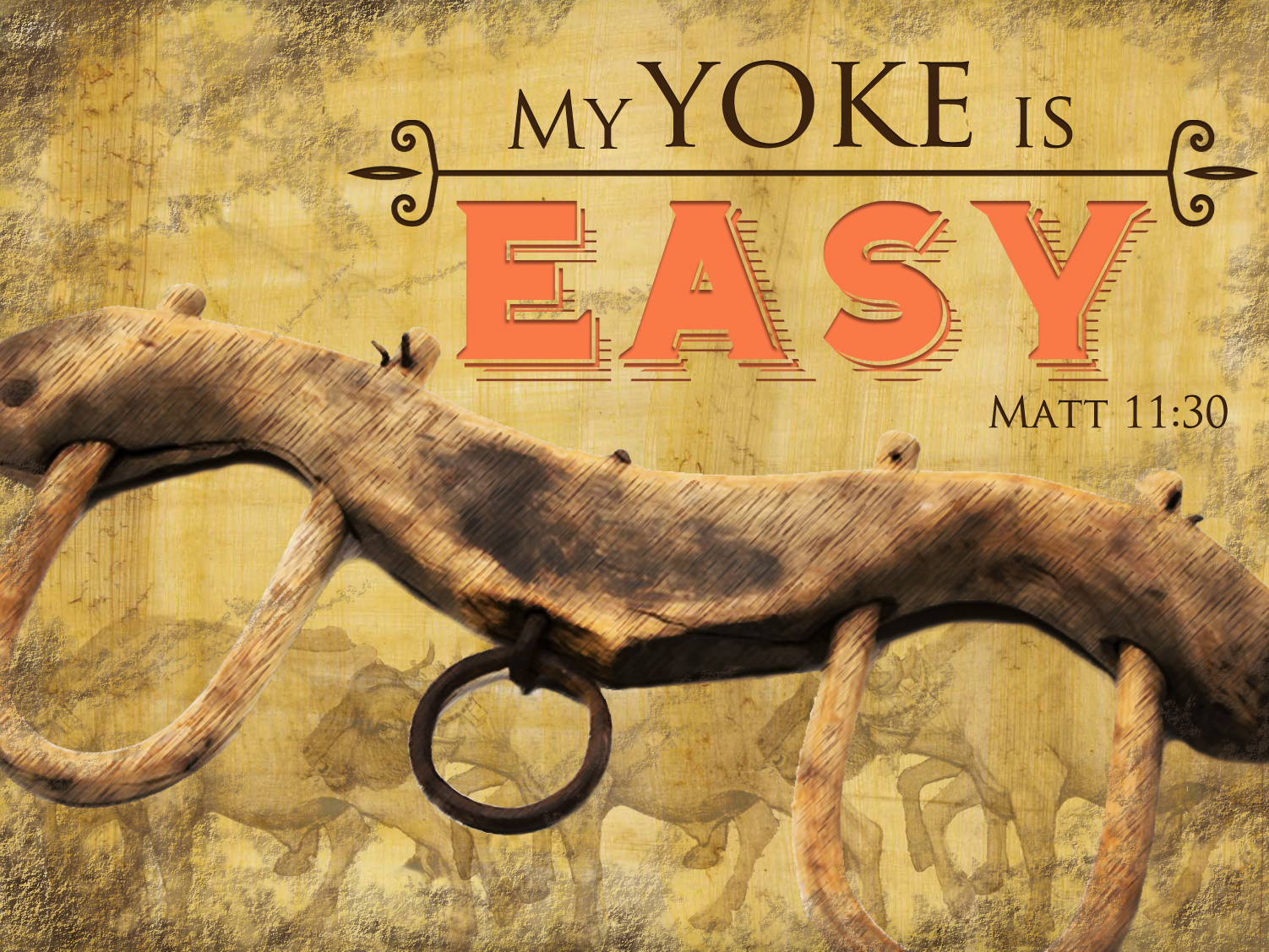
    That’s just what Jesus invites us to in today’s Gospel.  He invites us to take his yoke upon our shoulders.  A yoke back then was an implement that kept the oxen together so they could work the fields.  So a yoke implies a few things.  First, it’s going to be work.  That’s what yokes are for.  So when Jesus says he’s going to give us rest, that doesn’t mean that there won’t be some work involved.  Disciples have work to do in this world, living the Gospel, witnessing to God’s love, and reaching out to a world that needs hope.

    Second, a yoke meant that more than one animal was working; they were working together.  So as we take Jesus’ yoke upon us, we are yoked to him and we are yoked to other disciples.  Jesus calls us to work for the kingdom, but never expects us to go it alone.  That’s why his burden is easy and light: it’s still a burden, but we never ever bear it alone, Christ is always with us, and we always live our discipleship in community with other believers.

    This model of working for the kingdom leads us right back to humility.  If we are not going it alone, that means that we can’t take sole credit for the mighty things we do in Jesus’ name.  Yes, we do great things, but we do them because he has transformed us and has taken the yoke with us; we do them with the help of other disciples to whom we are yoked for the particular purpose of being God’s presence in the world.  We are no longer men and women in the flesh, as Saint Paul says today, we are people of the Spirit, with the Spirit of Christ in us, and so in Christ we cast aside those deeds of darkness and, taking his yoke, we accomplish the work Jesus has given us.  Saint Augustine once said, “Humility must accompany all our actions, must be with us everywhere; for as soon as we glory in our good works they are of no further value to our advancement in virtue.”

    And that is our goal as disciples: to advance in virtue.  Some days, that’s very hard work.  But we never have to go it alone, if we are truly humble people working in the image of our God.

  • Saturday of the Thirteenth Week of Ordinary Time

    Saturday of the Thirteenth Week of Ordinary Time

    Today’s readings

    There’s an old saying, “if it ain’t broke, don’t fix it.”  And that’s fine, as far as it goes.  But the danger is that sometimes we get so attached to that principle that we fail to recognize when something is, in fact, broke.

    That’s what the prophet Amos has been complaining about in the  first readings over the last week or so.  Today’s reading is much more conciliatory, because it comes after the punishment, after Israel had already felt the consequences of their sinfulness and gone into exile.  But Amos’s theme has been to prophecy against the way Israel’s leaders had been so focused on the laws that they had missed taking care of the poor, needy, oppressed, and widows and orphans.  They had convinced themselves they could cheat the poor if they just paid attention to the laws governing worship.  Their practice of their faith was, well, broke.  Only they didn’t want to fix it.

    And that’s what Jesus is saying in today’s Gospel: stop trying to fit everything new into the old wineskins.  God is trying to fix what’s broke, trying to do something new, only the religious authorities keep trying to make it fit with what they already saw as important, or else throw it out.  And for the disciple, that’s just not acceptable.

    We do that too.  How often have you heard: “but we’ve always done it that way?”  Our traditions are certainly important, but we can’t be so focused on them that we miss the movement of the Holy Spirit.  If God is trying to do something new in our lives, who are we to try to stuff it into old wineskins, old ideas of what works, old ideas of what our relationship with God must be?  When we try to do that, well, the whole life of faith just falls apart.

    We have to be open-minded to what God is doing in our lives.  We have to be good discerners.  We have to be open to the possibility of God doing something new in us and in our community.  We have to be ready to meet all that fresh wine with brand spankin’-new wineskins, so that God’s activity in our lives can be preserved, and our faith can be freshened.  So for those things in our lives that are, in fact, broken, let us let God fix them.

  • Independence Day

    Independence Day

    Today’s readings

    We hold these truths to be self-evident, that all men are created equal, that they are endowed by their Creator with certain unalienable Rights, that among these are Life, Liberty and the pursuit of Happiness. 

    That to secure these rights, Governments are instituted among Men, deriving their just powers from the consent of the governed…

    So begins our nation’s Declaration of Independence, a document of inestimable worth, authored by passionate men.  The independence that document brought came at the price of many lives, and so that independence and the rights it brought forth, must always be vigorously defended and steadfastly maintained.  About 200 years later, the bishops of the Church, gathered in synod for the second Vatican Council, spoke boldly of the specific liberty of religious freedom.  They wrote:

    This Vatican Council declares that the human person has a right to religious freedom. This freedom means that all men are to be immune from coercion on the part of individuals or of social groups and of any human power, in such wise that no one is to be forced to act in a manner contrary to his own beliefs, whether privately or publicly, whether alone or in association with others, within due limits. 

    The council further declares that the right to religious freedom has its foundation in the very dignity of the human person as this dignity is known through the revealed word of God and by reason itself. This right of the human person to religious freedom is to be recognized in the constitutional law whereby society is governed and thus it is to become a civil right.  (Dignitatis Humanae, 2.)

    So the Church teaches that the right to free practice of religion belongs to each person as part of their fundamental human dignity.  A person’s right to form a relationship with, worship, and live in accord with the God who created them is foundational to all civil liberties.  And while having this right in a nation’s constitution is important, actually putting it into practice is another matter entirely.

    In our nation, the free practice of religion was so important that passionate men took the radical step of breaking ties with the country of the patrimony, and forging a new nation.  Because of that, we have inherited the freedom they fought hard to arrange.  But again, we have to be vigilant to protect that freedom, or it can become just words on paper.

    Freedom of religion was never intended to be freedom from religion, a notion that well-meaning agnostics, atheists and secularists have popularized of late.  The Church teaches that true freedom isn’t some misguided notion of being able to do whatever the heck we want; our own freedoms are never meant to impinge on the freedom of another.  That was the mistake of Israel in today’s first reading, and the prophet Amos takes them soundly to task for it.  He even prophecies that that misguided notion of freedom will lead them into exile, which in fact it does.  God’s view of freedom is that we are free to love as God is free to love.  He has freely chosen to love us; we are invited to freely choose to love him too.  And when we do, that love has an impact on what we believe and how we live, or at least it should.  And we have the right to live that impact without coercion from any other person, or group, or earthly power.

    So it is important on this Independence Day, to take a stand for freedom that is truly free, to defend the freedom that our Founding Fathers dedicated their lives to, and to insist that our freedoms are not just freedoms on paper, but instead, true freedoms, extended to every person.  Because it is that freedom that leads us to our God.

    In today’s Gospel, Jesus asks the sinful tax collector Matthew to follow him.  And he does.  He exercises his freedom to walk away from the sinfulness of his past life and pursue new life of dedication to our Lord.  We are all called to follow our Lord in one way or another.  Blessed are we, free are we, when we put everything that impinges on our freedom aside and follow him.

    In the last line of the Declaration of Independence, our forefathers pledged themselves to the great task of building a nation based on freedom: “And for the support of this Declaration, with a firm reliance on the protection of divine Providence, we mutually pledge to each other our Lives, our Fortunes and our sacred Honor.”  They gave everything so that we might all be free.  May we always make the same pledge that our nation may always be great.