Category: Preaching, Homiletics & Scripture

  • Seventh Sunday of Ordinary Time/Diocesan Appeal Announcement

    Seventh Sunday of Ordinary Time/Diocesan Appeal Announcement

    Today’s readings

    Our readings today pick up the sermon that Jesus was giving in last week’s gospel.  Last week, he used the formula: “You have heard that it was said…  But I say to you…” to raise the bar on living the fifth, sixth and eighth commandments.  Merely refraining from actual murder no longer means that we have not murdered in our heart.  Never having had an extra-marital affair doesn’t any longer mean that we haven’t committed sexual sin.  And never having lied under oath doesn’t mean we haven’t stretched the truth in ways that are sinful.  Disciples, people who believe in Christ, are expected to live differently: our faith looks like something, and that something is radical lives of integrity that set out to witness to God’s love in the world.

    This week we have a bit more of the same, but this time expressed in terms of positive behavior.  Christian disciples, he tells us, are not just to refrain from anything that would tear down another’s life, they are not just to refrain from seeing people as objects, nor are they just to refrain from lying.  They are to go beyond all that and give of themselves, even when it doesn’t seem like they would strictly be required to do so.  Disciples are to give of themselves even when they themselves have been wronged.  They are to do more than the law requires and offer no resistance to evil.  Disciples are even to love their enemies, for heaven’s sake!

    So what we are seeing over these two weekends’ Scriptures are a completely new message for the people of Israel.  Hopefully the message is not a new one for us, but it is, we have to admit, one of which we need to be reminded from time to time.  Because it’s really easy to get caught up in our own entitlement, and looking out for number one, and doing what seems best for us.  But disciples are called to a different kind of life, one that leads ultimately to the kingdom of heaven.  If we’re ever going to attain that eternal reward, we have to bring everyone with us that we can.  And to do that, sometimes we’re going to have to let someone else win the argument, or see the good in someone who isn’t presenting a real good side right now.  We might even have to go so far as to love and pray for those who are working against us, and trust God to work it all out.

    And the thing is, God is that trustworthy, but sometimes we don’t have faith enough to do that.  That’s something we have to work on every day.  Because if the only one we ever trust in is ourselves, we are destined for a pretty bad end.  Even the brightest and best of us have limited ability, and none of us can ever make up to God for the offenses of our sins.  So our ability to be okay in bad times goes only as far as we can manage, unless we trust in the Father’s care.

    Today I am speaking at all the Masses about the Catholic Ministries Annual Appeal.  As you are aware, the appeal funds the various ministries of the Diocese of Joliet and is integral to providing funding for so many activities that support our work at the parish level, and also reach out to those in need.  You probably already received a mailing from the diocese asking for your contribution; I know I did.  If, like me, you have already made your pledge, I want to thank you for your participation.  Your generosity makes a huge difference to those who depend on these funds.

    In today’s bulletin, you’ll find this tabloid about the appeal.  My favorite part is on the inside where it talks about how our money is being used.  I wanted to briefly point out a few of those.  One of the best, I think, is the education of seminarians, of which our own Chris Lankford is a beneficiary.  We also have another young man who has been accepted from our parish, and he will benefit for that too.  I know that during my time in seminary, I estimated that my education cost the diocese over $100,000, and the costs have certainly gone up in the years since.  We need priests, and so we need to have the funds to educate them.

    The diocese serves over 660,000 Catholics in our seven-county area.  Some of the other ways the appeal helps us is by funding Young Adult and Youth Ministry programs that serve over 25,000 young people.  More than 155,000 nights of shelter and housing were provided to the homeless.  The Catholic Schools Office assists and gives direction to our own school and others, serving over 20,000 elementary and high school students, and the Religious Education Office helps train and direct catechists who reach almost 50,000 students a year.

    Our parish has always been very generous in so many ways, including to the Catholic Ministries Annual Appeal.  Last year we exceeded our goal and received a rebate from the diocese that helps us to balance our own budget and provide for unforeseen needs, like the greater need for snow removal and salting this year.  I am grateful for all that you have done to accomplish this, and as your pastor, I am proud of the way that we come together to help those who need us.

    Our Psalmist today reminds us that “The Lord is kind and merciful.”  God is never outdone in generosity, and so when we extend ourselves to those in need, when we give above and beyond what is strictly required, when we love those who maybe don’t love us, and even pray for our enemies, we can trust that God will give us all that we need and bless us in ways that we may never have expected.  Trust in the Father’s care: that’s what our Scriptures and this year’s appeal ask us to do.  It’s sound advice, and I pray that we would all take note of it!

  • Monday of the Sixth Week of Ordinary Time

    Monday of the Sixth Week of Ordinary Time

    Today’s readings

    St. James today encourages us to consider it all joy when we experience trial.  I don’t know about you, but that’s not the emotion I usually find in frustrating or fearful circumstances.  And considering that the people to whom James was writing were probably being persecuted, they probably weren’t overjoyed at their trials either.  But the spiritual principle is that when one’s faith is tested, ones learns perseverance, and learns to trust in God.

    But that presupposes that we will remain faithful in the midst of trial.  The minute we stop looking to our Lord for help in times of difficulty, perseverance and trust in God go right down the tubes.  The Pharisees in the Gospel had not yet learned faithfulness.  They kept their eyes on the minutiae of the Law instead of on God, and so they lost sight of faith and everything that was of true importance.  They were fearful; they wanted a sign, but they would never get a sign because they were always looking in places other than God.

    Faithfulness is a difficult thing.  When we are tested, it’s so easy to want to throw in the towel and leave behind everything we believe in.  I have been there myself, but thankfully I still had prayer and people praying for me.  I think we’re all in that place at some time or another in our lives.  It’s easy to be faithful when there are no trials, but faith in times of trial produces the perseverance and lively faith that gets us through life.  And we definitely should consider that all joy.

  • Saints Cyril and Methodius

    Saints Cyril and Methodius

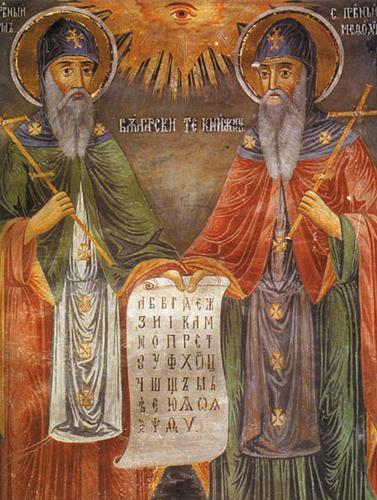
    You might have been expecting to celebrate Saint Valentine’s Day today, but we don’t actually have that feast on the modern Liturgical calendar.  Instead today we have the feast of two brothers: Saints Cyril and Methodius.  They lived in the ninth century in an area of Greece inhabited by many Slavs, and eventually they became missionaries to the Slavic people.

    Cyril was known as Constantine until he became a monk very late in life, and at that time took the name Cyril.  Cyril and his followers invented an alphabet, known as the Cyrillic alphabet, which is used in some form in modern Russian language.  Together with his followers, he translated the Gospels, the psalter, Paul’s letters and the liturgical books into Slavonic, and composed a Slavonic liturgy.

    Cyril’s work was not universally accepted.  He faced opposition from German clergy in the area who denounced the Slavonic liturgy and their use of the vernacular language in preaching.  More than once, they went to Rome to answer charges of heresy and were exonerated every time.  While in Rome, Cyril became a monk, and fifty days later, he passed away.

    His brother Methodius, however, kept the mission work going for another sixteen years.  He became the papal legate for all the Slavic peoples, was consecrated as a bishop and given a see in what is now the Czech Republic.  When much of their former territory was removed from their jurisdiction, the Bavarian bishops retaliated with a violent storm of accusation against Methodius.  As a result, Emperor Louis the German exiled Methodius for three years, at which time he was freed by Pope John VIII.

    Legend has it that Methodius translated the whole Bible into Slavonic in eight months.  He died on Tuesday of Holy Week, surrounded by his disciples, in his cathedral church.


    Cyril and Methodius worked long and hard, and in the face of much opposition, to make the faith known.  They made the faith accessible by inventing an alphabet and preaching in the language of the people.  We too are called to make the faith known, meeting people where they are, and explaining it in a way that makes it accessible.  The most honest way to do this is by living the Gospel so that we can be a witness for all to see – being people of integrity in our work, in our families, and in our communities.

  • Thursday of the Fifth Week of Ordinary Time

    Thursday of the Fifth Week of Ordinary Time

    Today’s readings

    The women in today’s Liturgy of the Word give us contrasting views of the spiritual life.  In our first reading, the women give us the example of what not to do.  Solomon, known for his wisdom and dedication to God by building the temple, is soon seduced by the foreign women he had married to abandon God.  They entice him to abandon the worship of the one, true God in order to worship and adore their so-called gods.

    Marrying into the families of the foreigners among them was a real problem for the Israelites.  God had forbidden them to do so, and when they did this, they were soon led astray and picked up the pagan customs of the world around them.  It’s kind of a metaphor for what can go wrong in our spiritual lives.  If we keep our eyes on Christ and follow the way he has laid out for us, we can progress in our devotion.  But the minute we start looking at other things, we can soon be distracted from the straight and narrow.

    On the other hand, we have the wonderful Syrophoenician woman in the Gospel.  She knows exactly where to look for salvation and she persists in it.  When it seemed that Jesus was not interested in helping her daughter, she persisted because she knew that Christ alone could heal her daughter and expel the demon.

    Once again, there’s a deeper message here.  I don’t think any of us believes that Jesus wasn’t interested in healing the woman’s daughter.  I just think he knew her faith and wanted to give those who were in the house where he was to see that faith.  The story gives us, too, the opportunity to asses our own faith in God, not looking to other things or foreign gods to bring us salvation.  If these women teach us anything in today’s readings, it’s that we need to be focused on our God alone.

  • Our Lady of Lourdes / World Day of the Sick

    Our Lady of Lourdes / World Day of the Sick

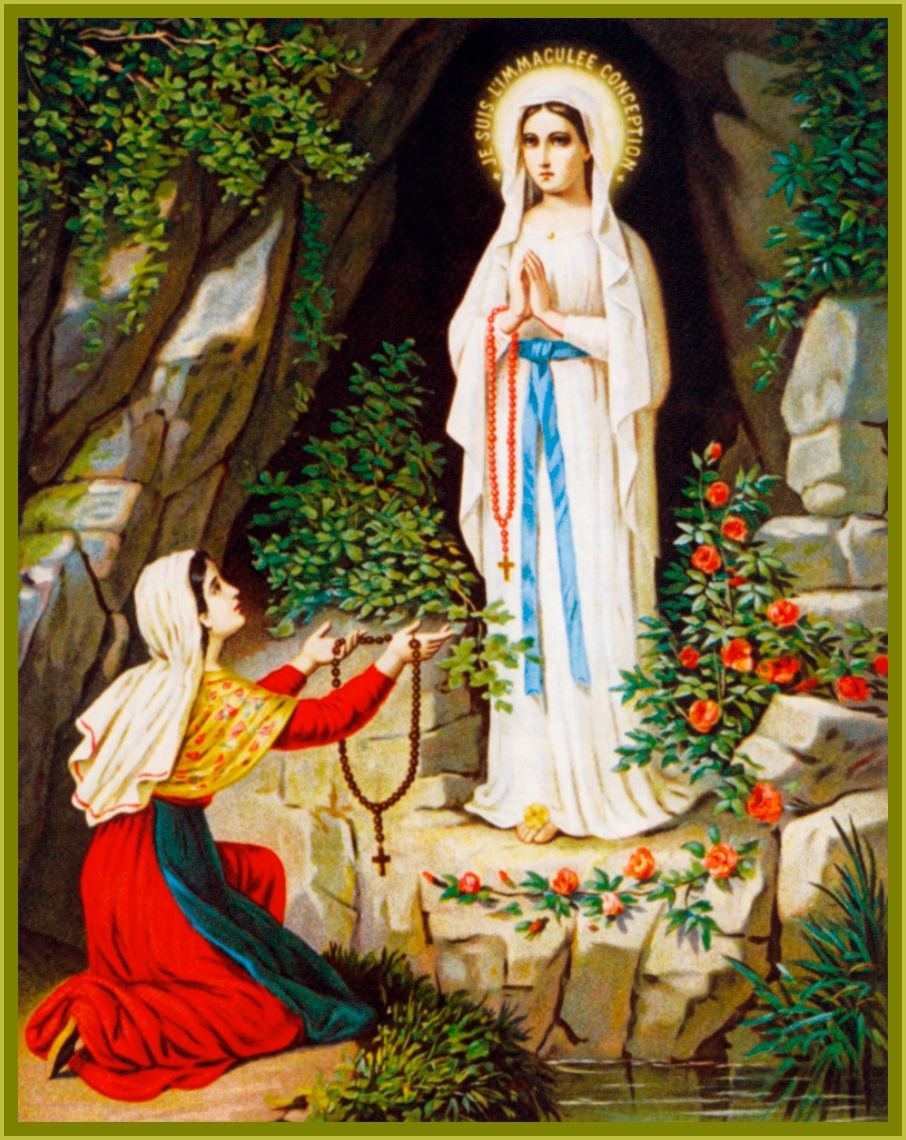
    Bernadette Soubirous was a sickly young woman.  But on February 11, 1858, her entire life changed when a beautiful lady, clothed in white, with a rosary over her arm and a yellow rose on each foot, appeared to her and said, “I am the Immaculate Conception.”  In the years since, the site of those wonderful apparitions, Lourdes, has been a place of pilgrimage and healing, but even more of faith.  Church authorities have recognized over 60 miraculous cures, although there have probably been many more.  To people of faith this is not surprising.  It is a continuation of Jesus’ healing miracles—now performed at the intercession of his mother.  Some would say that the greater miracles are hidden ones.  That is, many who visit Lourdes return home with renewed faith and a readiness to serve God in their needy brothers and sisters.

    In today’s Gospel, people flock to Jesus for healing.  Whenever people heard he was in the area, they would flock to him, bringing their sick loved ones on mats and laying them in the marketplaces so that as he passed, they might touch his cloak, and be healed.  And they were healed.  One can only imagine how faith in his power to heal grew as these miracles continued.

    Many continue to be healed in body, mind and spirit today.  Maybe it’s the remission of cancer, or deliverance from the flu.  Perhaps the intercessor was Saint Blaise, who we recently remembered, or Saint Peregrine, or Our Lady of Lourdes who we celebrate today.  However it is accomplished, healing is the ministry of our God.  Sometimes an illness is not cured, perhaps it even grows worse or is terminal, and so maybe the healing that God intends in that situation isn’t the physical one we hope for, but instead some spiritual gift or growth in faith.  God answers our prayers in all sorts of ways, though the prayers of many intercessors; a person of faith takes comfort in that.

    In 1992, Pope John Paul II proclaimed today as the World Day of the Sick, “a special time of prayer and sharing, of offering one’s suffering for the good of the Church and of reminding us to see in our sick brother and sister the face of Christ who, by suffering, dying and rising, achieved the salvation of humankind.”  In our prayer today, we remember all of those who are sick, and we offer our own illnesses and frailties for the accomplishment of God’s will in our world.

  • Saint Scholastica, Virgin

    Saint Scholastica, Virgin

    We are told in the Gospel today that “Mary has taken the better part and it will not be taken from her.” Much the same could be said about St. Scholastica, whose memorial we celebrate today. St. Scholastica is known as the sister of St. Benedict. Some traditions speak of them as twins. St. Gregory tells us that Benedict ruled over both monks and nuns, and it seems as if St. Scholastica was the prioress of the nuns.

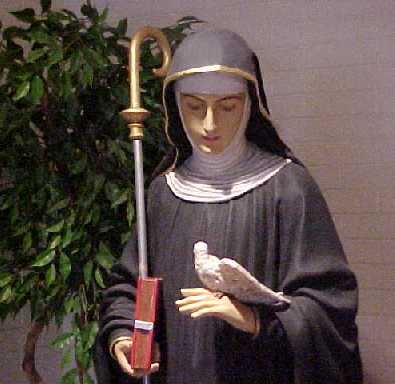
    Not much is known of St. Scholastica except what we have from St. Gregory, and his account tells us of a spiritual kinship between she and Benedict that was extremely close. They would often meet together, but could never do so in their respective cloisters, so each would travel with some of their confreres and meet at a house nearby. On one occasion, the last of these meetings together, they were speaking as they often did of the glories of God and the promise of Heaven. Perhaps knowing that she would not have this opportunity again, Scholastica begged her brother not to leave but to spend the night in this spiritual conversation. Benedict did not like the idea of being outside his monastery for the night, and initially refused. With that, Scholastica laid her head on her hands and asked God to intercede. Her prayer had scarcely ended when a very violent storm arose, preventing Benedict’s return to the monastery. He said: “God forgive you, sister; what have you done?” She replied, “I asked a favor of you and you refused it. I asked it of God, and He has granted it.”

    Three days later, Scholastica died. St. Benedict was alone at the time, and had a vision of his sister’s soul ascending to heaven as a dove. He announced her death to his brethren and then gave praise for her great happiness. Like Mary in today’s Gospel and like St. Scholastica, we are called to spend our days and nights in contemplation of our Lord and discussing his greatness with our brothers and sisters. If we would do this, we too might find as the writer of the Song of Songs that deep waters cannot quench the great love we have for Christ and for our brothers and sisters in Christ.

  • Saturday of the Fourth Week of Ordinary Time

    Saturday of the Fourth Week of Ordinary Time

    Today’s readings

    In today’s first reading, King Solomon is asked a question that seems to me something like the fabled question that people get asked when they find a genie in a bottle.  Make a wish, and it’s yours.  Solomon has a relationship with the Lord, and so he treats the opportunity as something quite more than a chance to get rich quick.  Instead, he asks for the spiritual gift of understanding, which he knows that he will need in his ministry of governing the people Israel.  He gets that, and much more besides.

    Jesus offers the Apostles an opportunity, too.  They were so busy, they had no opportunity to eat, let alone rest.  So he invites them on retreat: “Come away by yourselves to a deserted place and rest a while.”  He gives them a chance to recharge, to rest and grow.  Meanwhile, Jesus continued the ministry of preaching and teaching.

    So we too, have opportunities today.  Those of us gathered for the Liturgical Minister Day of Renewal have the opportunity to come away and rest a while, to reflect on what we do and why we do it, and why it’s important that we do it well.  We come to be fed by the Eucharist and nourished in prayer, we come to receive the gifts that we need to do our ministries well.

    Opening ourselves up to our Lord today, we are asked what it is that we need.  For each of us the answer is probably quite different.  We may need to go deeper in the spiritual life, or we may need to learn more about the Liturgy and our faith.  We may need more time for prayer.  Whatever it is, our God presents us with the opportunity today.  Sometimes I think we underestimate God or don’t want to bother him, or we may even think we can do our ministry or handle whatever life throws at us alone.  But we can’t and we don’t have to.

    God speaks to us today: “Ask something of me and I will give it to you.”  How do you answer?  Choose wisely.

  • Friday of the Fourth Week of Ordinary Time

    Friday of the Fourth Week of Ordinary Time

    Today’s readings

    We’ve been listening, these last couple of weeks, to the story of the rise and fall of good King David.  Yesterday, in our first reading, we heard the story of his peaceful death and the transfer of the kingship to his son, Solomon.  Today, Sirach the Wisdom writer tells us about David in more poetic, and somewhat apologetic and glowing terms.  From it, we can see that, when David was at his best, he gave praise to God.  Such was the topic of today’s psalm, ostensibly also written by King David.

    In our Gospel today, we hear of the end of Saint John the Baptist’s life.  He was one who lived his entire life pointing the way to the Lord.  With every fiber of his being, and until his last breath, he gave praise to God.

    This is the role of disciples, which includes you and me.  We should always give praise to God and point others to him.  At our best, we should be an Assembly of holy people, helping all the world to find our God.  May we all sing with the Psalmist, “Therefore, I will proclaim you, O LORD, among the nations, and I will sing praise to your name.”

  • Saint Paul Miki and Companions, Martyrs

    Saint Paul Miki and Companions, Martyrs

    Today’s readings

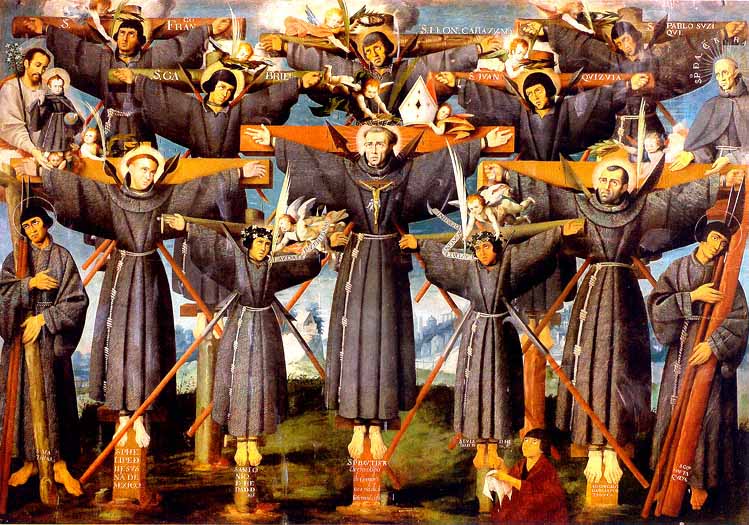
    We have been hearing from the martyrs a lot this week.  On Tuesday, we remembered Saint Blase, a bishop and martyr who is the patron saint of those with illnesses, specifically of the throat.  Yesterday, we remembered Saint Agatha, a virgin and martyr who was put to death in the third century.  Today we remember Saint Paul Miki and his 25 companions – religious, lay people, catechists, and even children – who were crucified on a hill in Nagasaki in the late sixteenth century.

    Saint Paul Miki wrote, in his final moments: “The sentence of judgment says these men came to Japan from the Philippines, but I did not come from any other country.  I am a true Japanese.  The only reason for my being killed is that I have taught the doctrine of Christ.  I certainly did teach the doctrine of Christ.  I thank God it is for this reason I die.  I believe that I am telling only the truth before I die.  I know you believe me and I want to say to you all once again: Ask Christ to help you to become happy.  I obey Christ.  After Christ’s example I forgive my persecutors.  I do not hate them.  I ask God to have pity on all, and I hope my blood will fall on my fellow men as a fruitful rain.”

    In our first reading today, King David accepts his impending death with peace and wisdom.  The same might be said of the courageous death of Saint Paul Miki, his companions, and all the other martyrs we have brought to memory in these past days.  May their courage and wisdom inspire us to live and die with faith in God’s mercy, and give us the grace to live our lives in witness to God’s love and Truth.

  • Tuesday of the Fourth Week of Ordinary Time

    Tuesday of the Fourth Week of Ordinary Time

    Today’s readings

    There is a lot of anguish in the readings today, isn’t there?  Most markedly is the anguish of King David, mourning the death of his son Absalom.  His anguish was most surprising to his army, because they had been fighting Absalom’s thugs who were helping him to overthrow the government of David.  But even though Absalom was seeking his father’s life, Absalom is still his son, and his death is no occasion for joy.

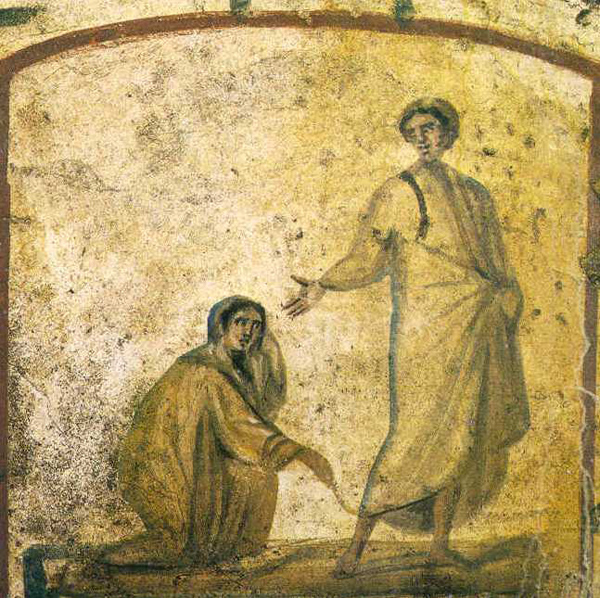
    Then there is the anguish of Jairus, the synagogue official, whose daughter was near death when he reached out to Jesus.  It becomes more distressing when, on the way to heal his daughter, they are confronted with the anguish of the hemorrhagic woman, who had been suffering for twelve years, at “the hands of many doctors,” who had apparently done nothing for her but take her money.  Knowing that he had healed someone, he stopped to reach out to her so as to heal her spirit.  All of which becomes even more distressing as they reach Jairus’s daughter, who has just died.

    But Jesus is the enemy of death and anguish, so he heals the hemorrhagic woman, he raises the daughter of Jairus with a word of command, and he teaches us the essential truth that faith is essential to healing.  David had faith and poured out his heart to God in our psalm today, and was eventually given peace.  Jairus had faith, and found out that death is not more powerful than God.  The hemorrhagic woman had faith and found that God’s love can bind up the wounds of so many years.

    Whatever our anguish is today, may we bring it to God, trusting as David did: “For you, O Lord, are good and forgiving, abounding in kindness to all who call upon you.”