Blog

  • Monday of the Thirty-first Week of Ordinary Time

    Monday of the Thirty-first Week of Ordinary Time

    Today’s readings

    A story is told about the third-century martyr Saint Lawrence that, after the death of Pope Sixtus II, the prefect of Rome demanded that Lawrence, who was the keeper of the material goods of the Church, turn over to him all of the Church’s treasures.  In response, Saint Lawrence brought out the poor, the blind and the lame, to whom he had distributed alms, saying, “Behold in these poor persons the treasures which I promised to show you; to which I will add pearls and precious stones, those widows and consecrated virgins, which are the Church’s crown.”  That act cost Lawrence his life, but it also testified to the real truth of where our treasure is found.

    In today’s Gospel, our Lord instructs those dining at the home of one of the leading Pharisees to do much the same.  Rather than inviting those who would give you a boost in social status or cause you to have the opportunity for repayment, instead they should “invite the poor, the crippled, the lame, the blind,” expecting blessing because of their inability to repay the favor.

    As we near the end of our liturgical year, the Church gives us this reading to help us to reflect on our discipleship over the last year.  What has been our response to the Gospel?  Have we sought our own honor and glory, or have we instead turned to have compassion on others?  Have we treated people as stepping stones to something better, or have we humbled ourselves?

    Friends, Jesus makes it clear that we cannot receive the blessing God wants to give us if we aren’t humble enough to let go of social status and wealth and the high estimation of others.  We cannot receive blessing when we are grasping for things that look better.   So if toward the end of this year, we have not grown in blessing, maybe it’s time we took stock of what we need to get rid of.  Empty hands can receive blessing.

  • All Souls Remembrance Mass

    All Souls Remembrance Mass

    The souls of the just are in the hand of God,
    and no torment shall touch them.

    Each year, the Church gives us the grace of remembering, and praying for, all of our loved ones who have gone before us, marked with the sign of faith, and all the dead whose faith is known to God alone.  The Church is great in wisdom in giving us this feast every year.  Because even though on this day, we might shed a few tears, still we will have the grace of remembering the ones who have given us life, given us wisdom, those who have been Christ to us, those who have made God’s love tangibly present in our lives.

    Perhaps the deepest mystery of the human experience lies in the reality of life and death.  Everyone has, or will, experience the death of loved ones, sometimes after a long life, sometimes far too soon, always with feelings of sadness, regret, pain, grief and perhaps even anger or confusion.

    That’s how grief works.  It might seem sometimes like it would have been better to live without love, but we know deep down that that’s not true.  Sadness and even death are temporary; love is eternal.  As the Church’s vigil for the deceased tells us, “all the ties of friendship and affection which knit us as one throughout our lives do not unravel with death.”  We know that death only separates us for a short time, and even though there is that hole in our heart, the sadness that we feel is way better than never having loved at all, never having had our loved ones in our lives at all.

    I want to pause here and speak a little about the reality of grief.  Because, if there is one thing that we as a society do extremely poorly these days, it’s grieving.  We rush through it and hope it’s all done before we have a chance to feel any kind of pain.  That’s part and parcel of how things work in our world; we have a pill for every malady and a quick remedy for every pain, plagued with a whole host of horrifying side effects.  And what’s important to know is that this is not how the Church teaches us to grieve.  One of the most important reasons that we have All Souls Day each year is to give us the experience of remembering and grieving and healing.  If you truly love, you will truly grieve, and not turn away from it.

    The Church’s Catechism (989) teaches us: “We firmly believe, and hence we hope that, just as Christ is truly risen from the dead and lives for ever, so after death the righteous will live for ever with the risen Christ and he will raise them up on the last day.”  And so we Christians never grieve as if we have no hope.  The Church’s Liturgy echoes this hope in the third Eucharistic Prayer: “There we hope to enjoy for ever the fullness of your glory, when you will wipe away every tear from our eyes.  For seeing you, our God, as you are, we shall be like you for all the ages and praise you without end, through Christ our Lord, through whom you bestow on the world all that is good.”  One of the Prefaces to the Eucharistic Prayers for the Dead makes it very clear that this hope touches our experience of grieving: “In him the hope of blessed resurrection has dawned, that those saddened by the certainty of dying might be consoled by the promise of immortality to come (Preface I for the Dead).”

    And so I have some tips on grieving that I hope you will find helpful:

    1. Don’t rush into the funeral. It’s hard to make all those difficult decisions at a moment’s notice.  It’s great if you’ve talked about your wishes with your family, because it makes things easier.  But if that hasn’t happened, the family would do well to take its time and avail itself of the resources of the funeral director and the church staff so that a funeral that adequately honors the deceased and comforts the living can be prepared.
    2. Parents: please talk to your children about your funeral. Yes, that’s going to be a hard conversation.  But these days, too many young people are so disconnected from the Church and so averse to any kind of unhappiness, that they really don’t know how to grieve.  You have to help them with that.
    3. Let other people help you. Even if you can do all the preparations, you don’t have to.  Let the Church and others help you and minister to you in your time of grief.  As a priest, I presided at my father’s funeral, but one of the priests who knew him preached the homily.  I found that was very helpful to me in my own grieving.  On that day, I was a son grieving the death of his father; it would have been hard to be the preacher too.
    4. Have a wake. A lot of people try to short-cut this one because they think it will be too painful.  It will hurt a little, yes, but the comfort of others expressing their love for the deceased and for you will do so much to heal you in the time to come.
    5. Don’t be afraid to shed tears. Anyone who has ever seen me preach at some funerals of people I’ve known especially well has seen me get choked up.  Or they have seen me shed a tear when I’ve talked about my father or my grandparents in a homily.  Tears heal us, and it’s good for other people, especially your children, to see you cry.  They need to know that pain and sorrow are part of life so that they don’t feel like they’ve gone nuts when it happens to them.  You aren’t doing anyone any favors by not allowing them to see you grieve.
    6. Understand that grief doesn’t “go away.” Feelings soften with time, yes, but you will grieve your loved ones for many years to come, perhaps your whole life long.  I still grieve for my grandparents who have been gone from my life for many, many years now.  Sometimes those waves of grief will come up all of a sudden, without warning, kind of out of the blue.  And that’s okay.  Remember grief is a sign that we have loved, and loving is the most important thing we will ever do.

    One of my most vivid childhood memories was when I was just about nine years old.  My grandfather on my mother’s side, who had retired just a few months earlier, was diagnosed with cancer.  There wasn’t so much that could be done about cancer in those days, so he wasn’t expected to live long.  And so one night, as the oldest of the children, Mom and Dad came to my room to talk to me about Grandpa.  That was the night I learned about life and death, sadness and grief, love and pain.  We cried a bunch, hugged a lot, and talked about how we were going to miss him.

    I went to the wake and funeral with my family, because that’s what we did when a loved one died.  My parents could have shielded me from that experience in many ways, as so many parents do, but they chose not to, and I’m glad they made that decision.  Death and grief aren’t things we actively seek, but we can’t be afraid to meet them head on, girded with faith, and confident of the hope we have in Christ Jesus.

    Brothers and sisters, I can’t say this strongly enough: if we don’t learn to grieve, as early as possible, we will never ever truly love.  We won’t want to invest ourselves in love because we won’t want to ever feel pain.  Jesus so deeply invested himself in love that he suffered the pain of the cross for us, so as to open for us the way to resurrection.  We have to be willing to suffer loss in order to gain anything truly glorious.

    Even if the memories aren’t the best, and even if we struggle with the pain of past hurts mixed with the sorrow of grief, there is grace in grieving and remembering.  Maybe this day can be an occasion of healing, even if it’s just a little bit.  Maybe our tears, mixed with the saving Blood of Christ, can wash and purify our wounded hearts and sorrowful souls.  And certainly our prayers are heard by our God who gives us healing and brings our loved ones closer to him, purifying them of any stain of sin gathered along the journey of life.

    That pain that perhaps we feel won’t all go away today.  We are left with tears and loneliness, and that empty place at the table, and that hole in our heart.  But sadness and pain absolutely do not last forever, because death and sin have been ultimately defeated by the Blood of Christ.  We can hope in the day that our hearts will be healed, and we will be reunited with our loved ones forever, with all of our hurts healed and relationships purified, in the kingdom that knows no end.

    Eternal rest grant unto all of our departed loved ones, O Lord, and let perpetual light shine upon them.  May the souls of all the faithful departed, through the mercy of God, rest in peace.  Amen.
  • The Thirty-first Sunday of Ordinary Time

    The Thirty-first Sunday of Ordinary Time

    Today’s readings

    For everyone who exalts himself will be humbled,
    but the one who humbles himself will be exalted.

    We know about, or at least have heard about the deadly sins.  These are those sins that drag us down into further sin, and really work to cut us off from the relationship with Christ that we hold dear.  So we remember that these sins are pride, greed, lust, envy, gluttony, wrath and sloth.  But for each of these deadly sins, there is also a life-giving virtue.  Today, our readings focus on humility, which is the life-giving virtue that is the antidote to pride.  Of the seven deadly sins, pride is usually considered the original and the most serious of the sins. Pride is a particularly ugly thing.

    Jesus tells us quite clearly today: “Whoever exalts himself will be humbled; but whoever humbles himself will be exalted.”  But not many of us really seek to be humbled, do we?  When we think about humility, we might associate that with a kind of “wimpiness.”  As you think about humble people do you imagine breast-beating, pious souls who allow themselves to be the doormats for the more aggressive and ambitious? Humble people, we tend to think, don’t buck the system, they just say their prayers and, when they are inflicted with pain and suffering, they just “offer it up.”

    But that’s not how Jesus sees it.  He doesn’t see humble people as wimpy or weak-minded.  He sees them as leaders: “The greatest among you,” he tells us, “must be your servant.”  So do you want to be a leader?  Do you want people to look up to you?  Do you want to be a role model for your children?  Well, if you do, you need to be a servant of others.

    When I think about humility, I often think about a man named Mike, who was a member of my home parish.  Mike was one of my favorite people in the world.  He owned the service station where my family had, and still has, our cars repaired and maintained ever since we first moved out to the suburbs, over forty years ago now.  Dad used to joke that with all the cars we brought in there over the years, we probably had ownership in at least the driveway by now.  But Mike never took advantage of anybody; Mike was the kind of guy who, if you brought your car in for a tune-up, would call you and say, “your car doesn’t really need a tune-up yet, so I’ll just change the oil and a couple of the spark plugs and you’ll be fine.”  He was honest and did great work, and it seemed like everyone knew him.  He taught that to a kid who came to work for him when he was just sixteen.  When Mike retired, Ted took over for him and runs the business just the way Mike taught him.

    Mike was a regular at the 7am Mass on Sunday, and after his retirement was a pretty regular daily Mass-goer.  The church would sometimes ask him to help a person in need with car repairs.  This he did gladly; he was always ready to serve.  Several years ago, when Mike died, I took Mom to his wake.  It took us an hour and a half to get in to see him and his family, and it was like that all night long.  His funeral packed the parish church, and eight of us priests concelebrated the Mass.  Mike left his mark on our community in incredible ways, and nobody ever forgot it.  Mike was the kind of servant leader that Jesus talked about in today’s Gospel.

    The attitude of humility is counter-cultural.  We want the places of honor at banquets and wherever we go; that’s just human nature.  We may not wear phylacteries or tassels when we come in to worship, but we are pleased when someone notices how wonderful is something that we have done.  And Jesus would have nothing of all this.

    I don’t really think that Jesus was saying there shouldn’t be people we call “father” or “teacher” or “master.”  Sometimes non-Catholics will cite this passage to dismiss the value of the Priesthood.  But they are taking one verse out of context and miss the point: Jesus knew well that the world needs leaders.  But the message here is that those leaders must be the servants of all.  They shouldn’t be in the position to have the titles of honor.  Rather the title should recognize the servant leadership that is the heart of who they are.  It’s something I pray to get better at every day; maybe you do too.  And so we need to reflect on how willing we have been to be servants.  Have we reached out to the poor in some way?  Have we given adequately of our time, talent and treasure for the mission of the Church?  Do we carry out our roles in our family, job, or community with love and compassion and humility?

    We can see how Jesus modeled leadership in his own life.  Indeed, he is not asking us to do something he was unwilling to do himself.  When he said, “For everyone who exalts himself will be humbled, but the one who humbles himself will be exalted” he was clearly foreshadowing what would happen to him.  Humbling himself to take up our cross – our cross – he would be exalted in the glory of the resurrection.

    The good news is that glory can be ours too, if we would humble ourselves and lay down our lives for others.  If we stop treating the people in our lives as stepping stones to something better, we might reach something better than we can find on our own.  If we humble ourselves to feed the poor and needy, to reach out to the marginalized and forgotten, we might be more open to the grace our Lord has in store for us in the kingdom of heaven.

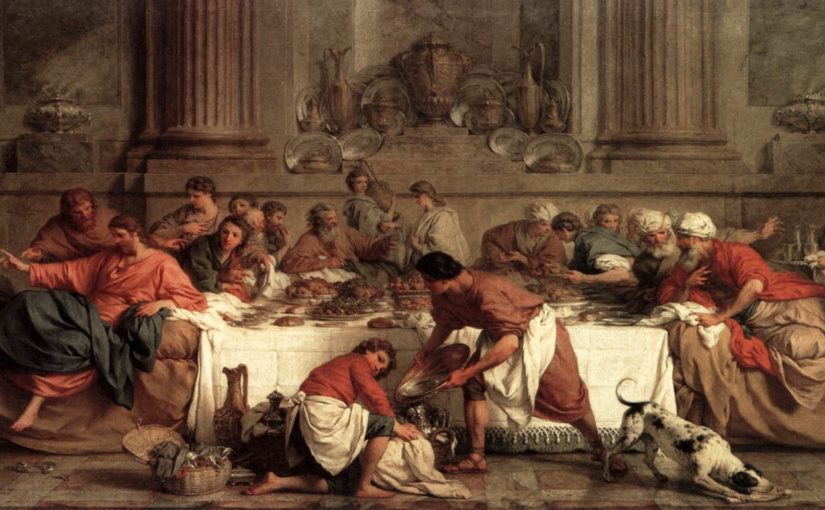
    At this Mass, we have been invited to a very important banquet, and we ourselves are completely unworthy of being here.  And I include myself in that statement, brothers and sisters.  Yet, through grace, through the love of our God, we have been given an exalted place at the banquet table.  Realizing how great the gift is and how unworthy of it we are is a very humbling experience.  In that humility, we are called to go out and feed those who need to know how much God loves them.

    For everyone who exalts himself will be humbled,
    but the one who humbles himself will be exalted.

  • Friday of the Thirtieth Week of Ordinary Time

    Friday of the Thirtieth Week of Ordinary Time

    Today’s readings

    It could have been jealousy.  Or maybe they just felt threatened.  Either way, the Pharisees had lost sight of the mission.

    You could see how they would have been jealous: here they are working long and hard to take care of the many prescripts of their religion, attending with exacting detail to the commandments of God and the laws that governed their way of life.  But it is Jesus, this upstart, and not them, who is really moving the people and getting things done.  People were being healed – inside and out – and others were being moved to follow him on his way.  That had to make them green with envy.

    And, yes, they probably felt threatened.  The way that he was preaching, the religion he was talking about – well, it was all new and seemed to fly in the face of what they had long believed and what they had worked so hard to preserve.

    But how had they gotten here, how did they lose the way?  Because what Jesus advocated was really not a different message: it was all about how God loves his people and that we should love God and others with that same kind of love.  That message was there: buried deep in the laws and rules that they were so familiar with, but somehow, the laws and rules became more important than the love.

    The Pharisees wanted to preserve their religion and the way of life they had lived for so long.  Jesus wanted to make manifest God’s love, forgiveness of sins, and true healing.  It’s not that the rules of religion are not important, but the underlying message and the greatness of God cannot be overshadowed by legalism.  That is the argument in today’s Gospel; that is the argument that ultimately brought Jesus to the cross.  He would rather die than live without us; he paid the price that we might be truly healed and might truly live.  As the Psalmist reminds us today: Praise the Lord!

  • The Commemoration of All the Faithful Departed (All Souls)

    The Commemoration of All the Faithful Departed (All Souls)

    One of my most vivid childhood memories was when I was just about nine years old.  My grandfather on my mother’s side, who had retired just a few months earlier, was diagnosed with cancer.  There wasn’t so much that could be done about cancer in those days, so he wasn’t expected to live long.  And so one night, as the oldest of the children, Mom and Dad came to my room to talk to me about Grandpa.  That was the night I learned about life and death, sadness and grief, love and pain.  We cried a bunch, hugged a lot, and talked about how we were going to miss Grandpa.

    I went to the wake and funeral with my family, because that’s what we did when a loved one died.  My parents could have shielded me from that experience in many ways, but they chose not to, and I’m glad they made that decision.  Death and grief aren’t things we actively seek, but we can’t be afraid to meet them head on, girded with faith, and confident of the hope we have in Christ Jesus.

    I still miss Grandpa to this very day.  He had a wonderfully silly sense of humor that never failed to make me laugh, he made a homemade ravioli that blew away anything I’ve ever eaten since, he came from Italy, learned our language and made a beautiful life for his family, and the stories of that have been an inspiration to me every day.  The same is true of all of my grandparents, all who have gone on to the Kingdom, all of whom I miss and all of whom were a great example for me.

    I miss Grandma Mulcahy when I’m planting flowers in my Mom’s garden, because she did that better than anyone, and while she did, we would talk about Ireland and I would hear about life in the “Old Country.”  I miss Grandma Mastrodonato – Mom’s Mom – when I’m out in a public setting and see people doing crazy things or wearing something odd, because she always enjoyed people watching and listening to others.  I missed Dad’s Dad a lot in my job previous to seminary, because he built the monstrous printing press that was, at the time, printing a job for my customer.

    And I miss Dad.  When I’m having a rough day, I just want to sit down and talk, knowing he’d listen and understand, and support me in whatever way I needed.  I missed him especially a couple of months ago when I celebrated the funeral of his best friend, one of the pillars of our neighborhood.  Together, they were two of the best, most giving men I ever knew.

    And there are aunts and uncles who have gone on to the Lord, too.  All of these characters have been inspirational to me in some way, and I find that the grieving, while it may dissipate a bit, never seems to completely go away.  I don’t think it’s supposed to.  Because when we have loved much, the passing away of one we have loved leaves a hole in our life that shouldn’t go away.  That doesn’t mean that our life comes to an end: we move on, as move on we must, but always with a sense of loss, hopefully tempered with fondness for the relationship we had, hopeful of a reunion in heaven one day.

    “The souls of the just are in the hand of God.”  So says the author of the book of Wisdom.  That is our prayer for our loved ones, for all the faithful departed.  Because, if we are convinced of that grace, we know they are alright, and have hope that we will be alright too.  And our Liturgy gives us words to hope on as well.  In a few moments, I will sing the words that have comforted me so many times in my sorrow: “Indeed, for your faithful, Lord, life is changed, not ended, and when this earthly dwelling turns to dust, an eternal dwelling is made ready for them in heaven.”  That is the promise derived from Jesus’ words in the Gospel: “I am the resurrection and the life, whoever believes in me, even if he dies, will live…”

    On this feast of the Commemoration of All the Faithful Departed, I have chosen to reflect on our experience of grief, and I’ve done that because it’s an experience we all have, on some level, at some time in our lives.  I want you to know how very natural grief is, and how very blessed an experience it is.

    Death is always a time of great sadness, but our Liturgy teaches us that we who believe in the Lord Jesus must never grieve as if we have no hope.  Our hope is always in Christ, the one who knows our grief and pain, and is with us in every moment of our lives, most especially when we are in pain.  The Church teaches us that if we believe in God and do his will, we can be reunited with all of our loved ones forever one day.  For the believer, the hopelessness of death is always overcome by the great hope of God’s grace.

    And so we know that death only separates us from those we love for a short time, and that death never has the last word because Christ has triumphed over death.  The beginning and end of everything is Christ, and Christ is with us in our first moments, and also in our last.  He is with us in our pain and with us in our joy.  He helps us to remember our loved ones with love that continues beyond our death and beyond the grave.  Grief and loss and pain are temporary things for us.  Love is eternal, love never ends, love can never be destroyed by death, love leads us all to the great glory of the resurrection and eternal light in that kingdom where Christ has conquered everything, even death itself.

    Eternal rest grant unto all of our loved ones, O Lord, and let perpetual light shine upon him.  May the souls of all the faithful departed, through the mercy of God, rest in peace.  Amen.
  • The Solemnity of All Saints

    The Solemnity of All Saints

    Today’s readings

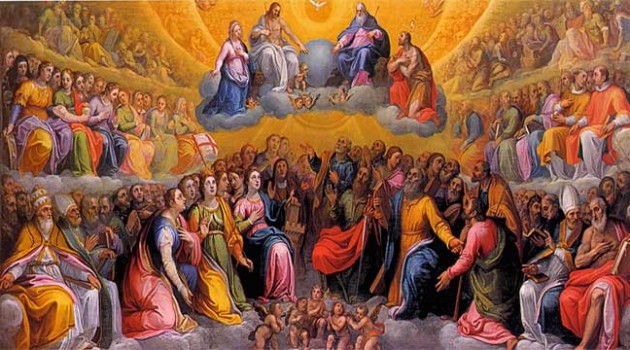
    I think we all bristle, mistakenly, at the idea of being a saint.  Saints are those super-holy folks who are depicted in artwork and glorified in amazing stories.  We are just ordinary people who struggle with our holiness, at best.  But today, the Church is asking us to think about saints in a broader way.  Yes, we include all those “official” saints that have been canonized through the ages.  The Church rejoices in the saints because when someone becomes a saint, the Church recognizes that he or she is definitely in heaven, the goal of all our lives.  That’s what the process of canonization is all about.  And bringing people to heaven is the whole point of the Church.  So, from the many saints of every time and place, we know of thousands of people that are certainly in heaven.  This illustrates that God’s will is done in the end, doesn’t it?

    But, as I said, I think the Church wants us to think about saints in a broader way.  There is the story of a schoolteacher who asked her children what a saint was.  One little girl thought about the saints she saw in stained glass windows, and said “Saints are people the light shines through.”  Think about that for a minute – that little girl isn’t far from the kingdom of God there.  Because all people are called to let the light of Christ shine through them, and saints are those people who have made that the business of their lives.

    Heaven is that great multitude that John the Revelator tells us about in today’s first reading: that multitude “which no one could count, from every nation, race, people, and tongue.”  They are wearing, he tells us, white robes, which have been washed in the blood of the lamb.  That seems very counter-intuitive, doesn’t it?  Everyone knows that blood stains like nobody’s business.  But he’s speaking poetically here, and recognizes that nothing washes us sinners quite as clean as the saving blood of Jesus Christ, and the white robes that the saints are wearing are the same ones we receive at Baptism.

    And that’s really the only way.  Because we’re quite right when we bristle a bit at being called saints.  We can’t be saints all on our own.  We aren’t good enough, we can’t make up for our sins with any kind of completeness, and there’s basically no way that we can jump high enough to get to heaven.  But this feast of All Saints recognizes that we don’t have to.  We don’t have to because Christ has saved us through no merit of our own but based solely on God’s love for us.  The fact that we can be called saints is a grace, and we dare not bristle so much that we turn away from that grace.

    It may help to know that most, if not all, of the saints struggled with holiness too.  Think about Saint Paul himself: he began his career by persecuting Christians and we know that he had a hand in the stoning of Saint Stephen.  Or think about Saint Augustine who was an intellectual man who disdained Christianity, until his mother’s prayers caught up with him.  Or we might think even more recently of Saint Teresa of Calcutta who experienced a very dark time in her life when she could not even communicate with Jesus.  But Jesus was still there and led her to heaven.

    We are all of us on a journey, and we know that our true home is not in this place, however good it may be.  We are on a journey to heaven, and that means that we are in the process of becoming saints.  That journey consists in following the Way who is Jesus the Christ, our Lord and Redeemer.  He has commanded, “be perfect as your heavenly Father is perfect” and there is no way to do that except to follow him.

    So, no, of course, not all of us will be canonized.  Most of us will go to the Kingdom rather imperfect in many ways, and will have to work that out in the grace of Purgatory.  But if we look to those canonized saints for inspiration, perhaps our relationship with the Lord will lead us and our brothers and sisters to that place where all the saints worship around the Throne of the Lamb.

    Today we, the Church militant, honor the Church triumphant: not only the great saints like Mary and Joseph, Patrick and Benedict, Michael and Gabriel, Francis and Dominic, but also those saints that God alone has known.  We glory in their triumph that was made possible by them joining themselves to Christ.  We take inspiration from their battles and from the faith that helped keep them in Christ when they could have turned away.  If God could do that in their lives, he can certainly do that in ours too.  Perhaps, if we are willing to accept it, he can fill us with saintly attributes: strength in weakness, compassion in the face of need, witness to faith in times when society lacks direction, and so much more.

    Those virtues are virtues that we think about when we call to mind those official, canonized saints.  But they are virtues for which we can and should strive as well.  The desire and the grace to attain those virtues comes from God himself, and the reward for receiving that grace and living those virtues is a heavenly relationship with God.  What could be better than that?  We are indeed, as the Psalmist says today, the people who longs to see God’s face!

    This is a lot of work, and it’s not easy to live a saintly life, but Jesus makes a promise today to those who strive to do so: “Rejoice and be glad, for your reward will be great in heaven!”

  • All Saints’ Day Eve (All Hallows Eve): Would Jesus Trick-or-Treat?

    All Saints’ Day Eve (All Hallows Eve): Would Jesus Trick-or-Treat?

    Today’s readings

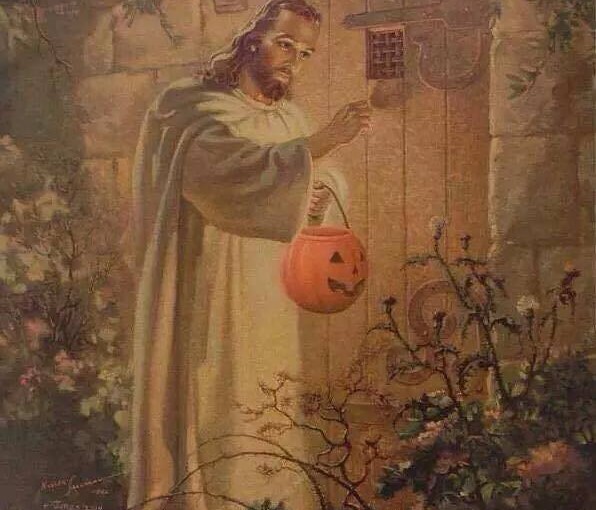
    Since we’re gathered here on Halloween, All Hallows Eve, I thought I might get your attention by doing a little homily I like to call “Would Jesus Go Trick-or-Treating?” It’s an important topic, because I think a lot of parents wrestle with the message of Halloween and whether or not they should support their children joining in the festivity.

    And I think it’s an important thing to wrestle with. On one hand, we don’t want to make a joke out of evil, because evil is real and it’s no joke. But on the other hand, we don’t want to call attention to evil by making a big thing out of it. Exorcists tell us that those are the two common mistakes that we can make about: First, we might say think there is no such thing as the devil. Satan would be happy for us to do that, because then we’re not on guard against him. He is real, he’s out there, and we do have to be on guard. Second, we might look for evil everywhere, and that just shuts us down and keeps us from living the Gospel. Neither of these is a good thing.

    So let’s talk about Halloween. Its origins are a bit murky, and lots of people think that what happened is that we sort of baptized a pagan festival. And there is a traditional pagan festival on October 31st, but apparently there is a traditional pagan festival on the last day of every month, so really that’s nothing special. More likely, Halloween was a celebration of the Eve of All Saints – hence the name. All Saints Day originated in the year 609, when it was celebrated in May. But in the ninth century, it was moved to the first of November, which is when the Germanic church celebrated it, and it’s been celebrated then ever since.

    The origins of trick-or-treating may have been in Ireland where an ancient Gaelic festival celebrated the harvest and marked the beginning of winter – the time of year when a significant portion of the population would often die. Because of the fear of death that came with winter, these celebrations seemed to have included going door to door asking for treats dressed in costumes, which were thought to disguise the living from life-taking spirits.

    So the origins and intent of Halloween are relatively benign, and mostly intended to honor the saints. But in our country, over time, a more sinister tone was added to the celebration. Think of some of the more horrific costumes, extremely elaborate and grotesque “haunted houses,” and parties where more evil customs were brought to the celebration. Add that to some of the more elaborate horror movies that get released this time of year, and you can see how it would be easy to brand Halloween as an evil holiday.

    Fundamentalist Christians especially see the evil, and thus throw out the entire holiday. But we are not fundamentalist Christians. So we remember that God is good, and that he is in control, and we do not give the demonic or the evil any power that they don’t already have. Indeed, a lot of people think that there is more demonic activity at this time of year than normal, but exorcists tell us that is not true. It’s just that people tend to open more doors by their worrying and by doing some things they shouldn’t to celebrate the holiday.

    So now let’s remember what this holiday is really about. Today we celebrate the feast of all the Saints – those who have been officially canonized over the ages, and those that perhaps we don’t know of, but who God certainly knows. This is the Church Triumphant, those who have conquered evil and have mastered holiness. They have accomplished what they were created for, to take up their rightful place in the Kingdom of Heaven, that place that God has prepared for each one of us. Today we celebrate their triumph, and hope for our own triumph, for we too wish to live forever with our God. We celebrate the example the saints have given us and we celebrate their intercession, which helps to guide our lives and lead us on the path of life eternal. So it is right to celebrate this as we celebrate other holidays, with great festivity.

    I think it’s important that we celebrate Halloween and All Saints Day as one, which is the intent. If we do that, we keep our minds on what is positive and turn away from all that bids us evil. So yes, I think it’s okay to trick-or-treat, to celebrate with parties, and to dress up. But I’d skip the more evil costumes, and any party games that summon evil, like Ouija boards. Those are things that open the door to evil, and we always want to avoid that.

    Avoiding evil was the glory of the saints. That was part of the path to holiness for them. As we celebrate all the saints today, we might think of some who famously battled evil and won. Saint Michael the Archangel, my middle-name patron, fights the battle of evil that we don’t see, every single moment. He is a wonderful patron, and we should memorize the prayer to him and pray it often. Saint Patrick, my principal patron, famously converted the pagan king of Ireland to Catholicism and exorcised the forces of evil in that country. His famous Breastplate prayer is considered a deliverance prayer and a help to those who feel oppressed by evil. Of course, the Blessed Virgin Mary, Queen of Heaven and Earth, is a powerful protector of all of us, her children. And let’s not forget our Guardian Angels, who do battle for us on a daily basis. That’s just some of the saints who battle for our good.

    And in the spirit of their glorious battle, we should dedicate ourselves to joining them one day. We are all supposed to be saints, and as tall an order as that may sound, it needs to be our number one priority. Because there is no one in heaven who is not a saint. So then, we need to take all the help God and His Church gives us: we must dedicate ourselves to the sacraments, particularly the sacrament of Penance and the Eucharist, which together are more powerful than a solemn exorcism. We must put prayer at the beginning, in the middle and the end of our to-do lists, dedicating ourselves to the Blessed Sacrament, to the reading of scripture, and devotions, particularly the rosary. We have to make every effort to live the Gospel, and to give witness to the power of God’s love in our lives and in our world. Because if we honor and witness to Christ in this life, he will surely be our advocate in the life to come.

    So yes, I think Jesus might trick-or-treat. But we come to him today for the best of all treats, the saving grace that he offers us that we might join the saints in heaven one day. We come to Jesus rejoicing and full of gladness, because we know that those who belong to him will have great reward in heaven.

  • Monday of the Thirtieth Week of Ordinary Time

    Monday of the Thirtieth Week of Ordinary Time

    Today’s readings

    The leader of the synagogue had it all wrong, and he of all people should have known what was right. God always intended the Sabbath day to be a day of rest, yes, but also of healing, also of mercy. There is no way that we can rest if we are in need of those things. The woman in the story was plagued by a demon that kept her bent over for eighteen years. Some translations of this passage say that she was “bent double.” So she wasn’t just slouched over or bent part way, but more like this, bent in half, for eighteen years! For eighteen years she never had a moment’s rest from this demon. Not only that, because she was bent double, people never even really saw her – really looked her in the eye.

    We find great healing when we rest, and so the healing of a person who had been plagued for so long by a demon that she was bent over double from the weight of it, that healing had every right to take place on the Lord’s Day, the Sabbath Day of rest. Who are we to decide when someone should be healed? That grace comes from God, and his mercy comes on his timetable, not ours. The Sabbath has come and gone for us this week, but as we head into the workweek this day, it would be wonderful if we could take a moment to plan for the coming Sabbath day of rest. We too are offered healing and mercy if only we would ask for it, if only we would rest in the Lord.

    (Image by Doris Klein)

  • The Thirtieth Sunday of Ordinary Time

    The Thirtieth Sunday of Ordinary Time

    Today’s readings

    Today I think our Scriptures call us to get love right.  Love is an important thing for Christians because we know that God is love, and that we are called to love.  But what we sometimes define love to be, and what we often settle for is so much less than what it’s supposed to be.

    Let’s set this up quickly.  In our Gospel today, the Pharisees are at it again.  They saw that Jesus silenced the Sadducees, a rival party, and so they wanted to put him to the test yet again.  So they ask him a classic trick question: “Which commandment of the Law is the greatest?”  It’s a question that scholars of the law back then argued about all the time: there were 613 commandments in the Jewish law, so which of them was most important?  You can just imagine the arguments about it.  So they pose the question to Jesus, not so much to see where he stands on the subject, but rather so they could have something to hold against him.  That’s the whole point here.

    But Jesus isn’t having any of it.  He boils all of the law and the prophets down to just two basic commandments: love the Lord your God with everything that you are, and then also love your neighbor as yourself.  And when you think about it, this is so common-sense.  If we love God and neighbor, there won’t be any room for sin or crime or war or anything else bad.  It’s so simple.  And yet so hard to do.

    But it shouldn’t be that way: it shouldn’t have been hard for the Pharisees and it shouldn’t be hard for us either.  The Pharisees made up the strongest part of the religious establishment of the time.  They were so concerned about getting the law right, that they often missed the whole point of the law in the first place.  The law came from none other than God himself, and he gave it for the good of the people, but the Pharisees used it to keep people under their thumb, which was what they were trying to do to Jesus here.

    And God is all about justice.  So if that’s how he wanted it, the law would indeed be very rigid.  But as we see from the small sample of the law we have in our first reading, God wanted justice to be tempered with mercy.  Sure, go ahead and take your neighbor’s cloak as collateral on a loan.  But you better give it back to him before sundown, because that’s all he has to keep him warm in the night.

    This shouldn’t be a surprise to those of us who have learned that God is love.  God is love itself, and God cannot not love.  That’s what God does and who God is: he loves us into existence, loves us in repentance, loves us with mercy, and loves us to eternity.  God is love in the purest of all senses: that love which wills the good of the other as other.

    So when Jesus boils the whole Judaic law down to two commandments, it’s not like he’s made it easy.  As I said; it is simple, but simple doesn’t always mean easy.  It means giving the person who just cut you off in traffic a break, because you don’t know what’s really going on in their life.  It means showing kindness to your family after a long day, even when they’re testing your patience.  It means finding ways to be charitable and help those less fortunate.  And, I’ll just say it, it means cutting yourself some slack when you mess up, even when you’ve just committed the sin you’ve been trying to stamp out of your life forever.  You have to love yourself if you are going to do what Jesus said: “Love your neighbor as yourself.”

    So in the quiet time of our worship today, perhaps after receiving Holy Communion, maybe our prayer could be “Help me, God, to love as you love.”  That’s a really appropriate prayer after Communion because in Holy Communion, we have just received Love itself, we have received our Jesus who laid down his life so that we would not be dead in our sins.  If anyone can teach us how to love, it’s Jesus.

    The whole law and the prophets depends on love.  The way we live our lives needs to show that we depend on love too.

  • Thursday of the Twenty-ninth Week of Ordinary Time

    Thursday of the Twenty-ninth Week of Ordinary Time

    Today’s readings

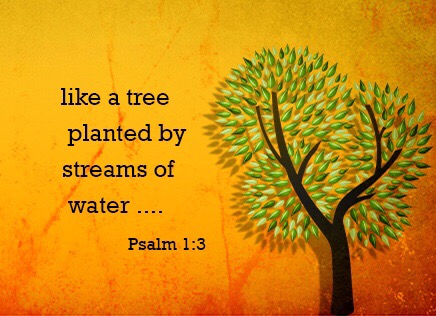
    Today’s Responsorial Psalm, Psalm 1; has always been one of my very favorite psalms. One interpretation of this Psalm is to look at it as a blueprint for blessedness. In Biblical terms, of course, blessedness equals happiness. So the person who doesn’t follow the counsel of the wicked or walk with sinners but instead meditates on the law of the LORD is happy, or blessed. This person is productive and vibrant, and all of his activities are prosperous. This person is contrasted to the wicked person who is anything but enduring. These are unhappy people who are driven away by the first storm that comes along.

    On the other hand, the Church has also looked at the blessed one in this psalm as referring to Christ himself. None of us is able to steer clear of evil all the time, nor meditate on God’s law day and night. But Jesus is the One who is like us in all things but sin and who is the fulfilled promise of God’s law. Jesus definitely is the tree planted near running water, which takes root strongly and shades us from the burning heat of evil under his never-fading leaves. Jesus is the one who can prosper any work that we do, if we just ask him to do so. If we want to know the person who really embodies the spirit of Psalm 1; then all we have to do is look to our Savior.

    But that doesn’t absolve us of our responsibility to become holy enough to take up the spirit of this Psalm within ourselves. We certainly don’t want to be the chaff which is driven away by the wind. Joining ourselves to our Savior, meditating on him day and night, as best we can, we can be refreshed by those running waters and become the sturdy trees that shelter the Church in good times and in bad. Blessed indeed are all of us who hope in the Lord.