Tag: humility

  • Saturday of the Seventh Week of Easter

    Saturday of the Seventh Week of Easter

    Today’s readings

    One of the greatest obstacles to the Christian life is comparing ourselves to others. The Fathers of the Church all warn against that practice, and urge us to keep our eyes on our own relationship with God.  The essence of discipleship is doing what we were put here to do, we ourselves.  We discern that vocation by reflecting on our own gifts and talents, given to us by God, by prayerfully meditating on God’s will for us, and then engaging in conversation with the Church to see how best to use those talents and gifts.  That’s the process of discernment, which is always aided by the working of the Holy Spirit, and a worthy exercise on this eve of Pentecost.

    What causes us to get off track, though, is looking at other people and what they are doing, or the gifts they have, or the opportunities they have received.  We might be envious of their gifts or the opportunities they have to use them.  We may see what they are doing and think we can do it better.  We might be frustrated that they don’t do what we would do if we were in their place.  And all of that is nonsense.  It’s pride, and it’s destructive.  It will ruin the Christian life and leave us bitter people.

    That’s the correction Jesus made to Peter.  Poor Peter was getting it all wrong once again.  He thought Jesus was revealing secrets to John that he wanted to know also.  But whatever it was that Jesus said to John as they reclined at table that night was none of Peter’s business, nor was it ours.  Peter had a specific job to do, just as John did, and so do we.  If we are serious about our discipleship, then we would do well to take our eyes off what others are doing or saying or experiencing, and instead focus on the wonderful gifts and opportunities we have right in front of us.  As for what other people are up to, as Jesus said, “what concern is that of yours?”

    And so we pray this morning for the grace of discernment, the wisdom of the Holy Spirit, and the gift of being able to mind our own business, spiritually speaking.

  • Saturday of the Third Week of Lent

    Saturday of the Third Week of Lent

    Today’s readings

    “O God, be merciful to me, a sinner.”

    These are perhaps the most important words of the spiritual life, uttered today by the repentant tax collector in the temple area. These words are so important, actually, that they form the basis of one of the most ancient acts of contrition that we have, called the Jesus Prayer. The Jesus Prayer comes out of the eastern and orthodox Church traditions, and the full version is “Lord Jesus Christ, be merciful to me, a sinner.” I want to put that in your prayer toolbox today: everyone should memorize this prayer.

    The Jesus Prayer, and our readings today, give us one of the great tools of Lent: humility. Humility is that great virtue that recognizes that I need a Savior. That because of my sins, I have no access to God, except for the fact that he loves me beyond anything I have a right to hope for. Humility recognizes that God loves us all so much that he gave everything for us, poured himself out for love of us, and desires to heal all of our sins and brokenness.

    All it takes is a little repentance: realizing my sinfulness, turning back to Christ, letting him love me, and accepting his forgiveness. The prayer that manifests that kind of attitude is not the prayer of the Pharisee in the Gospel reading today: his attitude is the antithesis of what prayer needs to be. The prayer that manifests the attitude we must have is that of the tax collector: “O God, be merciful to me, a sinner.”

    O, that God would grant us the great gift of humility this Lenten day.

  • Friday of the Twenty-sixth Week of Ordinary Time

    Friday of the Twenty-sixth Week of Ordinary Time

    Today’s readings (Mass for the school children.)

    Today I want to talk to you about one of the most important virtues in the life of a person who follows Jesus. And that virtue is humility. Humility is the antidote to the sin of pride, which is one of the most devastating sins there is. When we commit the sin of pride, what we are doing is saying we don’t need God, and when we don’t need God we put him out of our lives completely and can’t have a relationship with God. When that happens, we are destined for nothing but sadness, which is why humility is so important.

    Humility helps us to recognize that God is in control. It helps us to rejoice that God takes care of us in good times and bad, and that he helps us to be the best that we can be in every facet of life.

    In our readings today, Job has to be reminded of humility. He’s had some really bad things happen to him in the part of the story that comes before our reading today, and so he takes God to task for it. He lectures God about how God should care more for him, since he has done nothing but love God all his life long. God reminds Job that God sees the big picture, and Job cannot. God reminds Job that God knows how to do his job, and he has never needed Job’s advice on how to do it.

    We do the same thing all the time. When we are having hard times, our prayer can sound a lot like telling God how to do his job. “Dear Lord, help Susie to remember that I’m her friend and she should be spending more time with me.” “Please God tell my teacher to give me an A on that test.” We’ve all done it. But we have to remember that God sees the big picture and he knows how everything is going to turn out.

    We also have to remember, just as much as Job did, that even though God sees the big picture and everything that’s out there, he also sees us too. Even with everything happening in the world, God still sees us and loves us and cares about us individually. God still wants us to be happy with him forever and wants to love us more than we can ever imagine.

    All we have to do is embrace a little humility. When we pray, we should remember that God knows the times and seasons of our lives and that he wants us to be happy. Even when we are going through hard times, as often we will, he will work in our lives to bring us to happiness, if we let him do it in his time. And along the way, he won’t ever leave us. That’s all that we need. Because if God is walking next to us, nothing in heaven or on earth can ever take us away from God and his love for us.

    God was with Jesus even when he was dying on the Cross. God showed his love for Jesus by raising him from the dead. And all of that was a foretaste of our own lives. Yes, sometimes we may have to go through our own little crosses, but God won’t abandon us, and he will raise us up. All we have to do is let him, and not try to tell him how to work everything out. He knows how better than we do.

  • Thursday of the Fifteenth Week of Ordinary Time

    Thursday of the Fifteenth Week of Ordinary Time

    Today’s readings

    Today’s Scripture readings have some “sound bytes” that I have found most meaningful in my prayer life.  Isaiah’s profession of faith today says, “For it is you who have accomplished all we have done.”  What a beautiful thing for us to remember.  This one statement, if we integrate it into our prayer life, will keep us from both false humility and excessive pride.  Because we have no right, when we are called by God to do something, to say, “Oh no, I could never do that.”  That might be absolutely correct, but it’s still completely meaningless.  If God calls us, he will make miracles happen from our willingness to follow.  For it is he who has accomplished all we have done.

    And we have no right to be puffed up and call attention to ourselves, and say, “Now look how wonderful I am.”  Because the really good things that we do we could never possibly do on our own: whether that’s becoming a priest and preaching the Word, or becoming a parent and raising children, or whatever our vocation consists of.  That we are willing is cause enough for celebration, but let’s not forget to celebrate the miracle that happens when God does what he needs to do in us.  For it is he who has accomplished all we have done.

    And the three verses in our Gospel reading are verses that have long stuck with me.  I have an old Bible in my office that my aunt gave me when I was probably in high school, so like a million years ago!  That Bible has these verses outlined in ink because I went back to them so often.  We all go through trials sometimes, but we can never give ourselves to despair because our Lord is so willing to help us shoulder the burden, and longs to give us the rest we all need to recuperate from the world’s trials.  All we need to do is to come to him for that rest, and to be willing to take up the burdens he offers us, knowing that we will never shoulder them alone.  For it is he who has accomplished all we have done.

  • The Fourteenth Sunday of Ordinary Time

    The Fourteenth Sunday of Ordinary Time

    Today’s readings

    So we’re finally in Ordinary Time on a Sunday.  We’ve travelled through Lent in which we have been called to repentance, and through Easter during which we have been made new people.  We are now here in Ordinary Time when we are called to figure out how to live as a people redeemed and made new.  During these days of Ordinary Time, we get the tools we need to live the life of discipleship.

    So, looking at our Liturgy of the Word today, our tool for discipleship seems to be humility.  I know what you’re thinking: “Well, no thanks, actually.  I may just leave that particular tool in the toolbox.”  Because being a person of humility in our culture can be seen as something of a character flaw.  For decades, maybe even longer, our society has encouraged us to toot our own horn, to look out for number one.  “Believe in yourself” has been the mantra of Oprah and Doctor Phil and all those other so-called gurus.  But we have to remember that we have not been breathed into existence in the image of Oprah or Doctor Phil.  We have been created in the image and likeness of God, and so we need to emulate our God as closely as we can.

    So what does our God look like?  Well, Zechariah gives us a pretty clear portrait today:  “See, your king shall come to you; a just savior is he, meek, and riding on an ass, on a colt, the foal of an ass.”  So our Savior was prophesied to be meek and just, and far from coming into the city riding on a mighty horse of a king, he comes in on a donkey, the beast of burden employed by the poor.  And that’s just how Jesus was, wasn’t he?  This kind of reminds me of Pope Francis.  He could ride into town in any kind of pope-mobile he wanted, but he chose a second hand car.  Pope Francis is encouraging is all to live as Jesus did, and Jesus was a model of humility.

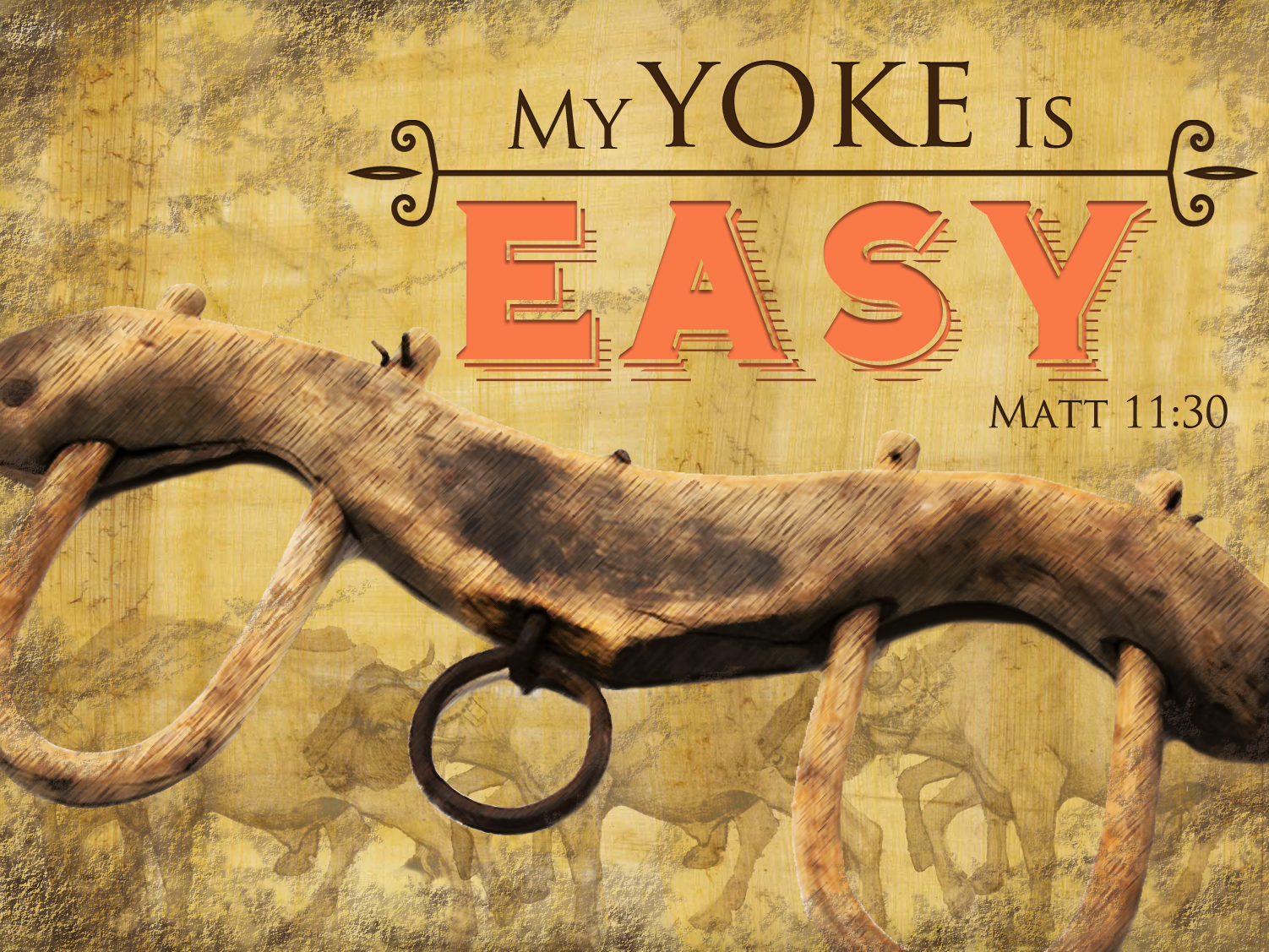
    That’s just what Jesus invites us to in today’s Gospel.  He invites us to take his yoke upon our shoulders.  A yoke back then was an implement that kept the oxen together so they could work the fields.  So a yoke implies a few things.  First, it’s going to be work.  That’s what yokes are for.  So when Jesus says he’s going to give us rest, that doesn’t mean that there won’t be some work involved.  Disciples have work to do in this world, living the Gospel, witnessing to God’s love, and reaching out to a world that needs hope.

    Second, a yoke meant that more than one animal was working; they were working together.  So as we take Jesus’ yoke upon us, we are yoked to him and we are yoked to other disciples.  Jesus calls us to work for the kingdom, but never expects us to go it alone.  That’s why his burden is easy and light: it’s still a burden, but we never ever bear it alone, Christ is always with us, and we always live our discipleship in community with other believers.

    This model of working for the kingdom leads us right back to humility.  If we are not going it alone, that means that we can’t take sole credit for the mighty things we do in Jesus’ name.  Yes, we do great things, but we do them because he has transformed us and has taken the yoke with us; we do them with the help of other disciples to whom we are yoked for the particular purpose of being God’s presence in the world.  We are no longer men and women in the flesh, as Saint Paul says today, we are people of the Spirit, with the Spirit of Christ in us, and so in Christ we cast aside those deeds of darkness and, taking his yoke, we accomplish the work Jesus has given us.  Saint Augustine once said, “Humility must accompany all our actions, must be with us everywhere; for as soon as we glory in our good works they are of no further value to our advancement in virtue.”

    And that is our goal as disciples: to advance in virtue.  Some days, that’s very hard work.  But we never have to go it alone, if we are truly humble people working in the image of our God.

  • Thursday of the Twenty-fourth Week of Ordinary Time

    Thursday of the Twenty-fourth Week of Ordinary Time

    Simon the Pharisee had committed a grave error in hospitality, and a serious error in judgment.  In those days, when a guest came to your home, you made sure to provide water for him or her to wash their feet, because the journey on foot was often long and hot and dirty, and it was pretty much always made on foot.  But Simon had done no such thing for Jesus.

    Simon’s intentions were not hospitable; rather he intended to confront Jesus on some minutiae of the Law so as to validate his opinion that Jesus was a charlatan.  He judged the woman to be a sinner, and reckoned Jesus guilty of sin by association.  But Jesus is about forgiveness.  He didn’t care about the woman’s past; he just knew that, presently, she had need of mercy.  Her act of love and hospitality, her posture of humility, her sorrow for her sin, all of these made it possible for Jesus to heal her.

    But the one who doesn’t think he is in need of healing can never be healed.

  • The Twenty-second Sunday of Ordinary Time

    The Twenty-second Sunday of Ordinary Time

    Today’s readings

    For each of the deadly sins, there is also a life-giving virtue.  Today, our readings focus on humility, which is the life-giving virtue that is the antidote to pride.  Of the seven deadly sins, pride is usually considered the original and the most serious of the sins.  Pride was the sin that caused the angel Lucifer to fall from grace to become the devil.  Pride was the sin that caused our first parents to reach for the forbidden fruit that was beyond them, all in an attempt to know everything God does.  A good examination of conscience would probably convince all of us that we suffer from pride from time to time, and sometimes even pervasively, in our own lives.  It’s what causes us to compare ourselves to others, to try to solve all our problems in ways that don’t include God, to be angry when everything does not go the way we would have it.  Pride, as the saying goes, and as Lucifer found out, doth indeed go before the fall, and when that happens in a person’s life, if it doesn’t break them in a way that  convinces them of their need for God, will very often send them into a tailspin of despair.  Pride is a particularly ugly thing.

    But, if you’ve been paying attention to our readings during these summer months, we have been building up a kind of toolbox for disciples.  We’ve had prayer and faith and some others in that toolbox, and today we are given the tool that unlocks the prison of pride, and that tool of course is humility.  But when we think about humility, we might associate that with a kind of wimpiness.  When you think about humble people do you imagine breast-beating, pious souls who allow themselves to be the doormats for the more aggressive and ambitious? Humble people, we tend to think, don’t buck the system, they just say their prayers and, when they are inflicted with pain and suffering, they just “offer it up.”

    But Jesus described himself as “humble of heart,” and I dare say we wouldn’t think of him as such a pushover.  He of all people, took every occasion to buck the system – that was what he came here to do.  But he was indeed humble, humbling himself to become one of us when he could easily have clung to his glory as God.  He was strong enough to call us all, in the strongest of terms, to examine our lives and reform our attitudes, but humble enough to die for our sins.

    And so it is this humble Jesus who speaks up and challenges his hearers to adopt lives of humility in today’s gospel reading.  The “leading Pharisee” had obviously invited people who were important enough to repay the favor some day – with one obvious exception – Jesus was decidedly not in a position to repay the favor, at least not in this life.  So he tells two parables, one exhorting the guests not to think so highly of themselves that they take the best positions at table, and another exhorting his host to humble himself and invite not those who are in a position to repay his generosity.  The guests were to humble themselves, and the host too, by inviting “the poor, the crippled, the lame, the blind” – and know that because they cannot repay him, he would be repaid at the banquet of the righteous in heaven.

    We don’t know how the guests or the host responded to Jesus’ exhortation to practice humility.  We do, however, know that Jesus modeled it in his own life.  Indeed, he was not asking them to do something he was unwilling to do himself.  When he said, “For every one who exalts himself will be humbled, but the one who humbles himself will be exalted” he was in a way foreshadowing what would happen to him.  Humbling himself to take up our cross – our cross – he would be exalted in the glory of the resurrection.

    The good news is that glory can be ours too, if we would humble ourselves and lay down our lives for others.  If we stop treating the people in our lives as stepping stones to something better, we might reach something better than we can find on our own.  If we humble ourselves to feed the poor and needy, to reach out to the marginalized and forgotten, we might be more open to the grace our Lord has in store for us in the kingdom of heaven.

    In today’s Liturgy we are focusing on baptism, not just N.’s, but also recalling our own.  In baptism we were united with Christ, and that means that we are called on to live lives of humility and grace, living the gospel and following the way that Jesus himself walked through life.  We want to be in that “resurrection of the righteous” that Jesus speaks of in today’s Gospel, and so we reject pride and embrace humility, taking up our own crosses, and leaving it to God to exalt us on that great day when he brings everything to fulfillment.
  • Untitled post 2920

    Today’s readings

    What an incredible privilege to gather today to pray for our new Holy Father, Pope Francis!  These have been historic days, and I am sure we have all felt the movement of the Holy Spirit on all those involved, from Pope Emeritus Benedict, humbly retiring so that the Church could be led with new vigor, to the cardinals gathered in conclave surrounded with prayer, to the announcement of our new Pope, just two days into the deliberations.

    First impressions say a lot, we all know that.  And I think Pope Francis made a wonderful one.  He began by leading us in prayer for Pope Emeritus Benedict XVI, by showing some humor in his remarks about being chosen from the ends of the earth, to the absolutely incredible favor that he asked of all of us, our prayer and blessing, before he gave the Apostolic Blessing itself.  I must say that I was rather moved by his humility, because I see in that humility a reflection of God himself.

    Today’s readings give us that blueprint.  Jesus himself brushed aside human praise, and humbly deferred to the Father.  He holds up Moses as the quintessential leader.  We see that in the first reading, when Moses courageously comes to the aid of his people rather than accepting the fact that God was going to destroy them.  We see in these readings that a leader needs to be courageous and humble, and I think we will be seeing that in Pope Francis as well.

    Today we continue our prayer for him.  His job is a big one – it always has been and today’s issues are as daunting as those of previous centuries.  He has chosen the patronage of Francis of Assisi, which points to his embrace of poverty, but also embraces Saint Francis’s call to rebuild the Church.

    These are historic days, and how blessed we are to see them!  May our prayers and the leadership of Pope Francis guide and sustain the Church!

  • Saturday of the Third Week of Lent

    Saturday of the Third Week of Lent

    Today’s readings

    “O God, be merciful to me, a sinner.”

    These are perhaps the most important words of the spiritual life, uttered today by the repentant tax collector in the temple area.  These words are so important, actually, that they form the basis of one of the most ancient acts of contrition that we have, called the Jesus Prayer.  The Jesus Prayer comes out of the eastern and orthodox Church traditions, and the full version is “Lord Jesus Christ, be merciful to me, a sinner.”  Everyone should memorize this prayer.

    The Jesus Prayer, and our readings today, give us one of the great tools of Lent: humility.  Humility is that great virtue that recognizes that I need a Savior.  That because of my sins, I have no access to God, except for the fact that he loves me beyond anything I have a right to hope for.  Humility recognizes that God loves us all so much that he gave everything for us, poured himself out for love of us, and desires to heal all of our sins and brokenness.

    All it takes is a little repentance: realizing my sinfulness, turning back to Christ, letting him love me, and accepting his forgiveness.  The prayer that manifests that kind of attitude is not the prayer of the Pharisee in the Gospel reading today: his attitude is the antithesis of what prayer needs to be.  The prayer that manifests the attitude we must have is that of the tax collector: “O God, be merciful to me, a sinner.”

    O, that God would grant us the great gift of humility this Lenten day.

  • Friday of the Twenty-sixth Week of Ordinary Time

    Friday of the Twenty-sixth Week of Ordinary Time

    Today’s readings

    Pride and presumption are insidious sins.  They make any kind of grace impossible, for they even deny that grace is needed or wanted.  If we have no need of a Savior, then no relationship with God is even possible.  And not having a relationship with God is something that theologians like to call “hell.”  So the disciple doesn’t get to harbor pride and doesn’t get to presume that God will take care of her or him.  Instead the disciple must be very mindful of God, and must constantly nurture the relationship in such a way that they are caught up in the very life of God.

    Job needed a little reminder.  Things were getting very bad for him, and he takes God to task on it.  But today’s first reading shows us God, in his loving mercy, giving Job the proverbial slap in the back of the head.  Does Job know the source of the sea, or has he comprehended the breadth of the earth?  Does he know where light and darkness come from?  No, of course not.  Job doesn’t have the big picture and we don’t either.  That’s something we have to remember when times are bad, as they are bad for many people right now.

    And the people of Chorazin and Bethsaida needed to be taken down a peg or two as well.  They were totally unmindful of God, and they refused to repent.  Which is inconceivable given the mighty deeds Jesus had been doing among them.  Even a ton of bricks falling on them wouldn’t seem to get them to repent.  Jesus calls them to task on it, and calls us too when we are so presumptuous of God’s mercy and favor that we refuse to repent of the things that separate us from God.

    The disciple is called to humbly place himself or herself in God’s mercy, acknowledging dependence on a Savior who has loved us into existence and sustains those who follow him.  The disciple shuns pride and presumption, and humbly prays with the Psalmist, “Guide me, Lord, along the everlasting way.”