Tag: Prayer

  • Friday after Ash Wednesday

    Friday after Ash Wednesday

    Today’s readings

    A lot of people say they aren’t giving up something for Lent, they’re just going to try to do something positive. I think that can be a little vague, to be honest. I usually tell people it doesn’t just have to be one or the other. Indeed, today’s Liturgy of the Word tells us that it should actually be both.

    Fasting is important because it helps us to see how blessed we are. It is important because it helps us to realize that there is nothing that we hunger for that God can’t provide. Fasting teaches us, once again, that God is God and we are not. This is important for all of us independent-minded modern-day Americans. We like to be in charge, in control, and the fact is that whatever control we do have is an illusion. God is in control of all things, even when it seems like we are in chaos. Fasting teaches us that we can do without the things we’ve given up, and that God can provide for us in much richer ways. Fasting is absolutely essential to having an inspiring, life-changing Lent, and I absolutely think that people should give things up for Lent.

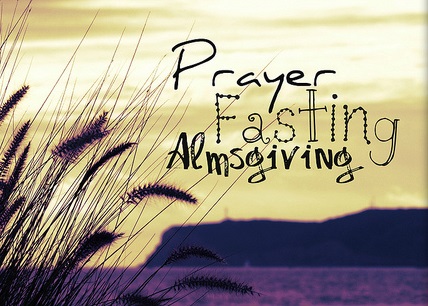
    But giving something up for Lent does not excuse us from the obligation to love our neighbor. This falls under the general heading of almsgiving, and along with fasting and prayer, it is one of the traditional ways of preparing our hearts for Easter during Lent. We might be more mindful of the poor, contributing to our food pantry or a homeless shelter or relief organization. We might reach out by actually serving in some capacity, like at a soup kitchen, or spending an hour at PADS. We also might give the people closest to us in our lives a larger portion of the love that has been God’s gift to us, in some tangible way.

    Today’s first reading reminds us that fasting to put on a big show is a sham. Fasting to bring ourselves closer to God includes the obligation of almsgiving and prayer. Together, these three facets of discipleship make us stronger Christians and give us a greater share of the grace that is promised to the sons and daughters of God.

  • Thursday of the Twenty-fifth Week of Ordinary Time

    Thursday of the Twenty-fifth Week of Ordinary Time

    Today’s readings

    You know, I think Herod was asking the right question.  Sure, he was asking it for all the wrong reasons, but still, it is the right question.  And that question is, “Who is Jesus?”

    What Herod was hearing about Jesus is pretty much what the disciples told Jesus when Jesus asked, “Who do people say that I am?”  Elijah, or one of the prophets, or maybe even John the Baptist.  But Herod was the one who killed John so he knew that couldn’t be it, so who is he really?  Herod kept trying to see him, and of course, he’d have more than ample opportunity soon enough, after Jesus is arrested.

    So we have the question too.  Oh, we know well enough – intellectually – who Jesus is, but we still have to answer that question in our hearts.  Who is Jesus for us?  We know he is not just some prophet; that he is not like anyone who lived before or after him.  But have we stopped being intrigued by the question, have we lost our fascination with Jesus?  Herod kept trying to see Jesus, and it’s the right instinct, or at least it is for us.  We have to keep trying to see him too, whether that takes us to a rereading of the Gospels or to adoration of the Blessed Sacrament or to contemplative prayer or even to service to the poor.  Whatever the case, fascination with Jesus is the right way to go, and we have to let ourselves be intrigued by the question again.  Who is Jesus for us?

  • The Sixteenth Sunday of Ordinary Time

    The Sixteenth Sunday of Ordinary Time

    Today’s readings

    I think a lot of us can identify with what’s going on in today’s Gospel reading. Jesus and the Twelve had been working hard: they had just been out on mission, proclaiming the Gospel and the Kingdom of God, and healing the sick. They were busy, they were tired, but they were excited. Jesus calls them together to go to an out-of-the-way place to rest a while, maybe have something to eat. But as soon as they arrive, they find that the crowds figured it out and got there ahead of them.

    If you’re a parent, that might sound familiar. When’s the last time you had a minute to yourself, only to find out that the children have figured out where you were and needed something right now? Or at work, you finally have five minutes to take care of your own work, only to have a coworker come and ask for help with something they are doing? We know the experience. Responsibility for whatever we are charged with never really ends. We have so many things to do, we don’t have time for ourselves, for our spiritual lives, for those things that are ultimately important.

    And Jesus doesn’t want it to be so. He wants to shepherd all of us to an out-of-the-way place to rest a while, to rest in him. He wants to feed all of us with the best of food: his own Body, Blood, Soul and Divinity, that we might have strength to take care of the crowds clamoring around us for our attention.

    So we have to let him. We have to give him five minutes of our day, if we haven’t been giving him anything at all. We have to give him a little more now, so that he can use that space to help us rest a while, to refuel, to recharge, to grow and become more. It won’t be easy. If we can’t find five minutes for ourselves, it’s going to be hard to find five minutes for Jesus. But it is possible. Maybe it’s too much at the end of the day when we’re dog tired. But maybe we can get up five minutes earlier just to read a verse of Scripture and put ourselves in the presence of our Lord for the day.

    Jesus can do a lot with five minutes. In these hot days of summer, those five minutes can be the refreshment we need to move forward in our relationship with God and with the people in our lives. They can help us to not be resentful of what we’re called to do for others. They can help us to give more than we think we can. They can help us in good times and in bad. Give him five minutes, go to an out-of-the-way place to rest a while.

  • Friday after Ash Wednesday

    Friday after Ash Wednesday

    Today’s readings

    The prophets of the Old Testament were always pretty clear about the fact that God was sick and tired of people trying to claim righteousness but not really being righteous. The idea of keeping the letter but not the spirit of the Law, of fasting and praying with the express idea of getting these things over with so one could return to cheating the poor was repugnant – is repugnant – to our God. The prophets cried out full-throated and unsparingly that worship of God was not a part-time endeavor, that the time for “business as usual” was over.

    In Hebrew, the word for “righteousness” is tseh’-dek, which has the connotation of right relationship. This was the theme of the prophets: that right relationship, a relationship directed toward God and toward others, was the only thing that could ever deliver true peace.

    This is the call of Isaiah in today’s first reading. God makes it clear through Isaiah that showy fasting, mortification and sacrifice is not what God wants from humankind. God, who made us for himself, wants us – all of us, and not just some dramatic show of false piety, put on display for all the world to see. God doesn’t want fasting that ends in quarrelling and fighting with others, because that destroys the right relationships that our fast should be leading us toward in the first place.

    So, if we really want to fast, says Isaiah, we need to put all that nonsense aside. Our true fast needs to be a beacon of justice, a wholehearted reaching out to the poor, the oppressed and the marginalized. As we get into our Lenten practices these days, we too might find that our self-sacrifice ends up pushing us away from others, and ultimately from God. That’s not a sign to give it up, but maybe more to redirect it. If we give up something, we should also balance that with a renewed effort to reach out to God and others. Right relationship should be the goal of all of our Lenten efforts this year. And we can truly live that kind of penitence with joy because it comes with a great promise, says Isaiah:

    Your light shall break forth like the dawn,
    and your wound shall quickly be healed;
    Your vindication shall go before you,
    and the glory of the LORD shall be your rear guard.
    Then you shall call, and the LORD will answer,
    you shall cry for help, and he will say: Here I am!

  • Thursday, October 30, 2014

    Thursday, October 30, 2014

    I think today’s reading from St. Paul’s letter to the Ephesians is a good one for us to hear. How often are we beset by all the frustrations of the world, and all of the sadness that our own lives can sometimes bring? I’m not saying that every day is horrible, but we all go through times when it seems like it’s too much, like one more phone call and we’ll explode.

    And to all of that today, St. Paul advises us to “put on the armor of God.” Because when things go wrong, we have two choices. We can go to pieces, wondering where is God when we really need him, getting angry with God, ourselves, and others, and lashing out at anyone and everyone in our lives. Or, we can realize that what God allows he doesn’t necessarily wish on us. We can join ourselves to him, and draw our strength and courage from the Lord himself, knowing that he walks with us in good times and in bad.

    Because we know which one the devil himself would choose for us, right? That evil one wants to use the trying times to drive a wedge between God and us. And we need strength to guard against that “evil day.” And so, St. Paul tells us, “In all circumstances, hold faith as a shield, to quench all the flaming arrows of the Evil One.” And that shield, he says, is prayer: “With all prayer and supplication, pray at every opportunity in the Spirit.” Prayer and faith are the armor we need to get through the trying times of life without falling victim to the evil one.

    Sometimes life can feel like a war, but as the Psalmist says today, “Blessed be the LORD, my rock, who trains my hands for battle, my fingers for war.” Our stronghold is that whatever life brings us, we are never alone. Never.

  • The Twenty-third Sunday of Ordinary Time

    The Twenty-third Sunday of Ordinary Time

    Today’s readings

    I have to say, when the Scriptures talk about prayer, I get a little uneasy. Not because I don’t like to pray, or think prayer is a bad thing. But more because I think mostly we misunderstand prayer, and usually a brief mention in the readings can do more harm than good. This week’s Gospel is a good example of that. The line almost at the end of the reading is the culprit: “if two of you agree on earth about anything for which they are to pray, it shall be granted to them by my heavenly Father.”

    Really? Anything? I don’t know about you, but I personally have an example of something that my friends and I had been praying about, and just this week it was denied. You can probably think of examples too. So what are we to make of this? Well, I’d like to make three points.

    First, in the line right after this, Jesus says, “For where two or three are gathered together in my name, there am I in the midst of them.” Notice how he says, “in my name.” So it’s not like a couple of us can get together and pray for something crazy and hold God accountable for granting it. If we’re gathered in anything less than the name of Jesus, we’re in the wrong place, and you don’t get what you want, or even what you need, when you’re in a place other than where Jesus is.

    Second, reflecting on that same line, I would point out the last phrase: “there am I in the midst of them.” Sometimes God doesn’t answer all our prayers in the way we think he should. But he definitely always answers them with his presence. Sometimes that leads to resolution of a problem that is greater than we could have imagined. Sometimes it makes us a stronger, more faith-filled person. And sometimes the answer to a prayer means that we have to change, not the situation. So the abiding presence of our God, most perfectly experienced in community, when two are three are gathered in his name, is the most important answer to every prayer.

    Finally – and I can’t say this often enough, nor stress it strongly enough – prayer is not a magic wand. You might read in this brief little passage that all you have to do is pray and you get it. Prayer is always experienced in relationship: relationship with God and relationship with others. That’s why this brief little passage mentions praying together, and praying in Jesus’ name. Those are important points, and it’s best not to overlook them.

    Prayer is a relationship, prayer is work – sometimes hard work, prayer is a way of life for the disciple of Jesus. We enter that relationship at our Baptism, and it’s our task as disciples to nurture that relationship our whole lives long.

  • Thursday of the First Week of Lent

    Thursday of the First Week of Lent

    Today’s readings

    The readings for these early days of Lent have been teaching us how to accomplish the various disciplines of Lent – which really are the various disciplines of the spiritual life.  Today’s discipline then, I think, would be persistence in prayer.  In the first reading, we have Queen Esther, who is really between a rock and a hard place.  The king does not know she is Hebrew, and worse than that, if she goes to the king without being summoned, she could well lose her life.  But, Mordecai, the man who was her guardian and raised her as his own daughter, revealed to her that the king’s advisor had planned genocide against the Jews, and she was the only person in a position to beg the king to change his mind.  So today, she prays that her life, as well as those of her people would be spared.  Esther prayed for three days and nights that her prayer would be answered, and her persistence was rewarded.  She received the reward that Jesus promised when he said, “Ask and it will be given to you; seek and you will find; knock and the door will be opened to you.”

    Which is nice for her and the Israelites, certainly, but how many of us have prayed persistently to God that he would answer our prayer and have yet to be answered?  I think most of us at some point or another have experience the exasperation of prayer unanswered, or at least prayer that seems to be unanswered.  We can be so frustrated when a loved one is ill or unemployed, or whatever the issue may be, and God seemingly does not hear.

    But the discipline of prayerful persistence is not like wishing on a star or anything like that.  There’s no magic to our words.  We may or may not be rewarded with the exact gift we pray for; in fact, that rarely happens.  But we will always be rewarded with the loving presence of our God in our lives.  In fact, it could well be that God’s answer to our prayer is “no” – for whatever reason – but even in that “no” we have the grace of a relationship that has been strengthened by our prayerful persistence.

    The Psalmist prays, “Lord, on the day I called for help, you answered me.”  This Lent, may the discipline of persistence in prayer lead us to a renewed and enlivened sense of the Lord’s will and presence in our lives.

  • Tuesday of the First Week of Lent

    Tuesday of the First Week of Lent

    Today’s readings

    The prophet Isaiah and Jesus speak today about the great power of words. Isaiah speaks specifically of the power of God’s word, a word that will not return empty but will go out and accomplish the purpose for which God sent it.  We see the word that the prophet speaks of here, of course as the Word – with a capital “W.”  That Word is Jesus Christ who comes to accomplish the salvation of the world, the purpose of God ever since the world’s creation.

    The prayer that Jesus gives us today, the classic prayer that echoes in our hearts in good times and in bad, is a prayer with a specific purpose in mind.  That prayer, if we pray it rightly, recognizes that God’s holiness will bring about a Kingdom where his will will be done in all of creation.  It begs God’s forgiveness and begs also that we too would become a forgiving and merciful people, just as God is merciful to us.  Finally, it asks for help with temptation and evil, something with which we struggle every day.

    Today’s readings are a plea that God’s will would finally be done.  That his Word would go forth and accomplish God’s purpose.  That his will would be done on earth as in heaven.  As we pray those familiar words, they can often go past us without catching our attention.  But today, maybe we can slow down just a little, and pray them more reflectively, that God’s will would be accomplished in every place, starting in our very own lives.

    Because to God belongs the Kingdom, and the power, and the glory, forever and ever.

  • Monday of the Seventh Week of Ordinary Time

    Monday of the Seventh Week of Ordinary Time

    Today’s readings

    So the disciples are waiting for Jesus to come down the mountain after the Transfiguration.  They have attempted to cure a man’s son from the hold of a demon, but they were apparently unable to do so.  This seems to have led to an argument between them and the scribes.  You can almost feel Jesus’ exasperation.  Both the disciples and the scribes should have been able to do something for the boy, but they couldn’t.  Why?  Because instead of praying, they argued about it.  “This kind can only come out through prayer,” Jesus tells the disciples when they ask why they were ineffective.

    I often wonder, with more than a little fear, how many demons I could have cast out – in myself and in others – if I had a little more faith, if I prayed a little more than I do.  There are, of course, all sorts of demons: demons of illness, demons of cyclical sin, demons of impure attachments, demons of homelessness, poverty, and marginalization, and so many more.  Think of all the demons we could cast out if we just had more faith, if we prayed more fervently.

    Sometimes, when we are trying to overcome some problem, the last thing we think to do is pray, when it should absolutely be the first.  The disciples were guilty of it, the scribes were, and we are too sometimes, if we’re honest.  And all of us should know better.  I know that I myself can think of a number of problems I’ve tried to solve all by myself, when it would have been so much more effective to first turn to the Lord.  We can’t just cut God out of the picture and rely on our own strength; that never works – our own strength is so fiercely limited.  We have to turn to the tools we have been given: faith and prayer.  And we can start by saying with the boy’s father: “I do believe, Lord; help my unbelief.”

  • Saturday of the Thirty-second Week of Ordinary Time

    Saturday of the Thirty-second Week of Ordinary Time

    Today’s readings

    You know, this Gospel reading is filled with all sorts of off-putting comments, isn’t it?  I don’t know about you, but I bristle at the thought of comparing God to a dishonest judge!  But that’s not the point here.  Of course, Jesus means that God is so much greater than the dishonest judge, that if the dishonest judge will finally relent to someone pestering him, how much more will God, who loves us beyond anything we can imagine, how much more will he grant the needs of this children who come to him in faith?

    But people have trouble with this very issue all the time.  Because I am sure that almost all of us have been in the situation where we have prayed and prayed and prayed and nothing seems to happen.  But we can never know the reason for God’s delay.  Maybe what we ask isn’t right for us right now – or ever.  Maybe something better is coming our way, or at least something different.  Maybe the right answer will position itself in time, through the grace of God at work in so many situations.  Most likely, we just don’t have the big picture, which isn’t ours to have, really.

    But whatever the reason, the last line of the Gospel today is our key: “When the Son of Man comes, will he find faith on earth?”  It’s a good question, even if it is a tough one.  Faith is what leads us to continue the prayer until it is finally answered.  Maybe the situation will come to a peaceful resolution, or maybe it is we who will be changed.  But if we approach it all in faith, then we know we have to approach it all with the long haul in mind, because our faith tells us that God answers in God’s time and in God’s way.

    A delay could either bring us closer to God as we continue to pray in faith, or it can fracture our relationship with God when we give in to despair.  But let that not be so for us.  When the Son of Man comes, may he find us faithful ones busy in prayer.