Category: Liturgy

  • The Fourteenth Sunday of Ordinary Time

    The Fourteenth Sunday of Ordinary Time

    Today’s readings

    You know, I am not sure how some people get through the hard times of their lives if they don’t have faith. We can all probably think of a time in our lives when we were sorely tested, when our lives were turned upside-down, and, looking back, we can’t figure out how we lived through it except for the comfort of our faith. I thought about that a lot this week. A friend and colleague of mine died; she had been the supervisor of my CPE program, the summer of hospital chaplaincy that I did while in seminary. And so that brought back many memories of all that summer brought me. Needless to say, I ministered to a great many people, some of whom had faith, and some who didn’t. It was always inspirational to see how people with faith lived through their hard times, and very sad to see how many who didn’t have faith just broken when their lives stopped going well.

    That’s the experience that today’s Liturgy of the Word puts before us, I think. Let’s look at the context. In last week’s Gospel, Jesus has cured two people miraculously. He actually raised Jairus’s twelve-year-old daughter from the dead, and he cured the hemorrhagic woman, who had been suffering for twelve years. So both of them had occurrences of the number twelve, reminiscent of the twelve tribes of Abraham, and later the Twelve Apostles, both of which signify the outreach of God’s presence into the whole world. So those two miraculous healings last week reminded us that Jesus was healing the whole world.

    And this week, we see the exception. This week, Jesus is in his hometown, where he is unable to do much in the way of miracles except for a few minor healings. Why? Because the people lacked faith. And this is in stark contrast to last week’s healings where Jairus handed his daughter over to Jesus in faith, and the hemorrhagic woman had faith that just grasping on to the garments of Jesus would give her healing. Faith can be very healing, and a lack of it can be stifling, leading eventually to the destruction of life.

    We see that clearly in the first two readings. First Ezekiel is told that the people he would be ministering to would not change, because they were obstinate. But at least they’d know a prophet had been among them. Contrast that with Saint Paul’s unyielding faith in the second reading to the Corinthian Church. Even though he begged the Lord three times to relieve him of whatever it was that was his thorn in the flesh, he would not stop believing in God’s goodness. His faith led him to be content with whatever weakness or hardship befell him, and he came to know that in his weakness, God could do more and thus make him stronger than he could be on his own.

    We people of faith will be tested sometimes; that’s when the rubber hits the road for our faith. Knowing of God’s providence, we can be sure that he will lead us to whatever is best. And our faith can help us to make sense of the struggles and know God’s presence in the dark places of our lives. People of faith are tested, but never abandoned. Never abandoned.

  • The Twelfth Sunday of Ordinary Time: Journeying from Fear to Faith

    The Twelfth Sunday of Ordinary Time: Journeying from Fear to Faith

    Today’s readings

    Getting ready for Mass today, I thought about my Dad. Not just because it’s Father’s Day, although that’s certainly part of it. But partly because of today’s Gospel. The story we have here today speaks about a journey, and I’ll say more about that in a minute. My Dad was great for journeys: he loved to drive and take the family to Wisconsin or to Disney, or wherever we needed to go. He’d have us up early in the morning so that we’d miss rush hour traffic, and we’d be on our way.

    Today, Jesus and his disciples set out on a significant journey. The reading we have today is at the end of chapter four, in which Jesus has been standing next to the sea, teaching the people by means of parables. He has told them the parable of the sower who went out to sow seeds, the parable of the mustard seed, and the lamp placed on the lamp stand. He is explaining the kingdom of God to them, but they don’t quite get it. Even the disciples have to have it explained to them. When he’s done the best that he can with them, he is ready to move on. There are other people that need to hear the Good News, others who need to know Jesus’ power and authority.

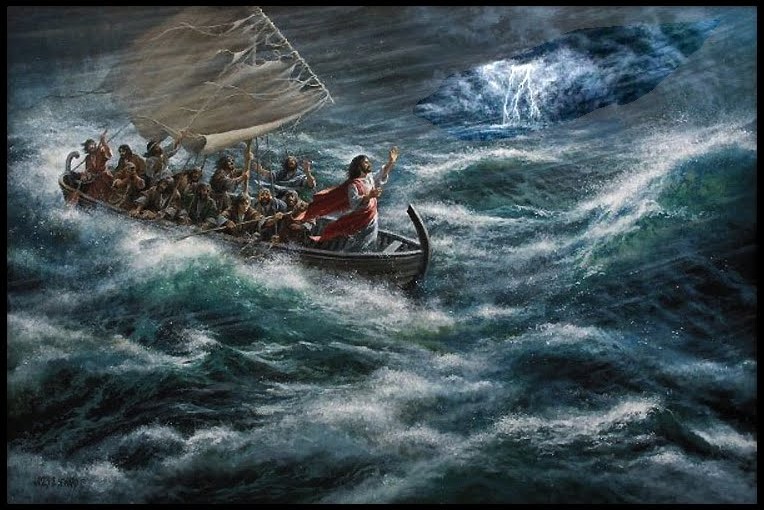
    And so he sets out on the journey, and the reading says that the disciples take him with them in the boat “just as he was.” That’s a curious detail, I think. But it makes me remember those trips with my dad. It’s time to get going, no time to change clothes or freshen up, just get in the car – or in this case, the boat – and let’s get started on the journey. But the journey isn’t always without its problems. On vacation trips we may run into traffic, or if in the air, perhaps turbulence. On the sea, the disciples experienced the raging waves of a fearsome storm. So they wake Jesus up, because apparently these storms don’t really affect him, and he rebukes the storm, and then rebukes the disciples for their little faith.

    We’re all on a journey. That journey, like that of the disciples, is from fear to faith. We very rarely have time to think about it; we just have to get in the boat and get moving, just as we are. The journey is not always smooth: storms arise, and when they do, it often seems like our God is sleeping, seeming not to care that we are about to perish. I’m not going to fill in the blanks for you – you can all do that well enough. You’ve been on many journeys in your life, and sometimes the ride has been bumpy. But if we stay on the journey, we definitely get to experience this One whom “even wind and sea obey.” Even when our God seems to be sleeping, he is never unaware of our situation, and his love for us is never on pause.

    The thing is, sometimes the storm doesn’t seem to stop so quickly as it does in today’s Gospel reading. Would that Jesus would stand up in the boat of our uncertainty and yell out: “Quiet! Be still!” But maybe he is. Maybe the “Be still” is directed at us and not at the storm. There was a contemporary Christian song a few years ago now, that had this wonderful line in it: “Sometimes he calms the storm, and other times he calms his child.” That song has given me peace in many situations. Because as frightening as the storms of our lives can be, they are no match for the grace of God. Even if God allows the storm to rage in our lives, if he is with us, calming us, we have nothing to fear. And maybe that is the occasion when we make progress on that journey from fear to faith.

    So as we leave this holy place today, we are on a journey to the most holy place, our true home in heaven. Along the way, we will have other destinations, and as we travel, we know that Jesus will be with us through it all. He may calm the storms that arise, or he may calm his children, whichever is most appropriate. And we know that the journey from fear to faith will lead us back one day to the place we really belong, at the banquet table in the kingdom of everlasting life. May all of our life’s journeys end up in that same, great place!

  • Friday of the Eleventh Week of Ordinary Time

    Friday of the Eleventh Week of Ordinary Time

    Today’s readings

    It amazes me when I think about all that the early Church had to go through and put up with. Saint Paul writes that he put up with persecution from all sides: from his own people as well as the Gentiles. He was beaten often, endured hazardous journeys and perilous weather, as well as every kind of deprivation. His experience was definitely extreme, but others who lived the faith in those days were also subject to persecution, torture and death. Our experience isn’t like that, is it? I mean, here we sit in this air-conditioned church and relatively comfortable surroundings. We came here freely to Mass this morning and it is unlikely that anyone will openly persecute us or torture us or put us to death for worshipping our God, although as we saw in the news yesterday, it does happen.

    But there is a subtle kind of persecution that we must endure. We know that even if our society is not openly hostile to living the Gospel, it is certainly just one step short of that. Life is not respected in our society: babies are aborted, the elderly are not respected or given adequate care, children are not raised in nurturing families, people are hated because of their race, color or creed. Faith is ridiculed as the crutch of the weak. Hope is crushed by those who abuse power. Love is overshadowed by sexual perversion and self-interest. Living the Gospel is dangerous to anyone who would want to be taken seriously in our culture.

    To all of us who come to this holy place to worship this morning and who hope to work out our salvation by living the Gospel, Saint Paul speaks eloquently. We know that he, as well as all of the communion of saints, is there to intercede for us and show us the way. He says to us today, “Who is weak, and I am not weak? Who is led to sin, and I am not indignant?” He points us to our Lord Jesus who paid the ultimate price for the Gospel, and reminds us that in living that Gospel, regardless of its cost, we store up for ourselves incredible treasures in heaven, because it is in heaven that our heart resides.

  • Monday of the Eleventh Week of Ordinary Time

    Monday of the Eleventh Week of Ordinary Time

    Today’s readings

    Today’s Gospel reading is from the very challenging portion of Matthew’s Gospel in which we hear Jesus use the formula: “You have heard it said … but I say to you…”  Basically, in all of these instructions, Jesus is taking the old Jewish law and cranking it up a notch.   He teaches that anger, vengeance and libel are as disastrous as murder; that lust is as morally reprehensible as adultery.   In today’s reading, Jesus takes on the concept of justice.

    In the days before Jesus, justice was met by inflicting on the one who had wronged you what they had done to you.  An eye for an eye, a tooth for a tooth; you steal one of my sheep, I take one of yours, that kind of thing.  It’s a very primitive sort of justice, but to be honest, I think, one that still kind of resonates in our society.  People might not like to say they believe this sort of thing, but you see it all the time.

    Jesus isn’t into defining justice in this way.  For Jesus, true justice consists in rendering to God what he belongs to God; it means giving to others as God has given to us.  In a way, it’s the primordial form of the whole “pay it forward” idea.  If God has been generous to us, then, in justice, we need to be generous to others.  So we don’t argue about our tunic, but instead give our cloak as well.  We go the extra mile, and never turn our back on those in need.

    We believers have to get our heads around the idea of true justice.  We have to be willing to give without counting the cost.  We have to remember that in justice, we should be condemned for our many sins, but instead we have salvation in Christ Jesus.  Because God has been merciful and generous to us, then in justice we must do the same for others.

  • Saint Justin, Martyr

    Saint Justin, Martyr

    Today’s readings

    The greatest men and women who have ever lived have followed the example of our Lord Jesus Christ in that they have been willing to give their lives for the truth, for what they believed in, for what is right. In our first reading, Tobit risks his life in order to give a fallen kinsman a proper burial. Tobit and his family had been exiled to Ninevah, and the people there were hostile to the Israelites. Their hostility was so noteworthy, that in another book, Jonah famously refuses to go there and instead gets swallowed up by a large fish. So Tobit has previously narrowly escaped execution for showing charity to his fellows in exile, and he ignores the obvious lesson in order to do what is right.

    For Saint Justin, whose feast we celebrate today, he chose to stand up for the truth. He was born a pagan, and spent a good deal of his youth studying pagan philosophy, principally that of Plato. But he eventually found that Christianity answered the great questions of life and existence better than did the pagan philosophers, so he converted. He wrote famous apologies, defenses of the Christian faith, to the Roman emperor and to the senate. Because of his unwavering dedication to his faith, he was beheaded in Rome in the year 165.

    “The just one shall be an everlasting remembrance,” says the Psalmist today. All of us are called to live our faith with conviction, as did Tobit and Saint Justin. We might never be in the dire straits in which they found themselves, but we too are called to give our lives, our comforts, our standing in the community, our reputation among our peers, for the faith. Today we pray for the grace to live what we believe and to be an everlasting remembrance.

  • Memorial Day

    Memorial Day

    Today’s readings: James 3:13-18; Psalm 72; Matthew 5:38-48

    I was talking to one of our parishioners today who is on a local board that, among other things, hires police officers for their municipality. He was telling me how hard it is to find qualified people willing to serve these days. I wasn’t surprised to hear it. I’ve read a lot over the last several years about how people are not going into service-related professions any more. The priesthood is, of course, no stranger to that phenomenon.

    So maybe it’s a little ironic that we spend today honoring those who have given their lives in service to our country. It’s a little like we’re saying “thanks for doing that, but please don’t ask me to serve.” And our Lord would admonish us for that kind of societal attitude; he didn’t give us the Gospel so that we could do nothing about it.

    In today’s Gospel reading, we hear the famous “but I say to you” sayings of Jesus. He takes very familiar religious practices of his day, and then cranks them up a notch. Believers are not supposed to be on autopilot; we are supposed to sacrifice ourselves for the salvation of others. If we’re asked to give, we have to do it expecting nothing in return. When we love, we are called to do it when it is completely inconvenient, and toward those who we might not prefer to love.

    Service is not optional for the Christian disciple. Laying down our lives is simply doing what our Lord has shown us how to do. If he could die on the cross for us, we can die to ourselves and give our lives in service to others, so they might know God’s love and mercy.

    We truly honor today those who have given their lives for our country. Without their sacrifice, we might not have the freedoms we enjoy today. If we would truly honor their service and their selflessness, then we have to set aside our selfish ambitions as Saint James encourages us in our first reading. To truly honor our fallen heroes, we have to make use of the freedom that they fought for in a way that frees others as well.

    Most of all, we have to work to change the attitude of our society. We have to earnestly set aside selfish ambition and entitlement or become a society that is not truly free. If we’re slaves to ambition, then we will accomplish little individually or as a society. We have to pray for religious vocations and also vocations of service to our country and community. We have to encourage our children and grandchildren to give of themselves in their profession. That is what will make us truly free.

    And that is what would honor our fallen service men and women most of all.

  • The Solemnity of Pentecost

    The Solemnity of Pentecost

    Today’s readings

    No one can say “Jesus is Lord” except by the Holy Spirit. That line from Saint Paul’s first letter to the Corinthians at the beginning of our second reading today says more about the Holy Spirit than we might catch at first.

    Words contain a lot of power. We know that well, because lots of times we say the wrong things and we see how it upsets people we love. And equally we experience the power of someone saying just the right thing at the right time and we see how that expression of love changes everything. Words can convey a range of emotions from love to hate, and everything in between. Words can start an argument, but the right words can diffuse a really bad situation. We’ve seen it thousands of times.

    Most of us receive the gift of speech at birth, and come into it during our childhood. We develop the gift of speech throughout our lives, perhaps learning foreign languages, or become skilled speakers. Speech is crucial to living in society.

    But it is the Holy Spirit who enables us to say anything really good. The only way that we can say “Jesus is Lord,” as Saint Paul tells us, is by the Holy Spirit. The only way that we can witness to the faith, is by the Holy Spirit. That was true of the first Apostles. Remember what happened to them right after the events of Good Friday. They scattered. When they did speak, they put their foot in their mouths. Peter used his gift of speech to deny that he even knew the Lord, let alone witness to the Lord’s power to save. At that time, the Apostles couldn’t even wrap words around what was going on in their own minds, so they were never going to be able to spread the Gospel.

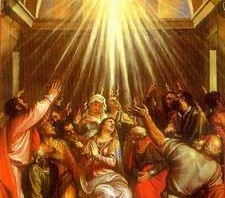
    Until Pentecost. Receiving the gift of the promised Holy Spirit, the Advocate that Jesus promised to send them, they are able not only to preach the Gospel, but to preach it in a way that people who spoke different languages were all able to understand it. The outpouring of the Holy Spirit brings everything together for them, and now, only now, are they able to say that Jesus is Lord!

    The absence of the Holy Spirit is unparalleled sadness. We can’t say – or do – anything really good without the advocacy of the Holy Spirit to inspire – literally breath into us – the goodness for which we were created. The sequence today proclaimed it well:

    Where you are not, we have naught,
    Nothing good in deed or thought,
    Nothing free from taint of ill.

    So when we receive the Holy Spirit, we are inspired to say and do good things too. The Holy Spirit will inspire us to speak many kinds of words in many situations. We can depend on the Spirit to give us the words when we don’t have them. Saint Paul teaches that the Spirit even prays in us when we can’t pray, expressing our needs in groanings when we can’t find the words to say. So the Holy Spirit will inspire us to speak…

    • Words of comfort to those who are going through difficult times. Maybe just by being with them and saying nothing at all.
    • Words of challenge when we are in a situation that is veering off course, and others are urging us to go the wrong way.
    • Words of correction when a child is acting out or not living up to their full potential.
    • Words of reconciliation when we seek to heal a broken relationship.
    • Words of vision when we are part of a group that is seeking to do something new.
    • Words of healing when we comfort another person who has been wronged by others.
    • Words of change when we stand up for what is right in a society that wants to do what it wants to do.
    • Words of mercy when we let go of a grudge, or forgive someone who has hurt us.

    The Holy Spirit will give us the right words for all of this at the right time, and we will be able to speak them in a way that everyone who needs to understand them can understand them. We may never be able to speak multiple languages – God knows I can’t! – but in the Holy Spirit we will be able to proclaim that Jesus is Lord in our words and actions and no one will be able to miss the significance of that – everyone will understand it.

  • Saturday of the Seventh Week of Easter

    Saturday of the Seventh Week of Easter

    Today’s readings

    One of the greatest obstacles to the Christian life is comparing ourselves to others. The Fathers of the Church all warn against that practice, and urge us to keep our eyes on our own relationship with God.  The essence of discipleship is doing what we were put here to do, we ourselves.  We discern that vocation by reflecting on our own gifts and talents, given to us by God, by prayerfully meditating on God’s will for us, and then engaging in conversation with the Church to see how best to use those talents and gifts.  That’s the process of discernment, which is always aided by the working of the Holy Spirit, and a worthy exercise on this eve of Pentecost.

    What causes us to get off track, though, is looking at other people and what they are doing, or the gifts they have, or the opportunities they have received.  We might be envious of their gifts or the opportunities they have to use them.  We may see what they are doing and think we can do it better.  We might be frustrated that they don’t do what we would do if we were in their place.  And all of that is nonsense.  It’s pride, and it’s destructive.  It will ruin the Christian life and leave us bitter people.

    That’s the correction Jesus made to Peter.  Poor Peter was getting it all wrong once again.  He thought Jesus was revealing secrets to John that he wanted to know also.  But whatever it was that Jesus said to John as they reclined at table that night was none of Peter’s business, nor was it ours.  Peter had a specific job to do, just as John did, and so do we.  If we are serious about our discipleship, then we would do well to take our eyes off what others are doing or saying or experiencing, and instead focus on the wonderful gifts and opportunities we have right in front of us.  As for what other people are up to, as Jesus said, “what concern is that of yours?”

    And so we pray this morning for the grace of discernment, the wisdom of the Holy Spirit, and the gift of being able to mind our own business, spiritually speaking.

  • Tuesday of the Seventh Week of Easter

    Tuesday of the Seventh Week of Easter

    Today’s readings

    Today’s Liturgy of the Word represents a kind of wrap-up to the lives of St. Paul and Jesus, respectively. They both have completed the mission for which they had been sent, and both are now giving the mission back to God who would continue it as He alone saw fit. Paul’s mission had been one of conversion, beginning with his own, and then reaching out to the Gentiles he met traveling far and wide. Now he did not know what would happen to him, only that the Holy Spirit kept telling him it was to be an end filled with hardship, from which Paul refused to shrink.

    Jesus, one with the Father from the beginning, had come from the Father and was now going back to the Father. He brought God’s love to bear on the aberrations of sin and death and had drawn disciples into the mission to continue the work. It could not continue unless he returned to the Father and sent the Holy Spirit upon them. Doing that has brought the Gospel into every nation and into the lives of millions. He too faced an end filled with hardship, from which he refused to shrink.

    We disciples will come to our own ends as well. Will we too be able to give the mission back to the Father, confident that we’ve done it as best we could, and confident that it would be continued as God saw fit? Have our days sometimes been filled with hardship, and if so, have we also refused to shrink from it? We disciples are part of the mission that God has in the world. We take it for a time and will eventually have to hand it back over. Please God, may we all be able to do so with confidence that God’s will has been done in us!

  • The Ascension of Our Lord

    The Ascension of Our Lord

    Today’s readings

    When I was on my pastoral internship in seminary, my supervisor and I talked about the fact that our Liturgy is very wordy. Think about it: all of the prayers and readings and songs – it’s a lot of words to take in in an hour or less, but we do it all the time. So once in a while, I like to reflect on what are the important words in the Mass. We have the words of institution of the Eucharist – those are extremely important. The proclamation of the Scriptures, especially the Gospel, well we can’t discount those either. And let’s not forget the Creed, the words of which were the cause of many arguments and literally fights over the centuries – those words are very carefully chosen.

    But there is one word that I think is the most important, and I bet it’s going to surprise you. Because that word is “GO.” Go: we have to wait all the way to the end of Mass to hear the deacon or priest say it. “Go in peace.” Because it’s way at the end of Mass, I wonder if some people ever get to hear it. But whether we hear it or not, it’s kind of a throw-away, or it seems so. But it’s not. It’s not just a word of dismissal kind of like “you don’t have to go home but you can’t stay here.” It’s not just a word to get us out of the church and on to the next thing in life.

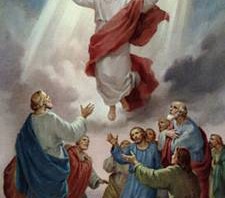
    I think it’s a word of mission. We’re singing a hymn with “Go” in the title today, and I think it catches the spirit of what the word “Go” means in our Liturgy. And we hear that spirit in our Gospel today. Jesus tells the disciples: “Go into the whole world and proclaim the gospel to every creature.” That was what the disciples were to do. They weren’t supposed to just stand there staring up into the sky: they were supposed to GO and do the work of salvation until Jesus returned in glory.

    Obviously, the command that was given to those first disciples is one that we are supposed to get as well. We are supposed to GO and preach the gospel in what we say and what we do. We are supposed to GO and baptize people by leading them to the faith in our witness. We are supposed to GO in peace, glorifying the Lord by our lives. We are supposed to GO and announce the gospel of the Lord. We do that by volunteering at the parish, looking in on a sick or elderly neighbor, living lives of integrity in the workplace. We do that by striving to be Christ-like to every person we meet.

    So I hope that you’ll hear that word “GO” at the end of Mass differently now than perhaps you have before. I hope that you’ll hear it as a calling, as a challenge, and as a sacred duty. I hope you’ll take up the call to GO and make the world into the Kingdom of God among us.