Category: Liturgy

  • Ash Wednesday

    Ash Wednesday

    Today’s readings

    Behold: now is the acceptable time!
    Behold: now is the day of salvation!

    This is the way the Scriptures today call us to repentance.  Repentance is an important spiritual theme for Lent: in fact, if it were not for our need for repentance, we wouldn’t need Jesus, he wouldn’t have to have taken on flesh, he wouldn’t have to suffer and die.  But we do need a Savior, and so Jesus came and he did all of that – for us.  He didn’t come and do all that just because religion in those days was out of whack, or that people in that time were more in need of repentance than people in other times, including our own.  He did that because we all have need of repentance, now just as much as always.  We all have things we need to let go of and move away from, so that we can return to the Lord, and be happy with him forever.  So we all need to repent, in little or big ways.

    Repentance is so much a part of Lent that one of the two instructions we can give when someone comes to us for ashes is “Repent and believe in the Gospel.”  The other, of course, is “Remember, you are dust and to dust you shall return.”  I tend to use both of these, alternating between the two, and letting the Holy Spirit decide who hears each.   I do that because I think they are both fitting reminders for us as we enter into holy Lent.  We have to keep repentance, and our own return to dust one day, in our minds and hearts so that we can long for the salvation God wants to bring us.

    We have come here today for all sorts of reasons. Lots of us may still have the remnants of old and bad teaching that you have to come to Church on Ash Wednesday or something horrible will happen to you, some may even think that getting ashes on Ash Wednesday is what makes us Catholic.  The real reason we come to Church on this, the first day of Lent, is for what we celebrate on the day after Lent: the resurrection of the Lord on Easter Sunday.  Through the Cross and Resurrection, Jesus has won for us salvation, and we have been blessed to be beneficiaries of that great gift.  All of our Lenten observance, then, is a preparation for the joy of Easter.

    Lent calls us to repent, to break our ties with the sinfulness and the entanglements that are keeping us tethered to the world instead of free to live with our God and receive his gift of salvation.  Our Church offers us three ways to do that: fasting, prayer and almsgiving.  Giving things up, spending more time in prayer and devotion, dedicating ourselves to works of charity, all of these help us to deeply experience the love of Christ as we enter into deeper relationship with him.  That is Lent, and the time to begin it, as we are told, is now:  Now is the acceptable time!  Now is the day of salvation!

    And none of this, as the Gospel reminds us today, is to be done begrudgingly or half-heartedly.  None of it is to be done with the express purpose of letting the world see how great we are.  It is always to be done with great humility, but also with great joy.  Our acts of fasting, prayer, and charity should be a celebration of who God is in our lives, and a beautiful effort to strengthen our relationship with him.

    It is my prayer that this Lent can be a forty-day retreat that will bring us all closer to God.  May we all hear the voice of the prophet Joel from today’s first reading: “Even now, says the Lord, return to me with your whole heart!”

  • Monday of the Eighth Week of Ordinary Time

    Monday of the Eighth Week of Ordinary Time

    Today’s readings

    The rich young man in today’s Gospel has to answer the question that really confronts all of us, especially considering the affluent area in which we live.  That question, of course, is what is most important in life?  Do we continue to strive to have the most stuff, the best stuff, the cutting-edge stuff?  Or do we give that up and go all in for the kingdom of God?  Because we can’t have both; that doesn’t work.  If our hands and hearts are filled with the stuff that we have, then we have no room for God and his love, and all the blessings he wants to give us.

    Saint Peter in the first reading gives us the goal of our lives: that living hope that comes through Christ’s resurrection and provides hope that is “imperishable, undefiled, and unfading.”  That is the hope worth striving for.  That is certainly worth opening up our hands and letting go of the stuff that gets in our way.

    We don’t know how the rich young man answered the question.  He walked away sad, but we don’t know if he decided to live with the sadness, if the sadness gave way to despair, or if the sadness moved him to make radical changes in his life.  But we do know that the ball is in our court.  Do we experience that sadness?  And if so, how will we deal with it?  Please God let us let go of what we have been grasping so that we can grab hold of God’s hand offered to us in love.  What is it that we will be letting go of?

  • Friday of the Seventh Week of Ordinary Time

    Friday of the Seventh Week of Ordinary Time

    Today’s readings

    It’s been interesting to me this week about how the letter of James has served to underscore Jesus’ teachings from the Gospel of Mark.  On weekends, the first reading and Gospel are selected to go together, but during the week that’s not always the case.  But this week, James and Mark have been boldly proclaiming some needed virtues in the Christian disciple.  Today’s virtue seems to be one of integrity.

    I say integrity because both passages are strongly cautioning all of us to make the right decision and then live accordingly, persevering with our conscience.  James tells us to stop complaining about one another so as to avoid judgment, and then to persevere as the ancient prophets did.  Finally, we are to avoid swearing under oath, instead letting our “yes” or “no” mean exactly what they sound like, and not to say one thing and do another.

    Jesus is speaking to the Pharisees in the Gospel reading, and it’s important to understand that he was not giving them marriage counseling, because that’s not what they asked for.  They seemed to be asking a question about divorce and whether or not it should be allowed, but what they were really trying to do was to get him to say something against Moses and thus prove himself to be a charlatan.  But he doesn’t play their game, and instead reminded them of Moses’ own words regarding the permanence of the marriage bond.  They wanted to use a loophole in Moses’ teaching to get him tripped up, but instead he trips them up by reminding them of what Moses really taught.  The Christian disciple doesn’t need loopholes: she or he lives the Gospel in integrity.

  • Thursday of the Seventh Week of Ordinary Time

    Thursday of the Seventh Week of Ordinary Time

    Today’s readings

    Today’s Scriptures extol the virtue of poverty of spirit, which is perhaps one of the more difficult virtues to embrace and nurture.  Saint James illustrates how things of this world, specifically the pursuit of riches, can be not only a powerful distraction from the spiritual life, but can also leave one complicit in serious sin.  In the Gospel, Jesus exhorts us not to let anything – not even the members of our own body – to get in the way.  We are called to be salt in the world; to flavor our interactions with others such that they see the attraction of life in Christ.

    But if we’re ever going to accomplish it, we have to be poor in spirit.  We have to get over ourselves and shed whatever takes us off the right path.  If our hands or feet or eyes lead us down the wrong path, we have to humble ourselves and get rid of that obstacle so that we can salt the world.

    Possessing the kingdom of heaven is our goal; in fact it’s why we were created.  That’s the ultimate destination on the spiritual journey.  To get there, we can’t be content with the things that get in the way.  We have to pluck out the errant eye, to lop off the wayward limb.  We have to give up worldly riches, especially those garnered at the expense of the poor, and go all in for the kingdom of God.

  • Tuesday of the Seventh Week of Ordinary Time

    Tuesday of the Seventh Week of Ordinary Time

    Today’s readings

    There’s been a lot of arguing in the Gospels these last couple of days.  Yesterday, the disciples were arguing with the scribes when both groups found they were incapable of casting a demon out of a person who was ill.  Today, we have the disciples arguing among themselves because they find they don’t understand Jesus’ message.

    All of this arguing betrays a real lack of growth in faith among those disciples.  They probably felt like, since they were in Jesus’ inner-circle, they should have the answers.  And perhaps they should, but to their defense, they hadn’t received the Holy Spirit yet.  In a real sense, they were still in formation, and they shouldn’t have been so afraid to ask Jesus for clarification.

    Jesus’ lesson to them then comes from him putting a little child in their midst.  Receive a child like this in my name, he tells them, and you receive me.  What’s the point of that?  Well, receiving a child in Jesus’ name is an act of service, because a child can do nothing but receive at that point in their life.  So serving others in Jesus’ name is what brings us to the Father.

    I think the take-away for us is that trying to be smarter than everyone else isn’t what shows that we are faithful people.  Instead of arguing our point, we need to ask God to help us get the point.  And we have to be ready to act on our faith, instead of arguing about it.

  • Monday of the Seventh Week of Ordinary Time

    Monday of the Seventh Week of Ordinary Time

    Today’s readings

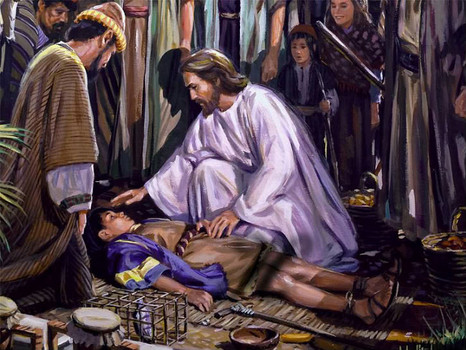
    So the disciples are waiting for Jesus to come down the mountain after the Transfiguration.  They have attempted to cure a man’s son from the hold of a demon, but they were apparently unable to do so.  This seems to have led to an argument between them and the scribes.  You can almost feel Jesus’ exasperation.  Both the disciples and the scribes should have been able to do something for the boy, but they couldn’t.  Why?  Because instead of praying, they argued about it.  “This kind can only come out through prayer,” Jesus tells the disciples when they ask why they were ineffective.

    I often wonder, with more than a little fear, how many demons I could have cast out – in myself and in others – if I had a little more faith, if I prayed a little more than I do.  There are, of course, all sorts of demons: demons of illness, demons of cyclical sin, demons of impure attachments, demons of homelessness, poverty, and marginalization, and so many more.  Think of all the demons we could cast out if we just had more faith, if we prayed more fervently.

    Sometimes, when we are trying to overcome some problem, the last thing we think to do is pray, when it should absolutely be the first.  The disciples were guilty of it, the scribes were, and we are too sometimes, if we’re honest.  And all of us should know better.  I know that I myself can think of a number of problems I’ve tried to solve all by myself, when it would have been so much more effective to first turn to the Lord.  We can’t just cut God out of the picture and rely on our own strength; that never works – our own strength is so fiercely limited.  We have to turn to the tools we have been given: faith and prayer.  And we can start by saying with the boy’s father: “I do believe, Lord; help my unbelief.”

  • Seventh Sunday of Ordinary Time/Diocesan Appeal Announcement

    Seventh Sunday of Ordinary Time/Diocesan Appeal Announcement

    Today’s readings

    Our readings today pick up the sermon that Jesus was giving in last week’s gospel.  Last week, he used the formula: “You have heard that it was said…  But I say to you…” to raise the bar on living the fifth, sixth and eighth commandments.  Merely refraining from actual murder no longer means that we have not murdered in our heart.  Never having had an extra-marital affair doesn’t any longer mean that we haven’t committed sexual sin.  And never having lied under oath doesn’t mean we haven’t stretched the truth in ways that are sinful.  Disciples, people who believe in Christ, are expected to live differently: our faith looks like something, and that something is radical lives of integrity that set out to witness to God’s love in the world.

    This week we have a bit more of the same, but this time expressed in terms of positive behavior.  Christian disciples, he tells us, are not just to refrain from anything that would tear down another’s life, they are not just to refrain from seeing people as objects, nor are they just to refrain from lying.  They are to go beyond all that and give of themselves, even when it doesn’t seem like they would strictly be required to do so.  Disciples are to give of themselves even when they themselves have been wronged.  They are to do more than the law requires and offer no resistance to evil.  Disciples are even to love their enemies, for heaven’s sake!

    So what we are seeing over these two weekends’ Scriptures are a completely new message for the people of Israel.  Hopefully the message is not a new one for us, but it is, we have to admit, one of which we need to be reminded from time to time.  Because it’s really easy to get caught up in our own entitlement, and looking out for number one, and doing what seems best for us.  But disciples are called to a different kind of life, one that leads ultimately to the kingdom of heaven.  If we’re ever going to attain that eternal reward, we have to bring everyone with us that we can.  And to do that, sometimes we’re going to have to let someone else win the argument, or see the good in someone who isn’t presenting a real good side right now.  We might even have to go so far as to love and pray for those who are working against us, and trust God to work it all out.

    And the thing is, God is that trustworthy, but sometimes we don’t have faith enough to do that.  That’s something we have to work on every day.  Because if the only one we ever trust in is ourselves, we are destined for a pretty bad end.  Even the brightest and best of us have limited ability, and none of us can ever make up to God for the offenses of our sins.  So our ability to be okay in bad times goes only as far as we can manage, unless we trust in the Father’s care.

    Today I am speaking at all the Masses about the Catholic Ministries Annual Appeal.  As you are aware, the appeal funds the various ministries of the Diocese of Joliet and is integral to providing funding for so many activities that support our work at the parish level, and also reach out to those in need.  You probably already received a mailing from the diocese asking for your contribution; I know I did.  If, like me, you have already made your pledge, I want to thank you for your participation.  Your generosity makes a huge difference to those who depend on these funds.

    In today’s bulletin, you’ll find this tabloid about the appeal.  My favorite part is on the inside where it talks about how our money is being used.  I wanted to briefly point out a few of those.  One of the best, I think, is the education of seminarians, of which our own Chris Lankford is a beneficiary.  We also have another young man who has been accepted from our parish, and he will benefit for that too.  I know that during my time in seminary, I estimated that my education cost the diocese over $100,000, and the costs have certainly gone up in the years since.  We need priests, and so we need to have the funds to educate them.

    The diocese serves over 660,000 Catholics in our seven-county area.  Some of the other ways the appeal helps us is by funding Young Adult and Youth Ministry programs that serve over 25,000 young people.  More than 155,000 nights of shelter and housing were provided to the homeless.  The Catholic Schools Office assists and gives direction to our own school and others, serving over 20,000 elementary and high school students, and the Religious Education Office helps train and direct catechists who reach almost 50,000 students a year.

    Our parish has always been very generous in so many ways, including to the Catholic Ministries Annual Appeal.  Last year we exceeded our goal and received a rebate from the diocese that helps us to balance our own budget and provide for unforeseen needs, like the greater need for snow removal and salting this year.  I am grateful for all that you have done to accomplish this, and as your pastor, I am proud of the way that we come together to help those who need us.

    Our Psalmist today reminds us that “The Lord is kind and merciful.”  God is never outdone in generosity, and so when we extend ourselves to those in need, when we give above and beyond what is strictly required, when we love those who maybe don’t love us, and even pray for our enemies, we can trust that God will give us all that we need and bless us in ways that we may never have expected.  Trust in the Father’s care: that’s what our Scriptures and this year’s appeal ask us to do.  It’s sound advice, and I pray that we would all take note of it!

  • Monday of the Sixth Week of Ordinary Time

    Monday of the Sixth Week of Ordinary Time

    Today’s readings

    St. James today encourages us to consider it all joy when we experience trial.  I don’t know about you, but that’s not the emotion I usually find in frustrating or fearful circumstances.  And considering that the people to whom James was writing were probably being persecuted, they probably weren’t overjoyed at their trials either.  But the spiritual principle is that when one’s faith is tested, ones learns perseverance, and learns to trust in God.

    But that presupposes that we will remain faithful in the midst of trial.  The minute we stop looking to our Lord for help in times of difficulty, perseverance and trust in God go right down the tubes.  The Pharisees in the Gospel had not yet learned faithfulness.  They kept their eyes on the minutiae of the Law instead of on God, and so they lost sight of faith and everything that was of true importance.  They were fearful; they wanted a sign, but they would never get a sign because they were always looking in places other than God.

    Faithfulness is a difficult thing.  When we are tested, it’s so easy to want to throw in the towel and leave behind everything we believe in.  I have been there myself, but thankfully I still had prayer and people praying for me.  I think we’re all in that place at some time or another in our lives.  It’s easy to be faithful when there are no trials, but faith in times of trial produces the perseverance and lively faith that gets us through life.  And we definitely should consider that all joy.

  • Thursday of the Fifth Week of Ordinary Time

    Thursday of the Fifth Week of Ordinary Time

    Today’s readings

    The women in today’s Liturgy of the Word give us contrasting views of the spiritual life.  In our first reading, the women give us the example of what not to do.  Solomon, known for his wisdom and dedication to God by building the temple, is soon seduced by the foreign women he had married to abandon God.  They entice him to abandon the worship of the one, true God in order to worship and adore their so-called gods.

    Marrying into the families of the foreigners among them was a real problem for the Israelites.  God had forbidden them to do so, and when they did this, they were soon led astray and picked up the pagan customs of the world around them.  It’s kind of a metaphor for what can go wrong in our spiritual lives.  If we keep our eyes on Christ and follow the way he has laid out for us, we can progress in our devotion.  But the minute we start looking at other things, we can soon be distracted from the straight and narrow.

    On the other hand, we have the wonderful Syrophoenician woman in the Gospel.  She knows exactly where to look for salvation and she persists in it.  When it seemed that Jesus was not interested in helping her daughter, she persisted because she knew that Christ alone could heal her daughter and expel the demon.

    Once again, there’s a deeper message here.  I don’t think any of us believes that Jesus wasn’t interested in healing the woman’s daughter.  I just think he knew her faith and wanted to give those who were in the house where he was to see that faith.  The story gives us, too, the opportunity to asses our own faith in God, not looking to other things or foreign gods to bring us salvation.  If these women teach us anything in today’s readings, it’s that we need to be focused on our God alone.

  • Saturday of the Fourth Week of Ordinary Time

    Saturday of the Fourth Week of Ordinary Time

    Today’s readings

    In today’s first reading, King Solomon is asked a question that seems to me something like the fabled question that people get asked when they find a genie in a bottle.  Make a wish, and it’s yours.  Solomon has a relationship with the Lord, and so he treats the opportunity as something quite more than a chance to get rich quick.  Instead, he asks for the spiritual gift of understanding, which he knows that he will need in his ministry of governing the people Israel.  He gets that, and much more besides.

    Jesus offers the Apostles an opportunity, too.  They were so busy, they had no opportunity to eat, let alone rest.  So he invites them on retreat: “Come away by yourselves to a deserted place and rest a while.”  He gives them a chance to recharge, to rest and grow.  Meanwhile, Jesus continued the ministry of preaching and teaching.

    So we too, have opportunities today.  Those of us gathered for the Liturgical Minister Day of Renewal have the opportunity to come away and rest a while, to reflect on what we do and why we do it, and why it’s important that we do it well.  We come to be fed by the Eucharist and nourished in prayer, we come to receive the gifts that we need to do our ministries well.

    Opening ourselves up to our Lord today, we are asked what it is that we need.  For each of us the answer is probably quite different.  We may need to go deeper in the spiritual life, or we may need to learn more about the Liturgy and our faith.  We may need more time for prayer.  Whatever it is, our God presents us with the opportunity today.  Sometimes I think we underestimate God or don’t want to bother him, or we may even think we can do our ministry or handle whatever life throws at us alone.  But we can’t and we don’t have to.

    God speaks to us today: “Ask something of me and I will give it to you.”  How do you answer?  Choose wisely.