Category: Lent

  • Friday of the First Week of Lent

    Friday of the First Week of Lent

    Today’s readings

    Today’s readings remind us that Lent is no time for “business as usual.” It’s not enough for us to merely claim to be righteous, because righteousness, literally a right relationship, means that righteous actions must back our lofty words. And so today we are called to a righteousness that surpasses the scribes and Pharisees, a righteousness that goes beyond our words and our reputations and what we want people to think about us. The righteousness that Jesus calls us to today is a righteousness that starts where everything must, and that is in the heart.

    Today’s Gospel comes from the somewhat scary “but I say to you” section of Matthew’s Gospel. Here, Jesus reiterates the teachings of Moses and then “kicks them up a notch.” That means that harsh words, grudges, anger, backbiting, gossiping and slander share equal dishonor with outright murder. They all, Jesus tells us, violate the fifth commandment, because they all start with the same murderous inclination of the heart. The one who has harbored these evil thoughts and actions must repent of them and seek reconciliation before offering his or her gift at the altar, or the offering will be tainted, ruined, and ultimately rendered sacrilegious.

    Ezekiel’s prophecy in the first reading is good news for those of us who have gone astray. His prophecy holds out the possibility of a second chance for us sinners and calls us to a fundamental change of life. Even if we have been known for our wicked deeds, we have the opportunity to repent and change our hearts and lives. If we repent, God will forget our wickedness and treat us with mercy.

    The Psalmist today rejoices in God who is trustworthy with his mercy and forgiveness. In this time of Lenten repentance, we can have confidence in our God who longs to bring us back:

    For with the Lord is kindness

    and with him is plenteous redemption;

    And he will redeem [all of us]from all [our] iniquities.

  • Thursday of the First Week of Lent

    Thursday of the First Week of Lent

    Today’s readings

    The readings for these early days of Lent are focused on teaching us how to accomplish the various disciplines of Lent – which really are the various disciplines of the spiritual life. The whole point is that we enter more deeply into the spiritual life during these days of Lent, with a view toward growing in holiness. Today’s discipline then, I think, would be persistence in prayer. 

    In the first reading, we have Queen Esther, who is really between a rock and a hard place. The king does not know she is Hebrew, and worse than that, if she goes to the king without being summoned, she could well lose her life. But, she needs to go to the king to plead for the lives of her fellow Hebrew people.  So today, she prays that her life, as well as those of her people would be spared. Esther prayed for three days and nights that her prayer would be answered, and her persistence was rewarded.  She received the reward that Jesus promised when he said, “Ask and it will be given to you; seek and you will find; knock and the door will be opened to you.”

    We, too, bring many prayers to our relationship with God.  We may or may not be rewarded with the exact gift we pray for; in fact, that rarely happens. But we will always be rewarded with the loving presence of our God in our lives. In fact, it could well be that God’s answer to our prayer is “no” – for whatever reason – but even in that “no” we have the grace of a relationship that has been strengthened by our prayerful persistence.

    The Psalmist prays, “Lord, on the day I called for help, you answered me.” This Lent, may the discipline of persistence in prayer lead us to a renewed and enlivened sense of the Lord’s will and of his loving presence in our lives.

  • Tuesday of the First Week of Lent

    Tuesday of the First Week of Lent

    Today’s readings

    The prophet Isaiah and Jesus speak today about the great power of words. Isaiah speaks specifically of the power of God’s word, a word that will not return empty but will go out and accomplish the purpose for which God sent it.  We see the word that the prophet speaks of here, of course as the Word – “Word” with a capital “W.”  That Word is Jesus Christ, the Second Person of the Blessed Trinity, who comes to accomplish the salvation of the world, the purpose of God ever since the world’s creation.  Indeed, that Word would never return to the Father empty or void, but instead filled with the richness of God’s beloved children – you and me, the ones he came to save.

    The prayer that Jesus gives us today, the classic prayer that echoes in our hearts in good times and in bad, is a prayer with a specific purpose in mind.  That prayer, if we pray it rightly, recognizes that God’s holiness will bring about a Kingdom where his divine will will be done in all of creation.  It begs God’s forgiveness and begs also that we too would become a forgiving and merciful people, just as God is merciful to us.  Finally, it asks for help with temptation and evil, something with which we struggle every day.  It is the prayer above all other prayers, the prayer that unites us to the Father’s will for us, the prayer that contains every prayerful attitude or thought.

    Today’s readings are a plea that God’s will would finally be done.  That his Word would go forth and accomplish God’s purpose.  That his will would be done on earth as in heaven.  As we pray those familiar words, they can often go past us without catching our attention.  But today, maybe we can slow down just a little, and pray them more reflectively, that God’s will would be accomplished in every place, starting in our very own lives.

    Because to God belongs the Kingdom, and the power, and the glory, forever and ever.

  • The First Sunday of Lent

    The First Sunday of Lent

    Today’s readings

    The devil wants more than anything for us to forget who we are.  He really didn’t care if Jesus ruined his fast by turning some stones into bread, or if he killed himself trying to test God, and he certainly had no intention of making him king of the world.  What he wanted, what he really wanted, was for Jesus to forget who he was and give himself over to him.  And we see in the first reading that that’s how it all started.  The serpent didn’t care what tree Eve ate from, he just wanted her, and Adam, to forget who they were, to forget that they were beloved children of God and that God would take care of them.

    So if I could suggest a motif for our Lenten prayer, it might be “Remembering Who We Are.”  That’s why we have the Cross up here, front and center.  I want us to see that in the Cross, God gave us the very best he had, and that when we take up our own cross, God sustains us and makes us more than we could be on our own.  Just as Jesus remembered that he was God’s Son and that he came here for a reason, and that reason was to save us from our sins, so we have to remember that we are sons and daughters of God, and we are here for a reason.  The devil will try all sorts of tricks to get us to forget that.  He will throw at us job difficulties, serious illnesses, the death of loved ones, family strife, and the list goes on and on.  He will tempt us with the latest gadgets, the job promotion, the opportunity to get rich quick, and that list goes on and on too.  He wants us, really wants us, more than anything, to forget who we are.

    Because if we forget who we are, the devil’s job is an easy one.  If we forget that God made us and redeemed us out of love for us, then he’s got his foot in the door.  Once that happens, hell looks like something mysterious, enticing and exciting.  It feels like living on our own terms, looking out for number one, and doing what “feels right to me.”  And that’s awesome, except of course, that it’s hell.  And the glamour fades and the excitement turns to rancor, and we’ve wasted our lives chasing after stuff that doesn’t really matter in the grand scheme of things.

    The antidote to this hell of our own making, is letting go – giving what might even seem to be necessary to us, and trusting that God will give us what we need.  That can be the treasure of Lent for us.  In fasting, we can let go of the idea that we alone can provide what is necessary for our survival.  God can feed our hungers much better than we can, if we will but trust in him to do it.  In almsgiving, we can let go of the idea that everything is ours if we would just worship the one who cannot give us what we truly need.  God gives us what’s really necessary in life, and eternal life besides.  And in prayer, we can let go of the fading pleasures of this world and of Satan and take on the enduring luster of a life lived as a son or daughter of God.

    And so I would like to suggest a program of retreat for these forty days of Lent.  It’s nothing new; I didn’t create it.  It’s what the Church gives us every Lent, and I feel like if we want to remember who we are, we should take it on in its entirety.  So this retreat consists of the three things I just mentioned: fasting, almsgiving and prayer.  And our parish gives you so many resources for choosing something to do for each of them.  You may have seen our Lenten tear-out sheet in today’s bulletin.  Take a look at it, post it on your fridge, and plan to make this Lent a good one.

    For fasting, you might consider giving up what’s really taking hold of you.  Maybe it’s some kind of food, but it could be technology, binge watching on Netflix or YouTube, or shopping for yourself on Amazon.  What would it be like to set whatever that is aside and let God give you what you really need?  Giving up these distractions, we can focus on our soul’s hunger for God.

    For almsgiving, maybe tie it in with your Friday abstinence.  Eat a simpler meal on Friday, perhaps come to our parish fish fry, but bring some food for the food pantry.  Summer will be coming and food pantry shelves tend to be emptier then, so your donations can make a real difference.  Or consider making a donation to Catholic Charities, and especially consider the Daybreak Shelter.  Our parish provides a meal for the homeless every other month, and this month it’s this coming Tuesday and they can use your help: check the sign-up sheet in the commons to see what is needed.  Those are just a few examples of almsgiving that will really make a difference.  The saints tell us that almsgiving covers a multitude of sins, so it can really be an important piece of our Lenten repentance.

    And for prayer, I’d like to encourage you to attend a daily Mass once a week during Lent.  We have our usual daily Mass at 7:30 Monday through Saturday, but also have a Mass and video at 7pm on Tuesdays, and a simple beginning of the workday Mass at 6:15am on Thursdays.  The Mass and Eucharist are the source and summit of our lives as Christians; I encourage you to deepen your relationship for our Savior who gave his life for you by attending an additional Mass once a week.

    Fasting, almsgiving and prayer remind us that we are beloved sons and daughters of God who are always taken care of by God, if we let Him; that when we give of ourselves, we all become more; and that as we become more our prayer leads us into the life of God himself.  May we have a blessed, and joyful Lenten retreat, never forgetting who we are, all of us, sons and daughters of God.

  • Saturday after Ash Wednesday

    Saturday after Ash Wednesday

    Today’s readings

    “Those who are healthy do not need a physician, but the sick do.”

    That’s advice I wish I’d taken sometimes when I’ve been coming down with something and think, “oh, it’ll pass.”  The sick need a physician!

     Anyone who has battled an addiction will tell you how true this is.  You cannot make any progress is wellness in any aspect of life if you don’t admit you’re sick and accept help.  We all have difficulty doing that sometimes, I think, and much to our demise.

    It’s important that we learn to do that in the spiritual life.  If you don’t think you need a physician for your spiritual life, congratulations, you can skip Lent.  In fact you don’t even need a Savior!  I say that in jest, but really it’s true.  Jesus is very clear today: he came to call sinners to conversion, and that includes all of us.  You and me, all of us, need conversion in our spiritual lives.  And the good news is that Jesus gives us Lent to do just that.  Be converted, be healed, be made whole so that the glory of Easter can brighten our lives.

    So our reflection this morning is two-fold. First, where and how do I need the Divine Physician in my life right now? And second, invite him in and let him heal us.

  • Thursday after Ash Wednesday

    Thursday after Ash Wednesday

    Today’s readings

    When it comes right down to it, we have a choice. We can choose life or death, blessing or curse, the way of the Cross or the way of the world. The choice that we make has huge consequences, eternal consequences. The stakes are big ones, and we must choose wisely.

    The command from Deuteronomy is clear: “Choose life, then, that you and your descendants may live, by loving the LORD, your God, heeding his voice, and holding fast to him.”  The way of the Lord is life-giving, the way of the world is death.  The way of the Lord is blessing, the way of the world is curse.  The passing pleasures of the world are nothing compared to the eternal pleasures of God’s way. 

    Jesus asks us today to make a choice to take up our crosses and follow him.  There is great suffering in the cross.  But, as he says, what profit is there for us if we gain the whole world but lose our very selves?  May we all this day renounce the hold the world has on us, and choose life, that we and our descendants might live.

  • Ash Wednesday

    Ash Wednesday

    Today’s readings

    Today we begin something really important.  And I don’t mean just the smudging of our foreheads with the ashes of burnt palms.  That’s just an outward sign.  What I mean is the inward activity those ashes represent, what our collect prayer today calls “this campaign of Christian service.”  This time of Lent is so important to us because it calls us to newness in our relationship with God, that relationship that brings us to the eternal reward for which we were created.

    We have come here today for all sorts of reasons. But the most important reason we come to Church on this, the first day of Lent, is for what we celebrate on the day after Lent: the resurrection of the Lord on Easter Sunday.  Through the Cross and Resurrection, Jesus has won for us salvation, and we have been blessed to be beneficiaries of that great gift.  All of our Lenten observance, then, is a preparation for the joy of Easter.

    Lent calls us to repent, to break our ties with the sinfulness and the entanglements that are keeping us tethered to the world instead of free to live with our God and receive his gift of salvation.  Our Church offers us three ways to do that: fasting, prayer and almsgiving.  Giving things up, spending more time in prayer and devotion, dedicating ourselves to works of charity, all of these help us to deeply experience the love of Christ as we enter into deeper relationship with him.  That is Lent, and the time to begin it, as we are told, is now: Now is the acceptable time! Now is the day of salvation!

    And none of this, as the Gospel reminds us today, is to be done begrudgingly or half-heartedly.  None of it is to be done with the express purpose of letting the world see how great we are.  It is always to be done with great humility, but also with great joy.  Our acts of fasting, prayer, and charity should be a celebration of who God is in our lives, and a beautiful effort to strengthen our relationship with him.

    It is my prayer that this Lent can be a forty-day retreat that will bring us all closer to God.  May we all hear the voice of the prophet Joel from today’s first reading: “Even now, says the Lord, return to me with your whole heart!”

  • Monday of Holy Week

    Monday of Holy Week

    Today’s readings

    There are two things going on in today’s Scripture readings. First, we have the Jews, and now Judas among them, who are very jealous of Jesus and are seeking to arrest and kill him. And not just him, but anyone who encourages people to believe in him, like Lazarus in today’s Gospel. In these holy days, it’s not safe to be around Jesus.

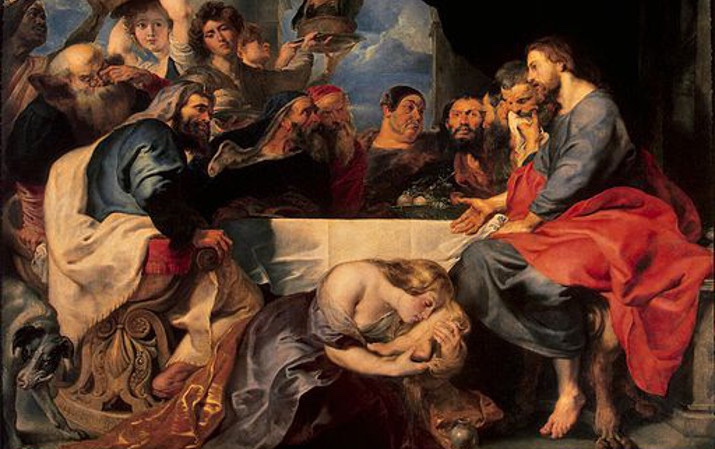
    Second, we have Mary, who pours out the most expensive thing she has for love of the Lord. She gives no thought to the expense, to what seems like waste, but instead gives it all out of love for her Lord.

    For Jesus’ enemies, it was all about them, and not at all about the God they supposedly believed in and served. But for Mary, it’s about Jesus, and she understands in some way where this is all headed.

    So we have the jealousy of the Jews and the cowardice of Judas against the love and generosity and even courage of Mary. In these Holy days, we are called to be Mary, to courageously pour ourselves out in love and generosity, even when the jealousy of the world around us would try to make us feel like it’s best we didn’t make waves.

  • Palm Sunday of the Passion of the Lord

    Palm Sunday of the Passion of the Lord

    Today’s readings

    Palm Sunday is, quite honestly, a feast with a bit of a split personality. We start out on a seemingly triumphant note.  Jesus enters Jerusalem, the Holy City, and the center of the Jewish religion; the city he has been journeying toward throughout the gospel narrative, and he enters it to the adulation of throngs.  Cloaks are thrown down in the street, the people wave palms and chant “Hosanna.”  This is it, isn’t it?  It seems like Jesus’ message has finally been accepted, at least by the crowds who have long been yearning for a messiah, an anointed one, to deliver them from foreign oppression.

    Only that wasn’t the kind of salvation Jesus came to offer.  Instead, he preached forgiveness and mercy and real justice and healed people from the inside out.  He called people to repentance, to change their lives, to hear the gospel and to live it every day.  He denounced hypocrisy, and demanded that those who would call themselves religious reach out in love to the poor and those on the margins.  It wasn’t a welcome message; it wasn’t the message they thought the messiah would bring.

    And that’s what brings us to the one hundred and eighty degree turn we experience in today’s second gospel reading, the reading of our Lord’s Passion and death.  Enough of this, they say; the religious leaders must be right: he must be a demon, or at least a troublemaker.  Better that we put up with the likes of Barabbas.  As for this one, well, crucify him.

    Who are we going to blame for this?  Whose fault is it that they crucified my Lord? Is it the Jews, as many centuries of anti-Semitism would assert?  Was it the Romans, those foreign occupiers who sought only the advancement of their empire?  Was it the fickle crowds, content enough to marvel at Jesus when he fed the thousands, but abandoning him once his message made demands of them?  Was it Peter, who couldn’t even keep his promise of standing by his friend for a few hours?  Was it the rest of the apostles, who scattered lest they be tacked up on a cross next to Jesus?  Was it Judas, who gave in to despair thinking he had it all wrong?  Was it the cowardly Herod and Pilate who were both manipulating the event in order to maintain their pathetic fiefdoms?  Who was it who put Jesus on that cross?

    And the answer, as we well know, is that it’s none of those. Because it’s my sins that led Jesus along the Way of the Cross.  It’s my sins that betrayed him; it’s my sins that have kept me from friendship with God.  Those sins could have kept me from friendship with God forever, but God’s love would not have that be that way.  And so he willingly gave his life that I might have life.  And you.

    He gave himself for us.

  • Saturday of the Fifth Week of Lent

    Saturday of the Fifth Week of Lent

    Today’s readings

    Caiaphas had no idea how prophetic his words were. Actually, as far as the intent of his words went, they were nothing but selfish. The Jews didn’t want to lose their standing with the Romans. As it was, they had an uneasy peace. The Romans pretty much let them practice their religion as long as there wasn’t any trouble. But they knew that if everyone started following Jesus, the Romans would give preference to the new way, in order to keep the peace. The religious leaders couldn’t let that happen, so they began plotting in earnest to kill Jesus, planning to find him when he came to celebrate the upcoming feast day, which they were certain he would attend.

    It’s a time of high intrigue, and for Jesus, his hour – the hour of his Passion – is fast approaching. That’s so clear in the Gospel readings in these last days of Lent. In just a few hours we will begin our celebration of Holy Week, waving palms to welcome our king, and praying through his passion and death. It is an emotional time for us as we know our God has given his life for us, the most amazing gift we will ever get. It is also a time of sadness because we know our sins have nailed him to the cross.

    But, this is where the significance of Caiaphas’s words brings us joy. Yes, it is better for one person to die than the whole nation. God knew that well when he sent his only Son to be our salvation. Jesus took our place, nailing our sins and brokenness to the cross, dying to pay the price those sins required, and rising to bring the salvation we could never attain on our own. Caiaphas was right. It was better for one person to die than for the whole nation to die. Amazing as it seems, that was God’s plan all along.