Category: The Church Year

  • Monday of the Eighteenth Week of Ordinary Time

    Monday of the Eighteenth Week of Ordinary Time

    Today’s readings

    What I think the folks in our first reading need to learn – and maybe us too – is that the spiritual life is always about the big picture.  The Israelites in today’s reading have completely rejected the God of their salvation.  God had taken them from abject slavery in Egypt, in which they were oppressed beyond anything we could possibly imagine – let alone endure – and led them through the desert, through the Red Sea (covering the pursuing Egyptians in the process), and into safety.  He is going to give them the Promised Land, but they, thank you very much, would prefer to return to Egypt so that they no longer have to sustain themselves on the bread that they have from the very hand of God himself.  They would rather have meat and garlic and onions, and whatever, than freedom and blessing from God.  What a horrible, selfish people they have become.

    And Moses is no better.  He alone has been allowed to go up the mountain to be in the very presence of God.  No one else could get so close to God and live to tell the story.  God has given him the power to do miraculous deeds in order to lead the people.  And yet, when things get tough, he too would prefer death than to be in the presence of God.

    And aren’t we just like them sometimes?  It’s easy to have faith when things are going well, and we are healthy, and our family is prospering.  But the minute things come along to test us, whether it is illness, or death of a loved one, or job troubles, or whatever, it’s hard to keep faith.  “Where is God when I need him?” we might ask.  We just don’t often have the spiritual attention spans to see the big picture.  We forget the many blessings God has given us, and ask “Well what has he done for me lately?”

    In today’s Gospel, Jesus feeds the crowds until they are satisfied and have baskets of leftovers besides.  God’s blessings to us are manifold, and it is good to meditate on them when times are good, and remember them when times are bad.  God never wills the trials we go through, and he never forgets or abandons us when we are in the midst of those trials.  God feeds us constantly with finest wheat.  That’s the big picture, and we must never lose sight of it.
  • The Eighteenth Sunday of Ordinary Time: Bread of Life Discourse II

    The Eighteenth Sunday of Ordinary Time: Bread of Life Discourse II

    Today’s readings

    My niece Molly used to say that she wanted to open a restaurant when she grows up. She even had a name all picked out for it: “Hungry.” That makes a lot of sense when you think about it. Where are you going to go when you’re hungry? Well, to Hungry, of course! I thought about that this week because today’s Liturgy of the Word speaks to those of us who are hungry – which is to say, all of us.

    There’s a lot of hunger in the readings today. First we have the Israelites, fresh from their escape from slavery in Egypt, finding that they are hungry as they wander through the desert. I think we can understand their hunger. But what is hard to understand is the content of their grumbling about it. They say that they would rather be back in Egypt, eating bread and the meat of the “fleshpots.” Why on earth did God have to drag them out into the desert only to kill them by hunger and let them die there? They would rather be in slavery in Egypt than be in the situation in which they find themselves. Please understand how serious this grumbling is: it is a complete rejection of God, God who has done everything miraculous to save them from abject slavery.

    Not so different is the clamoring of the people in today’s Gospel reading. Today we pick back up our reflection on the “Bread of Life Discourse,” the sixth chapter of John’s Gospel. Because Mark’s Gospel, which we are hearing from this liturgical year, is a little shorter than the others, we get five wonderful weeks to take a little journey into John’s Eucharistic theology during these summer days. We began last week, with the famous story of Jesus feeding the multitudes. Today’s story picks up where last week’s left off: the people were so impressed by Jesus feeding so many with so little that they pursue him across the sea to Capernaum.

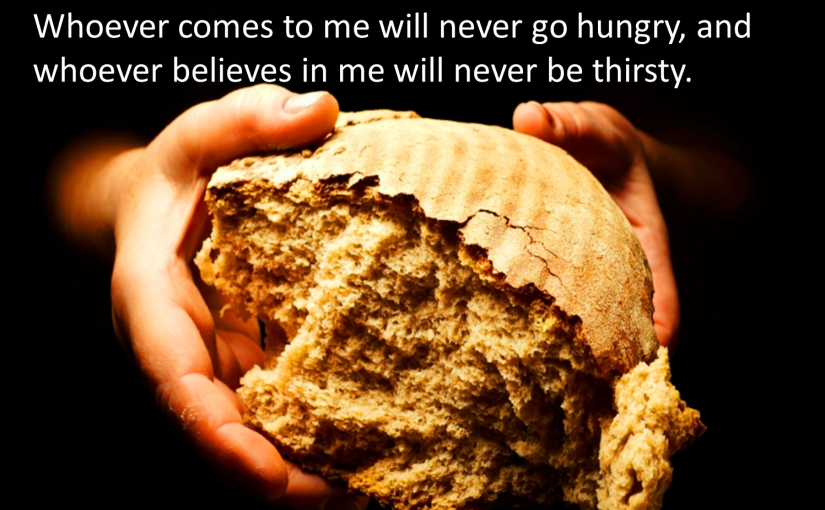
    Why do they follow him? Well, they want more food, of course. But the real feeding he intends is not just barley loaves, but instead something a little more enduring. So Jesus tells them that the best way they can do God’s will is to believe in him – the one God sent. So they have the audacity to ask him what kind of sign he can do so that they can believe in him. Can you believe that? He just finished feeding thousands of people with five loaves and two fish, and they want to see a sign? Instead, Jesus gives them a spiritual sign, a challenge really. He tells them to believe in him because “I am the bread of life; whoever comes to me will never hunger, and whoever believes in me will never thirst.”

    Jesus wants to get to the root cause of their hunger … and ours too, by the way. So I think the starting point is that we have to be clear about what it is we hunger for. And that question is very pressing on all of us today. Every one of us comes here hungering for something. Our hungers may be very physical: some here may be unemployed or underemployed, or perhaps our hunger is for physical healing of some kind. But perhaps our hungers are a bit deeper too: a relationship that is going badly, or a sense that we aren’t doing what we should be or want to be doing with our lives. Our hunger very well may be very spiritual as well: perhaps our relationship with God is not very developed or our prayer life has become stale. Whatever the hunger is, we need to be honest and name it right now, in the stillness of our hearts.

    Naming that hunger, we then have to do what Jesus encouraged the crowds to do: believe. Believe that God can feed our deepest hungers, heal our deepest wounds, bind up our brokenness and calm our restless hearts. Believe that Jesus is, in fact, the Bread of Life, the bread that will never go stale or perish, the bread that will never run out, or disappear like manna in the heat of the day. Jesus is the Bread that can feed more than our stomachs but also our hearts and souls. The Psalmist sings, “The Lord gave them bread from heaven.” And we know that bread is the most wonderful food of all, because it is the Body of Christ. Amen!

  • Tuesday of the Seventeenth Week of Ordinary Time

    Tuesday of the Seventeenth Week of Ordinary Time

    Today’s readings

    I think we get a more vivid picture of today’s Gospel if we’ve ever had the task of weeding a good-sized garden. I’ve done it plenty of times.  It’s not a task I really look forward to, but it is kind of good in that when you finish a job like that, you can look at it and see something good happened.  There’s a sense of accomplishment.  But discerning what is a weed and what is a plant is sometimes a difficult task.

    That’s the kind of question the disciples had for Jesus today.  Jesus had just told them several parables about the kingdom of God, and this one didn’t get read in the Gospels the last few days.  So we have the explanation, but not the parable.  You can check it out in the 13th chapter of Matthew.  The story basically went that the landowner sowed good seed in the field, but when it started to grow, weeds came up too.  His laborers asked him about it and he said, “An enemy has done this.” So they wanted to pull up the weeds, but the master said to let them grow together until harvest time, lest in pulling them up they also accidentally pull up the good plants.  They could then be pulled up and burnt at harvest time.

    Now I think a good gardener might quibble with the analogy.  But that’s not the point.  The point is good news, and the good news is this: however much we may resemble the weeds from day to day, Jesus gives us the time to grow into much lovelier plants during our lives.  He doesn’t blot us out of the book of life for one transgression.  But the warning is that we only have so much time until the harvest.  If we are going to turn to the God who sowed us and provide good fruit, we need to do it now.  If we wait until the harvest, it may well be too late.  Our God gives us the freedom to choose to be the good seeds in the field of the world, blessed are we who choose to grow that way.

  • Monday of the Seventeenth Week of Ordinary Time

    Monday of the Seventeenth Week of Ordinary Time

    These parables that we have today regarding the nature of the Kingdom of God are head-scratchers for sure! I am sure we can all understand how the people were confused by Jesus’ description of the Kingdom, since it even
    seems foreign to our ears. One might wish that he would just say: “Okay, look, here’s what the Kingdom is like.”

    But as I read this last night getting ready for this homily, it struck me that no words would be adequate to express how wonderful is the kingdom. It’s big, like a mustard tree, and expansive, like rapidly-rising dough. But whatever we can say about the Kingdom of God, it’s going to be too little. It will never even come close to describing the Kingdom in its fullness.

    My guess is, no matter how often we hear these wonderful parables, on that great day when we – please God! – get to the Kingdom of heaven, we will be amazed beyond our wildest dreams. God’s heavenly Kingdom is something we certainly don’t want to miss.

    The only way to get to the Kingdom is to follow our Lord. As we come to him in prayer and follow him by living the Gospel, maybe we’ll get just a tiny clue of what heaven will be like. That way we’ll recognize it when we get there.

  • Monday of the Sixteenth Week of Ordinary Time

    Monday of the Sixteenth Week of Ordinary Time

    Today’s readings

    It’s easy to have faith when our enemies aren’t pursuing us, isn’t it? When things are going well, we can be people of faith with the best of them. But it does take a certain amount of sainthood to have faith in the face of opposition of whatever kind you can imagine. For the Israelites, it was the pursuing Egyptians; for the Pharisees, it was the destruction of their worldview; for us it might be illness, or unemployment, or the death of a loved one. It’s hard to have faith when our faith is tested. But our faith is tested all the time; that’s what the life of discipleship entails.

    And that’s when faith is faith, really. Faith is remaining strong when things are really bleak. And we disciples should be able to embrace that kind of faith, because, like the Pharisees, there is something greater than Solomon here. We have Jesus Christ, who proved that God loves us first by laying down his life for us. If our faith is real, then we must trust that God has hold of us even in our darkest moments, and that the way he chooses to answer our prayers will be greater than we can imagine.

  • The Sixteenth Sunday of Ordinary Time

    The Sixteenth Sunday of Ordinary Time

    Today’s readings

    I think a lot of us can identify with what’s going on in today’s Gospel reading. Jesus and the Twelve had been working hard: they had just been out on mission, proclaiming the Gospel and the Kingdom of God, and healing the sick. They were busy, they were tired, but they were excited. Jesus calls them together to go to an out-of-the-way place to rest a while, maybe have something to eat. But as soon as they arrive, they find that the crowds figured it out and got there ahead of them.

    If you’re a parent, that might sound familiar. When’s the last time you had a minute to yourself, only to find out that the children have figured out where you were and needed something right now? Or at work, you finally have five minutes to take care of your own work, only to have a coworker come and ask for help with something they are doing? We know the experience. Responsibility for whatever we are charged with never really ends. We have so many things to do, we don’t have time for ourselves, for our spiritual lives, for those things that are ultimately important.

    And Jesus doesn’t want it to be so. He wants to shepherd all of us to an out-of-the-way place to rest a while, to rest in him. He wants to feed all of us with the best of food: his own Body, Blood, Soul and Divinity, that we might have strength to take care of the crowds clamoring around us for our attention.

    So we have to let him. We have to give him five minutes of our day, if we haven’t been giving him anything at all. We have to give him a little more now, so that he can use that space to help us rest a while, to refuel, to recharge, to grow and become more. It won’t be easy. If we can’t find five minutes for ourselves, it’s going to be hard to find five minutes for Jesus. But it is possible. Maybe it’s too much at the end of the day when we’re dog tired. But maybe we can get up five minutes earlier just to read a verse of Scripture and put ourselves in the presence of our Lord for the day.

    Jesus can do a lot with five minutes. In these hot days of summer, those five minutes can be the refreshment we need to move forward in our relationship with God and with the people in our lives. They can help us to not be resentful of what we’re called to do for others. They can help us to give more than we think we can. They can help us in good times and in bad. Give him five minutes, go to an out-of-the-way place to rest a while.

  • Friday of the Fifteenth Week of Ordinary Time: Merciful Like the Father

    Friday of the Fifteenth Week of Ordinary Time: Merciful Like the Father

    Today’s readings

    Today, Jesus gives us what might be considered to be his mission statement: “I desire mercy, not sacrifice.” Or at least we might consider this to be his statement of what he wants from us, his people. Because we, like the Pharisees, might be tempted to make all sorts of sacrifices. And that’s not necessarily a bad thing; it might mean sacrificing our time to work long hours to attain our goals. Or maybe we sacrifice to give to the poor, or spend more time at Church, or whatever. None of those things is bad in and of themselves. In fact, depending on our intentions, they are probably good things.

    But here’s where Jesus is making his point: if we don’t have mercy in the mix, if we don’t then also extend God’s love to our family, coworkers, or whoever God puts in our presence today, then we’ve blown it. It’s all for nothing. All our striving, all our hard work, none of that means anything if we don’t become more like God himself; our God who is mercy and love and grace at his core.

    Pope Francis has called for a special Year of Mercy to begin this December and the theme for it is “Merciful Like the Father.” That’s where we have to put our intentions and effort. We have to become more merciful in every moment: giving a break to the guy who just cut us off in traffic; being more patient with a six-year-old who has just asked the same question ten different ways, ten separate times; being loving enough to check in on an elderly relative whose disabilities have made him or her a bit cranky; and forgiving the one who has hurt us to our core. None of these things is easy to do, especially that last one. So we look to the one who is mercy itself to teach us how to do it; we ask him to make us more merciful like him.

    Because if we put mercy first, if we forgive as we have been forgiven and love as we have been loved, then we’ve gotten our mission statement right, too.

  • Friday of the Fourteenth Week of Ordinary Time

    Friday of the Fourteenth Week of Ordinary Time

    Today’s readings

    Our God never promises that the life of faith and discipleship will be an easy one; only that it will be blessed. One thing is certain: that life will certainly entail hardship, even suffering. That’s pretty evident in today’s Gospel reading. Faithful disciples have to worry about being betrayed by even their closest family members.

    None of this is a surprise to anyone who has tried to live the faith. Perhaps at times the hardest people to evangelize are the members of one’s own family. I’m sure we all can think of people close to us who have abandoned the faith or practice it rarely. Maybe the ones who receive the Church’s teachings least are those we would hope would get it and be partners with us as we journey to the kingdom. It happens all the time – in your family and in mine.

    These are trying times. It is hard to give witness to the Truth when the culture around us wants to make its own truth. And it’s painful to see our brothers and sisters fall for the lie hook, line and sinker. So how do we stand for the Truth when our loved ones tune it out? What do we do when our loved ones reject what we’ve tried to give them to bring them to eternal life?

    Our Gospel tells us that what we do is persevere: we continue to live the Truth and witness to our faith. If those close to us tune out our words, then we have to be all the more attentive to our actions, to our lived witness, so that they can see that we live what we preach and believe. We have to depend on God to give us the right words and help us to do the right things so that we won’t be a stumbling block. And then we have to trust in God to work it all out in his time.

    None of this is going to be easy, but Jesus tells us that the one who endures to the end will be saved.

  • Monday of the Fourteenth Week of Ordinary Time 

    Monday of the Fourteenth Week of Ordinary Time 

    Today’s readings

    In today’s readings, God proves himself trustworthy, yet again. He appears to Jacob in a dream and promises that he will be with him wherever he goes, protecting him, and bringing him back to the land, which he would also give to Jacob’s descendants. In his joy, Jacob reacts by consecrating the land to the Lord.

    In the Gospel, which we heard a week ago Sunday in Mark’s version, Jesus heals not one, but two people: he stops the hemorrhage of a women who had suffered from the malady for twelve years, and then he raises the daughter of one of the local officials. In their joy, news of Jesus’ mighty deeds spread all throughout the land.

    The Psalmist prays today, “In you, my God, I place my trust.” It’s a call for us to do the same today. We certainly don’t know how God will answer our prayers or even when he will do so. He might bring healing, but maybe in a way we don’t expect. But his promise to Jacob is one in which we can trust as well: he will be with us wherever we go, and he will protect us.

  • The Fourteenth Sunday of Ordinary Time

    The Fourteenth Sunday of Ordinary Time

    Today’s readings

    You know, I am not sure how some people get through the hard times of their lives if they don’t have faith. We can all probably think of a time in our lives when we were sorely tested, when our lives were turned upside-down, and, looking back, we can’t figure out how we lived through it except for the comfort of our faith. I thought about that a lot this week. A friend and colleague of mine died; she had been the supervisor of my CPE program, the summer of hospital chaplaincy that I did while in seminary. And so that brought back many memories of all that summer brought me. Needless to say, I ministered to a great many people, some of whom had faith, and some who didn’t. It was always inspirational to see how people with faith lived through their hard times, and very sad to see how many who didn’t have faith just broken when their lives stopped going well.

    That’s the experience that today’s Liturgy of the Word puts before us, I think. Let’s look at the context. In last week’s Gospel, Jesus has cured two people miraculously. He actually raised Jairus’s twelve-year-old daughter from the dead, and he cured the hemorrhagic woman, who had been suffering for twelve years. So both of them had occurrences of the number twelve, reminiscent of the twelve tribes of Abraham, and later the Twelve Apostles, both of which signify the outreach of God’s presence into the whole world. So those two miraculous healings last week reminded us that Jesus was healing the whole world.

    And this week, we see the exception. This week, Jesus is in his hometown, where he is unable to do much in the way of miracles except for a few minor healings. Why? Because the people lacked faith. And this is in stark contrast to last week’s healings where Jairus handed his daughter over to Jesus in faith, and the hemorrhagic woman had faith that just grasping on to the garments of Jesus would give her healing. Faith can be very healing, and a lack of it can be stifling, leading eventually to the destruction of life.

    We see that clearly in the first two readings. First Ezekiel is told that the people he would be ministering to would not change, because they were obstinate. But at least they’d know a prophet had been among them. Contrast that with Saint Paul’s unyielding faith in the second reading to the Corinthian Church. Even though he begged the Lord three times to relieve him of whatever it was that was his thorn in the flesh, he would not stop believing in God’s goodness. His faith led him to be content with whatever weakness or hardship befell him, and he came to know that in his weakness, God could do more and thus make him stronger than he could be on his own.

    We people of faith will be tested sometimes; that’s when the rubber hits the road for our faith. Knowing of God’s providence, we can be sure that he will lead us to whatever is best. And our faith can help us to make sense of the struggles and know God’s presence in the dark places of our lives. People of faith are tested, but never abandoned. Never abandoned.