Category: Preaching, Homiletics & Scripture

  • Thursday of the Thirtieth Week of Ordinary Time

    Thursday of the Thirtieth Week of Ordinary Time

    Today’s readings

    The question that Saint Paul asks at the beginning of today’s first reading is one that we’ve all heard countless times: “If God is for us, who can be against us?”  We might even be tempted to pass by that question and move on to something else in today’s Liturgy of the Word, but I don’t think that’s wise.  Because it’s an important question, and one that confronts us all, in some way, time and time again.

    We might go through a rough patch in our lives: loss of a job, death of a loved one, a severe and trying illness, damage to a marriage or strain in any relationship.  These are the issues that try our souls and sorely test our faith.  We might even at times be tempted to give in to despair and lose our focus in such a way that it affects our health and well-being.  But we believers dare not do so, because God is for us.

    We might hear news that is difficult to absorb.  Our society may be in a sad state of affairs; the political climate may be divisive and disheartening; we may be fatigued or even alarmed by the rise of terrorism and the proliferation of war; morality of our communities may be far off-base and all of this might cause us to question what is going on.  We might be tempted to throw up our hands and lose all hope.  But we believers dare not do so, because God is for us.

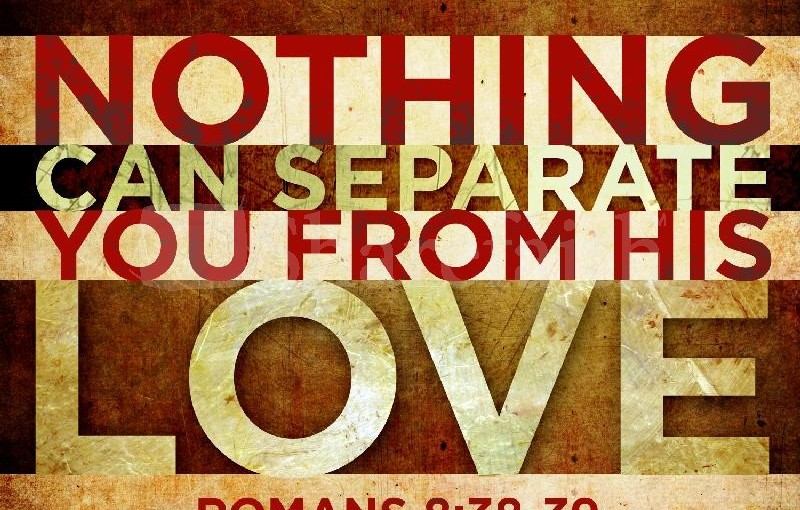
    There is someone, certainly, who is against us, and that one is Satan, and yes he and his threat are real.  Even the celebration of this Halloween day might make us shake our heads.  But Saint Paul reminds us that even Satan cannot ultimately take us down, because God is for us.  Saint Paul quite rightly insists that “Neither death, nor life, nor angels, nor principalities, nor present things, nor future things, nor powers, nor height, nor depth, nor any other creature will be able to separate us from the love of God in Christ Jesus our Lord.”

    That is the same consolation that comes from devotion to the Sacred Heart of Jesus or the Divine Mercy.  It is the consolation for which we gather this morning at the Table of the Lord.  It is the consolation that takes on every threat we encounter this day or ever in our lives: nothing and no one can separate us from God’s love.  Nothing.

  • Saints Simon and Jude, Apostles

    Saints Simon and Jude, Apostles

    Today, we celebrate two apostles who, as often is the case, are relatively unknown except that they were followers of Jesus.  Jude is called Judas in Luke and in the Acts of the Apostles.  Matthew and Mark call him Thaddeus.  We have in the New Testament the letter of Jude, which scholars say is not written by the man whose feast we celebrate today.  Saint Jude is perhaps best known as the patron saint of the seemingly-impossible, reminding us that in God, all things are possible.

    Simon – and this is not the Simon who Jesus later named Peter –  was a Zealot, a member of a radical party that disavowed all ties with the government, holding that Israel should be re-elevated to political greatness under the leadership of God alone.  They also held that any payment of taxes to the Romans was a blasphemy against God.

    Neither of these men held any claim to greatness here on earth; they found their glory in following Christ.  Their joy was, as St. Paul instructs us in his letter to the Ephesians, in that their citizenship was in heaven, as it is for all of us.  We are merely passing through this place, and our task while we are here, as was the task for Simon and Jude and all the apostles, is to live for Christ and to live the Gospel.  The reward for them, then, as is for all of us, is in heaven, their and our true home.

    Their message, as the Psalmist says, goes out to all the earth.  Blessed are all of us when we catch that message and live that message, following the way to Christ Jesus.

  • The Thirtieth Sunday of Ordinary Time

    The Thirtieth Sunday of Ordinary Time

    Today’s readings

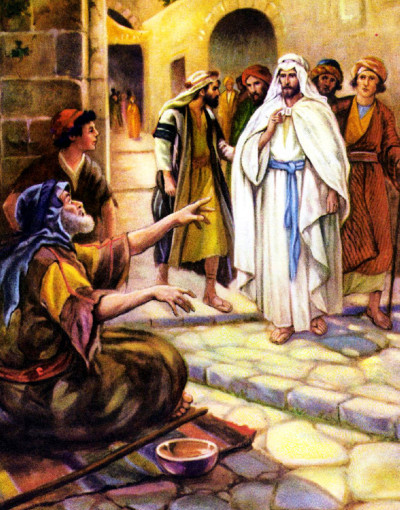
    You probably know me well enough that you know I’m going to say that the Gospel story that we have today isn’t about the healing of the blind man. And you’re right; I’m not. But you might be expecting me to say that the story is really about some more pervasive blindness that the man had, and truly, we all have, and the real miracle is that he was healed of that, and that we should reflect on what blindness we have and pray to be healed of that. And honestly, I thought that was how I was going to preach it, until Saturday afternoon when I noticed something I had never seen in the story before.

    It’s a throw-away detail, almost, but it changed what the message was for me. It comes at the end of the Gospel, when Jesus tells the man, “Go your way; your faith has saved you.” And then it says that it the man received his sight and followed him on the way. So notice the difference: “Go your way” versus “followed him on the way.”

    If Bartimaeus had gone his way, as Jesus suggested, he would have returned to sitting on his cloak begging for alms. After all, that was all he knew, having done it his whole life. But he had cast that aside in the pursuit of Jesus, and having received sight, he clearly saw that that was the wrong way, and instead follows Jesus on “the way.” So it’s important to note here that “The Way” was an early way that Christians, before they were called Christians, referred to themselves. They would be known as members of “The Way.” So here we see that the real miracle is that Bartimaeus clearly saw that his life lacked the meaning he needed and that the only cure was following Jesus.

    That jibes well with the first reading today. Through the prophet Jeremiah, God says to the Israelites in persecution that he would bring them back: back to Israel, back to the Temple, back to himself. Then, even though they departed in tears – as indeed they did – they would return shouting for joy.

    So the real miracle here is not one of blindness and seeing, but one of metanoia, which is the Greek word meaning a change in ones life – really a complete reversal – based on a spiritual interior conversion. The Israelites had been going the wrong way, so God gave them over to their persecutors, but because that penance produced conversion, he brought them back. Bartimeus had been going the wrong way living a pointless life of begging, but through giving himself over to Jesus and trusting in him, he found purpose in following him on The Way.

    And we have to see what’s going on in our own lives. For me, even though I’ve been busy about the stuff of pastoral ministry, God has been doing amazing things calling me to new holiness. What is he doing in you right now? Have you been coasting in your spiritual life? Have you paid it little attention? If so, maybe God is calling you to forsake your own way, and give yourself over to The Way.

  • Pope Saint John Paul II

    Pope Saint John Paul II

    Today’s readings

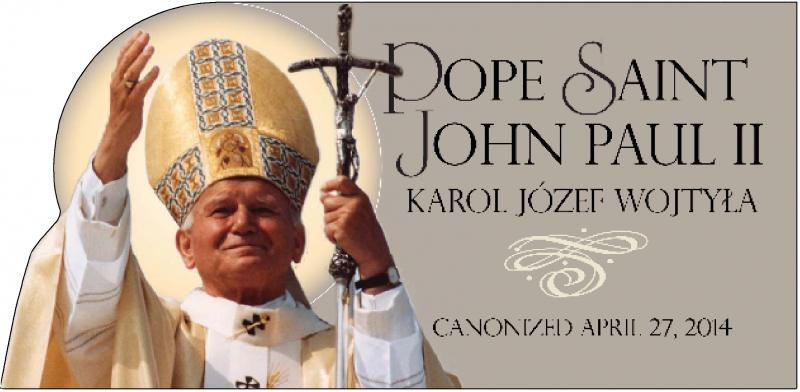
    Today, we celebrate the feast of Pope Saint John Paul II, who was born in 1920 in Wadowice, Poland.  After his ordination to the priesthood and theological studies in Rome, he returned to his homeland and resumed various pastoral and academic tasks.  He was ordained an auxiliary bishop and, in 1964, became Archbishop of Kraków and took part in the Second Vatican Council.  On October 16, 1978, he was elected pope and took the name John Paul II, honoring his two predecessors, Pope Saint John XXIII, and Blessed Pope Paul VI.  His exceptional apostolic zeal, particularly for families, young people, and the sick, led him to numerous pastoral visits throughout the world.  Among the many fruits which he has left as a heritage to the Church are above all his rich theological teaching and the promulgation of the Catechism of the Catholic Church as well as the Code of Canon Law for the Latin Church and for the Eastern Churches.  In Rome on April 2, 2005, the eve of the Second Sunday of Easter (or of Divine Mercy), he departed peacefully in the Lord. He was canonized by Pope Francis on that same feast in 2014. Normally a Saint’s feast day falls on the day of his or her death, but because that date would often fall during holy week, and because the Church desired that his feast be celebrated with due solemnity each year, his feast is today, on the anniversary of the date of the Mass for his inauguration to the pontificate.

    In many ways, Saint John Paul II embodied the zeal of Jesus in today’s Gospel. “I have come to set the earth on fire,” Jesus says. Saint John Paul indeed set the earth on fire in many ways, contributing to the fall of communism in Eastern Europe, and reinvigorating the Church through authentic teaching and his own personal charisma. We may remember that he often echoed the Scriptural teaching of “Do not be afraid,” and modeled the freedom of living ones faith and witnessing without apology. May we all be reinvigorated as we celebrate his feast, and devote ourselves totally to Jesus, through Mary, as he did.

  • Ss. Isaac Jogues, John de Brébeuf and Companions, Martyrs

    Ss. Isaac Jogues, John de Brébeuf and Companions, Martyrs

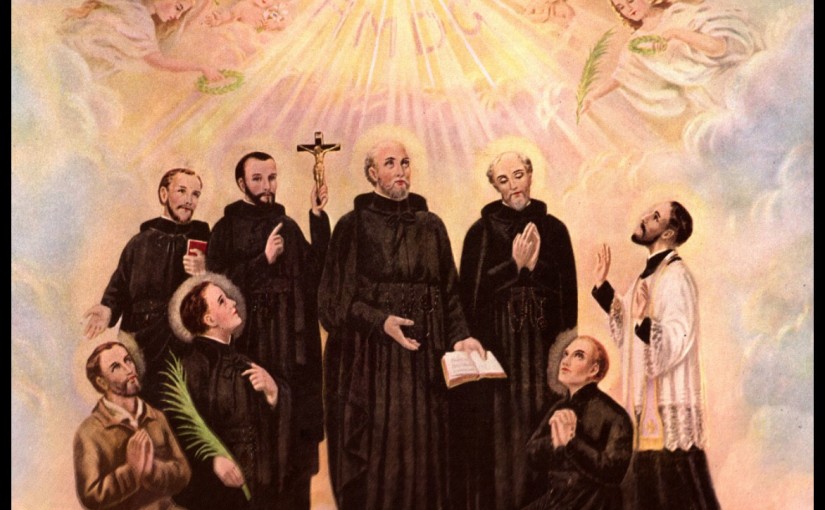
    St. Isaac and St. John were among eight missionaries who worked among the Huron and Iroquois Indians in the New World in the seventeenth century. They were devoted to their work and were accomplishing many conversions. The conversions, though, were not welcomed by the tribes, and eventually St. Isaac was captured and imprisoned by the Iroquois for months. He was moved from village to village and was tortured and beaten all along the way. Eventually he was able to escape and return to France. But zeal for his mission compelled him to return, and to resume his work among the Indians when a peace treaty was signed in 1646. His belief that the peace treaty would be observed turned out to be false hope, and he was captured by a Mohawk war party and beheaded.

    St. John worked among the Iroquois and ministered to them amid a smallpox epidemic. As a scholastic Jesuit, he was able to compose a catechism and write a dictionary in Huron, which made possible many conversions. He was eventually captured, tortured and killed by the Iroquois.
    St. Isaac, St. John and their companions inspire us to take up the mission: to make Christ known, relying on the treasure of grace he brings us and promises us, and accepting that this world’s glory is not worth our aspirations. This will not be easy, of course, in a culture that largely rejects the promises of heaven in its pursuit of instant gratification. But perhaps the witness of these French Jesuits would help us to bravely witness to the Truth with the same zeal for the mission that they did. Our mission may not be to a culture so different to us as the Indian cultures were to these men, but that mission is none the less vital to the salvation of the world.

  • The Twenty-ninth Sunday of Ordinary Time: Stewardship

    The Twenty-ninth Sunday of Ordinary Time: Stewardship

    Today’s readings

    At the heart of today’s Gospel reading is the question of whether or not we as disciples of Jesus are willing to go where he’s leading us. Much could be said about the posturing of James and John to get the good seats in the kingdom. But honestly, they didn’t even know what they was asking. They had no idea what the kingdom would look like. They even missed the fact that it was in some ways already there. But their ambition is not the point here.

    The point, as Jesus illustrates, is that his kingdom is not one of honor and glory, at least not in the way that James and John were thinking. His kingdom is about suffering and redemption, and then honor and glory. To get to the good stuff, you have to go through the cross. And the most honored one is the one who serves everyone else. Let me illustrate with an admittedly somewhat unflattering story about yours truly.

    When I was in seminary, there were a number of nice, fancy dinners that would follow important events in the school year. So we would have them after a class received ministries like Lector or Acolyte, or after Mass for a reunion of 25-year or 50-year jubilarians. At each of these dinners, the table would be set up very fancy, and there would be an apron draped over the back of one of the chairs at the table. The idea was, the person sitting in that seat would be expected to put on the apron and serve the others at the table.

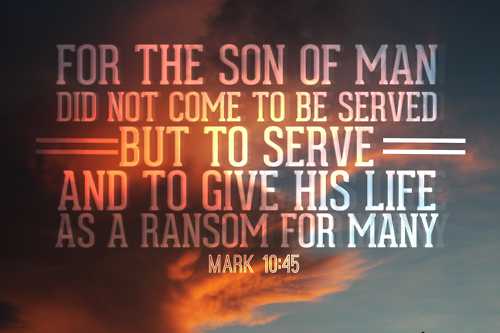
    When I first got to seminary, I still had a lot of changing to do. I brought with me a lot of the selfishness of my former life. So when it came time for these dinners, I would rush to get to the refectory so that I didn’t have to sit in that spot and serve the others. I know, not very pastor-like, was it? But one day, I reflected on those last two lines of today’s Gospel: For the Son of Man did not come to be served but to serve and to give his life as a ransom for many. And in that moment, I realized that it was indeed service that I was called to do, so if I was going to be successful in priesthood, maybe I could show it by embracing something menial like serving the others at my table.

    From that day forward, things changed for me. I would still rush to get over to the refectory as soon as I could, but that was so that I could sit in that seat and serve the others. Not only did I take on the server role, but I actually found joy in it. When you let go of thinking only about yourself, you find that you can actually receive many blessings. The blessings I found were that those dinners were a lot more fun; I had some wonderful conversations not only with the people at my table, but also with the kitchen staff.

    Jesus in our Gospel reading today is calling us all to sit in that seat at the table, to put on our aprons, and help serve everyone else. That flies in the face of our entitlement, it tears down the notion of looking out for number one, it means that inconvenience for the sake of others has to become a real option in our daily lives. But let’s be honest, not all of us, probably none of us, are ready to get up there on the cross and die for the sake of the ungodly. Instead, we have to find little ways of love that build up others and take them on despite the millions of other things clamoring for our attention.

    This is Stewardship Sunday. On this day, we always call on each other to take stock of the many blessings God has given us and move to respond to that blessing. Today’s Gospel ups the ante and calls us to be the servant of all. I am asking you to prayerfully consider how you can respond to that call. Two weeks ago, you heard our Finance Committee talk about the state of our parish finances and our parish buildings. We have accomplished a lot together, but there is still more to be done. This coming week, you’ll receive a letter from me in the mail, asking you to respond to God’s blessings in your life. I realize that you have many demands on your family’s finances, just as we do here at church. But whatever you can give helps us to accomplish the mission of our parish: worshipping God, educating children and adults in the faith, and reaching out to assist those in need. We cannot do that without your support. There is a form included in the letter that you can fill out to indicate your support. Please return it next week so that we can recognize and thank you for your participation.

    I am also asking that you help us with your time and talent. Included in the letter you will receive this week is a volunteer form that talks about a few of our most needed volunteers here at Notre Dame. There are many more ways that you can help, and we would be glad to match you up to a service opportunity that works for you.

    Our parish Day of Service is coming up on Saturday, November 21. Please mark you calendars and plan to be a part of this incredible day. We will begin with Mass at 8am, then after a light breakfast, will go out and serve the community and the parish in many ways. It’s a lot of fun, and there are service opportunities for everyone in the family. Sign-up sheets will go up in the Narthex in a couple of weeks.

    Jesus told us that whoever wishes to be great among us must be the servant of all. He himself did not think he was above washing the feet of his disciples on his last night on this earth. We are called to follow his ways if we want to follow him to the kingdom. Let’s none of us be afraid of taking that seat at the table and putting on the apron.

  • Saint Teresa of Avila

    Saint Teresa of Avila

    Saint Teresa was a virgin, mystic, nun, reformer of the Carmelite order, and, with Saint John of the Cross, foundress of the Discalced Carmelites. When she was a girl, her father sent her for a time to live in an Augustinian convent, until she became ill about a year or so later. During her illness, she began to contemplate the prospect of living a religious life, and eventually decided to join a convent of Carmelite nuns, which her father strongly opposed. After she turned twenty-one, she did join, and her father gave up opposition to it. She was known to be a woman of prudence, charity and personal charm, and so many people came to be devoted to her charism.

    Teresa struggled, though, with personal prayer until her early forties. Persevering in prayer, she found that she more and more enjoyed being in the presence of the Lord, and really began to grow in friendship with him. This is the message of today’s Gospel: “Remain in me,” Jesus says to us. The way that we do that is by persevering in prayer, whether it is difficult or easy. The saints all tell us that staying with prayer, even in the hard times, is the key to a fulfilling spiritual life. Sometimes it may feel dry or unfruitful, but the Spirit continues to work in us as we continue to pray.

    Saint Paul tells the Romans the same thing today: “We do not know how to pray as we ought, but the Spirit himself intercedes with inexpressible groanings.” So today we trust that, just like for Saint Teresa, the prayer of our hearts would find expression in whatever way God wants for us, and that we might always remain in Christ.

  • Monday of the Twenty-eighth Week of Ordinary Time

    Monday of the Twenty-eighth Week of Ordinary Time

    Today’s readings

    I think it’s a pretty common experience for people to look for a sign from God. So many comedies have that premise somewhere in the story line. Don’t we all look for signs from God to make sure we’re doing the right thing?

    So signs are necessary and helpful events in our spiritual journey. And Jesus was never stingy about giving signs. After all, he healed the sick, raised the dead, and fed the multitudes. Who could have possibly missed the signs and wonders he was providing? The thing was, the people, especially the religious authorities, were cynical and hard of heart, and they soon forgot the wonders he had done. So they wanted to see Jesus do things they were pretty sure he couldn’t do; in other words, they were asking for a sign not from an attitude of faith, but an attitude of cynicism.

    And Jesus had no intention of playing that game. These people would get no further sign, at least not until the sign of Jonah. So what did that mean? Well, as we remember, Jonah was swallowed up in the belly of a big fish for three days, then disgorged on the shores of Nineveh. Jesus was foreshadowing that, in the same way, he himself would be swallowed up in the grave for three days, then raised to new life. These cynical people would just have to wait for that great sign, and even then, well, chances are they wouldn’t believe.

    So I think it’s okay for us on occasion to ask for a sign. We can ask God to help us to know we have discerned the right path, or are at least headed in the right direction. But we must always ask from the perspective of our life of faith, being open to whatever God shows us, being open to silence if that’s what he gives us, ready to follow him, sign or no sign, wherever we are led. God is always there, even in our most difficult quandaries, ready to give us confidence by his presence.

    And never forget that we have already received the sign of Jonah, and that sign is incredibly good news for all of us!

  • The Twenty-seventh Sunday of Ordinary Time

    The Twenty-seventh Sunday of Ordinary Time

    Today’s readings

    If you’ve been to any number of Church weddings, you have probably heard today’s first reading, and part of the Gospel proclaimed. Obviously we usually leave out the part about divorce, but these readings are quite popular for weddings. The reason, of course, is that the story is about how man and woman were created for each other. The totality of the readings we have today, though, are challenging. We do have that piece about divorce there, and it does present a challenge in these days when so many marriages fail.

    Jesus’ point here is that the Christian disciple is called to a level of faithfulness that transcends the difficulties of life. We can’t just throw in the towel and walk away when things are difficult: marriage vows make demands of people – I say that in every wedding liturgy I do. In the very same way, ordination promises make demands of priests. We have to pray for the grace to be faithful in good times and in bad. But sometimes it doesn’t work out that way.

    That being the case, I want to take this opportunity to make some points and dispel some myths about the Church’s teaching on marriage, divorce, remarriage, and annulment. The first myth is that divorce is a sin that excommunicates a person from the Church and does not allow them to participate in the life of the Church or receive the sacraments. But divorce is not a sin in and of itself. It may well, however, be the result of sin, and a consequence of sin. Those who are divorced, however, remain Catholics in good standing and are free to receive the sacraments including the Eucharist, sacramental absolution in the sacrament of Penance, and the Anointing of the Sick. However, they remain married to their partner in the eyes of the Church and are not free to remarry, unless they receive an annulment. Those who remarry without an annulment have taken themselves out of communion with the Church and are not free to receive the sacraments.

    The second myth is that an annulment is really just “Catholic Divorce.” However, annulment is recognition by the Church that a valid marriage, for some reason, had never taken place. The diocesan policy document on annulment defines it in this way: “Although not every marriage is a sacrament, every marriage (Catholic, Protestant, Jewish, Non-Believer, etc.) is presumed to be a valid marriage. The good of all concerned (spouses, children, in-laws, society, the Church, etc.) demands this presumption. In every presumption, the opposite may be true. If sufficient evidence can be shown that a particular marriage is invalid, the original presumption no longer holds. Therefore, when it can be shown that a particular marriage is not a true marriage, or not a sacrament, or not consummated, then it is possible for the Tribunal to declare that the parties are free to marry in the Catholic Church.” (Declaration of Nullity Proceedings, Diocese of Joliet , p.3) The annulment basically states that a valid marriage never happened in the first place, usually because the parties for some reason were not free to marry. These reasons may include extreme immaturity, a previous and previously undiscovered prior marriage, or entering marriage with no intention of remaining faithful or of having children. Pope Francis recently added some other reasons, including a fictitious marriage to enter into citizenship, a very brief marriage, stubborn persistence in an extramarital affair, and the procurement of an abortion to avoid procreation. In addition, Pope Francis somewhat simplified the process of an annulment in order to decrease the amount of time it takes to proceed.

    A third myth is that those who are marrying a non-Catholic who had been previously married are automatically free to marry, since the non-Catholic’s marriage did not take place in the Catholic Church. But as I just said, the Church presumes marriages between non-Catholics to be valid, so their previous marriage would have to be annulled by the Catholic Church before a Catholic is free to marry them.

    A fourth myth is that the Church always insists that the parties stay together. Today’s readings show that the permanence of the marriage relationship is the intent of God, and the strong preference of the Church. However, we all understand that there are circumstances in which that may not be possible. The Church would never counsel someone to stay together in an abusive. That is completely unacceptable. If you are in an abusive relationship, whether the abuse is physical, verbal, or emotional, you need to seek help and safety. The Church will support you in that decision. If you find yourself in that kind of relationship, whether you are married or not, I want you to see someone on our staff immediately.

    Finally, there are some misconceptions about annulment proceedings that I want to clear up. First, if you do receive an annulment, that does not mean your children are illegitimate. The Church sees children as a gift from God, and thus never takes away their status as sons and daughters of God. Second, people think annulments are too expensive. They are not. The cost of an annulment in our diocese is around $700, not the tens of thousands of dollars people had thought was necessary in the past. But, under no circumstances will an annulment be denied if a person cannot meet those expenses. But I always tell people that there are other costs in an annulment, most of which are emotional. An annulment dredges up all sorts of things that may have been suppressed, and that’s never going to be painless. But that kind of pain is part and parcel of any healing, so when you are in the right place for it, if you think your marriage was invalid, you should speak to someone who can help you begin the process. That person is called a field advocate, and here at Notre Dame, there are two of us: Dr. Muir and me. Please feel free to speak with us any time.

    What it all comes down to is this: we must all do what we were created for. Relationships and vocations are opportunities to do that, but to be effective, we must choose to be faithful. When life throws stuff at us, as indeed it will, we must choose to be faithful anyway. But if brokenness destroys that grace, we should turn to the Church for reconciliation and mercy.
  • Saint Thérèse of Liseaux, Virgin and Doctor of the Church

    Saint Thérèse of Liseaux, Virgin and Doctor of the Church

    Today’s readings

    St. Thérèse knew well the instruction of today’s Gospel reading. She was one who sought to proclaim the Lord in every simple act of her life. St. Thérèse had a child-like faith, child-like, that is, in her trusting obedience to God’s will, even in the smallest of matters. She truly believed that small acts of faith and love would work wondrous miracles for the Kingdom of God.

    Thérèse was a very sickly young lady. A childhood illness left her weak for the rest of her life, and during her last year on earth, she was dying of tuberculosis. She entered the convent at the age of fifteen, and when she died she was just twenty-four years old. Yet in that short span of time she wrote much about her faith and encouraged others to embrace a simplicity of life and a dedicated obedience to God’s will. In 1997, Pope John Paul II named her a Doctor of the Church, one of just three women to have that special title.

    Thérèse was not one who sought the limelight. She did not seek to make a name for herself or become anything other than what God wanted her to be. In Thérèse’s view, even the most menial tasks in the convent could be transformed into great acts of love. And her preference for hidden sacrifice did indeed convert souls. Thérèse is one of the most beloved saints in the Church. Her autobiography, The Story of a Soul, is read and loved throughout the world.

    The Psalmist reflects Thérèse’s rule of life by singing, “The precepts of the Lord give joy to the heart.” Perhaps today we too can find joy in doing small acts of love for the great glory of the Kingdom of God.