Category: Preaching, Homiletics & Scripture

  • The Twelfth Sunday of Ordinary Time: Journeying from Fear to Faith

    The Twelfth Sunday of Ordinary Time: Journeying from Fear to Faith

    Today’s readings

    Getting ready for Mass today, I thought about my Dad. Not just because it’s Father’s Day, although that’s certainly part of it. But partly because of today’s Gospel. The story we have here today speaks about a journey, and I’ll say more about that in a minute. My Dad was great for journeys: he loved to drive and take the family to Wisconsin or to Disney, or wherever we needed to go. He’d have us up early in the morning so that we’d miss rush hour traffic, and we’d be on our way.

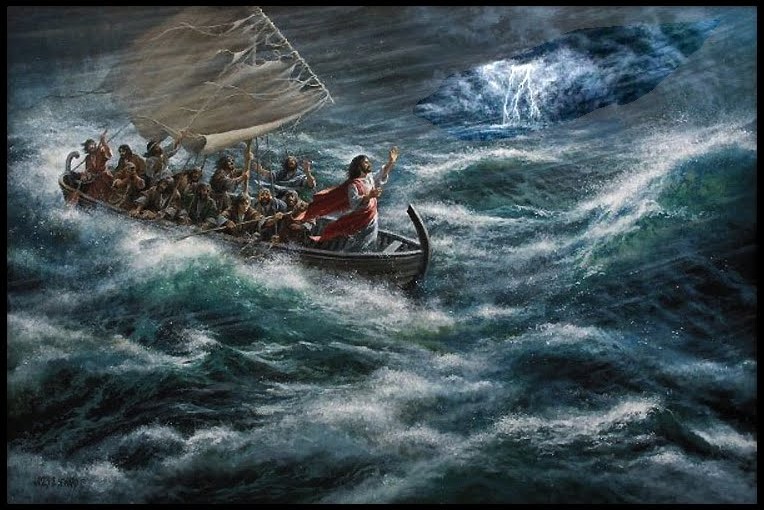
    Today, Jesus and his disciples set out on a significant journey. The reading we have today is at the end of chapter four, in which Jesus has been standing next to the sea, teaching the people by means of parables. He has told them the parable of the sower who went out to sow seeds, the parable of the mustard seed, and the lamp placed on the lamp stand. He is explaining the kingdom of God to them, but they don’t quite get it. Even the disciples have to have it explained to them. When he’s done the best that he can with them, he is ready to move on. There are other people that need to hear the Good News, others who need to know Jesus’ power and authority.

    And so he sets out on the journey, and the reading says that the disciples take him with them in the boat “just as he was.” That’s a curious detail, I think. But it makes me remember those trips with my dad. It’s time to get going, no time to change clothes or freshen up, just get in the car – or in this case, the boat – and let’s get started on the journey. But the journey isn’t always without its problems. On vacation trips we may run into traffic, or if in the air, perhaps turbulence. On the sea, the disciples experienced the raging waves of a fearsome storm. So they wake Jesus up, because apparently these storms don’t really affect him, and he rebukes the storm, and then rebukes the disciples for their little faith.

    We’re all on a journey. That journey, like that of the disciples, is from fear to faith. We very rarely have time to think about it; we just have to get in the boat and get moving, just as we are. The journey is not always smooth: storms arise, and when they do, it often seems like our God is sleeping, seeming not to care that we are about to perish. I’m not going to fill in the blanks for you – you can all do that well enough. You’ve been on many journeys in your life, and sometimes the ride has been bumpy. But if we stay on the journey, we definitely get to experience this One whom “even wind and sea obey.” Even when our God seems to be sleeping, he is never unaware of our situation, and his love for us is never on pause.

    The thing is, sometimes the storm doesn’t seem to stop so quickly as it does in today’s Gospel reading. Would that Jesus would stand up in the boat of our uncertainty and yell out: “Quiet! Be still!” But maybe he is. Maybe the “Be still” is directed at us and not at the storm. There was a contemporary Christian song a few years ago now, that had this wonderful line in it: “Sometimes he calms the storm, and other times he calms his child.” That song has given me peace in many situations. Because as frightening as the storms of our lives can be, they are no match for the grace of God. Even if God allows the storm to rage in our lives, if he is with us, calming us, we have nothing to fear. And maybe that is the occasion when we make progress on that journey from fear to faith.

    So as we leave this holy place today, we are on a journey to the most holy place, our true home in heaven. Along the way, we will have other destinations, and as we travel, we know that Jesus will be with us through it all. He may calm the storms that arise, or he may calm his children, whichever is most appropriate. And we know that the journey from fear to faith will lead us back one day to the place we really belong, at the banquet table in the kingdom of everlasting life. May all of our life’s journeys end up in that same, great place!

  • Friday of the Eleventh Week of Ordinary Time

    Friday of the Eleventh Week of Ordinary Time

    Today’s readings

    It amazes me when I think about all that the early Church had to go through and put up with. Saint Paul writes that he put up with persecution from all sides: from his own people as well as the Gentiles. He was beaten often, endured hazardous journeys and perilous weather, as well as every kind of deprivation. His experience was definitely extreme, but others who lived the faith in those days were also subject to persecution, torture and death. Our experience isn’t like that, is it? I mean, here we sit in this air-conditioned church and relatively comfortable surroundings. We came here freely to Mass this morning and it is unlikely that anyone will openly persecute us or torture us or put us to death for worshipping our God, although as we saw in the news yesterday, it does happen.

    But there is a subtle kind of persecution that we must endure. We know that even if our society is not openly hostile to living the Gospel, it is certainly just one step short of that. Life is not respected in our society: babies are aborted, the elderly are not respected or given adequate care, children are not raised in nurturing families, people are hated because of their race, color or creed. Faith is ridiculed as the crutch of the weak. Hope is crushed by those who abuse power. Love is overshadowed by sexual perversion and self-interest. Living the Gospel is dangerous to anyone who would want to be taken seriously in our culture.

    To all of us who come to this holy place to worship this morning and who hope to work out our salvation by living the Gospel, Saint Paul speaks eloquently. We know that he, as well as all of the communion of saints, is there to intercede for us and show us the way. He says to us today, “Who is weak, and I am not weak? Who is led to sin, and I am not indignant?” He points us to our Lord Jesus who paid the ultimate price for the Gospel, and reminds us that in living that Gospel, regardless of its cost, we store up for ourselves incredible treasures in heaven, because it is in heaven that our heart resides.

  • Monday of the Eleventh Week of Ordinary Time

    Monday of the Eleventh Week of Ordinary Time

    Today’s readings

    Today’s Gospel reading is from the very challenging portion of Matthew’s Gospel in which we hear Jesus use the formula: “You have heard it said … but I say to you…”  Basically, in all of these instructions, Jesus is taking the old Jewish law and cranking it up a notch.   He teaches that anger, vengeance and libel are as disastrous as murder; that lust is as morally reprehensible as adultery.   In today’s reading, Jesus takes on the concept of justice.

    In the days before Jesus, justice was met by inflicting on the one who had wronged you what they had done to you.  An eye for an eye, a tooth for a tooth; you steal one of my sheep, I take one of yours, that kind of thing.  It’s a very primitive sort of justice, but to be honest, I think, one that still kind of resonates in our society.  People might not like to say they believe this sort of thing, but you see it all the time.

    Jesus isn’t into defining justice in this way.  For Jesus, true justice consists in rendering to God what he belongs to God; it means giving to others as God has given to us.  In a way, it’s the primordial form of the whole “pay it forward” idea.  If God has been generous to us, then, in justice, we need to be generous to others.  So we don’t argue about our tunic, but instead give our cloak as well.  We go the extra mile, and never turn our back on those in need.

    We believers have to get our heads around the idea of true justice.  We have to be willing to give without counting the cost.  We have to remember that in justice, we should be condemned for our many sins, but instead we have salvation in Christ Jesus.  Because God has been merciful and generous to us, then in justice we must do the same for others.

  • The Immaculate Heart of the Blessed Virgin Mary

    The Immaculate Heart of the Blessed Virgin Mary

    Today’s Gospel story is a fitting one, I think, for this celebration of the Immaculate Heart of Mary.  The evangelist tells us that Mary’s heart was filled with wonder.  There are a few stories in the Gospels that end with that wonderful line: “and his mother kept all these things in her heart.”  I think the moms here can understand the sentiment of these lines.  I think any mother is amazed at the things their children learn to do, but Mary’s wonderment goes beyond even that: she is amazed at the coming of age of Jesus Christ as the Son of God.  She knew her child would be special, and when you read these stories you can just imagine how astounded she is at times.  Her heart was filled with wonder.

    At other places in the Gospel, I imagine her heart is filled with fear.  She began to see, I am sure, that the wonderful things her son was doing were not universally appreciated.  She must have known that the authorities were displeased and were plotting against him.  She probably worried that he would be in danger, which of course he was.  Her heart was filled with fear.

    Toward the end of the Gospel, her heart is certainly filled with sorrow.  As she stood at the foot of the cross, her son, the love of her life, is put to death.  The Stabat Mater hymn calls that well to mind: “At the cross her station keeping, stood the mournful mother weeping, close to Jesus at the last.”  The prophet Simeon had foretold her sorrow when she and Joseph presented Jesus in the temple.  Her heart was filled with sorrow.

    At the end of the Gospel, her heart must have been filled with joy.  Jesus’ death was not the end of the story.  Not only did his life not end at the grave, now the power of the grave is smashed to oblivion by the power of the resurrection.  In those first hours after his resurrection, she shared the joy of the other women and the disciples.  Her heart was filled with joy.

    And as the community went forward in the book of Acts to preach the Good News and to make the Gospel known to every corner of the world, Mary’s heart was filled with love.  That love that she had for her son, that love that she received from God, she now shared as the first of the disciples.  Her place in the community was an honored one, but one that she took up with great passion.  Her heart was filled with love.

    For us, perhaps, the best news is that, through it all, her heart was always filled with faith.  That faith allowed her to respond to God’s call through the angel Gabriel with fiat: “let it be done to me according to your word.”  Because of Mary’s faith, the unfolding of God’s plan for the salvation of every person came to fruition.  We are here this morning, to some extent because of her faith, that faith that allowed her to experience the wonder, sustained her through fear and sorrow, and brought life to the joy and love she experienced.  She kept all these things in her heart, that heart that was always filled with faith.

  • The Most Sacred Heart of Jesus

    The Most Sacred Heart of Jesus

    Today’s readings

    Yesterday I had a bad flare-up of plantar’s fasciitis, and had to go to the doctor. I was in pain a lot of the day, and it just got exhausting. In the evening, I was to have dinner with one of my priest friends, and when he found out how I was feeling, he had dinner for me at his rectory so we could relax and not have to walk around a lot. It was nice to be taken care of. I think that is true whenever we’re not feeling well: when someone takes care of us, it seems to heal us deep inside.

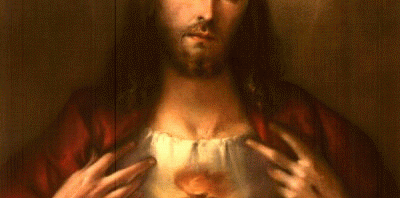
    And that’s what today’s feast of the Most Sacred Heart of Jesus is all about. We are all broken and hurting and in pain, spiritually. We might ignore it, or offer it up, or worst of all, might try to mask it with alcohol or other addictions. But none of that really heals us. The only thing that really heals is the Most Sacred Heart of Jesus.

    We don’t trust God as much as we should; we don’t let God love us as much as we should. We want to pull ourselves up by our own bootstraps, take care of number one all by ourselves. Pope Francis says that God never gets tired of showing us mercy, it’s we who get tired of asking. And that’s so wrong. We weren’t made for that. We were made to be cared for and to be loved so that we can take care of others and love them in the name of Christ.

    God’s love is awesome. It doesn’t just cover our sins, it wipes them out, obliterates them so that they aren’t who we are any more. In the Sacred Heart of Jesus, we find a love that is so pure and so powerful that it cannot be overshadowed by any kind of darkness, nor be snuffed out even by the grave.

    But we absolutely have to let him love us, or we will miss it every time.

  • The Most Holy Body and Blood of Christ

    The Most Holy Body and Blood of Christ

    Today’s readings

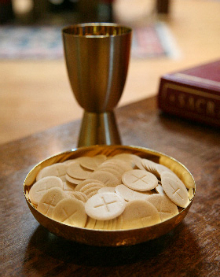
    Today we celebrate with great joy one of the most wonderful feasts on our Church calendar, the Most Holy Body and Blood of Christ. Through this greatest of all gifts, we have been made one with our God who loves his people beyond all imagining. We experience this love in perhaps one of the most basic ways of our human existence, which is to say by being fed. Learning to satisfy our hunger is one of the first things we learn; we learn who we can depend on and develop close relationships with those people. Today’s feast brings it to a higher level, of course. The hunger we’re talking about is not mere physical hunger, but instead a deep inner yearning, a hunger for wholeness, for relatedness, for intimate union with our God. This is a hunger that we all have, and despite our feeble attempts to do otherwise, it cannot be filled with anything less than God.

    What we see in our God is one who has always desired deep union with his people. Salvation began with the creation of the whole world, the saving of Noah and those on the ark, the covenant made with Abraham, the ministry of the prophets, and ultimately culminated in the life, death, and resurrection of Christ, the acceptable sacrifice which brings salvation to the whole world. God never lost interest in his creation; he didn’t set the world in motion and then back off to leave everything to its own devices. God has time and again intervened in human history, offering us an olive branch, seeking renewal of our relationship with him, and bringing us back no matter how far we have fallen.

    God has repeatedly sought to covenant with us. Eucharistic Prayer IV beautifully summarizes God’s desire: “You formed man in your own image and entrusted the whole world to his care, so that in serving you alone, the Creator, he might have dominion over all creatures. And when through disobedience he had lost your friendship, you did not abandon him to the domain of death. For you came in mercy to the aid of all, so that those who seek might find you. Time and again you offered them covenants and through the prophets taught them to look forward to salvation.” And unlike human covenants, which have to be ratified by both parties, and are useless unless both parties agree, the covenant offered by God is effective on its face. God initiates the covenant, unilaterally, out of love for us. Our hardness of heart, our sinfulness, our constant turning away from the covenant do not nullify that covenant. God’s grace transcends our weakness, God’s jealous love for us and constant pursuit of us is limitless.

    Today’s Liturgy of the Word shows us the history of the covenant. The first reading recalls the covenant God made with the Israelites through the ministry of Moses. The people agree to do everything the Lord commanded, and Moses seals the covenant by sprinkling the people with the blood of the sacrifice and saying, “This is the blood of the covenant that the LORD has made with you in accordance with all these words of his.” The writer of the Letter to the Hebrews makes the point that if the blood of sacrificed animals can bring people back in relationship with God, how much more could the blood of Christ draw back all those who have strayed. Christ is the mediator of the new covenant, as he himself said in the Gospel: “This is my blood of the covenant, which will be shed for many.”

    And so we, among the many, benefit from Christ’s blood of the covenant. The preface for the Eucharist Prayer today says, “As we eat his flesh that was sacrificed for us, we are made strong, and, as we drink his Blood that was poured out for us, we are washed clean.” God’s desire for covenant with us cannot be stopped by sin or death or the grave because his grace is mightier than all of that.

    We disciples are called then to respond to the covenant. Having been recipients of the great grace of God’s love, we are called to live the covenant in our relationships with others. Which isn’t always the easiest thing to do. Sometimes people test our desire to covenant with them; sometimes they don’t even want to be in covenant with us. But the model for our relationships with others is the relationship God has with us. And so sometimes we have to unilaterally extend the covenant, even if the other isn’t willing, or doesn’t know, that we care for them. God wants to offer the covenant to everyone on earth, and he may well be using us to extend the covenant to those he puts in our path.

    We do this in so many ways. Here at Notre Dame, one of the important ways we do that is through our food pantry which serves over 60 families each month. Our Food Pantry has the distinction of bringing the food donations to the families, which is so helpful to those who do not have reliable transportation. Over the past months, our food donations have dwindled, and we were hopeful of a large donation from the food drive by the Clarendon Hills Post Office, but it was not as large as we had hoped. During the summer months, food donations tend to dwindle further, although the need for them does not. One way that we can extend the covenant of grace that we have received is to feed the hungry. I would like to invite all of you to bring a bag of food for the poor next week, even though this is not our regular food pantry collection week. It will go a long way to helping needy families through the summer months.

    God’s covenant with us is renewed every day, and celebrated every time we come to receive Holy Communion. When we receive the Most Holy Body and Blood of Christ in the Eucharist, we are renewed in the covenant, strengthened in grace and holiness, and brought nearer to our God who longs for us. We who are so richly graced can do no less than extend the covenant to others, helping them too to know God’s love for them, feeding them physically and spiritually.

    The Psalmist asks today, “How shall I make a return to the LORD for all the good he has done for me?” And the answer is given: by taking up the chalice of salvation, drinking of God’s grace, renewing the covenant, and passing it on to others. May the Body and Blood of Christ keep us all safe for eternal life!

  • Saint Boniface, Bishop and Martyr

    Saint Boniface, Bishop and Martyr

    Today’s readings

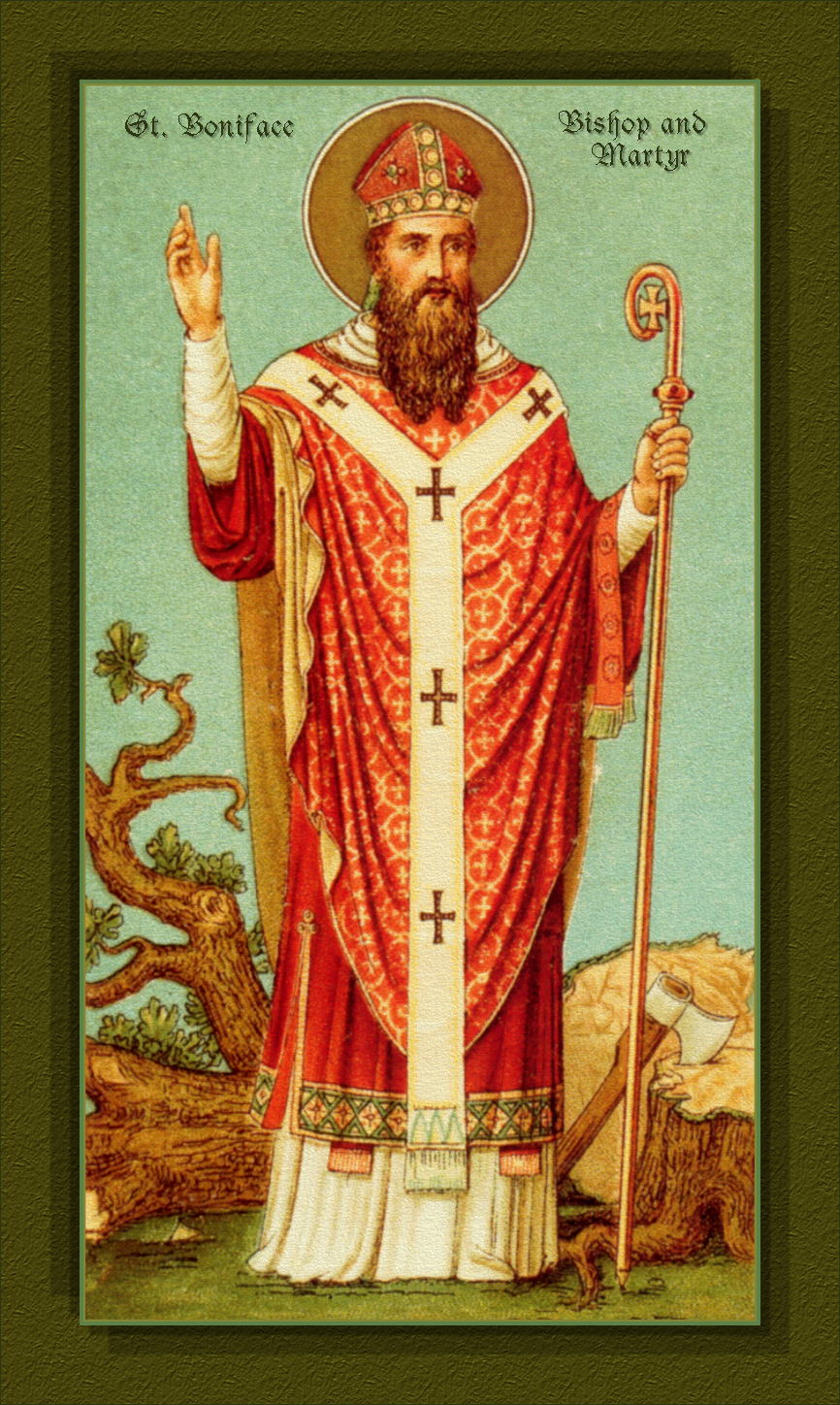
    Saint Boniface was a Benedictine monk in England. Pope Gregory II sent Boniface to a Germany where paganism was a way of life, and where the clergy were at best uneducated and at worst corrupt and disobedient. Reporting all of this back to Pope Gregory, the Holy Father commissioned him to reform the German Church. He was provided with letters of introduction to civil and religious authorities, but even so met with some resistance and interference by both lay people and clergy. Even so, he was extremely successful, centering his reforms around teaching the virtue of obedience to the clergy and establishing houses of prayer similar to Benedictine monasteries. Boniface and 53 companions were finally martyred during a mission, in which he was preparing converts for Confirmation. The success of Boniface’s mission was that he helped the people and the clergy to see what was important: how far they had strayed from God’s plan for the Church.

    In his blindness, Tobit came to see what was important, too. We’ve been hearing this story all week, and way back on Tuesday, we heard about Tobit being made blind by cataracts caused by bird droppings. And later in that same story, he scolded his wife for accepting a goat as a bonus on her labor, because he did not believe her story. At that point, Tobit had to learn that charity – for which he was quite well known – begins at home. His period of blindness gave him that very insight, I think, and in today’s story he rejoices in his cleared vision.

    Through the intercession of St. Raphael, Tobit regained his sight and was able to see his son safely returned from a long and dangerous journey. He saw also the return of his family fortune. And he saw the union of his son Tobit with his new wife Sarah. There was great cause for rejoicing in all that he was able to see and Tobit didn’t miss a beat in placing the credit where it belonged: on God alone.

    And so we praise God today for angels who help us to see what’s really important. We praise God for angels who clear up our clouded vision and help us to see past the obstacles we’ve put in God’s way. We praise God for saints that point us back in the right direction – toward Jesus Christ. We praise God for all those witnesses who help us to overcome our pride and self-righteousness so that God’s way can become clear to us. May we rejoice along with Tobit and Anna and Boniface and his companions, and all the rest that God has brought us back to him, time and time again.

  • Saint Justin, Martyr

    Saint Justin, Martyr

    Today’s readings

    The greatest men and women who have ever lived have followed the example of our Lord Jesus Christ in that they have been willing to give their lives for the truth, for what they believed in, for what is right. In our first reading, Tobit risks his life in order to give a fallen kinsman a proper burial. Tobit and his family had been exiled to Ninevah, and the people there were hostile to the Israelites. Their hostility was so noteworthy, that in another book, Jonah famously refuses to go there and instead gets swallowed up by a large fish. So Tobit has previously narrowly escaped execution for showing charity to his fellows in exile, and he ignores the obvious lesson in order to do what is right.

    For Saint Justin, whose feast we celebrate today, he chose to stand up for the truth. He was born a pagan, and spent a good deal of his youth studying pagan philosophy, principally that of Plato. But he eventually found that Christianity answered the great questions of life and existence better than did the pagan philosophers, so he converted. He wrote famous apologies, defenses of the Christian faith, to the Roman emperor and to the senate. Because of his unwavering dedication to his faith, he was beheaded in Rome in the year 165.

    “The just one shall be an everlasting remembrance,” says the Psalmist today. All of us are called to live our faith with conviction, as did Tobit and Saint Justin. We might never be in the dire straits in which they found themselves, but we too are called to give our lives, our comforts, our standing in the community, our reputation among our peers, for the faith. Today we pray for the grace to live what we believe and to be an everlasting remembrance.

  • Memorial Day

    Memorial Day

    Today’s readings: James 3:13-18; Psalm 72; Matthew 5:38-48

    I was talking to one of our parishioners today who is on a local board that, among other things, hires police officers for their municipality. He was telling me how hard it is to find qualified people willing to serve these days. I wasn’t surprised to hear it. I’ve read a lot over the last several years about how people are not going into service-related professions any more. The priesthood is, of course, no stranger to that phenomenon.

    So maybe it’s a little ironic that we spend today honoring those who have given their lives in service to our country. It’s a little like we’re saying “thanks for doing that, but please don’t ask me to serve.” And our Lord would admonish us for that kind of societal attitude; he didn’t give us the Gospel so that we could do nothing about it.

    In today’s Gospel reading, we hear the famous “but I say to you” sayings of Jesus. He takes very familiar religious practices of his day, and then cranks them up a notch. Believers are not supposed to be on autopilot; we are supposed to sacrifice ourselves for the salvation of others. If we’re asked to give, we have to do it expecting nothing in return. When we love, we are called to do it when it is completely inconvenient, and toward those who we might not prefer to love.

    Service is not optional for the Christian disciple. Laying down our lives is simply doing what our Lord has shown us how to do. If he could die on the cross for us, we can die to ourselves and give our lives in service to others, so they might know God’s love and mercy.

    We truly honor today those who have given their lives for our country. Without their sacrifice, we might not have the freedoms we enjoy today. If we would truly honor their service and their selflessness, then we have to set aside our selfish ambitions as Saint James encourages us in our first reading. To truly honor our fallen heroes, we have to make use of the freedom that they fought for in a way that frees others as well.

    Most of all, we have to work to change the attitude of our society. We have to earnestly set aside selfish ambition and entitlement or become a society that is not truly free. If we’re slaves to ambition, then we will accomplish little individually or as a society. We have to pray for religious vocations and also vocations of service to our country and community. We have to encourage our children and grandchildren to give of themselves in their profession. That is what will make us truly free.

    And that is what would honor our fallen service men and women most of all.

  • The Solemnity of Pentecost

    The Solemnity of Pentecost

    Today’s readings

    No one can say “Jesus is Lord” except by the Holy Spirit. That line from Saint Paul’s first letter to the Corinthians at the beginning of our second reading today says more about the Holy Spirit than we might catch at first.

    Words contain a lot of power. We know that well, because lots of times we say the wrong things and we see how it upsets people we love. And equally we experience the power of someone saying just the right thing at the right time and we see how that expression of love changes everything. Words can convey a range of emotions from love to hate, and everything in between. Words can start an argument, but the right words can diffuse a really bad situation. We’ve seen it thousands of times.

    Most of us receive the gift of speech at birth, and come into it during our childhood. We develop the gift of speech throughout our lives, perhaps learning foreign languages, or become skilled speakers. Speech is crucial to living in society.

    But it is the Holy Spirit who enables us to say anything really good. The only way that we can say “Jesus is Lord,” as Saint Paul tells us, is by the Holy Spirit. The only way that we can witness to the faith, is by the Holy Spirit. That was true of the first Apostles. Remember what happened to them right after the events of Good Friday. They scattered. When they did speak, they put their foot in their mouths. Peter used his gift of speech to deny that he even knew the Lord, let alone witness to the Lord’s power to save. At that time, the Apostles couldn’t even wrap words around what was going on in their own minds, so they were never going to be able to spread the Gospel.

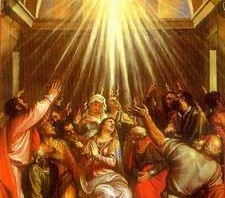
    Until Pentecost. Receiving the gift of the promised Holy Spirit, the Advocate that Jesus promised to send them, they are able not only to preach the Gospel, but to preach it in a way that people who spoke different languages were all able to understand it. The outpouring of the Holy Spirit brings everything together for them, and now, only now, are they able to say that Jesus is Lord!

    The absence of the Holy Spirit is unparalleled sadness. We can’t say – or do – anything really good without the advocacy of the Holy Spirit to inspire – literally breath into us – the goodness for which we were created. The sequence today proclaimed it well:

    Where you are not, we have naught,
    Nothing good in deed or thought,
    Nothing free from taint of ill.

    So when we receive the Holy Spirit, we are inspired to say and do good things too. The Holy Spirit will inspire us to speak many kinds of words in many situations. We can depend on the Spirit to give us the words when we don’t have them. Saint Paul teaches that the Spirit even prays in us when we can’t pray, expressing our needs in groanings when we can’t find the words to say. So the Holy Spirit will inspire us to speak…

    • Words of comfort to those who are going through difficult times. Maybe just by being with them and saying nothing at all.
    • Words of challenge when we are in a situation that is veering off course, and others are urging us to go the wrong way.
    • Words of correction when a child is acting out or not living up to their full potential.
    • Words of reconciliation when we seek to heal a broken relationship.
    • Words of vision when we are part of a group that is seeking to do something new.
    • Words of healing when we comfort another person who has been wronged by others.
    • Words of change when we stand up for what is right in a society that wants to do what it wants to do.
    • Words of mercy when we let go of a grudge, or forgive someone who has hurt us.

    The Holy Spirit will give us the right words for all of this at the right time, and we will be able to speak them in a way that everyone who needs to understand them can understand them. We may never be able to speak multiple languages – God knows I can’t! – but in the Holy Spirit we will be able to proclaim that Jesus is Lord in our words and actions and no one will be able to miss the significance of that – everyone will understand it.