God never forgets how much he loves us. If this weren’t so, I don’t think any of us would be in existence. God loves us into life and loves us through our life and one day, if we let him, will love us into eternal life. The people of Israel had to know this better than anyone. Ezekiel today reminds them that God loved them enough that he would remember the covenant he had made with them, the covenant that they had broken many times, and that he would pardon them for all they had done. Because he loved them.
The question the Pharisees asked Jesus in the Gospel today had nothing to do with love, which is odd because it was a question about marriage. Or, actually, the converse of marriage: divorce. They were asking not because they wanted to know about how to love better in their relationships, but rather because they were trying to trick Jesus into some Moses-bashing. But Jesus has none of that, reminding them of the indissolubility of love.
Many things can be forgotten. God forgets things all the time – namely, our sins. But love can never be forgotten. God never forgets how much he loves us, and we dare not forget how much we love him, and because we love him, how much we love one another. That love may require all kinds of forgetting: forgetting past hurts, forgetting resentments, forgetting what we think we deserve. It’s that “letting go” that I spoke about yesterday.
May we all forget what we have to so that love is the only thing we can remember, and may we all go together, one day, to eternal life.
Blog
-

Friday of the Nineteenth Week of Ordinary Time
-

Saint Clare
Today we celebrate Saint Clare, who, having refused to marry at 15, was moved by the dynamic preaching of Saint Francis. He became her lifelong friend and spiritual guide.
So at age 18, she escaped one night from her father’s home, in order to flee the pressure to marry, and was met on the road by friars carrying torches. They led her to a little chapel called the Portiuncula, where she received a rough woolen habit, exchanged her jeweled belt for a common rope with knots in it, and had her long hair cut by Saint Francis himself. He placed her in a Benedictine convent, which her father and uncles immediately stormed in rage. She clung to the altar of the church, threw aside her veil to show her cropped hair and remained adamant.
Sixteen days later her sister Agnes joined her. Over time, others joined them too. They lived a simple life of great poverty, austerity and complete seclusion from the world, according to a Rule that Saint Francis gave them as a Second Order, which became known as the Poor Clares. Francis obliged her under obedience at age 21 to accept the office of abbess, one she exercised until her death.
The nuns went barefoot, slept on the ground, ate no meat and observed almost complete silence. Later Clare, like Francis, persuaded her sisters to moderate this rigor, saying: “Our bodies are not made of brass.” The greatest emphasis, of course, was on gospel poverty. They possessed no property, even in common, subsisting on daily contributions. When even the pope tried to persuade her to mitigate this practice, she said to him: “I need to be absolved from my sins, but I do not wish to be absolved from the obligation of following Jesus Christ.”In the Convent of San Damiano in Assisi, Saint Clare served the sick, waited on table, and washed the feet of the begging nuns. She came from prayer, it was said, with her face so shining it dazzled those about her.
We are all called to the holiness of life that leads us to see God’s glory. For Saint Clare, that meant breaking away from her family’s expectations of marriage so that she could be wed to Christ. For us, there will also be some kind of sacrifice involved. Through the intercession of Saint Clare, please God let us be willing to make the sacrifice so that we can see the glory of God.
-
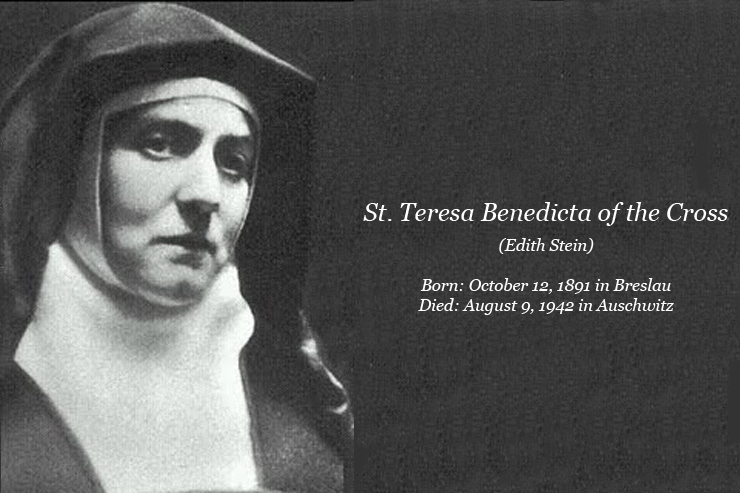
Saint Teresa Benedicta of the Cross
Today Jesus extols the virtues of child-like faith. Such a faith is dependent on our God who seeks us out like a shepherd in search of a lost sheep. This is a faith that realizes that God is in charge, and that we are happiest when we let God do what he wants to do in us, rather than fighting his inspiration. This was the kind of faith that Saint Teresa Benedicta of the Cross had.
Born into a prominent Jewish family in Breslau, Germany as Edith Stein, she abandoned Judaism in her teens. She studied philosophy under Edmund Husserl, a leading proponent of the philosophy of phenomenology. Edith earned a doctorate in philosophy in 1916. Later, she was influenced by the writings of Saint Teresa of Avila, and she became a Catholic on January 1, 1922. She taught in various schools until 1933, when anti-semitic legislation went into effect, and at that time entered the Carmelite convent at Cologne, where she took the name Teresa Benedicta of the Cross.
At the end of 1939, she moved to the Carmelite monastery in Echt, Netherlands. The Nazis occupied that country in 1940. In retaliation for being denounced by the Dutch bishops, the Nazis arrested all Dutch Jews who had become Christians. Teresa Benedicta and her sister Rosa, also a Catholic, died in a gas chamber in Auschwitz on August 9, 1942.
Faithfulness is easy when there aren’t any obstacles on our path to God. What we need to remember is that when obstacles appear, it doesn’t mean we are cut off from our God. That can never happen. When obstacles appear, when our faith is tested, we need to listen for God’s voice and follow the way he marks out for us. The Psalmist today has all the advice we need to hear: “How sweet to my palate are your promises, sweeter than honey to my mouth!”
-

Saint Dominic
Today’s readings
On a journey through France with his bishop, St. Dominic came across people who espoused the Albigensian heresy. The Albigensians believed in just good and evil – there was no middle ground. For them, anything material was evil, which meant that they denied the Incarnation and the sacraments. On the same principle they abstained from procreation and took a minimum of food and drink. It’s important to see that while the ascetic practices they undertook were good, their ultimate conclusions were deeply flawed.
St. Dominic sensed the need for the Church to combat this heresy, and he was commissioned to be part of the preaching crusade against it. He saw immediately why the preaching was not succeeding: the ordinary people admired and followed the asceticism of the Albigensians. Understandably, they were not impressed by the Catholic preachers who traveled in luxury, stayed at the best inns and had servants. Dominic therefore, with three Cistercians, began itinerant preaching – living simply and depending on the goodness of others to support them – according to the gospel ideal.
One of the ancient histories of the Dominican order says of him, “Two or three times he was chosen bishop, but he always refused, preferring to live with his brothers in poverty. Throughout his life, he preserved the honor of his virginity. He desired to be scourged and cut to pieces, and so die for the faith of Christ. Of him Pope Gregory IX declared: ‘I knew him as a steadfast follower of the apostolic way of life. There is no doubt that he is in heaven, sharing in the glory of the apostles themselves.’” (Office of Readings)
Dominic continued his preaching work for ten years, being successful with the ordinary people but not with the leaders. Eventually, he founded his own religious order, the Order of Preachers, or Dominicans, that was dedicated to preaching the Gospel to ordinary people.
We too are called to preach to every person. We do that not just in words, but mainly by the way we live. When people see our faith at work in our actions, they may well be moved by our example to draw near to God who longs to draw near to them. As we approach the Eucharist today, may we all turn to God for the words to speak and the actions to do, that all the world may come to know that our God is merciful and the source of all grace.
-
The Nineteenth Sunday of Ordinary Time
Listen to that opening line from Jesus in today’s Gospel parable: “Do not be afraid any longer, little flock, for your Father is pleased to give you the kingdom.” That is a revelation so glorious that it should have us up dancing in the aisles, praising God, and throwing a huge party. Think about it: the Father is pleased to give us the kingdom. The whole thing. Doesn’t cost us a cent. All of it is ours! If there was ever any good news to share, this is it. It’s better than a huge promotion at work, it’s even better than winning the lottery. All those things last but a moment, but the kingdom, well that’s for eternity.
So now that we know that the Father is pleased to give us the kingdom, I’d like to explore two questions. First, are we pleased to receive the kingdom? And second, what on earth do we do with it?
Okay, so are we pleased to receive the kingdom? Well, the obvious answer is “yes!” I mean, the kingdom is the great promise that brings us here to church today. Inheriting the kingdom means we are not going to hell; indeed, we will have everlasting happiness. But I wonder how readily we receive this gift of all gifts – and let’s be clear: this is the best gift we’re ever going to get. But there are so many other things out there, and we want to keep our options open. We’d rather pursue the big promotion, the latest and greatest shiny gadget, the American dream house, and so much more. Lots of things tempt us and look better than the gift the Father is pleased to give us.
Another obstacle to receiving the kingdom is maybe we feel like there’s always time to receive that gift. We’re going to live a long time, right? So why deny ourselves so many passing things in favor of receiving the kingdom? We can always receive the Father’s gift later. Except for the fact that none of us knows how much time we have in this life. Procrastination is our enemy, because some day could well turn into never. Not only that, but Jesus came to clearly proclaim that the kingdom is now, and why would we deny ourselves the pleasure of receiving the kingdom now and latch on to so many easily-tarnished things? Now is the time, and there’s no gift greater.
So if we receive the kingdom, what are we supposed to do with it? Well, just like all of God’s gifts, it’s not just for us. We’re supposed to share it. We’re supposed to live like we are part of it. So this gift of the kingdom calls us to greater integrity, greater love, greater mercy, greater holiness. And this may well seem like hard work, but that’s because it is. Jesus made it clear at the end of today’s Gospel: “Much will be required of the person entrusted with much, and still more will be demanded of the person entrusted with more.”
So does that make the gift of the kingdom seem like a burden? Well, maybe. But it’s a happy burden, a glorious burden, a sweet burden. All the saints tell us as much. Even Jesus said, “My yoke is easy, and my burden is light.” (Matthew 11:30) But we’ll never realize that until we go all in and receive the gift the Father is pleased to give us today. It’s kind of like that project that seems daunting, but once we get into it, is actually kind of fun. That’s the burden of the kingdom.
So Jesus brings us Good News today: the Father is pleased to give us the kingdom. So what do we have to do, what do we have to let go of, in order to receive it? That’s what should be our to-do list this week. And then we can rejoice in that gift with the Psalmist today who sings: “Blessed the people the Lord has chosen to be his own.”
-

The Transfiguration of the Lord
How do you picture Jesus? We’ve never seen him face to face, but we have definitely seen artwork depicting him. That artwork can be very inspiring. But that artwork can also give us a perhaps false, overly-familiar look at Jesus our God. I tend to think Peter, James and John also had a kind of familiar picture of their Jesus. Over the time they had spent with him thus far, they had become close to him and saw him as a friend, a companion on the journey, and a great teacher. But they were always having trouble with his divinity. We can be like that too. We’ve been taught to see Jesus as a friend, and so sometimes we forget that he is also our God. Or vice-versa. The truth is, of course, that he is both.
Today’s feast changes things for those disciples, and for us as well. If there was any doubt about who Jesus was, it’s gone now. That voice from the cloud is absolutely specific: “This is my chosen Son; listen to him.” Jesus is the Son of God and his divinity must be embraced and proclaimed. While it can be comfortable for us to have a picture of Jesus that is absolutely human, we must always keep in mind the Transfigured Christ, dazzling white, radiating glory, the lamp shining in a dark place. He is the Son of Man of whom Daniel speaks, and to him belongs dominion, glory, and kingship. If Jesus were only human, we would have no Savior, we would have no chance of touching divinity ourselves, that divinity for which we were created.
On the way to the mountain, the disciples came to know Jesus in his humanity, and on the way down, they came to know Jesus in his divinity. That trip down from the mountain took him to Calvary, and ultimately to the Resurrection, the glory of all glories. Christ is both human and divine, without any kind of division or separation. We must be ready to see both natures of our Jesus, so that we ourselves can transfigure our world with justice, compassion and mercy, in the divine image of our beautiful Savior. No matter what challenges may confront us or what obstacles may appear along the way, we must be encouraged to press on with the words of the Psalmist: “The Lord is king, the Most High over all the earth.”
-

Saint John Vianney, priest
Saint John Vianney’s seminary education got off to a rather rocky start. In fact, his poor previous education nearly kept him out of the seminary. Then he had trouble understanding lectures in Latin. He was only able to overcome this with some private tutoring and amazing dedication to his calling to become a priest. He was eventually ordained, and in sainthood, he is the patron saint of parish priests.
Saint John Vianney is the image of the good shepherd who guarded the flock zealously. He considered it his mission to heal the broken and drive out the demons of sin. He was known to spend 11 or 12 hours in the confessional every day in the winter, 16 hours in the summer! He said that he drew his strength for this ministry from the Eucharist.
In fact, he tried to bring everyone together for the public worship that was the Eucharist. About public and private prayer, he said: “Private prayer is like straw scattered here and there: If you set it on fire it makes a lot of little flames. But gather these straws into a bundle and light them, and you get a mighty fire, rising like a column into the sky; public prayer is like that.”
As we are gathered here for our public prayer today, we pray for that mighty fire to well up in all of us so that our dark world can be set ablaze with the fire of God’s love.
-
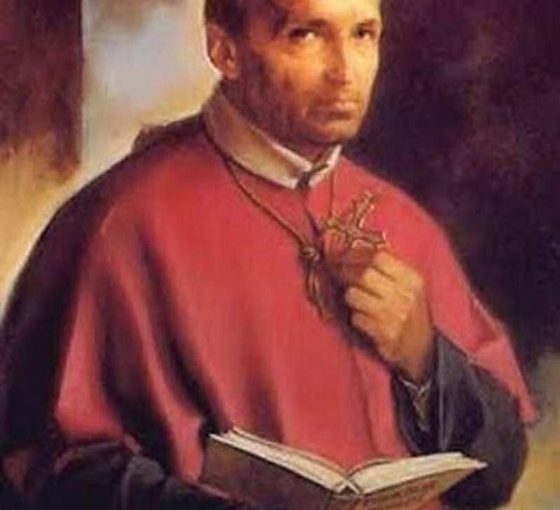
Saint Alphonsus Liguori, Bishop and Doctor of the Church
Today we have a kind of celebration of moral theology. In today’s first reading, Jeremiah receives word from the Lord that he is to go to the false prophet Hannaniah and rebuke him for preaching platitudes to the people and giving them false hope.
Today is also the feast of St. Alphonsus Liguori, the patron saint of moral theology. At the age of just sixteen, Alphonsus Liguori received degrees in both canon and civil law by acclamation. He later gave up the practice of law to concentrate on pastoral ministry, particularly giving parish missions and hearing confessions. He was noted for his writings on moral theology, particularly against the rigorism of the Jansenists. The Jansenists were an overly-rigorist movement that developed after the protestant reformation and the Council of Trent and emphasized original sin, human depravity, the necessity of divine grace, and predestination. Alphonsus’s moral theology was much more accessible to the average person.
In 1732, Alphonsus formed the congregation of the Redemptorists, who had as their special charism the preaching of parish missions. They lived a common life dedicated to imitating Christ and reaching out to the poor and unlearned. Although they went through their own struggles as a congregation, they were reunited after Alphonsus’s death and are of course active today.
Although Alphonsus was best known for his moral theology, he also wrote many other works on topics of systematic and dogmatic theology, and the spiritual life. Both Alphonsus and Jeremiah call us to return to the Lord. The call is a simple one; we need not be learned in all the intricacies of Canon Law to figure out how to live the Christian life. The Psalmist makes it clear today: all we have th do is rely on God to make his statutes known to us, and pray as he did: “From your ordinances I turn not away, for you have instructed me.”
-
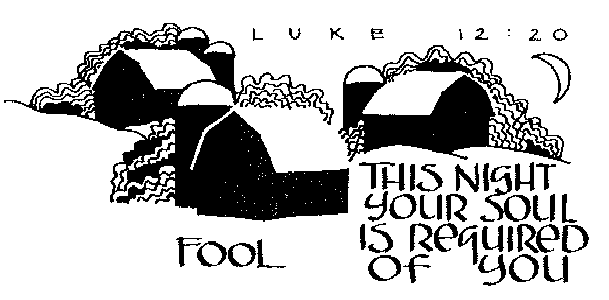
The Eighteenth Sunday of Ordinary Time: Stop Hoarding!
Once in a while in the news, you will hear a story of someone who has hoarded possessions so much as to put them in danger. A while ago, I remember hearing of someone who had passed away, and rescuers needed to cut a hole in the roof in order to remove the person from the home. People like this have an illness with regard to hoarding, of course. But today’s Liturgy of the Word seems to address the hoarder in all of us. We are people of means, maybe not the most well-off, but certainly better off than most of the world. When do we have enough? When does it all become too much?
Listen to the last line of this morning’s Gospel one more time: “Thus will it be for all who store up treasure for themselves but are not rich in what matters to God.” So right away the parable is turned around and directed at all of us. And it wouldn’t be so hard to put that parable in modern terms, would it? Think of winning the lottery, only to know that the day you receive the check is the day you go home to the Lord. Or think of spending your days and nights in the office, building wealth and prestige, only to be part of massive layoffs when the company is sold. Or, even worse, spending your days and nights at the office, only to miss the growing of your family. So, Jesus asks us, what treasures have we built up? With what have we filled our barns?
Today’s first reading is from the book of Ecclesiastes, which in Hebrew is Qoheleth, who is the teacher in the book. Among the Wisdom books in the Scriptures, Ecclesiastes can be the hardest to read because it is almost prophetic in content. Qoheleth is the main character in the book, a man who is considered wise among his contemporaries, much like many of the popular wisdom teachers of his day. While we don’t know who Qoheleth was, the book is attributed to Solomon, the wise king. Solomon often wrote of the prizes that lay in store for those who were successful. But this book is a little different. Here he questions if it is all worth it, and challenges the complacence and dishonesty that run rampant in that society. If we didn’t know any better, he could well have been writing his words today, couldn’t he? In the end, though, Qoheleth’s message is basically encouraging, and brings us back to the God who made us. At the end of his book, which is not part of today’s reading, he says: “The last word, when all is heard: Fear God and keep his commandments, for this is man’s all; because God will bring to judgment every work, with all its hidden qualities, whether good or bad.” (Ecc. 12:13-14) Which is exactly what Jesus is telling us in today’s Gospel.
St. Paul has a little bit of Qoheleth in him too, today. In the letter to the Colossians, which we have been hearing these past few weeks, he is trying to get that community to lay aside earthly things and seek God. Sounds like the message of Qoheleth, doesn’t it? “If you were raised with Christ,” he tells them, “seek what is above, where Christ is seated at the right hand of God.” In other words, stop filling your barns with the stuff that you accumulate on this earth, and be rich in what matters to God. Qoheleth, St. Paul, and Jesus are in complete concert today, and we must be careful to hear their message. St. Paul, typical for him, is very blunt about what he is asking us to lay aside: “Put to death then,” he tells us, “the parts of you that are earthly: immorality, impurity, passion, evil desire, and the greed that is idolatry.” And, “stop lying to one another.” We are called to be disciples who are pure, compassionate and truthful, because absolutely nothing else will lead us to the kingdom of God!
So, let’s look at Jesus’ instruction at the end of today’s Gospel parable: “Thus will it be for all who store up treasure for themselves but are not rich in what matters to God.” We have to ask ourselves, then, the very important question: “what is it that matters to God?” I think we know what doesn’t qualify – St. Paul made that very clear. I think the things that matter to God are those things we might count among our blessings: namely our family and friends. Those things that matter to God might also be the things that make us disciples who are pure, compassionate and truthful. So we might seek to be rich in prayer, rich in reaching out to the poor and needy, rich in standing up for truth and justice.
Today God is tugging at the heart-strings of the hoarder in all of us. What are we stockpiling? Maybe we need a look at our checkbooks, our calendars, and our to-do lists to see where our money, time and resources have gone. Can we take any of that with us if we are called home to God tonight? If those things are all we have, we could find ourselves in real poverty when we arrive at the pearly gates. This week’s to-do list might find us letting go of some of what we thought was important, so that we can be rich in what matters to God. These, brothers and sisters in Christ, are the riches that will not spoil and can never be taken away from us.
-
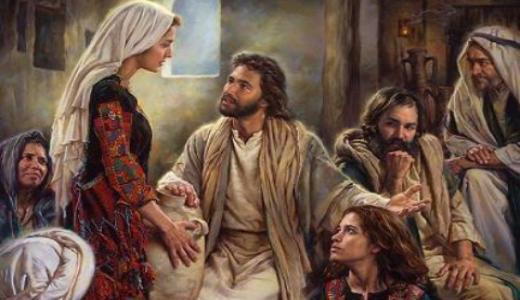
Saint Martha
Along with her sister Mary, and brother Lazarus, Saint Martha was a personal friend of Jesus. We have all heard the story about Mary sitting at Jesus’ feet while Martha did all the cooking and serving. Martha quite rightly (in my opinion!) demands that all should lend a hand in the preparation of one’s house for guests. Jesus’ response there is that “Mary has chosen the better part.” This reminds us that everything isn’t always up to us. We are called to do our part and rest in God’s loving care for us.
But today’s Gospel reading is really the great story of Martha’s saintliness. She says three very faith-filled things in and around this passage. The first comes when she runs out to greet Jesus and proclaims a small part of her faith: “Lord, if you had been here, my brother would not have died. But even now I know that whatever you ask of God, God will give you.” Here her faith is not quite perfect. She is confused that Jesus was detained and her brother died. But there is that aspect of trusting faith that knows that Jesus has power to do whatever he wills. The second great thing she says here comes right at the end of the story we hear today. In this, she proclaims a more perfect faith: “I have come to believe that you are the Christ, the Son of God, the one who is coming into the world.” In this great profession of faith, Martha is just as bold and courageous as Saint Peter who says much the same when Jesus asks him “who do you say that I am?”
The final great thing that Martha says comes in the part of John’s Gospel, right after the story we read today. Having professed her faith in Jesus, Martha now returns to her sister Mary and calls her to come to Jesus. She says, “The teacher is here and is asking for you.” Those who profess their faith in Jesus cannot possibly keep it to themselves. And Martha does not. She goes to retrieve her sister, who once sat at the Lord’s feet, but now for some reason chose to remain at home. Perhaps Mary was hurt that Jesus had not come right away. Whatever the case, Martha’s faith does not leave her sister in the dark. Like Martha, we who believe in Jesus must tell everyone who needs to hear it that the Teacher is asking for them.
You must be logged in to post a comment.