Tag: salvation

  • Thursday Within the Octave of Christmas

    Thursday Within the Octave of Christmas

    Today’s readings

    What did you get for Christmas?  Was it everything you’d hoped for?  Or are you at that stage of life where gifts are nice, but you really don’t need anything special?  A lot of my family has come to that point, because we’re at that point where the gifts aren’t so important as it is to be together at Christmas and enjoy one another.

    Today’s first reading is exhorting us to something similar.  While the rest of the world waits in line for hours to get whatever the coveted gift of the year may be, we have the consolation of knowing that nothing like that is ultimately important, or will ever make us ultimately happy.  The real gift that we can receive today, and every day, is the gift of Jesus, the Word made flesh, our Savior come to be one with us as Emmanuel.

    Saint John tells us quite clearly: “Do not love the world or the things of the world.  If anyone loves the world, the love of the Father is not in him.”  Because what we have is so much better than anything the world can give.  Anna the prophetess in the Gospel reading recognized the Gift.  She had been waiting for it, praying for it, every day of her life.  Heaven forbid that we should miss it! 

    The real gift this Christmas, and really every day, is the gift of eternal life.  And we have that gift because Jesus came to earth and chose to be one with us in our human nature.  That’s why the angels sang that night, and why we sing his praise every day of our lives.

  • The Twenty-eighth Sunday of Ordinary Time

    The Twenty-eighth Sunday of Ordinary Time

    Today’s readings

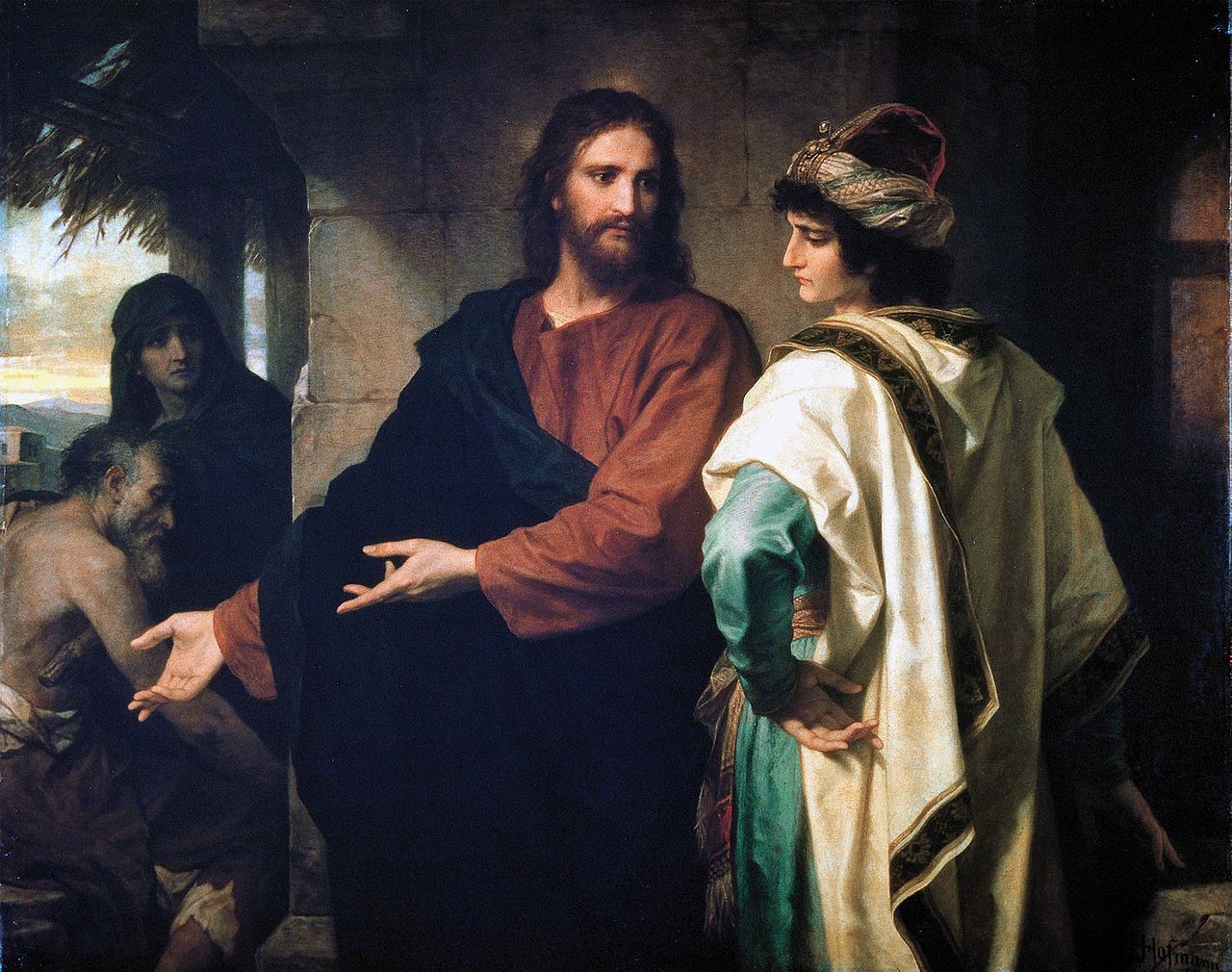
    Today’s gospel reading is a rather heartbreaking story, to be honest.  The rich young man is obviously a follower of the law and a religious man, because he is able to talk to Jesus about his observance of the law.  But when Jesus tells him to let go of what he has in order to gain eternal life, he walks away dejected because he has so much.  We don’t know what ultimately happens to the rich young man.  Maybe he did go and begin the hard work of letting go, selling his possessions and giving to the poor.  And maybe he just couldn’t do it.  But at least he knows what he has to do.

    I think that far more heartbreaking than this story of the rich young man is the story of modern men and women, rich and not-so-rich, young and old alike.  I am more heartbroken for these because as much as the rich young man in the gospel story asked what he had to do to gain eternal life, too many of today’s men and women have lost the desire even to ask the question.

    I hope your heart is breaking too.  These are not words of joy and blessing that Jesus is speaking to us today.  They are words of challenge.  He wants to light a fire under us and smack us full force out of our complacency.  “Children, how hard it is to enter the kingdom of God!”  So many people are not with us here at Mass today.  Whether it’s soccer or football or work or sloth or whatever, they are missing, and our gathering is the poorer for it.  Many of them will feel guilty about missing, perhaps some of them will even confess it.  But far too many of them don’t care or don’t even know that they should care.  How hard it is to enter the kingdom of God!

    People today, even maybe some of us gathered here today, are so greatly focused on getting ahead, becoming rich in the things of earth, skyrocketing careers, being well thought of – we are so embarrassingly rich in all these ways.  But none of those things are going to get us into heaven, into the kingdom of God.  We are all being told today to go, sell those paltry, fading glory things and give to those who are poorer, so that we can all enter the kingdom of God together.  Will we too walk away, like the rich young man in the gospel, dejected and depressed because we have too much to let go of it all?  How hard it is to enter the kingdom of God!

    In this respect life month, we might find we are too rich in other ways as well.  We may cling to the way that we’re thought of and so encourage or at least look the other way when a mother ends a pregnancy.  Or we’re so concerned about the value of our homes and the safety of our riches that we tolerate the death penalty.  Or the care of a loved one takes us away from our work so we don’t care for those loved ones the way we should.  But we are a people who are gifted with life from conception to natural death, and we are called to reverence that life and celebrate that gift.  We have to let go of anything that gets in the way of that.  How hard it is to enter the kingdom of God!

    Taking hold of the kingdom of God necessarily means we have to let go of something.  That is the clear message of today’s gospel reading.  What we have to let go of is different for all of us, but clearly there is a rich young man or woman in all of us, and we have to be ready to give up whatever gets in our way, or what we will end up letting go of is the kingdom of God.  And that would be truly, horribly, unforgivably heartbreaking.

    “Children, how hard it is to enter the kingdom of God!”

    And so what do we do?  Do we give up, throw up our hands, and walk away dejected because we know it’s all too much – that what we have to let go of is beyond our capacity to do it?  Certainly not.  For us, truly, it may be impossible.  But nothing is impossible for God.  God hears that desire for eternal life in us and opens up the way to salvation.  He gave his Son to live our life and die our death and rise to new life that lasts forever.  That same glory is intended for all of us too.  All we have to do is let go – as frightening as that may well be for us – let go, and let God worry about the implications of it all.

    And Jesus points out that this will not be easy.  Those who give up their riches to follow him will receive blessing, but also challenge: they will receive “receive a hundred times more now in this present age: houses and brothers and sisters and mothers and children and lands, with persecutions, and eternal life in the age to come.”  There will be persecution in this life.  Not everyone will get why we are letting go.  And that makes the letting go so much more difficult.  But the rewards of a hundredfold here and a million-fold in the kingdom are worth it.

    So let’s pray with this Gospel reading now.  I’d like you to close your eyes and put the stuff that you’re holding onto in your hands.  Whether they are possessions, ambitions, improper relationships, patterns of sin, whatever they are – put them in your hands and close your hands around them.  Hang on to them tight, and try to remember why they are important to you.  Then, imagine Jesus, coming to you, reaching out to you, offering you eternal life – everything you ever hoped for.  Do you reach out and accept it, dropping the stuff you were hanging onto?  Or do you keep hanging on and let the Lord pass you by?  Spend a little time now, quietly, speaking to Jesus about what you’re hanging on to, and ask him for the grace to let go of all that, and accept what he really wants to give you.

  • Monday of the Tenth Week of Ordinary Time: Votive Mass of the Precious Blood of Jesus

    Monday of the Tenth Week of Ordinary Time: Votive Mass of the Precious Blood of Jesus

    Today’s readings

    God’s blessings aren’t always things that might spring to mind when we think of blessings we would like.  For example, we might not think that those who are meek and those who mourn are blessed.  And we certainly wouldn’t celebrate the blessings of those who are persecuted for the sake of righteousness, would we?  It’s even more challenging when we remember that the word “blessed” in Scripture could also be translated as “happy.”  Would we think of those people as happy?  Probably not, but God does.

    Paul and Timothy in our first reading write to the people of the Church at Corinth that, when they are afflicted – as they surely were! – it was for the Church’s encouragement and salvation.  Paul knew well that following Christ meant going to the Cross.  Paul saw the blessing in suffering for the sake of Christ.  He realized that suffering, for him, it probably meant death, but for all of us, it means some kind of mortification, some kind of sacrifice.

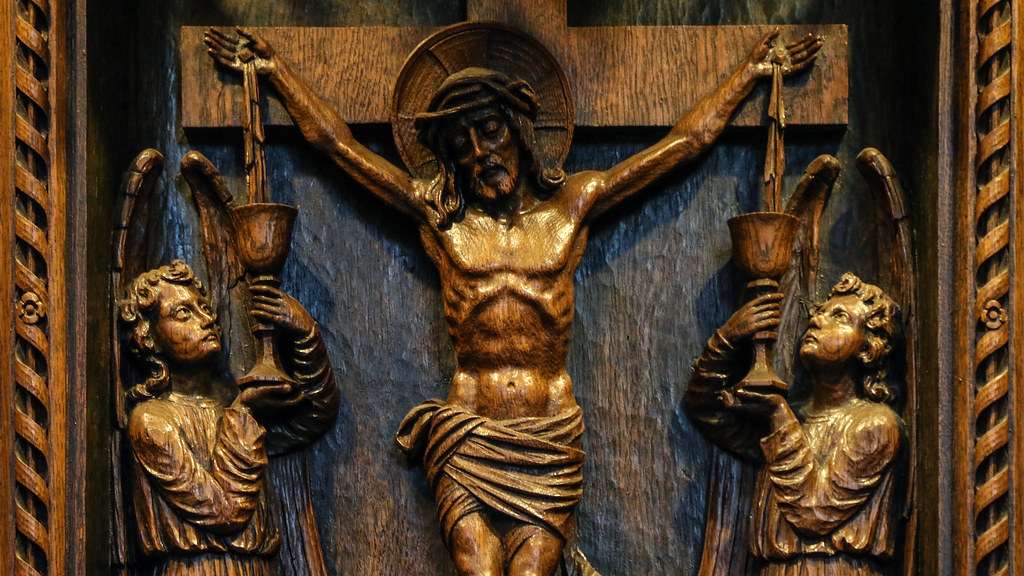
    Today we celebrate a votive Mass of the Precious Blood of Jesus.  This Mass calls to mind the saving sacrifice of Jesus, in which his most Precious Blood was poured out for us.  That blood washes away the sins of the whole world, yes, our sins too, if we let him, if we join our sufferings to his.  The salvation won at the immense cost of the Precious Blood of Jesus is a blessing that should never be taken for granted.

    So it’s important for us to remember, I think, that while God never promises to make our lives free and easy, he does promise to bless us.  He will bless us with whatever gifts we need to do the work he has called us to do, the work for which he formed us in our mother’s womb.  We may be reasonably happy in this life, but the true happiness must come later.  Our reward, which Jesus promises will be great, will surely be in heaven.

    May the Precious Blood of Jesus keep us safe for eternal life.

  • Tuesday of the Sixth Week of Easter

    Tuesday of the Sixth Week of Easter

    Today’s readings

    Today’s first reading always fascinates me.  Paul and Silas are in a terrible situation, not for the first or last time, I might add.  But just look at how their vibrant faith allows God to do things in and through them that are nothing short of miraculous.  First, there’s the earthquake that brings down the prison walls, although Paul and Silas did not take advantage of the situation.  Then there’s the conversion of the jailer, who was an employee of the Romans, and so would have been expected to worship their pagan gods, and he probably had up until this very moment.  You might also note the rather miraculous faith of Paul and Silas, who despite being very badly mistreated on account of Jesus, did not abandon their faith but actually grew stronger in it.  Authentic faith, lived in freedom, makes possible the salvation of many, many souls.

    Just observing the story as it unfolds in our Liturgy of the Word, it’s all so amazing, although Paul and Silas probably just viewed it as part and parcel of the life they had been called to live.  They had faith in Jesus and they probably didn’t expect anything less than the miracles they were seeing!  The baptism of the Roman guard’s household in particular, was a huge win for the kingdom of God, and Paul and Silas wouldn’t have expected anything less, it seems.

    People of great faith experience great miracles.  This is not to say that all their troubles go away or that they can wave a wand and prison walls tumble down.  Paul and Silas were still imprisoned, and continued to be hounded by the people and the government because of their faith.  But the miracles always come through the abiding presence of Christ.  These God-moments give us strength when we need it most.  It might not be a huge thing, maybe just a kind word from a stranger that comes at the right moment, a phone call from a friend that makes our day, an answer to prayer that is not what we expected but exactly what we needed.  The Psalmist today has that same great faith: “Your right hand saves me, O Lord,” he sings.  Let us pray that our hearts and eyes and minds would be open to see the miracles happening around us, and that we might live authentic faith for the sake of the kingdom of God.

    Christ is risen! He is risen indeed! Alleluia!

  • The Second Sunday of Lent

    The Second Sunday of Lent

    Today’s readings

    What would you give up for love?

    That’s the question I want us to focus on today because I think it is, perhaps, the question of the spiritual life.  What is it that we are willing to give up for love?  And I’ll be honest: this set of readings gets me every time, and this is one of those homilies that has given me a few tears of repentance as I wrote it, and probably will as I preach it.  When I see what Abraham, Jesus, and ultimately God the Father would give up for love, it makes me repentant of the shoddy things I tend to hang on to.  But let’s bookmark that for a bit and get into the readings we have today.

    Today’s first reading puts poor Abraham in an awful position.  Remember, he and Sarah were childless well into their old age.  And it is only upon entering into relationship with God that that changes.  God gives them a son, along with a promise, that he would be the father of many nations.  That was unthinkable.  Think of anyone you know who has had to struggle with the pain of being childless.  And here God puts an end to that just when they have come to terms with the fact it was never going to happen.  Everything changes for them, an old and childless couple.

    And so put yourself in Abraham’s place.  After rejoicing in the son he never thought he’d have, God tells him: “Take your son Isaac, your only one, whom you love, and go to the land of Moriah.  There you shall offer him up as a holocaust on a height that I will point out to you.”  It’s not a suggestion, it’s not an invitation, it’s an order.  Now, Abraham knows that it’s only because of the gift of God that he has Isaac to sacrifice in the first place.  But for those of you who are parents: think about it, what would you do?  How would you feel in that moment?  That boy is the answer to your life-long prayers, and now God wants him back.  Wow.

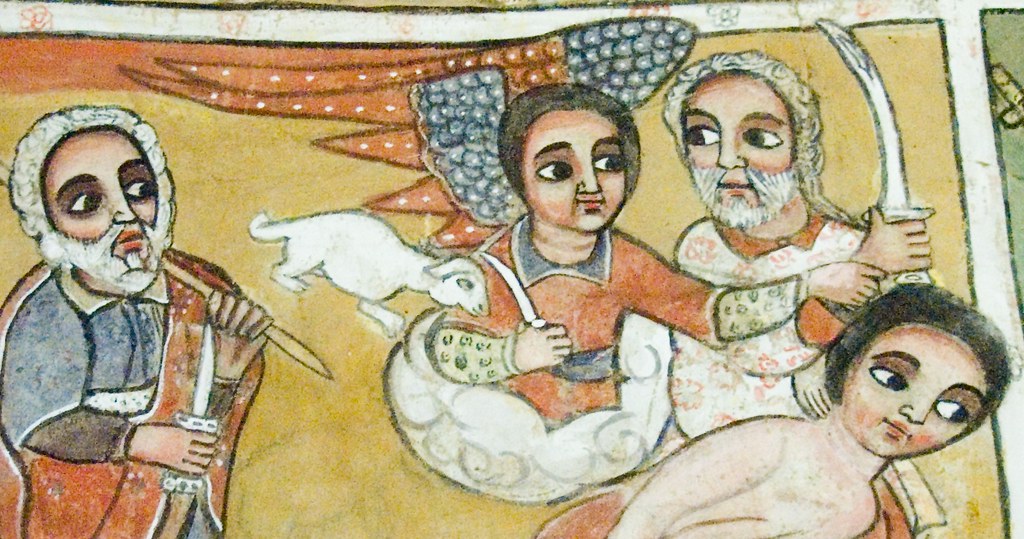
    The reading omits a chunk in the middle that is perhaps the most poignant part.  Abraham packs up and takes his son on a journey, travels with some servants, and at the end of it, he and Isaac haul the wood and the torch up the mountain.  Isaac asks him: “Here are the fire and the wood, but where is the sheep for the burnt offering?”  Can you even begin to imagine the anguish in poor Abraham’s heart?  And yet he responds in faith: “My son, God will provide the sheep for the burnt offering.”  Which, of course is true.  God had provided Isaac, who was intended to be the sheep.  God had, indeed, provided Isaac.  But Abraham couldn’t have known that God would intervene.

    Now, we could get caught up in the injustice here and call God to task for asking such a horrible thing in the first place.  Why would God test poor Abraham so?  Why would he give him a son in his old age, only to take him away?   What purpose did that have?  Who wants to worship a God who would do something like that.  But we have to know that the purpose of the story is to illustrate that God has salvation in mind; he always intends the good for us.  Yes, God would provide the lamb.  It was never going to be Isaac; it’s not even the sheep caught up in the thicket – not really.  We know that the sheep for the burnt offering is none other than God’s own Son, his only one, whom he loves.  The story is ultimately about Jesus, and his death and resurrection are what’s really going on in today’s Liturgy of the Word.

    Let’s let that sink in for a minute.  No, we don’t want to worship a God who would be evil enough to give a couple the gift of a child in their old age and then demand that he be sacrificed.  But we certainly worship this God who, in his great love for us, sacrifices his Son, his only one, whom he loves.  That, friends, is our God.  That’s what all of this is all about.

    Now let’s get back to the thought I asked you to bookmark at the beginning of my homily today: Abraham trusted God and was willing to give up the thing he’d probably die for – his own son.  God asked, and he, anguished as he must have been, made the preparations and was ready to do it.  That’s what love of God meant to him.  So what are we willing to give so that we can demonstrate – to ourselves if no one else – our trust in God’s ability to love us beyond all telling?  For Lent, we’ve given up chocolate, or sweets, or even negative thinking or swearing.  Maybe we’ve not done well with them, or maybe we have even given up on the things we gave up!  But we need to see in Abraham’s willingness that our sacrifices are important; they mean something.  So maybe now, still early in Lent, it’s time to take a second look at our Lenten sacrifices.  Can we go deeper?  What are we willing to give up to experience God’s love more fully?

    Jesus goes up a mountain in today’s readings too – and he too sees that he is to become the sheep for the sacrifice – sooner rather than later.  That was the meaning of the Law and the prophets of old, symbolized by Moses and Elijah on the mountain.  But knowing that, and knowing what’s at stake, he does not hesitate for a moment to go down the mountain and soldier on to that great sacrifice.  He willingly gives his own life to be the sheep for the sacrifice, because leaving us in our sins was a price he was not willing to pay.  His life was the thing he was willing to give up for love; for love of us.

    There are a lot of things out there for us that seem good.  But the only supreme good is the life of heaven, and eternity with our God.  Think of the thing that means everything to you: are you willing to sacrifice that to gain heaven?  Are you willing to give everything for love of God?

    Because, for you, for me, God did.

    God did that for us.

  • The Fourth Sunday of Advent

    The Fourth Sunday of Advent

    Today’s readings

    Do you remember the best gift you ever got?  What was it?  Who gave it to you?  How long did it last?  Do you still have it? 

    Every gift is a little different: some are big, some are small, some make a lasting impact, some are used up and soon forgotten.  The best gifts, I think, are those that create a memory of good times; perhaps the best gifts are those that can be shared.

    God gives us gifts too.  And some are big, and some are small, but all of them are important to us and to others.  In this season of giving, I’d like to take a moment to talk about God’s gifts, and how they are to be enjoyed.  There are four points I want to make.

    First, God’s gifts are given to be used.  They’re not supposed to be like an action figure that is to be kept in its package and preserved so it can be sold in ten years for a lot of money on eBay!  They aren’t like the “good china” some of us have and almost never use.  They’re supposed to be used for our happiness and God’s glory.  So if it’s a talent for sports, we ought to play.  If it’s intelligence, we ought to study and research and invent.  If it’s creativity, we ought to paint or act or sing.  Keeping it in a box and denying it is an insult to the Giver.

    Second, God’s gifts are never just for us.  God gifts us in ways that we can build up our community and our world and help people to come to know God’s love for them.  Always.  Mary never could have kept Jesus to herself, and we’re not supposed to keep our gifts to ourselves either.

    Third, we will never know how wonderful our gifts are until we share them with others.  Our gifts are supposed to create memories and bring people together and help people to know God.  When that happens, the full wonder of those gifts will be revealed to us and in us, and we will enjoy them in ways we never could have before we shared them.

    Finally, we don’t lose our gifts when we share them.  They don’t get used up when we give them away.  Just as Mary didn’t lose her Son when she gave him to the world, so we won’t lose what God has given us when we share it with others.  That’s just how God’s gifts are.

    In today’s Gospel, Mary received a gift.  I don’t know how any of us would feel about that kind of gift, but Mary received it in faith, because Mary was full of grace.  She received the gift of a Savior before anyone else did; her fiat meant that she received salvation before it was ever played out on earth.  It was the best gift ever, and she got to watch it all unfold before her.  Some of it was difficult and painful, but so much of had to be amazing.

    Because of Mary’s faith, God was able to send the best gift possible to be shared with all of us: the gift of his only-begotten Son.  Jesus took on our flesh as a little baby, and grew to become a man like us in all things but sin.  He walked among the people of his time and helped them to know of God’s kingdom.  Though he was without sin, he eventually took on our sins and went to the cross for all of us, dying to pay the price for our sins, and canceling out the power that sin and death had to keep us from God.  Because of Mary’s faith, we received the gift of salvation, if we are open to accept it.

    And just like all our other gifts from God, those same four principles apply: we have to use, or live our salvation; we have to share the gift of salvation with others; salvation becomes more wonderful every time someone else is saved, and salvation is not something that ever gets used up – it’s meant for everyone.

    So this is a bit of a “pep talk” for the coming feast of Christmas and how we should receive and live that gift of salvation.  Let’s be clear: we always need a Savior.  We are sinful, and in our sinfulness we could never enter into relationship with God.  And in this year, our need for a Savior seems to be even greater: the darkness of a pandemic and the sadness of racial unrest and all the other societal unrest we have endured this past year.  This year has been hard on families and workers and schools and just about everybody.  We need to be people of faith and follow our Savior more than ever. And we have to be people who share that gift with others, pointing them to the love and salvation we have in Jesus. 

    Our salvation, our relationship with God, is a gift, and it’s up to us to spread it around.  It’s a shame if someone doesn’t know about God and his love for them.  But if they don’t know because we didn’t use our gifts to tell them, then it’s a sin.  This is the season for giving gifts.  The very best gift you can give to anyone is a relationship with God.  Whether it’s your children, or coworkers, or people in the neighborhood, your gift will do so much to make the world a better place.  All we have to do is respond like Mary: “I am the handmaid of the Lord, let it be done to me according to your word.”

  • The Twenty-fifth Sunday of Ordinary Time

    The Twenty-fifth Sunday of Ordinary Time

    Today’s readings

    I wonder if you find this Gospel parable a little aggravating.  I have heard it many times now, and I certainly have bristled with aggravation on occasion when I’ve heard it.  And, as I often say, it’s good when the Gospel gets us a little riled up, because that means God is doing something in us that invites us to salvation.

    Certainly the people hearing it in Jesus’ day would have been aggravated when they heard this parable too.  They knew the economics of day laboring better than we do (although day laborers are by no means extinct in the twenty-first century).  The very thought that those who labored hard all day, in the sun, would get the same as those who worked but an hour was unthinkable.  I dare say we find it that way too.

    So it’s important for us to notice, first of all, that this is not intended to be a parable about justice.  Jesus tells us right away: “The kingdom of God is like a landowner…”  So the parable is not about justice, but instead it is an illustration of the workings of the Kingdom of God.  In one sense, that’s comforting, because Jesus is not telling us that we should run our businesses with lavish disregard for economic wisdom.  I would be hard pressed to be convinced to even run the parish that way.

    But now let’s think about the fact that the parable is about the Kingdom of God.  Jesus was delivering a message to the religious establishment: they didn’t have the monopoly on the kingdom.  They thought they had earned God’s reward, and Jesus tells them it doesn’t work that way.  It’s not about what you’ve done or how long you’ve been doing it, it’s about God’s mercy and love that is poured out with lavish generosity.  They would have found that pretty irritating.  I think we know that in our heads, but when it comes to how this parable plays out, it reveals that we may not have accepted it in our hearts.

    Do you mean to tell me that those of us who have worked hard and long for the mission and spent our days and nights at church might inherit just as much as someone who ignores the Gospel and converts on his or her death bed?  Well, yes.  That very well could be.  Many years ago now, I heard about the deathbed conversion of actor John Wayne.  I remember thinking at the time, “Gee, that’s convenient.”  Here he may well have led a life of excess and who knows what all debauchery and only on his deathbed was he willing to form a relationship with God.  Here those of us disciples have been working hard at it all this time, and yet some can get it just at the last minute?  That makes me bristle with thoughts of unfairness.  But, as the prophet Isaiah tells us today, our thoughts are not God’s thoughts, and our ways are not God’s ways.

    And who am I to judge John Wayne, or really anyone?  It’s important to note that we cannot pass judgment on anyone.  I don’t know the details about John Wayne’s life and certainly not about his relationship with the Lord.  Who knows if a conversion wasn’t something he had been looking forward to for a long time and he didn’t know how to make it happen.  Maybe he had, in fact, been kept from hearing the Gospel in his formative years and so didn’t have the basis for a life of faith that many of us do.  The important thing is that his desire was granted, in the waning moments of his life, and God is generous.  That’s all we need to know.

    Let’s face it, none of us wants God to be too strict an accountant.  No matter how hard we may try to be good disciples, we often fall short in big ways and small ways.  God gives us second chances all the time.  And we are blessed that we worship a generous, or we’d all of us be in a world of hurt, without exception.  

    If anything, even us cradle Catholics should be grateful for this message, because if we are honest, our tiniest sins are a grave offense to Almighty God, who is goodness itself, and who gives us everything we need in this life and in the next.  We who have gravely offended God by our sins need those second chances too, and we have them.

    Another good way to think about this parable on this Catechetical Sunday, is that the time to foster a relationship with Jesus isn’t limited to the beginning of the day, or the beginning of our life.  We are called to form a life-long relationship of learning, and growing in relationship, with the God who loves us beyond anything we can imagine.  Every hour of the day, every stage of our life, is an opportunity to let Jesus come and get us, and put us to work in the field of the faith.

    The last line of the Gospel might sound unfair, but ultimately, I think, it is hopeful: “The first will be last and the last will be first.”  Let that sink in for a minute: whether you’re first or last, you still have the possibility of life eternal.  It doesn’t matter when you get there, or where you were in line, or if someone cut in ahead of you.  There is always enough grace and mercy to go around.  There are always dwellings for us in the kingdom of heaven.  None of us will be left without the love of God, if only we approach it, if only we accept it, if only we don’t get caught up in thinking about who gets in ahead of us.  News doesn’t get any better than that.

  • The Twenty-third Sunday of Ordinary Time

    The Twenty-third Sunday of Ordinary Time

    Today’s readings

    At the core of salvation and the message of the Gospel, Jesus came to forgive sinners and to make things right so that all might go to live in the eternal kingdom.  He came to give new life to sinners and to show them the way to the kingdom.  It’s in that spirit that I think we should dig into the interesting instructions Jesus gives in today’s Gospel reading.

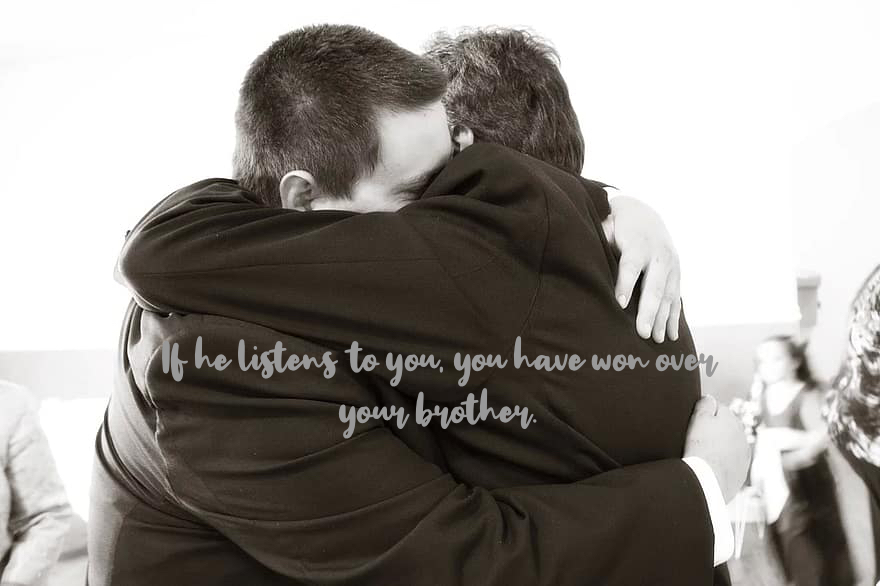
    Those of us who have been in, or are in, seminary can tell you that the community of a seminary is somewhat of a cross between a fishbowl and a pressure cooker.  It’s a community unlike most others, because in seminary everyone pretty much knows everyone, and whatever happens, mostly everyone hears about it.  And so when something doesn’t go right, or worse, when someone is wronged, it becomes, well, a whole thing.  It was in that milieux that I first learned the whole concept of fraternal correction; that is, bringing your brother’s faults to him and working through that together.

    That’s the kind of thing that’s happening in today’s Gospel.  By the time Matthew’s Gospel was composed, the early Church community was already separate from the Jewish community.  They weren’t subject, then, to the daily expectations of the Jewish community.  And much like my seminary experience, they were in a bit of a fishbowl, because they were a recognizable community surrounded by non-believers.  So Matthew’s Gospel has Jesus teaching the community how they are to be a community.  This part deals with how to diffuse conflicts and right wrongs, and it begins with that idea of fraternal correction.

    Step one has the wronged party going to his or her brother or sister and discussing the matter privately.  This respects the privacy of both parties, and respects, and expects, their desire to live in concord with the other and not be simply a troublemaker.  This, I think, is different from how most of us were brought up.  I’m Irish and Italian.  So either we never speak about the problem, force it into repression, and harbor ongoing resentment, or we have a massive blowup and everyone gets emotional shrapnel.  Or sometimes all of the above.  Now, I have a great family, and I’ll say that most of that is a stereotype and isn’t functionally true, but it doesn’t mean I’ve never seen it.  And we could all tell the same story, if we’re honest.  So this idea of actually talking to the party who wronged us and working toward a solution is one that we need to take to heart.

    Step two, if the person doesn’t repent, is to get a couple of other people together to talk to her or him.  This, actually, well-reflects the last line of today’s Gospel: “For where two or three are gathered together in my name, there am I in the midst of them.”  When two or three come together, Jesus is there, waiting to make things right, wanting to affect forgiveness, yearning to bring salvation.  That’s why he came.  So that microcosm of the community has the power of Christ to bring resolution to the situation.

    Step three, if it gets that far, is to tell the Church.  This is the one that, in my experience as a pastor, we abuse all the time.  Way too often someone gets mad about something, and they go right to the pastor, or the bishop, or whatever.  They’ve skipped steps one and two, the steps that are more satisfying, and, in my experience, more likely to work well.  By the time it gets to the top, however it works out, chances are, no one’s going to be happy with the outcome.  But that is step three, and it’s there if it’s needed.  That reflects the power Jesus gives to the Church in the very next verse, the power to bind and loose: “whatever you bind on earth shall be bound in heaven, and whatever you loose on earth shall be loosed in heaven…”

    Step four is the most heartbreaking of all.  If the person doesn’t listen to the Church, then treat her or him as an outcast, “as you would a Gentile or a tax collector.”  Gentiles and tax collectors were the collective term for the pariahs of society at that time.  But here’s the catch: Jesus welcomed Gentiles and tax collectors, so what does he really mean?  I think you know: if the person won’t listen to the Church, then I guess the idea is to welcome the person in and let the community of the Church and the presence of Christ soften their hearts and change their attitudes.  How’s that for a challenge for the week ahead?

    Here’s the idea.  None of us is an island; we are not intended to live on our own without interaction with other people.  But in community, there will be the occasional problem with someone else.  How we handle that has to reflect who we are and with whom we are identified, namely our Lord, Jesus Christ.  That same Lord who, again, came to forgive sinners and make things right so that all might find salvation.  All.  All of us find salvation.  Even the person who just cut you off in traffic; even the person that drives you nuts.  All of us.  And so, in our dealing with one another when we have discord, our goal has to be not just the absence of conflict, but instead the salvation of both of us, because that’s what’s ultimately at stake.

    Now, another challenge if you’re up for it.  This method of solving conflicts doesn’t apply just to individual conflict, or individual sins and sinners.  It doesn’t just apply in the fishbowl of a seminary or church community.  It has to apply also to societal ills and social sins.  It has ramifications about how we address racial injustice.  It has meaning for dealing with the government official or political candidate whose stance or actions are offensive.  It convicts us when we have, as a society, sinned against the poor and the marginalized.  The salvation of all is of ultimate importance.

    “For where two or three are gathered together in my name, there am I in the midst of them.”

  • Thursday of the Twelfth Week of Ordinary Time

    Thursday of the Twelfth Week of Ordinary Time

    Today’s readings

    Some people say all you need to do is make a one-time decision to accept Jesus as your personal Savior and you’re saved. If salvation were something magical that came about as the result of just saying a simple prayer, once and for all, then why wouldn’t everyone do that? The fact is, salvation is hard work. It was purchased at an incredible price by Jesus on the cross. And for us to make it relevant in our lives, we have work to do too. Not the kind of work that earns salvation, because salvation is not earned, but the kind of work that appropriates it into our lives.

    People who are saved behave in a specific way. They are people who take the Gospel seriously and live it every day. They are people of integrity that stand up for what’s right in every situation, no matter what it personally costs. They are people of justice who will not tolerate the sexist or racist joke, let alone tolerate a lack of concern for the poor and the oppressed. They are people of deep prayer, whose lives are wrapped up in the Eucharist and the sacraments, people who confront their own sinfulness by examination of conscience and sacramental Penance.  They are people who sacrifice their own personal comfort for others, like wearing a mask when they go out in public so that others might remain well.  They are people who live lightly in this world, not getting caught up in its excess and distraction, knowing they are citizens of a heaven where such things have no permanence. Saved people live in a way that is often hard, but always joyful.

    Not everyone who claims Jesus as a personal Savior, not everyone who cries out “Lord, Lord,” will enter the kingdom of heaven. That’s what Jesus tells us today. We have to build our spiritual houses on the solid rock of Jesus Christ, living as he lived, following his commandments, and clinging to him in prayer and sacrament as if our very life depended on it. Because it does. It does.

  • The Sixth a Day in the Octave of Christmas

    The Sixth a Day in the Octave of Christmas

    Today’s readings

    What did you get for Christmas?  Was it everything you’d hoped for?  Or are you at that stage of life where gifts are nice, but you really don’t need anything special?  A lot of my family has come to that point, because we’re at that point where the gifts aren’t so important as it is to be together at Christmas and enjoy one another.

    Today’s first reading is exhorting us to something similar.  While the rest of the world waits in line for hours to get whatever the coveted gift of the year may be, we have the consolation of knowing that nothing like that is ultimately important, or will ever make us ultimately happy.  The real gift that we can receive today, and every day, is the gift of Jesus, the Word made flesh, our Savior come to be one with us as Emmanuel.

    Saint John tells us quite clearly: “Do not love the world or the things of the world.  If anyone loves the world, the love of the Father is not in him.”  Because what we have is so much better than anything the world can give.  Anna the prophetess in the Gospel reading recognized the Gift.  She had been waiting for it, praying for it, every day of her life.  Heaven forbid that we should miss it! 

    The real gift this Christmas, and really every day, is the gift of eternal life.  And we have that gift because Jesus came to earth and chose to be one with us in our human nature.  That’s why the angels sang that night, and why we sing his praise every day of our lives.