Tag: security

  • Tuesday in the Third Week of Easter

    Tuesday in the Third Week of Easter

    Today’s readings

    At our core, we all want peace and security in our lives.  We don’t want rough waters, or pain, or discord in our families, and that’s all understandable.  Certainly we have more than enough of those things with all the political uncertainty at home, and the uncerainty of war abroad these days.  I think that’s something of the same sentiment that is behind our Scripture readings today.

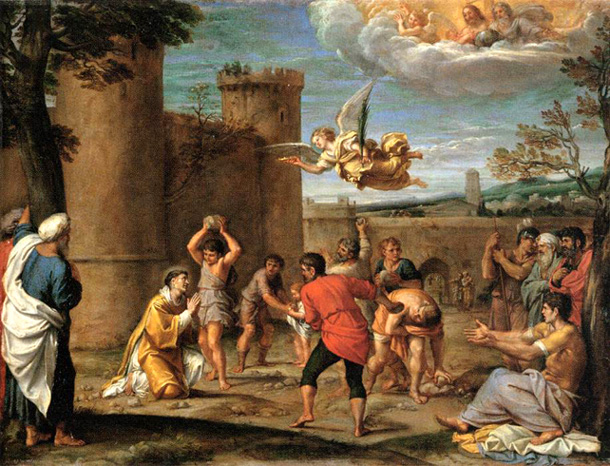
    The Jewish people, the elders and the scribes, the religious establishment of the time, had their laws and customs, and for them, following those laws and customs represented a peaceful and secure life.  So they were not at all open to any kind of teaching that challenged their thinking.  Stephen points out that whenever a prophet called them to a deeper reality, a deeper sense of God’s call, rather than accept that teaching and reform their lives, their ancestors instead murdered those prophets.  And so their response was to prove his point.  They could not accept Stephen’s own prophecy that Christ in his glory was the key to human salvation.  So they stone him to death, with the tacit approval of a man named Saul, a man for whom God had future plans.

    The crowd in the Gospel reading wants peace and security too.  They had recently been fed in the miracle of the loaves and fishes.  But they had missed the point.  They wanted just the bread they could eat for today; they didn’t get and didn’t want to get the bread Jesus really wanted them to have – the bread of eternal life.  And so they ask today for another feeding sign.  Just like Moses was able to provide bread from heaven, they wanted Jesus to feed their physical hunger too.  But Jesus is more interested in their spiritual hunger, and longs to provide that in himself, he who is the bread of life.

    So if all we hunger for is peace and security, bread for today, then we will certainly miss receiving the Bread of Life, a far greater reality.  Our hearts have to be open, and our desires have to be for the deepest longings.  And very often, those deep longings take a lot more waiting and effort than the bread for today.  If we remember to long for the One who wishes to give us his very self, we can receive everything we truly need.  “I am the bread of life,” he says to us.  “Whoever comes to me will never hunger, and whoever believes in me will never thirst.”  In him, we will never need anything more.

    Because Christ is risen!  He is risen indeed!

  • Thursday of the Thirty-third Week of Ordinary Time

    Thursday of the Thirty-third Week of Ordinary Time

    Today’s readings

    If the readings today stir up feelings of anxiety in us, well, that’s to be expected. These are not readings of comfort and peace – anything but! And that’s just how the Lectionary is arranged. Every year at the end of the Church year – which this is – we have readings about how times will end. These readings are called apocalyptic readings, and at the close of a year, it makes sense to read about the close of time.

    Generally speaking, apocalyptic readings are written during times of intense persecution in the Church. It makes sense that as persecution increases, the imaginations of those being persecuted would turn toward a time when one’s enemies would be vanquished in a glorious battle, and a new time of grace would come.

    But often these apocalyptic readings speak of the persecution itself, and that’s what’s happening in the book of Maccabees, which we have been hearing the last week or so. On Tuesday, old Eleazar would not give in to the unreasonable demands of Antiochus Epiphanes, even though he had been faithful his whole life long. He refused to be a cause of scandal for the young and went to his death. The same happened yesterday to the seven brothers and their mother who were all put to death. Well, today, Mattathias has had enough of all of this, and has seen one too many faithful Jews give up and give in, so he incites a revolution and gives courage to all those being persecuted.

    If today these readings stir up more feelings of uneasiness than they have perhaps in the past, well, that’s easy to understand. The apostasy is catching up with us too, in these days. Persecution of Christians and the proliferation of terror and violence seems to be coming to a fever pitch – not just in Paris, or even just in Beirut or Syria, but day after day in our cities.

    Understandably, we all wonder how to stay safe and stay out of harm’s way. But the truth is, living our faith is dangerous. Just ask Eleazar or the seven brothers, or Mattathias. It might seem “safe” to give up and give in to society, or even to go into hiding. But the Psalmist knows the only way to real safety and real peace: “Offer to God praise as your sacrifice / and fulfill your vows to the Most High; / Then call upon me in time of distress; / I will rescue you, and you shall glorify me.”

    The way to fight this spiritual battle is to find our safety where the only true safety exists: in God alone. Jesus tells us in another place that we ought not to fear those who can merely kill the body, but to fear instead the one who seeks to kill our souls (Matthew 10:28). So we believers put on the armor of faith: good works, fervent prayer, honest confession, reception of the sacraments. And then we trust in the One who alone is trustworthy: our God who gives us the only life worth living.

  • Tuesday of the Third Week of Easter

    Tuesday of the Third Week of Easter

    Today’s readings

    At our core, we all want peace and security in our lives.  We don’t want rough waters, or pain, or discord in our families, and that’s all understandable.  I think it’s that sentiment that is behind our Scripture readings today.

    The Jewish people, the elders and the scribes, the religious establishment of the time, had their laws and customs, and for them, following those laws and customs represented a peaceful and secure life.  So they were not at all open to any kind of teaching that challenged their way of life.  Saint Stephen points out that whenever a prophet called them to a deeper reality – a deeper sense of God’s call – rather than accept that teaching and reform their lives, their ancestors instead murdered the prophets.  And so their response was to prove his point.  They could not accept Stephen’s own prophecy that Christ in his glory was the key to human salvation.  So they stone him to death, with the tacit approval of a man named Saul, a man for whom God had future plans.

    The crowd in the Gospel reading wants peace and security too.  They had recently been fed in the miracle of the loaves and fishes.  But they had missed the point.  They wanted just the bread they could eat for today; they didn’t get and didn’t want to get the bread Jesus really wanted them to have – the bread of eternal life.  And so they ask today for another feeding sign.  Just like Moses was able to provide bread from heaven, they wanted Jesus to feed their physical hunger too.  But Jesus is more interested in their spiritual hunger, and longs to provide that in himself, he who is the Bread of Life.

    But if all we hunger for is peace and security, bread for today, then we will certainly miss receiving the Bread of Life.  Our hearts have to be open and our desires have to be for the deepest longings.  Then we can receive our Savior who wants to give us everything we truly need.  “I am the Bread of Life;” he says to us.  “Whoever comes to me will never hunger, and whoever believes in me will never thirst.”

  • Monday of the Twentieth Week of Ordinary Time

    Monday of the Twentieth Week of Ordinary Time

    Today’s readings

    Today’s readings remind us of the danger of holding on to things that have no permanence.  The rich young man in today’s gospel reading discovers that following the rules is only just a good start; to really gain heaven you must be willing to let go of the fading riches of this world.  The people Israel in today’s first reading have grasped on to the uncertain security of alliances with this world’s powers and have let go of their belief in God, and Ezekiel prophecies that would come back to haunt them.  Holding on to the things of this world will never get us anywhere; we will never find ultimate security in alliances with the powers of this world.  To truly gain heaven, we have to let go and hold on to our God, whose riches never fade and whose power is never outmatched.