Category: The Church Year

  • The Third Sunday of Easter

    The Third Sunday of Easter

    Today’s readings

    How often have you said something that began with “I’ll be happy when…”?  You know, “I’ll be happy when I’m done paying for the kids’ college tuition;” “I’ll be happy when I get that promotion;” “I’ll be happy when I lose that last ten pounds;” “I’ll be happy when I can afford that new car…”  We’ve all done it, we’ve all set our hopes for happiness on some future event or accomplishment.  But then it gets there, or it doesn’t, and we’re not as happy as we’d like to be, so we look for happiness in something else.  Today’s Liturgy of the Word tells us that we’re doing it wrong.  We have to learn that we’re supposed to be happy in the journey.

    Listen to what the Psalmist says today: “You will show me the path to life, abounding joy in your presence, the delights at your right hand forever.”  Abounding joy happens along the path to life, at God’s right hand, who accompanies us on the journey.  I’ve been thinking a lot about journeys lately.  Obviously, my journey is taking me a bit southwest of here in June, and so that is always in the back of my consciousness, with its mix of sadness and fear and excitement and expectation – that’s one journey.  I’ve also been on WeightWatchers since January, and they are always talking about the journey to being healthy, and all of the steps it takes to get there.  So journeying has been really up front and foremost in my mind these days.

    Well, today’s Gospel finds two of Jesus’ disciples on a journey Jerusalem, where a lot of crazy stuff just went down, to Emmaus.  Along the way, they are discussing what had been going on, and we can just imagine how their minds had to be reeling!  For those of us who know the story, it’s pretty incredible.  But for them it had to have been mind blowing.  They were never expecting anything like this.  But here they were, walking along, discussing how Jesus’ death and resurrection had changed everything in just a few short days.

    And into that experience, as they journeyed along the road, Jesus appears.  They don’t get that it’s Jesus, though, probably because his body looked different, more radiant, after the resurrection.  So along the way, he explains how all the scriptures foretold all that had happened to their friend, who happened to be talking to them right then.  But they still don’t get it.  So after they stop for the evening and invite him to dinner, they finally recognize him in the breaking of the bread.  All of this, I think, is very interesting to us who are on the journey to be with the Lord and delight at his right hand forever.

    Because we’re all on a journey, brothers and sisters.  We are never at home in this world, as nice as it is.  We’re supposed to be in heaven, where there will be happiness forever.  But we can still seek reasonable happiness here on earth, and I believe we will find it if we just rejoice a little in the journey.  But to really enjoy the journey, we have to enter into it with our whole hearts and souls.  We can’t be wandering off the path and looking for happiness in all those things I mentioned at the beginning of my homily.  We have to focus on the journey from here to heaven if we ever really want to be happy in this life.

    So how do we do that?  Well, I think our Gospel story gives us some clues.  The first thing is to keep moving on the journey.  If God has called you to do something, go somewhere, try something, change something, then do that thing!  When we stop going because we think we’re not good enough, or that someone else would be more worthy, or whatever excuse we have, then we’re selling God short.  Because the truth is we are not good enough, all by ourselves.  We’re not the most worthy.  But, and this is very important to know, brothers and sisters, God can call whoever he wants to do whatever he wants done.  It’s not about you or me or who’s doing it.  God is in charge, always and forever, and he will always give you what you need to do what he’s called you to do.  So keep going.

    The second clue is we don’t go it alone.  There were two disciples going to Emmaus, and into their journey, our Lord asserted himself.  He did promise that elsewhere in the Gospel: “Where two or three are gathered, there am I among you.”  Other people on the journey give us accountability.  They help to keep us on the right path.  And frankly, it’s more pleasant to journey with others.

    The third clue is that we have to open ourselves up to the scriptures.  The scriptures aren’t just stories written for people thousands of years ago.  They are inspired by the Holy Spirit and intended as much for us as they were for our ancestors in faith.  You will be surprised how much the scriptures speak to you when you open them up on a regular basis.  Just a few verses a day is a great way to start, and it can really enliven your prayer.  The scriptures enlivened that journey with the disciples and made their hearts burn within them.  That can happen for us too, and it should.

    The final clue comes in the breaking of the bread.  That one seems pretty obvious, but it was a real eye opener for those two disciples.  In the breaking of the bread, they saw the Lord.  We can too, every time we receive the Holy Eucharist.  Just as those disciples came to recognize Jesus in the breaking of the bread, so it can be for us.  Filled with the grace of Holy Communion, maybe we can recognize our Lord with fresh eyes and truly see him in our brothers and sisters.  Maybe we will see our Lord in the faces of the needy when we come to serve them.  Maybe you will see him in the faces of your children as you teach them and correct them and love them into the kingdom of God.  Maybe you will see him in the face of a coworker or friend who is going through a difficult time.  As we love those people the Lord puts in our paths, maybe we can see our Lord among us in a new way.

    You’ve probably heard, “It’s not the destination, it’s the journey.”  For us Catholics that’s half right.  Because yes, it is about the destination.  We certainly want to get to the ultimate happiness of heaven.  But it needs to be about the journey too.  Because it’s on the journey that we grow in our faith, and see our Lord walking with us.  The journey might be long and difficult, but it’s always blessed by our Lord if we choose to look for our happiness along the way.

  • Monday of the Second Week of Easter

    Monday of the Second Week of Easter

    Today’s readings

    Today, after having completed the Easter Octave yesterday, we begin the second phase of our Easter celebration.  Now we begin the preparation for the descent of the Holy Spirit upon the first Apostles, and later to each Christian believer.

    We have in our Gospel today the emergence of the interesting figure of Nicodemus.  He was a Jew, and one of the Pharisees.  But he found Jesus and his message compelling, so a few times in John’s Gospel we get to hear from Nicodemus.  Even though the rest of the Pharisees flat out rejected Jesus, Nicodemus knew that he couldn’t reject him so quickly.  There was something to this Jesus, and he wanted to get to the bottom of it.   We don’t know if he never fully, publicly accepted Jesus, but he definitely took many steps on the way.

    Today Nicodemus and Jesus speak about being born again, born of the Spirit.  This for us is a process of accepting the Gospel in faith, and receiving the gift of the Holy Spirit and then living as a people reborn.  Although we can point to our Confirmation day, and even the day of our Baptism as days when we received the Holy Spirit, the process of accepting the Gospel in faith and living as a people reborn in the Spirit is one that takes the better part of all of our lives.  What we celebrate with joy today is that we are on that journey.  Because of the Resurrection of Our Lord and his gift of the Holy Spirit, we can now live according to the Spirit’s direction in our lives, confident that that Holy Spirit will give us the gifts and courage to do what we are called to do.  The Apostles did that in today’s first reading, and now we must do the same.

  • The Second Sunday of Easter (Divine Mercy Sunday)

    The Second Sunday of Easter (Divine Mercy Sunday)

    Today’s readings

    I often wonder what brings people to Mass on the Second Sunday of Easter.  We had crowds of people here last Sunday, as you know, but things this Sunday are, perhaps a bit unfortunately, back to normal.  The Easter duty is done, and most people go back to their normal Sunday routines, whatever they may be.  But many of us still gather for worship this morning.  What is it that brings us here today?

    Maybe our motives are grand ones.  We can’t get enough of the Word of God and his Real Presence in the Eucharist – I hope that’s the case!  Or maybe we need to be together with the community in order for our faith to make sense and our life to be on track.  Maybe we know that our presence in the worshipping community isn’t just about us, but rather about all of us being together, that there would be no community without all of us present.  Maybe you came to one of my Masses last Sunday and were struck with awe at the inspiring words I preached!

    But maybe our motives aren’t quite so lofty.  Maybe, at some level, we’re here because of fear.  Fear that our lives aren’t going the way we’d like them to.  Fear that family problems are not getting resolved.  Fear that our jobs are unfulfilling or our relationships are in disarray.  Fear that our lives are empty spiritually, and we don’t know where to find our Lord.  Fear that missing Mass will lead us to hell.  Fear that if we don’t get out we’ll be lonely.  I think if we’re honest, there’s a little fear in all of us, and at some level, that fear leads us here.

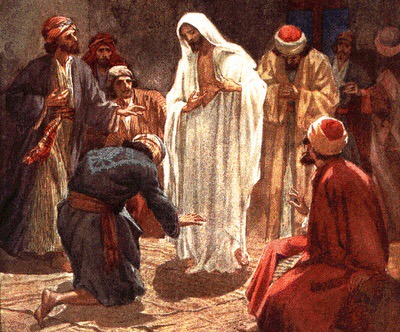
    And if you find that’s the case for you, you have ten patron saints locked up in that room.  They too had a great deal of fear.  Fear that they too might be led to the cross by the same people who took Jesus there.  There was certainly some reality to that fear, and I think we can all understand it.  But I also think it’s significant to realize that the Eleven, all of whom lived closely with Jesus for three years, were not yet able to overcome their fears and pursue the mission of Jesus.  Instead, they gather in a locked room, mourning their friend, confused about the empty tomb and stories of his appearances, and fearful for their own lives.  We whose lives are filled with fear at times definitely have the Apostles as our kindred spirits.

    The truth is that, like the Apostles, it doesn’t matter what has gathered us here.  The important thing is that at least we are here.  At least in our fear we did not hide away and refuse to be brought into the light.  Because there are many who have left us, aren’t there?  Many have had enough of church scandals and have decided to take their spiritual business elsewhere.  Many have been hurt in all kinds of ways and have not found immediate healing in the Church.  Many have been influenced by the allurements of the world and the false comforts of pop psychology and have given up on a religion that makes demands of them.  Many have left us, but at least we are here, at least we have gathered, albeit in fear, albeit locked up in our own little rooms, but definitely in the path of our Lord who longs to be among us in our fear and to say, “Peace be with you.”

    The peace that Jesus imparts is not just the absence of war or conflict in our lives.  It is instead a real peace, a peace from the inside of us out.  A peace that affects our body, mind and spirit.  A peace that brings us into communion with one another and most especially with God for whom we were created and redeemed.  The peace that the Ten had upon seeing their Risen Lord, the peace that Thomas had just one week later, is the same peace that our Risen Lord offers to all of us fearful disciples who gather together as a refuge against the storms and uncertainties of our own lives.  That peace is a peace that invites us to reach out like Thomas did and touch our Lord as we receive his very Body and Blood in all his Divine Mercy.

    That peace is not some passive greeting that rests upon us and goes no further.  Whenever we are gifted with any blessing, it is never intended only for us.  We who have been gifted and healed and transformed by the peace of our Risen Lord are called just like the Eleven to continue to write the story of Jesus so that others may see and believe.  We now become the peace of Christ to reach out to a world that appears to be hopelessly un-peaceful.  We must extend that peace by reaching out to touch those who are sick, or poor, or lonely, or despairing, or doubtful, or fearful, or grieving, or fallen away.  Our own presence in and among our loved ones and in and among the world must be a presence that is rooted in the Risen Lord and steeped in his peace.  We must be the ones who help a doubting world to no longer be unbelieving but believe.

    We have come here today for all kinds of reasons.  We may have come here in doubt and fear, but as we approach the Eucharist and receive the very Body and Blood of our Lord who invites us to reach out and touch him in all his brokenness and woundedness, as we go forth to glorify the Lord this day, may we leave not in doubt and fear but instead in belief and peace.  Christ is risen!  He is risen indeed!  Alleluia!

    Peace be with you.

  • Easter Friday

    Easter Friday

    Today’s readings

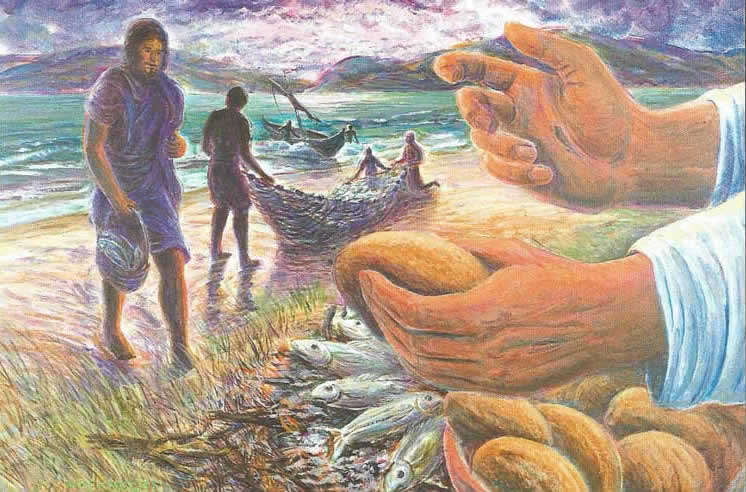
    It is always interesting to me that the disciples, who we are told were trained fishermen, never catch anything unless they are with Jesus.  Go through the Gospels and you will see that this is true.  Their nets always come up empty until he gives the command to cast the nets.  Then they can hardly bring in the catch because of the sheer number of fish they have caught.  Today’s episode finds the disciples dejected, not sure where to go, ready to return to their former life and their former career.  They have no idea what to do so they do what they always used to do … they go fishing.  And it is Jesus once again who not only gives them the fish, but cooks breakfast for them.  We too, are called to go fishing for the Lord in some way, but we’ll never catch anything if we go off on our own.  Praise God that he is always willing to go fishing with us!  Christ is risen!  He is risen indeed!  Alleluia!

  • Easter Thursday 

    Easter Thursday 

    Today’s readings 

    Can you imagine how the disciples were feeling at this point? Prior to today’s Gospel selection, the women found the empty tomb, Peter has seen the Lord, and the two disciples had experienced him in the breaking of the bread on the way to Emmaus. Their minds were most likely reeling with excitement; trying to get a grip on the things he had said to them while he was still with them. I’m sure they were trying to figure out what all this meant, what they needed to do next.
    Maybe that’s why the Lord’s initial words to them are “Peace be with you.” And apparently it didn’t work, because they think they’re seeing a ghost. After he eats some fish and speaks to them of the Scriptures, he sends them on mission with the words: “You are witnesses of these things.” 
    The peace that Jesus gives them is not the absence of conflict. That they will be witnesses to the fulfillment of the Scriptures will be anything but peaceful for them. They will have to make sacrifices – sacrifices of their very lives – to witness as Jesus calls them to, but there is no other choice. They are now beginning to understand the significance of what has happened among them, and they must go forward to do what they had been chosen to do. 
    When we have to make the decision to follow God’s call in our lives, we too will have to sacrifice. Not our lives, probably, but we will have to sacrifice our own comfort, our control over our own lives, our own point of view. But just like the disciples, we must remember what we have been chosen to do, and follow where we are being led. 
    We are witnesses of these things too, we are called to live and proclaim the Gospel. May we too receive the peace of Christ that we might focus on our call. 

  • Easter Tuesday

    Easter Tuesday

    Today’s Readings

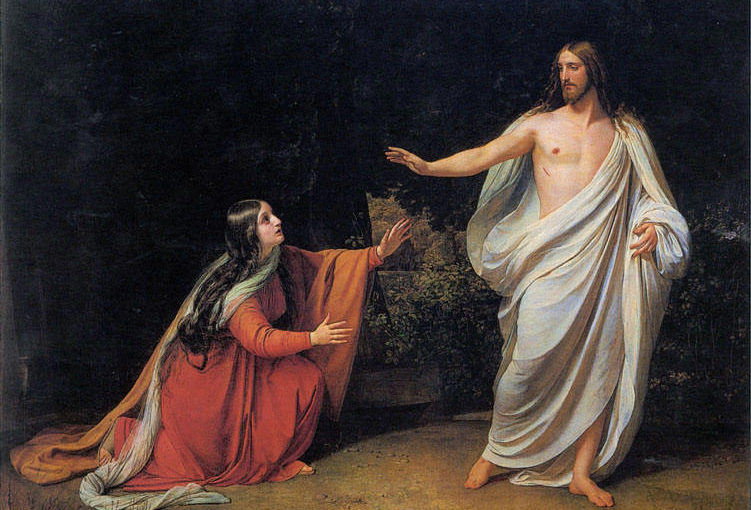
    Letting go of things is harder than we can sometimes even admit.  I think that’s what was going on with Mary Magdalene.  And we are just like her: we want to hold on to things and people as they are, because what is familiar is so very comfortable to us.  I think sometimes that’s true regardless of whether the familiar is positive or negative.  So many times we hold on to whatever we have and refuse to let them go because it’s as if we’re afraid we’ll be giving away some piece of ourselves.  So then what happens is that we hang on to images of ourselves or other people in our life that are outdated, and stifle any room for growth.  We hang on to resentments or past hurts and never give any chance for healing.  We hang on to unhealthy relationships and never give ourselves a chance to break the cycle of pain they bring.  We hang on to bad work situations and miss following our true calling.

    What Mary needed to hear from Jesus in today’s Gospel was that she had to stop hanging on to things as they were, and to allow God’s promise to be fully revealed.  The time for mourning was over, it was now time to rejoice and begin spreading the word that the Gospel was coming to its fruition.  She had to begin that by going and spreading the word to the other disciples.

    We too, have to stop grieving our past hurts and resentments and outdated notions of the world, ourselves and our relationships so that God’s promise can be fully revealed in us.  The message of Easter joy means that we must begin that by spreading the news that Jesus is doing something new in us and in our world, and make sure that everyone knows about it. We can do that by examining our lives every day and reflecting on what God is doing in us and how we are responding to it.  This is the kind of daily reflection that will help us to let go of what is unhelpful and grasp firmly to that which will lead us to Christ.

    As we continue to live lives of conversion like this, we too can proclaim with Mary Magdalene on this Easter day, and every day, “We have seen the Lord!”

  • Easter Monday

    Easter Monday

    Today’s readings

    Well, it wasn’t all that long ago that we saw the disciples scatter in fear, was it?  Here they had seen their friend arrested, tortured, and killed, so one could not blame them for running scared.  I’m sure I would have done no different if I had been them.

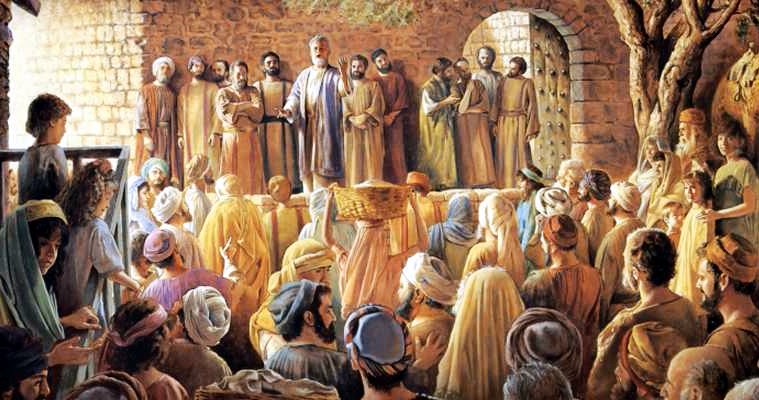
    But in today’s first reading, we see them different.  They have witnessed the resurrection of Jesus, they have seen him alive.  More than that, they have been filled with the gift of the Holy Spirit, that great gift he had promised them all along.  And so now they get it.  Now they realize what he had been saying to them, and now they have courage and fortitude to proclaim the Gospel.

    “God raised this Jesus, of this we are all witnesses,” Peter says on their behalf.  They have entered into mystagogia … that time following a great event when those involved look back on what they have experienced, and come to new understandings based on those experiences.  Their mystagogia of the Easter event has given them fresh hope and courage, and has empowered them to proclaim the message.

    Here at Notre Dame, we saw our brothers Jett, Jordan and Clinton baptized.  In addition, many were baptized into the Church and Christ Jesus throughout the world.  They are all experiencing mystagogia in these days.  They are looking back on their reception into full communion with us, and reflecting on what they have learned and how they have grown in their faith.  We cradle Catholics also experience mystagogia in these days.  Our baptisms are not as fresh in our minds as are the baptisms of our new brothers and sisters, but we recall with gratitude and profound joy the saving sacrifice that has given us hope of new life.  So we too, like the apostles, are empowered to proclaim the message.

    God has raised this Jesus from the dead, and we are witnesses of these things, brothers and sisters in Christ.  Praise God!  Christ is risen!  He is risen indeed!

  • Easter Sunday of the Resurrection of the Lord

    Easter Sunday of the Resurrection of the Lord

    Today’s readings

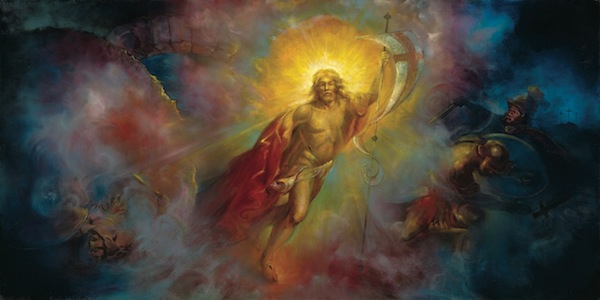
    There’s certainly a flurry of activity in today’s readings, isn’t there? Especially in the Gospel, we see Mary Magdalene run from the empty tomb to get the Apostles. And then Peter and the “disciple whom Jesus loved” ran to the tomb. This flurry of activity centers around a crisis in their faith, a time of confusion that will ultimately lead to stronger faith.

    So Mary comes to the tomb, early in the morning, while it is still dark. In St. John’s Gospel, the idea of light or dark always means something more than whether or not you can see outside without a flashlight. Often he is talking about light and darkness in terms of good and evil. That’s the way it was when we heard of Judas in Friday’s Passion reading: when he went out to do what he had to do, the Gospel says “and it was night.” That wasn’t just to record the time of day, it meant that we had come to the hour of darkness. But here when Mary comes to the tomb, I think the darkness refers to something else. Here, I think it means that the disciples were still in the dark about what was happening and what was going to happen.

    Obviously, their confusion gives that away. Jesus had tried to tell them what was going to happen, but to be fair, what was going to happen was so far outside their realm of experience, that really, how could they have understood this before it ever happened? All they know is what Mary told them: the tomb is empty and she has no idea of where they have taken the Lord. And after all that had just happened with his arrest, farce of a trial, and execution, their heads had to be spinning. How could they ever know this was all part of God’s plan?

    And even us – we who know that this was part of God’s plan – could we explain what was going on? Could we give a step-by-step picture of what happened when, and why? I know I couldn’t. But, like you, I take it on faith that, after Jesus died, the Father raised him up in glory. It’s a leap of faith that I delight in, because it is that leap of faith that gives me hope and promises me a future. How could we ever get through our lives without the grace of that hope? How could we ever endure the bad news that appears on our TV screens, in newspapers, and even closer to home, in our own lives – how could we endure that kind of news without the hope of the Resurrection?

    And so, even though there is this flurry of kind of confused activity among the Apostles this Easter morning, at least this day finds them running toward something, rather than running away as they had the night of the Passover meal. They are running toward their Lord – or at least where they had seen him last, hoping for something better, and beginning with the “disciple whom Jesus loved,” coming to understand at last. It’s not night anymore for them. The day is dawning, the hope of the Resurrection is becoming apparent, the promise of new life is on the horizon.

    And may this morning find us running too. Running toward our God in new and deeper ways. Running back to the Church if this has been the first visit you’ve made in a long while. Running back to families if you have been estranged. Running to others to witness to our faith both in word and in acts of service. We Christians have to be that flurry of activity in the world that helps the hope of the Resurrection to dawn on a world groaning in darkness. It’s not night anymore. The stone has been rolled away. This is the day the Lord has made!

    Christ is risen!  He is risen indeed!  Alleluia!

  • The Easter Vigil in the Holy Night

    The Easter Vigil in the Holy Night

    Today’s readings

    We English-speakers have just one word for time, but other languages have more; those languages recognize the different kinds of time.  Most notably for us, because it is reflected in the New Testament, the Greek language has two kinds of time: chronos and kairos.  Chronos is the kind of time you can measure.  It’s a day or a week or even the timeline of a project at work.  Kairos on the other hand can be thought of as quality time: a summer afternoon spent with your family, a visit to a sick loved one, or a chance encounter with an old friend.  This kind of time is mostly unmeasurable, and in some sense kairos is always “now.”

    It’s important to keep these kinds of time in mind because the world sometimes sees time in a rather cynical way.   But that’s not how our God sees time.  Did you hear what we prayed at the very beginning of tonight’s vigil?  Listen again: “Christ yesterday and today, the beginning and the end, the Alpha and the Omega, all time belongs to him, and all the ages, to him be glory and power through every age and for ever.  Amen.”  And these are important, even brave words for us to offer on this most holy night.  Tonight’s vigil proclaims that all time is holy, sanctified by our God who has walked with us through our yesterdays, remains with us today, and forges on with us toward our tomorrows.  There is not a single moment of our life, not a single moment of our history that is not holy because every moment has been, is now, and always will be imbued with the presence of our God who is holiness itself.  That’s what we gather to celebrate on this most holy night.

    But as we have walked through Lent, and especially through this Holy Week, there may even be a temptation, I think, to come to think that the world, and especially human history, was a creative experiment that went horribly wrong, that God sent his Son to clean up the mess only to have him killed for it, and then in a last move of desperation raised him up out of the grave.  But we know that’s not how this works.  Salvation was not some kind of dumb luck or happy accident.  The salvation of the world had been part of God’s creative plan all along.  Humanity, given the grace of free will had, and has, certainly gone astray.  But God did not create us simply to follow our own devices and end up in hell.  He created us for himself, and so sent his Son Jesus to walk our walk, to die our death, and to rise up over it all in the everlasting promise of eternal life.  That’s what we celebrate on this most holy of all nights.

    There is a cynical view of our world that would have us believe that everything is futile and that the only possible way to endure this world is to cultivate a kind of cynical apathy that divorces us from our God, our loved ones, our communities and our world.  We are conditioned to believe that time, and life itself, is meaningless, that there is nothing worth living for, and certainly nothing worth dying for.  But tonight’s vigil debunks all of that.  Tonight we are assured by our God that our present is no less redeemable than was our past, nor is it any less filled with promise than is our future.

    Tonight we have heard stories of our salvation, God’s saving action in the world throughout all time.  Each of our readings has been a stop in the history of God’s love for us.  God’s plan for salvation, and his sanctification of time, began back at the beginning of it all.  Each of the days was hallowed with precious creation, and all of it was created and pronounced good.  Then Abraham’s faithfulness and righteousness earned us a future as bright as a zillion twinkling stars.  Later, as Moses and the Israelites stood trapped by the waters of the red sea, God’s providence made a way for them and cut off their pursuers, making the future safe for those God calls his own.  The prophet Isaiah calls us to seek the Lord while he may be found, not spending our lives on things that fail to satisfy, but investing in our relationship with God that gives us everything.  The prophet Ezekiel foretells the recreation all humanity will experience as they come to know Christ and are filled with the Spirit.  St. Paul rejoices in the baptism that has washed away the stains of sin as we have died and risen with Christ, and has brought us into a new life that leads ultimately to God’s kingdom.  And finally, our Gospel tonight tells us not to be afraid, to go forth into the Galilee of our future and expect to see the Lord.

    We Christians have been spared the necessity of a cynical view of the world and its people.  Our gift has been and always is the promise that Jesus Christ is with us forever, even until the end of the world.  And so, just as God sanctified all of time through his interventions of salvation, so too he has sanctified our lives through the interventions of Sacrament.  We are a sacramental people, purified and reborn in baptism, fed and strengthened in the Eucharist, and in Confirmation, set on fire to burn brightly and light up our world.  Tonight we recall these three Sacraments of Initiation and recommit ourselves to the promises of our baptism.  Also, for the first time since Thursday, we have the opportunity to celebrate the Eucharist together, drawing strength from the food our God provides.

    These days of Lent have been a sanctifying journey for all of us, as we have walked the Stations of the Cross together, fasted together, celebrated the sacraments, reflected on living the Eucharist, gathered food for the food pantry, and so much more.  Christ has definitely sanctified this Lenten time for all of us, and has now brought us to the fullness of this hour, when he rises over sin and death to bring us all to the promise of life eternal.

    And it is this very night that cleanses our world from all the stains of sin and death and lights up the darkness.  The Exsultet, the Easter Proclamation that I sang when we entered Church tonight, tells us: “This is the night of which it is written: The night shall be as bright as day, dazzling is the night for me, and full of gladness.  The sanctifying power of this night dispels wickedness, washes faults away, restores innocence to the fallen, and joy to mourners, drives out hatred, fosters concord, and brings down the mighty.”  What a gift this night is, not just to us gathered here in this church, not just to all the Catholics gathered together throughout the world on this holy night, but to all people in every time and place.  Our world needs the light and our time needs the presence of Christ, and our history needs salvation.  Blessed be God who never leaves his people without the great hope of his abiding presence!

    And so, having come through this hour to be sanctified in this vigil, we will shortly be sent forth to help sanctify our own time and place.  Brightened by this beautiful vigil, we now become a flame to light up our darkened world.  That is our ministry in the world.  That is our call as believers.  That is our vocation as disciples.  “May this flame be found still burning by the Morning Star.  The one Morning Star who never sets, Christ your Son, who coming back from death’s domain, has shed his peaceful light on humanity, and lives and reigns forever and ever.  Amen.”

    Christ is risen!  He is risen indeed!  Alleluia!

  • Good Friday of the Passion of the Lord

    Good Friday of the Passion of the Lord

    Today’s readings

    Last night, I talked about the New Testament theme of kenosis, which is the idea of self-emptying, of pouring oneself out.  Last night, we talked about that in terms of the call to service: that Jesus himself got up from table, tied a towel around himself and took the lowest position, washing the feet of his disciples.  We reflected on how we are all called to that kind of kenosis, giving up our entitlement to see to the salvation of everyone in our life.  Today, I’d like to take another brief look at kenosis, because today we see that idea played out in its ultimate form.

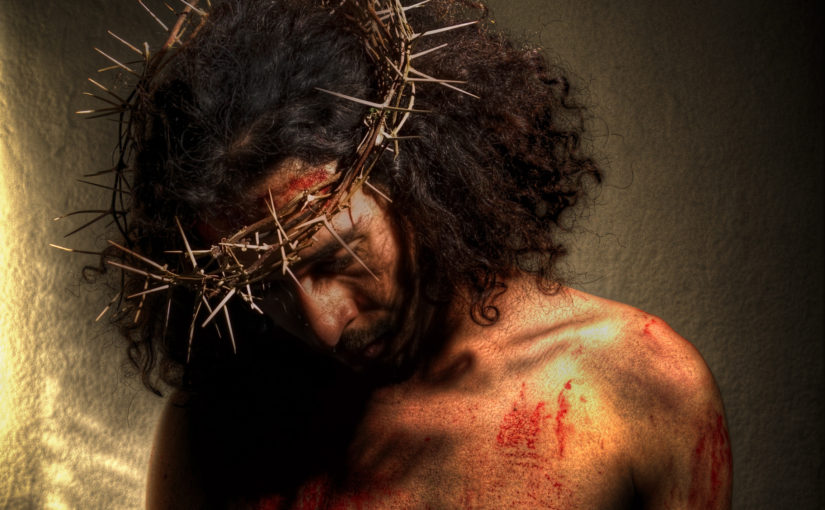
    I said yesterday that kenosis applied to our Lord, who, as Saint Paul wrote to the Philippians, “emptied himself, taking the form of a slave, coming in human likeness; and found human in appearance, he humbled himself, becoming obedient to death, even death on a cross.”  That’s today, of course.  It echoes what Isaiah says of the suffering servant in today’s first reading.  The suffering servant’s appearance is so marred, stricken, so infirm that we cannot bear to look at him.  It shouldn’t be that way; he is our God.  But that’s kenosis.

    The reason we can’t bear to look on him, of course, because if we really looked hard enough, we know, in our heart of hearts, that the marring, the strickenness, the infirmity are all ours.  This is a dark hour.  It seems like all is lost.  That’s one of the few guarantees that this fleeting life gives to us.  We will have to bear our own cross of suffering: the illness or death of loved ones, the loss of a job, the splintering of a family, or even the shame of addictive sin.  It is our brokenness that we see in the suffering servant, our sinfulness on the son of man.  And this suffering servant is embodied by our God, Jesus Christ our Savior, who carries all of that nastiness to the cross, and hangs there before us, bleeding and dying and crying out in agony.  That’s our sin, our death, our punishment – and he bore it all for us.  He chose to pour himself out – for us.

    And just when it seems like there is nothing left for him to give, when it seems like all life has been snuffed out, when it seems like death has the upper hand, the soldier thrusts his lance into the side of our Lord, and he pours himself out in one more glorious act of kenosis:  from his side pours forth the life blood and water that plants the seeds of the Church into the barren ground of the earth, guaranteeing the presence of the Lord in the world until the end of time.  Christ our God gives everything he has for us, takes away all that divides us, and performs the saving sacrifice that makes salvation possible for all people.  Our God gives up everything – everything – for love of us.

    We know that the suffering and death of Jesus is not the end of the story.  In the day ahead, we will keep vigil for the Resurrection of the Lord which shatters the hold that sin and death have on us.  We are a people who eagerly yearn for the Resurrection.  We certainly hope for the great salvation that is ours, and the light and peace of God’s Kingdom.  But that’s for tomorrow.  Today we remember that that salvation was bought at a very dear price, the price of the death of our Savior, our great High Priest.  Today we look back on all of our sufferings of the past or the present, we even look ahead to those that may yet be.  We see all those sufferings up there on that cross, willingly taken there by our Saving Lord.  And as we sit here in God’s presence we know that we are never ever alone in our dark hours, that Christ has united himself to us in his suffering and death.  May we too unite ourselves to him by embracing our own suffering, and walk confidently through it with him, pass the gates of salvation, and enter one great day into God’s heavenly kingdom.