Category: Prayer

  • Monday of the Twenty-fifth Week of Ordinary Time

    Monday of the Twenty-fifth Week of Ordinary Time

    Today’s readings

    I love the little line in the gospel reading that says, “Take care, then, how you hear.” It almost seems like a throw-away line, but really, I believe, it’s an essential instruction from Jesus. We disciples are to take care how we hear. Not what we hear, although that’s probably part of it, but how we hear.

    So how do we hear the words of the gospel? Do we hear them as something that seems nice but doesn’t really affect us? Do those words fly over our heads or go in one ear and out the other? Do we hear them at Mass, and then live however it is we want, seeming to ignore what we’ve just heard?

    Or, do we really hear the Word of the Lord? Does the gospel get into our head and our heart and stir things up? Do the words of Jesus get our blood flowing and our imaginations racing? Does hearing the gospel make us long for a better place, a more peaceful kingdom, a just society? We are not just hearing words about Jesus, we are hearing Jesus, we are experiencing the presence of God right here, right now, among us. If we open the door of our ears and our hearts, we might just find God doing something amazing in us and through us.

    Take care, then, how you hear.

  • The Twenty-fifth Sunday of Ordinary Time

    The Twenty-fifth Sunday of Ordinary Time

    Today’s readings

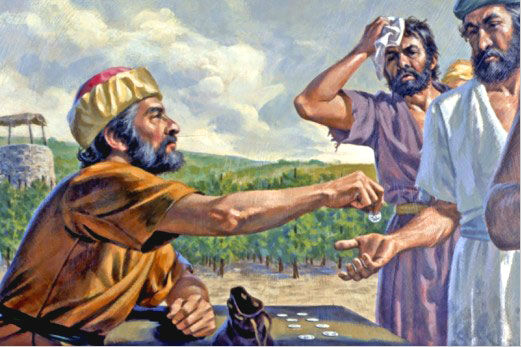
    I wonder if you find this Gospel parable a little aggravating. I know I do. Certainly the people hearing it in Jesus’ day would have been aggravated too. They knew the economics of day laboring better than we do (although day laborers are by no means extinct in the twenty-first century). The very thought that those who labored hard all day, in the sun, would get the same as those who worked but an hour was unthinkable. I dare say we find it that way too.

    So it’s important for us to notice that this is not intended to be a parable about justice. Jesus tells us right away: “The kingdom of God is like a landowner…” So the parable is not about justice, but instead it is an illustration of the workings of the Kingdom of God. In one sense, that’s comforting, because Jesus is not telling us that we should run our businesses with lavish disregard for economic wisdom. I would be hard pressed to be convinced to even run the parish that way.

    But now think about the fact that the parable is about the Kingdom of God. Jesus was delivering a message to the religious establishment: they didn’t have the monopoly on the kingdom. They thought they had earned God’s reward, and Jesus tells them it doesn’t work that way. It’s not about what you’ve done or how long you’ve been doing it, it’s about God’s mercy and love that is poured out with lavish generosity. They would have found that pretty irritating.

    And maybe some of us do, too. Do you mean to tell me that those of us who have worked hard and long for the mission and spent our days and nights at church might inherit just as much as someone who ignores the Gospel and converts on his or her death bed? Well, yes. That could be. Many years ago now, I heard about the deathbed conversion of actor John Wayne.  I thought at the time, “Gee, that’s convenient.”  Here he may well have led a life of excess and who knows what all debauchery and only on his deathbed was he willing to form a relationship with God.  Here those of us disciples have been working hard at it all this time, and yet some can get it just at the last minute?  That makes me bristle with thoughts of unfairness.  But, as the prophet Isaiah tells us today, our thoughts are not God’s thoughts, and our ways are not God’s ways.

    It’s important to note that we cannot pass judgment on anyone. I don’t know the details about John Wayne’s life and certainly not about his relationship with the Lord. Who knows if a conversion wasn’t something he had been looking forward to for a long time and he didn’t know how to make it happen. The important thing is that his desire was granted, in the waning moments of his life, and God is generous. That’s all we need to know.

    Let’s face it, none of us wants God to be too strict an accountant. No matter how hard we may try to be good disciples, we often fall short in big ways and small ways. God gives us second chances all the time. And thank God he’s generous, or we’d all of us be in a world of hurt, without exception. Pope Francis is reminding us all of that kind of humility and its value, and we would do well to live it. The last line of the Gospel is hopeful: “The first will be last and the last will be first.” So whether you’re first or last, you still have the possibility of life eternal. News doesn’t get any better than that.

  • Friday of the Twenty-fourth Week of Ordinary Time

    Friday of the Twenty-fourth Week of Ordinary Time

    Today’s readings

    Today we get a bit of a glimpse as to how Jesus’ day-to-day ministry worked.  We can see three things in particular that characterize how things happened.  First, he journeyed to proclaim the Good News.  He met people where they were, and even sought them out.  This shows us God’s relentless pursuit of the people he loves.

    Second, he brought people with him.  He travelled with the Twelve Apostles, some of the women he had cured of evil spirits and of illnesses, some particular women (Mary Magdalene, Joanna, and Susanna), and “many others.”  All of these were drawn to Jesus for various reasons.  We can assume they had all been given some gift: healing, a call to ministry, recognition of their worth – and all of them had responded by wanting to be near him.  This models for us our response to God’s work in our lives.

    And finally, those travelling with him provided for his ministry out of their resources.  Some of the women were well-connected, especially Joanna, whose husband was a high official in the court of Herod Agrippa.  So she would have had resources to help with the ministry as well as leisure to follow Jesus.

    We can hardly visit this gospel reading, though, and not notice the meticulous mention of the women that were among his followers.  In a day where a woman’s participation in anything of a public nature would be totally frowned upon, Jesus reached out to women, and brought them into his ministry.  Certainly the Evangelist would never have mentioned it if it weren’t important to the Gospel itself.

    We come here today for Mass, aware that our God seeks us out in little and big ways every single day.  We too want to be close to him, and respond as did the Twelve, the women, and the “many others.”  Our desire for God and our yearning for forgiveness are themselves God’s gift to us.  Blessed are those who journey with Christ on the way.

  • Thursday of the Twenty-fourth Week of Ordinary Time

    Thursday of the Twenty-fourth Week of Ordinary Time

    Today’s readings

    Simon the Pharisee had committed a grave error in hospitality, and a serious error in judgment. In those days, when a guest came to your home, you made sure to provide water for him or her to wash their feet, because the journey on foot was often long and hot and dirty, and it was pretty much always made on foot. But Simon had done no such thing for Jesus.

    Simon’s intentions were not hospitable; rather he intended to confront Jesus on some minutiae of the Law so as to validate his opinion that Jesus was a charlatan. He judged the woman to be a sinner, and reckoned Jesus guilty of sin by association. But Jesus is about forgiveness. He didn’t care about the woman’s past; he just knew that, presently, she had need of mercy. Her act of love and hospitality, her posture of humility, her sorrow for her sin, all of these made it possible for Jesus to heal her.

    But the one who doesn’t think he is in need of healing can never be healed. And so that’s our examination of conscience today. Are we aware of our need for healing, or have we been thinking we are without sin, without brokenness, without openness to God’s mercy? If so, our moments of reflection today need to guide us to honest and open acceptance of God’s mercy, and a pouring out of the best that we have in thanksgiving.

  • Memorial of 9-11

    Memorial of 9-11

    Today’s readings

    I think today’s Gospel reading presents some challenges on this particular day. “Love your enemies” is a fine instruction in times of peace and security, but we don’t live in those times. I wonder if anyone ever did, after Eden.

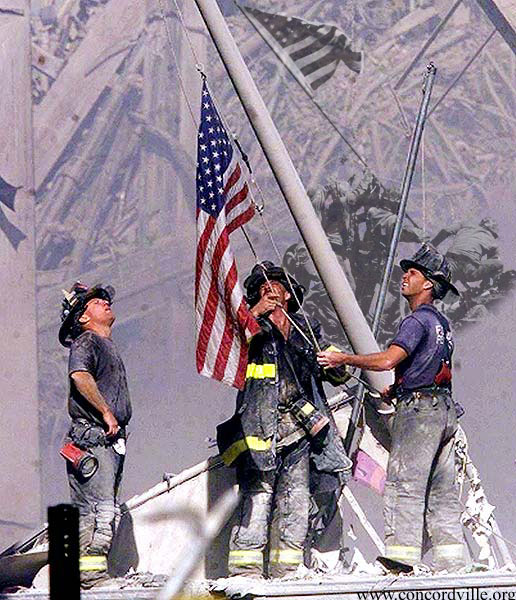
    I think many of us will never forget where we were eight years ago today. People say that about the day that President Kennedy died, or the day when the space shuttle Challenger exploded. But in a particular way, I think we will never forget September 11, 2001, because it was a day that changed our world in some very unpleasant ways and shattered whatever remained of our innocence. Traveling and doing business has changed so much in these years. So many of us have known people who have died in the twin towers, or in the war that has raged since.

    And today, war continues, and the lack of peace seems to continue, and there is that ever-present sense of terror. So maybe it is time for us to do some examination and to discern what has led to that sense of unrest. Today’s Gospel gives us the examination of conscience that will help us to do that. “Love your enemies.” The commandment is unsettling. We all know it’s hard sometimes to truly love those who are not our enemies, so what chance do we have to love our enemies? And why should we, anyway?

    Well, that last line of the Gospel tells us why: “For the measure with which you measure will in turn be measured out to you.” So the way that we deal with others is the way God will deal with us. That’s almost horrifying. So it is imperative that love be our first inclination. It’s the lack of love that got us into this mess in the first place. So if we want to be with God for eternity, we have to be like God, our God who is love itself.

    And yet, it’s easier to say that than to do it. We certainly struggle with our emotions in times of terror and tragedy. But Jesus never said our way in this world would be easy as his disciples, but only that it would lead to eternal blessedness.

    It didn’t all go wrong on 9-11; if we are honest, that horrifying day was a long time coming. But that day should have been a loud, blaring wake-up call to all of us that things have to change if we are ever going to experience the peace of Christ’s kingdom. We are not going to get there without any one person or even any group of people; we need for all of us to repent if any of us will ever see that great day. Today, brothers and sisters in Christ, absolutely must be a time when we all hear that wakeup call yet anew, and respond to it from the depths of our hearts, both as individuals, and as a society.

    Truly we will never forget where we were on that horrible day of 9-11. But wouldn’t it be great if we could all one day look back with fondness, remembering with great joy the day when we finally partnered with our God, found a way to love our enemies, and turned it all around?

  • The Twenty-third Sunday of Ordinary Time

    The Twenty-third Sunday of Ordinary Time

    Today’s readings

    I have to say, when the Scriptures talk about prayer, I get a little uneasy. Not because I don’t like to pray, or think prayer is a bad thing. But more because I think mostly we misunderstand prayer, and usually a brief mention in the readings can do more harm than good. This week’s Gospel is a good example of that. The line almost at the end of the reading is the culprit: “if two of you agree on earth about anything for which they are to pray, it shall be granted to them by my heavenly Father.”

    Really? Anything? I don’t know about you, but I personally have an example of something that my friends and I had been praying about, and just this week it was denied. You can probably think of examples too. So what are we to make of this? Well, I’d like to make three points.

    First, in the line right after this, Jesus says, “For where two or three are gathered together in my name, there am I in the midst of them.” Notice how he says, “in my name.” So it’s not like a couple of us can get together and pray for something crazy and hold God accountable for granting it. If we’re gathered in anything less than the name of Jesus, we’re in the wrong place, and you don’t get what you want, or even what you need, when you’re in a place other than where Jesus is.

    Second, reflecting on that same line, I would point out the last phrase: “there am I in the midst of them.” Sometimes God doesn’t answer all our prayers in the way we think he should. But he definitely always answers them with his presence. Sometimes that leads to resolution of a problem that is greater than we could have imagined. Sometimes it makes us a stronger, more faith-filled person. And sometimes the answer to a prayer means that we have to change, not the situation. So the abiding presence of our God, most perfectly experienced in community, when two are three are gathered in his name, is the most important answer to every prayer.

    Finally – and I can’t say this often enough, nor stress it strongly enough – prayer is not a magic wand. You might read in this brief little passage that all you have to do is pray and you get it. Prayer is always experienced in relationship: relationship with God and relationship with others. That’s why this brief little passage mentions praying together, and praying in Jesus’ name. Those are important points, and it’s best not to overlook them.

    Prayer is a relationship, prayer is work – sometimes hard work, prayer is a way of life for the disciple of Jesus. We enter that relationship at our Baptism, and it’s our task as disciples to nurture that relationship our whole lives long.

  • Friday of the Twenty-Second Week of Ordinary Time

    Friday of the Twenty-Second Week of Ordinary Time

    Today’s readings

    One of the most frustrating things to hear from people is that the argument that we shouldn’t change something because, “we’ve always done it that way.”  And I don’t think God likes that line of reasoning any better than we do.  Because God is not done creating the world yet.  His work of creation is ongoing; he continues to make all things new until that time when everyone and everything is indistinguishable from God himself.  God longs to re-create the world in such a way that we are all caught up in the life of God and share his glory.  Anything less needs to be re-created.

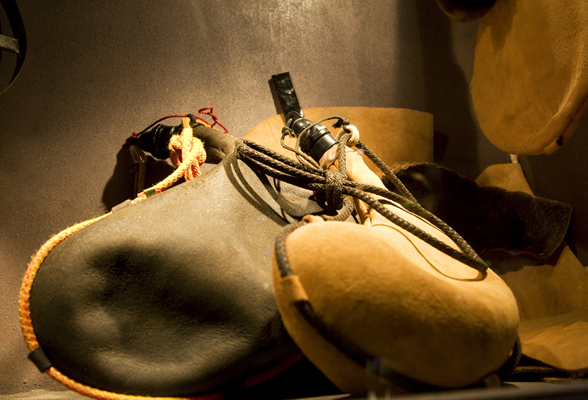
    So if God is making new wine, we have no business putting it into old wineskins.  We must take the new creation that he offers us and put it into the fresh wineskins of our hearts, renewed in Christ and refreshed by lively faith.  The wineskins of our souls have to be constantly made new so that they can receive new glory from God.

  • The Twenty-Second Sunday of Ordinary Time

    The Twenty-Second Sunday of Ordinary Time

    Today’s readings

    This month we’ve been seeing a lot of one of my favorite characters in the Gospel, and that is Saint Peter.  Just three weeks ago, the Apostles were out in a boat, and Jesus came to them on the water.  Saint Peter asked our Lord to command him to come to him on the water, and he did, and we all know how that went.  Then last week, Jesus was quizzing the Apostles about who people said that he was.  Peter was the one who spoke up and professed that Jesus was the Christ, the coming Anointed One, and Jesus proclaimed Peter the Rock on which he would build the Church.

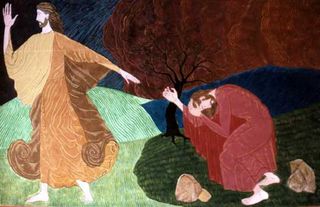
    And here we are today, just a couple of verses later in Matthew’s Gospel, and Peter steps in it yet again.  Because Peter was still clinging to the old notions of what the Messiah would be, he could not fathom that Jesus would have to suffer and die.  And so Jesus chastises him for thinking not as God does, but as people do.  It’s a mistake we all make time and again in our spiritual lives.

    Peter’s faith journey was like that: up one minute, and down the next.  One minute he’s walking on water, the next he’s drowning; one minute he speaks eloquently of his Lord, and the next he’s the voice of temptation.  So maybe it seems like Saint Peter, flawed as he was, was an inappropriate choice to be the pillar of the Church, the first of the Popes.  But our Lord never makes any mistakes.  He chooses who he chooses for a reason, and I think that’s what we have to spend some time looking at today.

    If Peter was unqualified for the position to which he was called – and he clearly was – then we have to expect to be unqualified for the roles to which we have been called.  Parents often feel that when they start to raise their first child.  Priests feel that every time they witness something incredible – which is almost all the time.  We are all unqualified, but God sees more in us, he sees our heart, he sees who he created us to be, and he won’t rest until we’ve fulfilled that potential.

    If Peter made some mistakes along his journey of faith and discipleship – and he clearly did – then we have to expect to make mistakes in our own faith journey.  One minute we’ll have a glimpse of God and we’ll feel like we could never let him down, then the next minute we’ll fall into sin, maybe a sin we’ve been struggling with for so long, and we’ll feel like God couldn’t love us.  But he loved Peter, and he loves us.  He pulled Saint Peter out of the stormy waves, and he will reach out and pull us out of our own storms of failure, as often as we cry out.

    The one thing you can’t fault Saint Peter for is his courage.  Eleven other guys stayed in the boat, but Peter wanted to be where our Lord was: out on the water.  Eleven other guys kept their mouth shut when Jesus asked who they said he was, but Peter did his best to make a profession of faith.  His life wasn’t perfect, his discipleship wasn’t perfect, his faith had a long way to go, but he knew that he couldn’t leave our Lord forever.  Even when he blows it in the hours before Jesus died and denies our Lord three times, he accepts our Lord’s forgiveness and fulfills the role Jesus gave him in last week’s Gospel.

    Saint Peter’s story kept evolving, and ours isn’t done yet either.  Our Lord loved Saint Peter and he loves us too.  And that’s all it takes for great things to happen.

  • Monday of the Twenty-first Week of Ordinary Time

    Monday of the Twenty-first Week of Ordinary Time

    Today’s readings

    Today’s gospel has Jesus taking the Scribes and Pharisees to task for forgetting what is really holy, and treating things as sacred while ignoring God who is holiness itself.  Apparently, they thought that swearing an oath by the gold of the temple was more binding than an oath simply sworn on the temple itself: but, Jesus asks, isn’t the temple what makes the gold holy?  And they confused swearing an oath by the altar and by the gift on the altar.  They had forgotten that the altar is what makes the gift holy.  But even more than that, they had been so caught up in details, that they forgot that God is holy, and makes anything that can be called holy, holy.

    Now, Jesus isn’t saying that people should disobey the first and third commandments, using God’s name as an assurance of an oath.  Swearing by the name of God isn’t to be taken lightly.  But what he is saying is that the Scribes and Pharisees needed to straighten out their flawed notion of holiness.  God is holy; and he alone makes holiness.

    So today might be a call for us to take a moral inventory of our own notion of holiness.  What have we been putting before God?  What do we hold sacred?  Do we have idolatry in our life?  Do we sometimes forget that, as we say in the Gloria: “you alone are the Holy One, you alone are the Lord, you alone are the most high, Jesus Christ…”?

  • Monday of the Twentieth Week of Ordinary Time

    Monday of the Twentieth Week of Ordinary Time

    Today’s readings

    A friend of mine told me that a wise old nun once taught him, “Work like everything depends on you, but pray like everything depends on God.”  It’s good advice, because everything, of course, does depend on God, but God expects us to work in cooperation with him, so that his will be done.  But it’s certainly a hard line to walk.  Once we get to working, we almost always get full of ourselves and think everything will fall apart if we don’t take care of it.  I know I find it hard to pack up and go on vacation or take time off unless I know I’ve got everything in order, and then I still worry about what comes up in the meantime.

    Today’s readings remind us of the danger of crossing that line and forgetting that God is in charge.  The rich young man in today’s gospel reading discovers that following the rules is only just a good start; to really gain heaven you must be willing to let go of the fading riches of this world.  The people Israel in today’s first reading have grasped on to the uncertain security of alliances with this world’s powers and have let go of their belief in God, and Ezekiel prophecies that would come back to haunt them.  Holding on to the things of this world will never get us anywhere; worrying about what God is doing is unproductive; we will never find ultimate security in alliances with the powers of this world.  To truly gain heaven, we have to let go and hold on to our God, whose riches never fade and whose power is never outmatched.

    The Psalmist gives us good advice today.  Do not forget the God who gave you birth.  He is in control; we are not.  God is God, and we are not.