Category: Prayer

  • Ash Wednesday: This Campaign of Christian Service

    Ash Wednesday: This Campaign of Christian Service

    Today’s readings
    #
    AshWednesday #LentND #AshTag

    Back when I was in seminary, I was a fire chaplain for one of the local fire departments.  On Wednesdays, we only had one class, and since it was Ash Wednesday and our teacher was a pastor of a parish, he was obviously busy, so we had the day free.  I went with my friend Jeff, who was a chaplain with me, to the station to see how things were going and to spend some time doing some ministry there.  When we got there, though, there really wasn’t anyone around.  The receptionist told us they had all gone out on a fire call, and it looked pretty big.

    So Jeff and I got the address and headed out to the scene of the fire.  This was the first major fire I ever worked on, and when I got there and saw this four unit condo on fire, I said something like, “Oh my gosh! That building’s on fire!”  Jeff said something like “Well, what did you expect?”  Checking in with the fire chief, he told us that the families were in an apartment building across the street.  We went there and introduced ourselves.

    We talked to the families that were there for a while, and then had to get some other information, and during a lull, I asked the woman whose apartment we were trampling with our wet boots if she knew these families before.  She said no, but she wouldn’t have thought of not opening her home to neighbors in trouble.  I noticed she was wearing a sweatshirt with the letters WWJD on it – what would Jesus do? And I thought, well she obviously knew the answer to that question, and was not afraid to live it.

    Again, that was Ash Wednesday that year, and it made a big impact on me.  I realized it was so important for me to live those four letters – WWJD – during Lent, and really all year long.  But doing that is a process.  You have to develop new attitudes, new habits – new habits of the soul.  This Lent is all about doing that for us.

    We are called to repent, to break our ties with the sinfulness and the entanglements that are keeping us tethered to the world instead of free to live with our God. Our Church offers us three ways to do that during Lent.  First, we can fast.  We can give up snacks, or a favorite food, or eat one less meal perhaps one day a week, or we can give up a favorite television program or activity.  Fasting helps us to be aware of the ways God works to sustain us when we’re lacking something we think we need.  The whole idea of fasting is that we need to come to realize that there is nothing that we hunger for that God can’t provide, and provide better than we could ever find in any other source.

    Second, we can pray.  Sure, we’re called to pray all the time, but maybe Lent can be the opportunity to intensify our prayer life, to make it better, to make it more, to draw more life from it.  Maybe we are not people who read Scripture every day, and we can work through one of the books of the Bible during Lent.  Maybe we can learn a new prayer or take on a new devotion.  Maybe we can spend time before the Lord in the Tabernacle or in adoration.  Maybe we can just carve out some quiet time at the end of the day to give thanks for our blessings, and to ask pardon for our failings.  Intensifying our prayer life this Lent can help us to be aware of God’s presence at every moment of our day and in every place we are.

    Third, we can give alms or do works of charity.  We can visit a soup kitchen or go out to collect groceries for our food pantry during our “40 Cans for Lent” campaign.  Maybe we can devote some time to mentoring a child who needs help with their studies, or volunteer to help in our school or religious education program.  Works of charity might be a family project, choosing an activity and doing it together.  When we do works of charity, we can learn to see others as God does, and love them the way God loves them and us.

    And none of this, as the Gospel reminds us today, is to be done begrudgingly or half-heartedly.  None of it is to be done with the express purpose of letting the world see how great we are.  It is always to be done with great humility, but also with great joy.  Our acts of fasting, prayer, and charity should be a celebration of who God is in our lives, and a beautiful effort to strengthen our relationship with him.

    It is my prayer that this Lent can be a forty day retreat that will bring us all closer to God.  Our collect prayer calls this a “campaign of Christian service.”  Lent is a time to pay more attention to the ways God wants to bless us and respond by giving blessing to others.  May we all hear the voice of the prophet Joel from today’s first reading: “Even now, says the Lord, return to me with your whole heart!”
  • Monday of the Eighth Week of Ordinary Time 

    Monday of the Eighth Week of Ordinary Time 

    Today’s readings 

    One of the most important aspects of the spiritual life is the knowledge that we can’t hold on to everything all at once. If we’re holding on to the stuff of this world, we have no way of taking hold of the blessings God wants to give us.

    The rich young man in today’s Gospel has to answer the question that really confronts all of us, especially considering the affluent area in which we live. That question, of course, is what is most important in life? Do we continue to strive to have the most stuff, the best stuff, the cutting-edge stuff? Or do we give that up and go all in for the kingdom of God? Because we can’t have both; that doesn’t work. If our hands and hearts are filled with the stuff that we have, then we have no room for God and his love, and everything else he wants to give us.

    We don’t know how the rich young man answered the question. He walked away sad, but we don’t know if he decided to live with the sadness, if the sadness gave way to despair, or if the sadness moved him to make radical changes in his life. But we do know that the ball is in our court. Do we experience that sadness? And if so, how will we deal with it? Please God let us let go of what we have been grasping so that we can grab hold of God’s hand offered to us in love. What is it that we will be letting go of?

  • The Eighth Sunday of Ordinary Time

    The Eighth Sunday of Ordinary Time

    Today’s readings
    For the Rite of  Acceptance Into the Order of Catechumens

    Worry will absolutely kill us, if we let it.  As a pastor and confessor, I hear worry from people all the time.  Worry about job issues or money in general, worry about illnesses or the grieving of loved ones, worry about children and other family members, worry about relationships gone wrong.  Then you could also worry about crime and war and terrorism and the economy and just about our country or world in general.  There’s plenty to worry about, and most of us worry about something, sometime, maybe even all the time, in our lives.

    But Jesus tells us today to cut that out.  Worrying does not solve our problems.  And what we worry about is so often not the most important thing in the vast scheme of things.  What I love in this passage is that Jesus provides us with the antidote to all that worry: We don’t need to waste time on worry because God’s providence is infinitely greater than our worry.  We are worth far more than the lilies of the field and the birds of the air.  God takes care of them, and he will take care of us.  Maybe not in the exact way we would pick, but always with love and his strong, abiding presence.  Even if a mother were to forget her child, as Isaiah reassures us today, God will never forget us.

    So now that we have the worry out of the way, what do we do?  I think sometimes that’s why so many of us hang on to worry – because that’s the only thing we know.  But Jesus says that we should put an end to the worrying so that we’ll have time for the one thing that really matters: “Seek first the kingdom of God and His righteousness, and all these things will be given you besides.”  Because when we possess the kingdom of God, brothers and sisters, we possess everything we could ever possibly need.  More than the birds of the air have, more than the lilies of the field possess; the kingdom of God is the pearl of great price.

    Today we have the opportunity to focus on that.  Jordan and Clinton have come here seeking the kingdom.  In the midst of those things that are going on in their lives, they have realized that there was something they were lacking and that could only be filled up by the presence of God.  In our gathering today, we pledge to support them in prayer and to walk with them on the journey.  Even better, their journeys give us pause to look at our own journeys of faith and maybe give us the encouragement to take a step closer to the cross if we have be lax or have laid it down.

    So now they have been admitted to the Order of Catechumens, and I’d like to say a word or two about what that means.  Catechumens are those who are preparing for baptism and are not infants.  Non-baptized people ordinarily do not have rights within the Church, but catechumens, even though they are not baptized, do.  Catechumens have the right to the Sacraments, particularly and firstly baptism, of course.  They also have the right, even before baptism, to be married in the Church if they are preparing for that.  And finally, they have the right, God forbid, to a Church funeral and Christian burial.

    They won’t be catechumens long, however.  Because next week, they will go to the Cathedral in Joliet to be chosen for the Sacraments of Baptism, Eucharist, and Confirmation by Bishop Conlon.  Then we will call them “the Elect.”  They have all the same rights, and election signals that they have entered into the final, more intensive, preparation for the Sacraments, which is called the period of “Purification and Enlightenment,” and focuses on their spiritual preparation for the Sacraments.

    All of these leads to the Easter Vigil, in which they will enter the waters of Baptism for the cleansing of their sins and their joining to the Body of Christ and His Church.  I hope that you will continue to keep them in their prayers, along with Jett Davis and Sylvia Spangenberg, who are also catechumens at this time.  May God bring them closer to himself as they approach the Sacraments, and may God bring us all together one day to eternal life.

  • Tuesday of the Seventh Week of Ordinary Time

    Tuesday of the Seventh Week of Ordinary Time

    Today’s readings

    There’s been a lot of arguing in the Gospels these last couple of days.  Yesterday, the disciples were arguing with the scribes when both groups found they were incapable of casting a demon out of a person who was ill.  Today, we have the disciples arguing among themselves because they find they don’t understand Jesus’ message.

    All of this arguing betrays a real lack of growth in faith among those disciples.  They probably felt like, since they were in Jesus’ inner-circle, they should have the answers.  And perhaps they should, but to their defense, they hadn’t received the Holy Spirit yet.  In a real sense, they were still in formation, and they shouldn’t have been so afraid to ask Jesus for clarification.

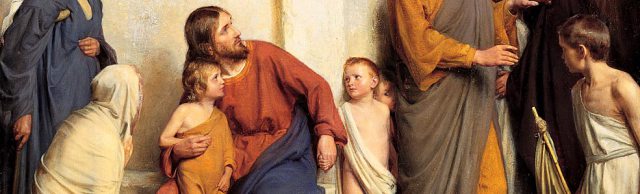
    Jesus’ lesson to them then comes from him putting a little child in their midst.  Receive a child like this in my name, he tells them, and you receive me.  What’s the point of that?  Well, receiving a child in Jesus’ name is an act of service, because a child can do nothing but receive at that point in their life.  So serving others in Jesus’ name is what brings us to the Father.

    I think the take-away for us is that trying to be smarter than everyone else isn’t what shows that we are faithful people.  Instead of arguing our point, we need to ask God to help us get the point.  And we have to be ready to act on our faith, instead of arguing about it.

  • Monday of the Seventh Week of Ordinary Time

    Monday of the Seventh Week of Ordinary Time

    Today’s readings

    So the disciples are waiting for Jesus to come down the mountain after the Transfiguration.  They have attempted to cure a man’s son from the hold of a demon, but they were apparently unable to do so.  This seems to have led to an argument between them and the scribes.  You can almost feel Jesus’ exasperation.  Both the disciples and the scribes should have been able to do something for the boy, but they couldn’t.  Why?  Because instead of praying, they argued about it.  “This kind can only come out through prayer,” Jesus tells the disciples when they ask why they were ineffective.

    I often wonder, with more than a little fear, how many demons I could have cast out – in myself and in others – if I had a little more faith, if I prayed a little more than I do.  There are, of course, all sorts of demons: demons of illness, demons of cyclical sin, demons of impure attachments, demons of homelessness, poverty, and marginalization, and so many more.  Think of all the demons we could cast out if we just had more faith, if we prayed more fervently.

    Sometimes, when we are trying to overcome some problem, the last thing we think to do is pray, when it should absolutely be the first.  The disciples were guilty of it, the scribes were, and we are too sometimes, if we’re honest.  And all of us should know better.  I know that I myself can think of a number of problems I’ve tried to solve all by myself, when it would have been so much more effective to first turn them over to our Lord.  We can’t just cut God out of the picture and rely on our own strength; that never works – our own strength is so fiercely limited.  We have to turn to the tools we have been given: faith and prayer.  And we can start by saying with the boy’s father: “I do believe, Lord; help my unbelief.”

  • Saturday of the Sixth Week of Ordinary Time

    Saturday of the Sixth Week of Ordinary Time

    Today’s readings

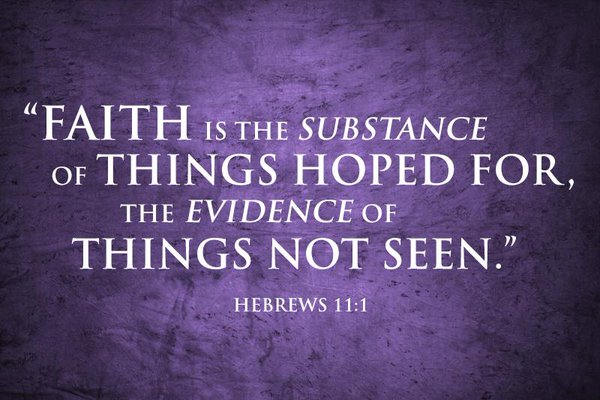
    “Faith is the realization of what is hoped for and evidence of things not seen.”  The writer of the letter to the Hebrews sums up for us this notion of faith, which can be so difficult to wrap our minds around.  What I love about the definition of faith that comes to us in this passage is that it seems to be telling us what we at some level already know: faith is a heritage.  The passage speaks of the faith of Abel, Enoch, and Noah, all stories we can readily read in our Old Testament, stories of men who had to really take a leap of faith because what they hoped for was unseen.  Only God could fulfill all their hopes and longings.

    The same, of course, is true for us.  We are living in difficult times.  There is uncertainty in the world, with wars being fought almost everywhere we can think of, and especially our own men and women fighting in the middle east, and in countries all over the world.  Our state and nation have political issues to the point that it’s hard to know which politicians are honest and which are not, and we almost hate to turn on the television and what’s happening today.  We have our own personal family uncertainties, maybe loved ones are sick, or are suffering from depression.  Maybe relationships are strained.

    For all of us who live in these uncertain times, Jesus offers us hope.  We get a glimpse today at what we hope for and cannot now see: Jesus is transfigured before Peter, James and John.  This is a foretaste of the glory of the Resurrection, a glory that Jesus knew when he rose from the dead, and a glory that we yet hope for.  It’s not pie in the sky: we know that our promise in Christ is greater than any of the difficulties our time can bring us.  We know that faith is our heritage, and that that faith has led all of our forebears through times as difficult or more difficult than this.  Today, we have the promise of things hoped for and evidence of things unseen: Christ is our hope, yesterday, today and for ever.

  • Monday of the Sixth Week of Ordinary Time

    Monday of the Sixth Week of Ordinary Time

    Today’s readings

    We’re still in the opening chapters of human history in our first reading, and in these opening chapters we see some of the less beautiful parts of human nature. The first reading reads like an exposition of deadly sins, and these sins have continued to plague humanity ever since.

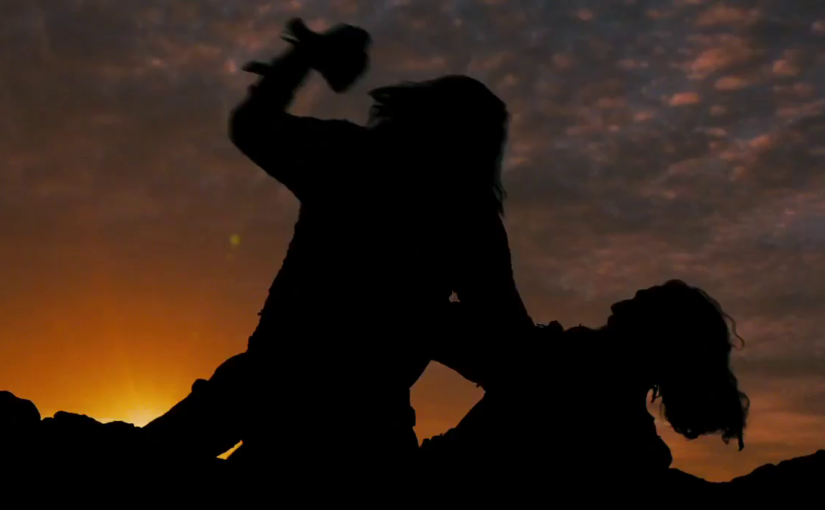
    We start with envy, as Cain laments that his offering was not accepted with the same favor as was his brother, Abel’s. We move from envy to murder, with Cain committing the very first fratricide, killing his very own brother. From there, we go to apathy, as Cain rejects the opportunity to be his brother’s keeper. And then we meet false witness, as he lies about the murder that he committed. And if all of that isn’t enough, Cain then complains about his punishment as if it was something he didn’t deserve. If he’d only tried repentance, or expressed sorrow for his sins, or even accepted responsibility for what he’d done, maybe things would have turned out differently.

    But, in this opening act of human history, we see God’s mercy. God does not remit the entirety of Cain’s punishment, but promises that even his death would be unacceptable. Maybe we should think about that in regard to the death penalty: if even God doesn’t condone the murder of a murderer, then who are we to do that? So God marks Cain, as we all are marked with God’s presence at our baptism. So even in this very early story of our history, we can see that baptism was always intended for our salvation.

    The Psalmist this morning says that we absolutely cannot profess God’s commandments and sing his praises, without also accepting God’s discipline and following God’s word. A sacrifice of praise is a life lived with integrity, and that is the sacrifice that God wants of us in every moment.

  • The Sixth Sunday of Ordinary Time

    The Sixth Sunday of Ordinary Time

    Today’s readings
    Today’s homily is lectio brevis because our parish mission speaker presented the first of his talks at Mass today.

    Today, very briefly, I want to talk to you about our need for repentance, reconciliation, and forgiveness.  Jesus makes it very clear in today’s Gospel that the spirit of the law is worth focusing on, because it is that spirit that will get us into heaven.  This, quite frankly, is a frightening Gospel reading, because in it, Jesus raises the bar.  We can’t just skate by if we’ve never murdered or had an abortion, and we’re liable if we have hated or refused to forgive.  Even if we think we’re okay because we’ve never had an extramarital affair, every occasion of lust in our hearts has made us unfaithful.  And just because we’ve lied under oath, we’ve still broken that commandment if we haven’t stood for the truth and made it our care to be known as an honest person with utmost integrity.

    The grace is that we’re not lost in despair, even looking at these daunting rules.  Living the Gospel is possible because of grace.  Forgiveness is possible because of the Paschal Mystery.  All we have to do is repent, to turn back, to seek forgiveness in the Sacrament of Reconciliation, and to pray for the grace to be lovers of the Gospel.

  • Thursday of the Fifth Week of Ordinary Time

    Thursday of the Fifth Week of Ordinary Time

    Today’s readings 

    “Blessed are those who fear the Lord,” the Psalmist tells us today. And today as our example of those who fear the Lord, we have two women. And we begin with the creation of the first woman. God has created all the creatures of the earth: land, water and air, yet none of these are found to be a suitable partner for him. And so it takes a new creative act of God, putting the man to sleep – putting things on pause for a moment. The only suitable partner for the man had to be someone who was made of his same flesh, and so one of his ribs is taken to form the basis of the woman. How significant it is that his partner is made from a bone right next to his heart! And only with this astounding new creation is all of creation complete. In the present, the work of creation goes on all the time, of course, largely because man and woman were created to participate in that creation together with their Creator.

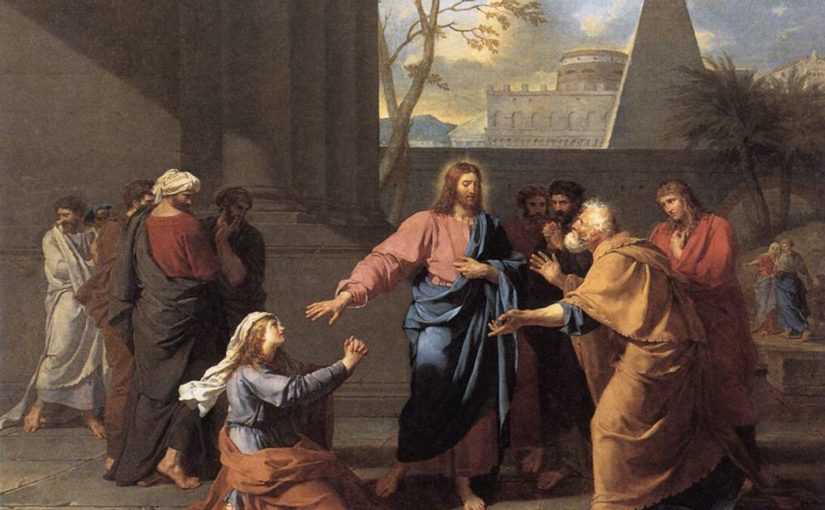
    The second woman we meet today is the Syrophoenician woman. She is a woman of great faith – persistent faith, even! Not only does she want Jesus to drive the demon out of her daughter, but she is convinced that he is the only one that can make it happen. Her faith and her persistence give us a model for our spiritual lives. For us disciples, a strong faith in Christ means never questioning his ability to act for our good, and never letting anything – not even the technicalities of a perceived mission – get in the way of acting on that faith. We too are called to steadfast faith, and persistent prayer.

    The Nuptial Blessing from the Rite of Marriage prays for the bride: “May she always follow the example of the holy women whose praises are sung in the scriptures.” There are many such wonderful examples, of course, and today’s are just two of them. They give all of us a shining example of what our faith should be like. May all of us – women and men! – follow their example.

  • Tuesday of the Fifth Week of Ordinary Time

    Tuesday of the Fifth Week of Ordinary Time

    Today’s readings

    Over the past two days, we have heard, once again, the wonderful story of the creation of the world.  It’s not meant to be a science textbook or a timetable of events, of course, but instead delivers the message that all of creation was set in motion by our God, and that all of creation was created good, and created for good.  That’s something we tend to forget, at times, and when we do, it causes things like pollution, environmental disasters, and so much more.  We were given the earth to use and to care for, and we have to be diligent in caring for it.

    Pope Francis has been outspoken in his teaching on caring for God’s creation, which has long been a pillar of Catholic social teaching, and is based on the very reading we’ve heard the last two days.  He even called care for creation a work of mercy, expanding on the themes of his first encyclical, Laudato Si’.  “We must not be indifferent or resigned to the loss of biodiversity and the destruction of ecosystems, often caused by our irresponsible and selfish behavior,” he said. “Because of us, thousands of species will no longer give glory to God by their very existence. … We have no such right.”

    When we abuse creation, we also cause problems for other people, most often the poor.  Francis has gone on to say, “When we mistreat nature, we also mistreat human beings. At the same time, each creature has its own intrinsic value that must be respected.”

    But none of this is to say that creation isn’t for our use.  In today’s first reading, God is very clear: “Be fertile and multiply; fill the earth and subdue it.  Have dominion over the fish of the sea, the birds of the air, and all the living things that move on the earth.”  But our use of God’s creation must reflect the gift that it is for us: we must also be able to hand that gift on to forthcoming generations.

    Just because we are unable to individually solve every environmental problem doesn’t mean that we aren’t important in the effort.  Every little thing we can do to protect creation means something.  As Pope Francis also said, “We should not think that our efforts – even our small gestures – don’t matter.  Virtue, including ecological virtue, can be infectious.”  And so every time we are in the presence of the beauty of creation, we should send up a prayer of thanks, along with the Psalmist today, who prayed: “When I behold your heavens, the work of your fingers, the moon and the stars which you set in place—What is man that you should be mindful of him, or the son of man that you should care for him?  O Lord, our God, how wonderful your name in all the earth!”