Blog

  • Saint Bartholomew, Apostle

    Saint Bartholomew, Apostle

    Today’s readings

    What tradition tells us about St. Bartholomew is that he is often identified with Nathanael in the Gospel.  That explains why Nathanael is prominent in the Gospel reading for today.  Nathanael – or Bartholomew, take your pick – is picked out of the crowd by Jesus.  Nathanael is surprised at what Jesus says about him: “Here is a true child of Israel.  There is no duplicity in him.”  We should recall that Jesus considered it his primary mission to seek out the lost children of Israel, so seeing Nathanael as a “true child of Israel” with “no duplicity in him” means that Jesus considered Nathanael a role model for his people.  He was one whose faith reached beyond mere observance of the Law or the Torah, and extended into the realm of living the Gospel.

    That’s where we are all led, I think.  When it comes down to it, there is nothing more important than living the Gospel, and every one of us is called to do it.  If our spiritual life is not our primary concern, then we have nothing to look forward to.  But the good news is that, by the intercession and example and preaching of the Apostles and especially Bartholomew today, we have  hope of eternal life.

  • The Twenty-first Sunday of Ordinary Time

    The Twenty-first Sunday of Ordinary Time

    Today’s readings

    In every homily there is, or should be, a “so what” moment. That’s the moment, very often toward the end of the preaching, where the Word that was preached is related to the people who heard it. I try to make every homily answer the question, “So what?” in some way. Maybe it’s a question that the hearers need to answer, or a challenge to the way we live, or a consolation in a difficult time. We believe that the Word of the Lord is living and active, and so it will always answer the question, “So what?” in some way.

    Over the past five weeks now, we have been hearing an extended homily of sorts in the Gospel readings. Our Gospels have all been from John chapter six, which is commonly called the “Bread of Life Discourse.” As I’ve mentioned before, John’s Gospel doesn’t have a Last Supper scene where Jesus gives the Eucharist to the Apostles. Instead, John’s Gospel has this discourse, in which Jesus gives the Eucharist to all the people.

    It all began, five weeks ago, with Jesus taking five loaves and a couple of fish, and with them feeding thousands of people, and leaving twelve baskets of leftovers. That was quite a miracle! Since then, the people naturally stuck with Jesus, wanting to see more, wanting more bread. But Jesus has been taking the opportunity to preach to them about the Bread of Life. Over the past weeks, he has made it clear that his gift of the Bread of Life was better than the manna Moses gave their ancestors. He made it clear that in both cases it was actually God the Father who gave the people what they needed. He made it clear that he – Jesus – is the way to the Father, that those who eat his Flesh and drink his Blood will have eternal life.

    And now it all comes down to the “so what?” piece. Many of the people find the whole image of eating someone’s flesh and blood disgusting, and so they walk away. Others take offense at Jesus telling them that this is the only way they can have eternal life; they take offense that he is telling them that he is God, and so they walk away. So then he turns to the disciples and says, “Will you also leave?” Peter speaks for them and makes a beautiful profession of faith: “Master, to whom shall we go? You have the words of eternal life.”

    Jesus will ask every single person who wants to follow him the same question at some time: “Will you also leave?” I remember in my young adulthood, before I went to seminary, having a crisis in my own faith. I had been attending Willow Creek – the big megachurch up in Barrington – with my friends. The music was nice and the sermons sounded good. But along the way my pastor called me in and had a come to Jesus with me. I remember he told me, “I know you would never be able to go to the chapel and stand in front of the Tabernacle and say that Jesus wasn’t there.” I took a while to think about that, and one night when I went to Willow Creek they were having their monthly communion. They passed around bread and grape juice and I realized that Father Mike was right: Jesus was in the Tabernacle, not there at Willow Creek, and that I would never be able to live without it.

    We all are offered the gift of the Bread of Life. Jesus offers us his true Body and Blood, Soul and Divinity, in the Holy Eucharist so that we might eat of it and come at last one day to Eternal Life. There is absolutely no other way to get there. And yet, we could all think of someone, or several someones, that should be here today. They may have been away for a long time. We know that they are missing out on the Gift beyond all gifts, that they are not getting the Food that strengthens us for what this life throws at us, and gives us the ability to come to eternal life one day.

    Maybe they don’t care, or can’t be bothered, or love their sins, or have soccer practice or dance class or sleep in time, or whatever. Maybe they don’t really believe in the Eucharist. Like those marginal disciples in the Gospel reading today, they may have decided it was all just too hard, too much to take, and have returned to their former way of life. But for us who remain, Jesus looks at us, deep into our eyes and our souls, and says to us: “So what? What about you? Will you also leave?”

    We’ll have to live with the answer to that question for a very, very long time.

  • Saint Bernard of Clairvaux, abbot and doctor of the Church

    Saint Bernard of Clairvaux, abbot and doctor of the Church

    Learning to follow the path of perfection is the most important goal of the spiritual life. How do we get our relationship with God right so that we can live with him forever in heaven? That was certainly the goal of Saint Bernard of Clairvaux, whose feast we celebrate today.

    In the year 1111, at the age of 20, Bernard left his home to join the monastic community of Citeaux. His five brothers, two uncles and around 30 of his friends followed him into the monastery. Within four years a that monastic community, which had been dying, had recovered enough vitality to establish a new house in the nearby valley of Wormwoods, with Bernard as abbot. The zealous young man was quite demanding, particularly on himself. A minor health problem, though, taught him to be more patient and understanding. The valley was soon renamed Clairvaux, the valley of light.

    Bernard’s strong support of the Roman See was well known; in fact it was Bernard who intervened in a full-blown schism and settled it in favor of the Roman pontiff against the antipope. The Holy See then prevailed on Bernard to preach the Second Crusade throughout Europe. His eloquence was so overwhelming that a great army was assembled and the success of the crusade seemed assured. The ideals of the men and their leaders, however, were not as pure as those of Abbot Bernard, and the project ended as a complete military and moral disaster. Bernard felt responsible in some way for the degenerative effects of the crusade. This heavy burden possibly hastened his death, which came on August 20, 1153.

    In striving for perfection throughout his life, Bernard readied himself for the wedding feast that Jesus spoke of in today’s Gospel reading. We too are called to clean up the garments of our lives so that we can come to the feast. Reflecting on the life of the saints, like Saint Bernard, can help us to follow that rather demanding path. One day, we hope that our striving for perfection will lead us to eternal life, the goal of all our lives.

  • Monday of the Twentieth Week of Ordinary Time 

    Monday of the Twentieth Week of Ordinary Time 

    So the question today is, what is it that holds us back? The rich young man seemed to have it all together: he acknowledged Jesus as the good teacher, so he must have been familiar with what Jesus said and did. He says he kept all the commandments, so he certainly had a religious upbringing and was zealous to follow the law. But, with all that, he still knew that something was lacking. “What do I still lack?” he asks. When Jesus reveals that the next step in following the Gospel involves letting go of his worldly possessions, he finds that to be somewhere he can’t go. He had many possessions, and he wasn’t yet ready to give them up.

    So back to my first question. What holds us back? Is it many possessions? Or is it our work, or status, or what the neighbors might think? It could be that we don’t want to get out of our comfort zone and follow Christ according to the way he is calling us. Whatever it is, it involves letting go – giving up what is not God and clinging to him alone. It’s not that Jesus didn’t want the rich young man to have money. He wanted him to have eternal life. And whenever we cling to what is not God, we are in grave danger of giving up eternal life. 

    We have to be ready to let go of whatever holds us back from accepting the life that God wants for us. What he has is so much better than whatever it is we’re holding on to. So the question is, will we give up what is holding us back, or will we give up eternal life? We’re going to have to live with the answer to that question for a very, very long time. 

  • The Transfiguration of the Lord 

    The Transfiguration of the Lord 

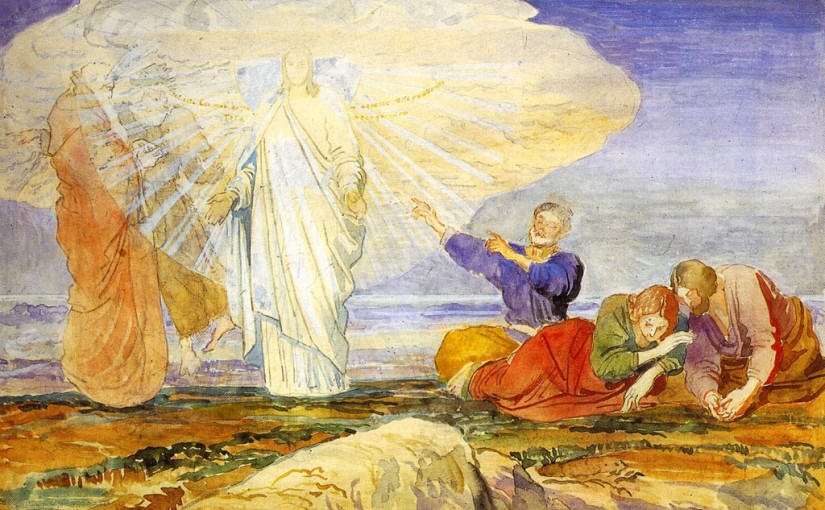
    Sometimes I think that, because of the limitedness of our minds, we accept a rather small view of Jesus. We think of him as a friend and brother, which is okay, but he is also our Lord and God. The disciples had this problem too, although they had a good excuse: they didn’t have two thousand years of Church history to guide them! So they were definitely familiar with the human side of Jesus: Over the time they had spent with him thus far, they had become close to him and saw him as a friend, a companion on the journey, and a great teacher. But they were always having trouble with his divinity. 

    Today’s feast changes all of that for them, and for us as well. If there was any doubt about who Jesus was, it’s gone now. That voice from the cloud is absolutely specific: “This is my chosen Son; listen to him.” Jesus is the Son of God and his divinity must be embraced and proclaimed. While it can be comfortable for us to have a picture of Jesus that is absolutely human, we must always keep in mind the Transfigured Christ, dazzling white, radiating glory, the lamp shining in a dark place. He is the Son of Man of whom Daniel speaks, and to him belongs dominion, glory, and kingship. If Jesus were only human, we would have no Savior, we would have no chance of touching divinity ourselves, that divinity for which we were created. 

    On the way to the mountain, the disciples came to know Jesus in his humanity, and on the way down, they came to know Jesus in his divinity. That trip down from the mountain took him to Calvary, and ultimately to the Resurrection, the glory of all glories. Christ is both human and divine, without any kind of division or separation. We must be ready to see both natures of our Jesus, so that we ourselves can transfigure our world with justice, compassion and mercy, in the divine image of our beautiful Savior. No matter what challenges may confront us or what obstacles may appear along the way, we must be encouraged to press on with the words of the Psalmist: “The Lord is king, the Most High over all the earth.” 

  • Monday of the Eighteenth Week of Ordinary Time

    Monday of the Eighteenth Week of Ordinary Time

    Today’s readings

    What I think the folks in our first reading need to learn – and maybe us too – is that the spiritual life is always about the big picture.  The Israelites in today’s reading have completely rejected the God of their salvation.  God had taken them from abject slavery in Egypt, in which they were oppressed beyond anything we could possibly imagine – let alone endure – and led them through the desert, through the Red Sea (covering the pursuing Egyptians in the process), and into safety.  He is going to give them the Promised Land, but they, thank you very much, would prefer to return to Egypt so that they no longer have to sustain themselves on the bread that they have from the very hand of God himself.  They would rather have meat and garlic and onions, and whatever, than freedom and blessing from God.  What a horrible, selfish people they have become.

    And Moses is no better.  He alone has been allowed to go up the mountain to be in the very presence of God.  No one else could get so close to God and live to tell the story.  God has given him the power to do miraculous deeds in order to lead the people.  And yet, when things get tough, he too would prefer death than to be in the presence of God.

    And aren’t we just like them sometimes?  It’s easy to have faith when things are going well, and we are healthy, and our family is prospering.  But the minute things come along to test us, whether it is illness, or death of a loved one, or job troubles, or whatever, it’s hard to keep faith.  “Where is God when I need him?” we might ask.  We just don’t often have the spiritual attention spans to see the big picture.  We forget the many blessings God has given us, and ask “Well what has he done for me lately?”

    In today’s Gospel, Jesus feeds the crowds until they are satisfied and have baskets of leftovers besides.  God’s blessings to us are manifold, and it is good to meditate on them when times are good, and remember them when times are bad.  God never wills the trials we go through, and he never forgets or abandons us when we are in the midst of those trials.  God feeds us constantly with finest wheat.  That’s the big picture, and we must never lose sight of it.

  • The Eighteenth Sunday of Ordinary Time: Bread of Life Discourse II

    The Eighteenth Sunday of Ordinary Time: Bread of Life Discourse II

    Today’s readings

    My niece Molly used to say that she wanted to open a restaurant when she grows up. She even had a name all picked out for it: “Hungry.” That makes a lot of sense when you think about it. Where are you going to go when you’re hungry? Well, to Hungry, of course! I thought about that this week because today’s Liturgy of the Word speaks to those of us who are hungry – which is to say, all of us.

    There’s a lot of hunger in the readings today. First we have the Israelites, fresh from their escape from slavery in Egypt, finding that they are hungry as they wander through the desert. I think we can understand their hunger. But what is hard to understand is the content of their grumbling about it. They say that they would rather be back in Egypt, eating bread and the meat of the “fleshpots.” Why on earth did God have to drag them out into the desert only to kill them by hunger and let them die there? They would rather be in slavery in Egypt than be in the situation in which they find themselves. Please understand how serious this grumbling is: it is a complete rejection of God, God who has done everything miraculous to save them from abject slavery.

    Not so different is the clamoring of the people in today’s Gospel reading. Today we pick back up our reflection on the “Bread of Life Discourse,” the sixth chapter of John’s Gospel. Because Mark’s Gospel, which we are hearing from this liturgical year, is a little shorter than the others, we get five wonderful weeks to take a little journey into John’s Eucharistic theology during these summer days. We began last week, with the famous story of Jesus feeding the multitudes. Today’s story picks up where last week’s left off: the people were so impressed by Jesus feeding so many with so little that they pursue him across the sea to Capernaum.

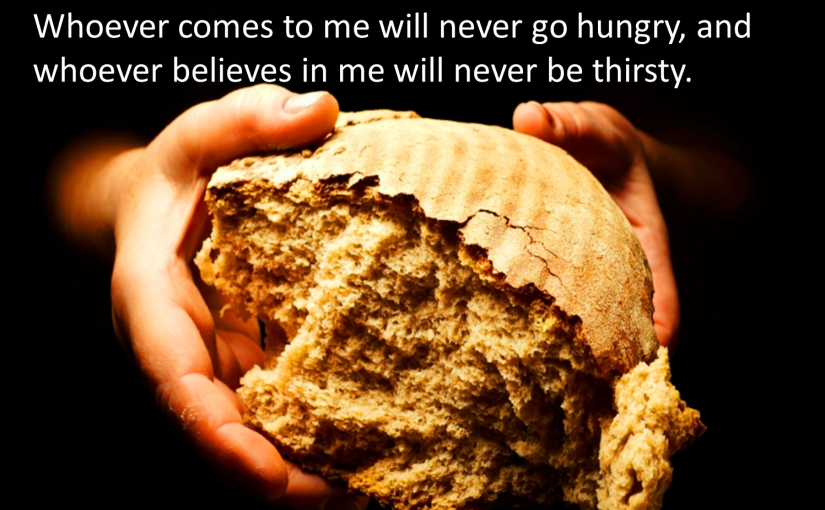
    Why do they follow him? Well, they want more food, of course. But the real feeding he intends is not just barley loaves, but instead something a little more enduring. So Jesus tells them that the best way they can do God’s will is to believe in him – the one God sent. So they have the audacity to ask him what kind of sign he can do so that they can believe in him. Can you believe that? He just finished feeding thousands of people with five loaves and two fish, and they want to see a sign? Instead, Jesus gives them a spiritual sign, a challenge really. He tells them to believe in him because “I am the bread of life; whoever comes to me will never hunger, and whoever believes in me will never thirst.”

    Jesus wants to get to the root cause of their hunger … and ours too, by the way. So I think the starting point is that we have to be clear about what it is we hunger for. And that question is very pressing on all of us today. Every one of us comes here hungering for something. Our hungers may be very physical: some here may be unemployed or underemployed, or perhaps our hunger is for physical healing of some kind. But perhaps our hungers are a bit deeper too: a relationship that is going badly, or a sense that we aren’t doing what we should be or want to be doing with our lives. Our hunger very well may be very spiritual as well: perhaps our relationship with God is not very developed or our prayer life has become stale. Whatever the hunger is, we need to be honest and name it right now, in the stillness of our hearts.

    Naming that hunger, we then have to do what Jesus encouraged the crowds to do: believe. Believe that God can feed our deepest hungers, heal our deepest wounds, bind up our brokenness and calm our restless hearts. Believe that Jesus is, in fact, the Bread of Life, the bread that will never go stale or perish, the bread that will never run out, or disappear like manna in the heat of the day. Jesus is the Bread that can feed more than our stomachs but also our hearts and souls. The Psalmist sings, “The Lord gave them bread from heaven.” And we know that bread is the most wonderful food of all, because it is the Body of Christ. Amen!

  • Tuesday of the Seventeenth Week of Ordinary Time

    Tuesday of the Seventeenth Week of Ordinary Time

    Today’s readings

    I think we get a more vivid picture of today’s Gospel if we’ve ever had the task of weeding a good-sized garden. I’ve done it plenty of times.  It’s not a task I really look forward to, but it is kind of good in that when you finish a job like that, you can look at it and see something good happened.  There’s a sense of accomplishment.  But discerning what is a weed and what is a plant is sometimes a difficult task.

    That’s the kind of question the disciples had for Jesus today.  Jesus had just told them several parables about the kingdom of God, and this one didn’t get read in the Gospels the last few days.  So we have the explanation, but not the parable.  You can check it out in the 13th chapter of Matthew.  The story basically went that the landowner sowed good seed in the field, but when it started to grow, weeds came up too.  His laborers asked him about it and he said, “An enemy has done this.” So they wanted to pull up the weeds, but the master said to let them grow together until harvest time, lest in pulling them up they also accidentally pull up the good plants.  They could then be pulled up and burnt at harvest time.

    Now I think a good gardener might quibble with the analogy.  But that’s not the point.  The point is good news, and the good news is this: however much we may resemble the weeds from day to day, Jesus gives us the time to grow into much lovelier plants during our lives.  He doesn’t blot us out of the book of life for one transgression.  But the warning is that we only have so much time until the harvest.  If we are going to turn to the God who sowed us and provide good fruit, we need to do it now.  If we wait until the harvest, it may well be too late.  Our God gives us the freedom to choose to be the good seeds in the field of the world, blessed are we who choose to grow that way.

  • Monday of the Seventeenth Week of Ordinary Time

    Monday of the Seventeenth Week of Ordinary Time

    These parables that we have today regarding the nature of the Kingdom of God are head-scratchers for sure! I am sure we can all understand how the people were confused by Jesus’ description of the Kingdom, since it even
    seems foreign to our ears. One might wish that he would just say: “Okay, look, here’s what the Kingdom is like.”

    But as I read this last night getting ready for this homily, it struck me that no words would be adequate to express how wonderful is the kingdom. It’s big, like a mustard tree, and expansive, like rapidly-rising dough. But whatever we can say about the Kingdom of God, it’s going to be too little. It will never even come close to describing the Kingdom in its fullness.

    My guess is, no matter how often we hear these wonderful parables, on that great day when we – please God! – get to the Kingdom of heaven, we will be amazed beyond our wildest dreams. God’s heavenly Kingdom is something we certainly don’t want to miss.

    The only way to get to the Kingdom is to follow our Lord. As we come to him in prayer and follow him by living the Gospel, maybe we’ll get just a tiny clue of what heaven will be like. That way we’ll recognize it when we get there.

  • Monday of the Sixteenth Week of Ordinary Time

    Monday of the Sixteenth Week of Ordinary Time

    Today’s readings

    It’s easy to have faith when our enemies aren’t pursuing us, isn’t it? When things are going well, we can be people of faith with the best of them. But it does take a certain amount of sainthood to have faith in the face of opposition of whatever kind you can imagine. For the Israelites, it was the pursuing Egyptians; for the Pharisees, it was the destruction of their worldview; for us it might be illness, or unemployment, or the death of a loved one. It’s hard to have faith when our faith is tested. But our faith is tested all the time; that’s what the life of discipleship entails.

    And that’s when faith is faith, really. Faith is remaining strong when things are really bleak. And we disciples should be able to embrace that kind of faith, because, like the Pharisees, there is something greater than Solomon here. We have Jesus Christ, who proved that God loves us first by laying down his life for us. If our faith is real, then we must trust that God has hold of us even in our darkest moments, and that the way he chooses to answer our prayers will be greater than we can imagine.