Blog

  • The Sixteenth Sunday of Ordinary Time

    The Sixteenth Sunday of Ordinary Time

    Today’s readings

    I think a lot of us can identify with what’s going on in today’s Gospel reading. Jesus and the Twelve had been working hard: they had just been out on mission, proclaiming the Gospel and the Kingdom of God, and healing the sick. They were busy, they were tired, but they were excited. Jesus calls them together to go to an out-of-the-way place to rest a while, maybe have something to eat. But as soon as they arrive, they find that the crowds figured it out and got there ahead of them.

    If you’re a parent, that might sound familiar. When’s the last time you had a minute to yourself, only to find out that the children have figured out where you were and needed something right now? Or at work, you finally have five minutes to take care of your own work, only to have a coworker come and ask for help with something they are doing? We know the experience. Responsibility for whatever we are charged with never really ends. We have so many things to do, we don’t have time for ourselves, for our spiritual lives, for those things that are ultimately important.

    And Jesus doesn’t want it to be so. He wants to shepherd all of us to an out-of-the-way place to rest a while, to rest in him. He wants to feed all of us with the best of food: his own Body, Blood, Soul and Divinity, that we might have strength to take care of the crowds clamoring around us for our attention.

    So we have to let him. We have to give him five minutes of our day, if we haven’t been giving him anything at all. We have to give him a little more now, so that he can use that space to help us rest a while, to refuel, to recharge, to grow and become more. It won’t be easy. If we can’t find five minutes for ourselves, it’s going to be hard to find five minutes for Jesus. But it is possible. Maybe it’s too much at the end of the day when we’re dog tired. But maybe we can get up five minutes earlier just to read a verse of Scripture and put ourselves in the presence of our Lord for the day.

    Jesus can do a lot with five minutes. In these hot days of summer, those five minutes can be the refreshment we need to move forward in our relationship with God and with the people in our lives. They can help us to not be resentful of what we’re called to do for others. They can help us to give more than we think we can. They can help us in good times and in bad. Give him five minutes, go to an out-of-the-way place to rest a while.

  • Friday of the Fifteenth Week of Ordinary Time: Merciful Like the Father

    Friday of the Fifteenth Week of Ordinary Time: Merciful Like the Father

    Today’s readings

    Today, Jesus gives us what might be considered to be his mission statement: “I desire mercy, not sacrifice.” Or at least we might consider this to be his statement of what he wants from us, his people. Because we, like the Pharisees, might be tempted to make all sorts of sacrifices. And that’s not necessarily a bad thing; it might mean sacrificing our time to work long hours to attain our goals. Or maybe we sacrifice to give to the poor, or spend more time at Church, or whatever. None of those things is bad in and of themselves. In fact, depending on our intentions, they are probably good things.

    But here’s where Jesus is making his point: if we don’t have mercy in the mix, if we don’t then also extend God’s love to our family, coworkers, or whoever God puts in our presence today, then we’ve blown it. It’s all for nothing. All our striving, all our hard work, none of that means anything if we don’t become more like God himself; our God who is mercy and love and grace at his core.

    Pope Francis has called for a special Year of Mercy to begin this December and the theme for it is “Merciful Like the Father.” That’s where we have to put our intentions and effort. We have to become more merciful in every moment: giving a break to the guy who just cut us off in traffic; being more patient with a six-year-old who has just asked the same question ten different ways, ten separate times; being loving enough to check in on an elderly relative whose disabilities have made him or her a bit cranky; and forgiving the one who has hurt us to our core. None of these things is easy to do, especially that last one. So we look to the one who is mercy itself to teach us how to do it; we ask him to make us more merciful like him.

    Because if we put mercy first, if we forgive as we have been forgiven and love as we have been loved, then we’ve gotten our mission statement right, too.

  • Friday of the Fourteenth Week of Ordinary Time

    Friday of the Fourteenth Week of Ordinary Time

    Today’s readings

    Our God never promises that the life of faith and discipleship will be an easy one; only that it will be blessed. One thing is certain: that life will certainly entail hardship, even suffering. That’s pretty evident in today’s Gospel reading. Faithful disciples have to worry about being betrayed by even their closest family members.

    None of this is a surprise to anyone who has tried to live the faith. Perhaps at times the hardest people to evangelize are the members of one’s own family. I’m sure we all can think of people close to us who have abandoned the faith or practice it rarely. Maybe the ones who receive the Church’s teachings least are those we would hope would get it and be partners with us as we journey to the kingdom. It happens all the time – in your family and in mine.

    These are trying times. It is hard to give witness to the Truth when the culture around us wants to make its own truth. And it’s painful to see our brothers and sisters fall for the lie hook, line and sinker. So how do we stand for the Truth when our loved ones tune it out? What do we do when our loved ones reject what we’ve tried to give them to bring them to eternal life?

    Our Gospel tells us that what we do is persevere: we continue to live the Truth and witness to our faith. If those close to us tune out our words, then we have to be all the more attentive to our actions, to our lived witness, so that they can see that we live what we preach and believe. We have to depend on God to give us the right words and help us to do the right things so that we won’t be a stumbling block. And then we have to trust in God to work it all out in his time.

    None of this is going to be easy, but Jesus tells us that the one who endures to the end will be saved.

  • Monday of the Fourteenth Week of Ordinary Time 

    Monday of the Fourteenth Week of Ordinary Time 

    Today’s readings

    In today’s readings, God proves himself trustworthy, yet again. He appears to Jacob in a dream and promises that he will be with him wherever he goes, protecting him, and bringing him back to the land, which he would also give to Jacob’s descendants. In his joy, Jacob reacts by consecrating the land to the Lord.

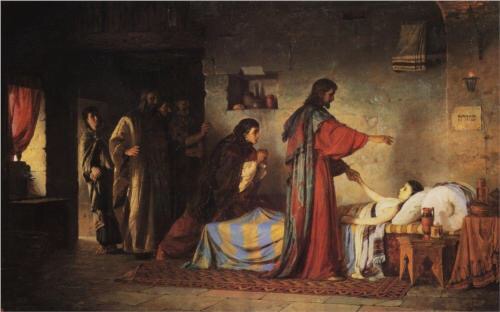
    In the Gospel, which we heard a week ago Sunday in Mark’s version, Jesus heals not one, but two people: he stops the hemorrhage of a women who had suffered from the malady for twelve years, and then he raises the daughter of one of the local officials. In their joy, news of Jesus’ mighty deeds spread all throughout the land.

    The Psalmist prays today, “In you, my God, I place my trust.” It’s a call for us to do the same today. We certainly don’t know how God will answer our prayers or even when he will do so. He might bring healing, but maybe in a way we don’t expect. But his promise to Jacob is one in which we can trust as well: he will be with us wherever we go, and he will protect us.

  • The Fourteenth Sunday of Ordinary Time

    The Fourteenth Sunday of Ordinary Time

    Today’s readings

    You know, I am not sure how some people get through the hard times of their lives if they don’t have faith. We can all probably think of a time in our lives when we were sorely tested, when our lives were turned upside-down, and, looking back, we can’t figure out how we lived through it except for the comfort of our faith. I thought about that a lot this week. A friend and colleague of mine died; she had been the supervisor of my CPE program, the summer of hospital chaplaincy that I did while in seminary. And so that brought back many memories of all that summer brought me. Needless to say, I ministered to a great many people, some of whom had faith, and some who didn’t. It was always inspirational to see how people with faith lived through their hard times, and very sad to see how many who didn’t have faith just broken when their lives stopped going well.

    That’s the experience that today’s Liturgy of the Word puts before us, I think. Let’s look at the context. In last week’s Gospel, Jesus has cured two people miraculously. He actually raised Jairus’s twelve-year-old daughter from the dead, and he cured the hemorrhagic woman, who had been suffering for twelve years. So both of them had occurrences of the number twelve, reminiscent of the twelve tribes of Abraham, and later the Twelve Apostles, both of which signify the outreach of God’s presence into the whole world. So those two miraculous healings last week reminded us that Jesus was healing the whole world.

    And this week, we see the exception. This week, Jesus is in his hometown, where he is unable to do much in the way of miracles except for a few minor healings. Why? Because the people lacked faith. And this is in stark contrast to last week’s healings where Jairus handed his daughter over to Jesus in faith, and the hemorrhagic woman had faith that just grasping on to the garments of Jesus would give her healing. Faith can be very healing, and a lack of it can be stifling, leading eventually to the destruction of life.

    We see that clearly in the first two readings. First Ezekiel is told that the people he would be ministering to would not change, because they were obstinate. But at least they’d know a prophet had been among them. Contrast that with Saint Paul’s unyielding faith in the second reading to the Corinthian Church. Even though he begged the Lord three times to relieve him of whatever it was that was his thorn in the flesh, he would not stop believing in God’s goodness. His faith led him to be content with whatever weakness or hardship befell him, and he came to know that in his weakness, God could do more and thus make him stronger than he could be on his own.

    We people of faith will be tested sometimes; that’s when the rubber hits the road for our faith. Knowing of God’s providence, we can be sure that he will lead us to whatever is best. And our faith can help us to make sense of the struggles and know God’s presence in the dark places of our lives. People of faith are tested, but never abandoned. Never abandoned.

  • Saint Thomas, Apostle

    Saint Thomas, Apostle

    “Unless I see the mark of the nails in his hands and put my finger into the nailmarks and put my hand into his side, I will not believe.” Saint Thomas sometimes gets a bad rap for having said that, but if we’re honest, I think most of us can understand Thomas’s hesitation to believe, since we have all probably struggled with belief at some point in our lives. And Thomas had good reason not to believe: the apostles were all frightened for their lives, having seen their Lord taken away to his death. Certainly that brings some healthy wariness to one’s thoughts, words and actions.

    I also wonder, sometimes, if Thomas’s response was an expression of hurt. For whatever reason, he was not present when the apostles first saw Jesus. They had a wonderful experience of the Lord that Thomas didn’t get to have. That experience helped them all to believe in the resurrection. It seems natural to me that Thomas may have felt a little left out, a little unjustly deprived of the Lord’s presence. We’ve all had experiences like that too, I think.

    But Thomas need not have felt deprived, because he was given an opportunity the others didn’t get: he got to reach out and touch the Lord Jesus, an experience way more intimate than just seeing him. We get to have that kind of experience too. In a few minutes, we will all get to come forward and reach out and touch the Body of our Lord, allowing the Lord to enter our lives and our selves once again to fill us up and send us forth to be his disciples.

    We’ve been a lot like Thomas, I think. We’ve all struggled with our faith, we’ve all experienced the hurt that comes from being left out. But we’re also all given the opportunity to have a real experience of our Lord by reaching out to receive him. So may we, all of us who have not seen but have believed, may we all cry out with Thomas, “My Lord and my God!”

  • Saints Peter & Paul, Apostles

    Saints Peter & Paul, Apostles

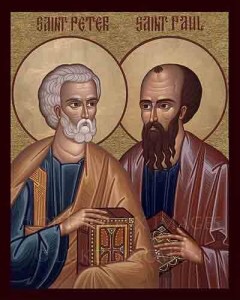
    In today’s Gospel, Peter and the others are asked, “Who do people say that the Son of Man is?” Now, both Peter and Paul were committed to the truth about who Christ was. They had too much at stake to let that go. Having both messed up their estimation of who Jesus was earlier in their lives, they knew the danger of falling into the trap. So for them Jesus could never be just a brother, friend or role model – that was inadequate. And both of them proclaimed with all of their life straight through to their death that Jesus Christ is Lord. We too on this day must repent of the mediocrity we sometimes settle for in our relationship with Christ. He has to be Lord of our lives and we must proclaim him to be that Lord to our dying breath. We must never break faith with Saints Peter and Paul, who preserved that faith at considerable personal cost.

    Perhaps Saints Peter and Paul can inspire our own apostolic zeal. Then, as we bear witness to the fact that Jesus is Lord of our lives and of all the earth, we can bring a banal world to relevance. Perhaps in our renewed apostolic zeal we can bring justice to the oppressed, right judgment to the wayward, love to the forgotten and the lonely, truth to a society that settles for relativism, and faith to a world that has lost sight of anything worth believing in. One might say that that is the Church’s mission, but actually the mission is what is of primary importance. And so we believe that the apostolic mission has a Church, and it’s time for the Church to be released from its chains and burst forth to give witness in the Holy Spirit that Jesus Christ is Lord, to the glory of God the Father. 

  • The Twelfth Sunday of Ordinary Time: Journeying from Fear to Faith

    The Twelfth Sunday of Ordinary Time: Journeying from Fear to Faith

    Today’s readings

    Getting ready for Mass today, I thought about my Dad. Not just because it’s Father’s Day, although that’s certainly part of it. But partly because of today’s Gospel. The story we have here today speaks about a journey, and I’ll say more about that in a minute. My Dad was great for journeys: he loved to drive and take the family to Wisconsin or to Disney, or wherever we needed to go. He’d have us up early in the morning so that we’d miss rush hour traffic, and we’d be on our way.

    Today, Jesus and his disciples set out on a significant journey. The reading we have today is at the end of chapter four, in which Jesus has been standing next to the sea, teaching the people by means of parables. He has told them the parable of the sower who went out to sow seeds, the parable of the mustard seed, and the lamp placed on the lamp stand. He is explaining the kingdom of God to them, but they don’t quite get it. Even the disciples have to have it explained to them. When he’s done the best that he can with them, he is ready to move on. There are other people that need to hear the Good News, others who need to know Jesus’ power and authority.

    And so he sets out on the journey, and the reading says that the disciples take him with them in the boat “just as he was.” That’s a curious detail, I think. But it makes me remember those trips with my dad. It’s time to get going, no time to change clothes or freshen up, just get in the car – or in this case, the boat – and let’s get started on the journey. But the journey isn’t always without its problems. On vacation trips we may run into traffic, or if in the air, perhaps turbulence. On the sea, the disciples experienced the raging waves of a fearsome storm. So they wake Jesus up, because apparently these storms don’t really affect him, and he rebukes the storm, and then rebukes the disciples for their little faith.

    We’re all on a journey. That journey, like that of the disciples, is from fear to faith. We very rarely have time to think about it; we just have to get in the boat and get moving, just as we are. The journey is not always smooth: storms arise, and when they do, it often seems like our God is sleeping, seeming not to care that we are about to perish. I’m not going to fill in the blanks for you – you can all do that well enough. You’ve been on many journeys in your life, and sometimes the ride has been bumpy. But if we stay on the journey, we definitely get to experience this One whom “even wind and sea obey.” Even when our God seems to be sleeping, he is never unaware of our situation, and his love for us is never on pause.

    The thing is, sometimes the storm doesn’t seem to stop so quickly as it does in today’s Gospel reading. Would that Jesus would stand up in the boat of our uncertainty and yell out: “Quiet! Be still!” But maybe he is. Maybe the “Be still” is directed at us and not at the storm. There was a contemporary Christian song a few years ago now, that had this wonderful line in it: “Sometimes he calms the storm, and other times he calms his child.” That song has given me peace in many situations. Because as frightening as the storms of our lives can be, they are no match for the grace of God. Even if God allows the storm to rage in our lives, if he is with us, calming us, we have nothing to fear. And maybe that is the occasion when we make progress on that journey from fear to faith.

    So as we leave this holy place today, we are on a journey to the most holy place, our true home in heaven. Along the way, we will have other destinations, and as we travel, we know that Jesus will be with us through it all. He may calm the storms that arise, or he may calm his children, whichever is most appropriate. And we know that the journey from fear to faith will lead us back one day to the place we really belong, at the banquet table in the kingdom of everlasting life. May all of our life’s journeys end up in that same, great place!

  • Friday of the Eleventh Week of Ordinary Time

    Friday of the Eleventh Week of Ordinary Time

    Today’s readings

    It amazes me when I think about all that the early Church had to go through and put up with. Saint Paul writes that he put up with persecution from all sides: from his own people as well as the Gentiles. He was beaten often, endured hazardous journeys and perilous weather, as well as every kind of deprivation. His experience was definitely extreme, but others who lived the faith in those days were also subject to persecution, torture and death. Our experience isn’t like that, is it? I mean, here we sit in this air-conditioned church and relatively comfortable surroundings. We came here freely to Mass this morning and it is unlikely that anyone will openly persecute us or torture us or put us to death for worshipping our God, although as we saw in the news yesterday, it does happen.

    But there is a subtle kind of persecution that we must endure. We know that even if our society is not openly hostile to living the Gospel, it is certainly just one step short of that. Life is not respected in our society: babies are aborted, the elderly are not respected or given adequate care, children are not raised in nurturing families, people are hated because of their race, color or creed. Faith is ridiculed as the crutch of the weak. Hope is crushed by those who abuse power. Love is overshadowed by sexual perversion and self-interest. Living the Gospel is dangerous to anyone who would want to be taken seriously in our culture.

    To all of us who come to this holy place to worship this morning and who hope to work out our salvation by living the Gospel, Saint Paul speaks eloquently. We know that he, as well as all of the communion of saints, is there to intercede for us and show us the way. He says to us today, “Who is weak, and I am not weak? Who is led to sin, and I am not indignant?” He points us to our Lord Jesus who paid the ultimate price for the Gospel, and reminds us that in living that Gospel, regardless of its cost, we store up for ourselves incredible treasures in heaven, because it is in heaven that our heart resides.

  • Monday of the Eleventh Week of Ordinary Time

    Monday of the Eleventh Week of Ordinary Time

    Today’s readings

    Today’s Gospel reading is from the very challenging portion of Matthew’s Gospel in which we hear Jesus use the formula: “You have heard it said … but I say to you…”  Basically, in all of these instructions, Jesus is taking the old Jewish law and cranking it up a notch.   He teaches that anger, vengeance and libel are as disastrous as murder; that lust is as morally reprehensible as adultery.   In today’s reading, Jesus takes on the concept of justice.

    In the days before Jesus, justice was met by inflicting on the one who had wronged you what they had done to you.  An eye for an eye, a tooth for a tooth; you steal one of my sheep, I take one of yours, that kind of thing.  It’s a very primitive sort of justice, but to be honest, I think, one that still kind of resonates in our society.  People might not like to say they believe this sort of thing, but you see it all the time.

    Jesus isn’t into defining justice in this way.  For Jesus, true justice consists in rendering to God what he belongs to God; it means giving to others as God has given to us.  In a way, it’s the primordial form of the whole “pay it forward” idea.  If God has been generous to us, then, in justice, we need to be generous to others.  So we don’t argue about our tunic, but instead give our cloak as well.  We go the extra mile, and never turn our back on those in need.

    We believers have to get our heads around the idea of true justice.  We have to be willing to give without counting the cost.  We have to remember that in justice, we should be condemned for our many sins, but instead we have salvation in Christ Jesus.  Because God has been merciful and generous to us, then in justice we must do the same for others.