Blog

  • The Fifteenth Sunday in Ordinary Time

    The Fifteenth Sunday in Ordinary Time

    Today’s readings

    I really think one of the greatest obstacles to progress in our spiritual lives is the thought that we have to do everything ourselves. That we have to be trained and recognized and that whatever it is that has to be done has to be done by us. After all, we are good enough, aren’t we? So why should we ask for help?

    I think you can see where I’m going to go with this. But this leads to one or both of two things. First, if whatever it is does work out, it’s all about me. Aren’t I wonderful? Aren’t I great? Did you see what I did? But second, if it does not work out, it can make us think we aren’t good enough, we are a failure, and send us into frustration and depression and all sorts of bad behavior.

    Very often, this kind of thinking it’s all on us and all about us makes us shy away from doing something we are called to do. How can I do something like that? I’m not good enough to accomplish that. Someone, anyone else is more qualified to do that than I am.

    Look at the apostles. What a rag tag bunch they were. Who would ever have thought they were good enough to come together and do anything, let alone foster a fledgling Church and proclaim a new Gospel that a lot of people couldn’t bear to hear? Yet, Jesus knew them best, of course, and he saw the men he created for that very moment to do that very important task. And then, because they didn’t know everything and weren’t qualified to accomplish the task ahead of them, he gave them what they needed in pouring out the Holy Spirit on them.

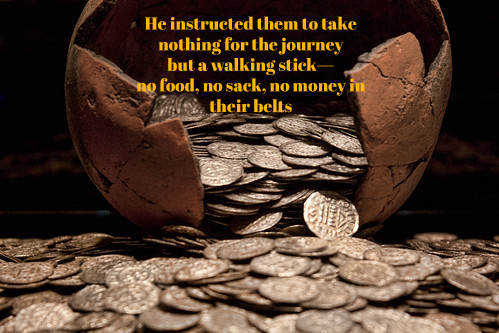
    It’s so clear in today’s Gospel reading: “He instructed them to take nothing for the journey but a walking stick—no food, no sack, no money in their belts.” Because if they have everything they need, then they don’t need Jesus, they don’t need the Holy Spirit. So by going without, they have more than they could hope for. By being unqualified, they accomplish great things. Jesus makes it very clear today that that is the life of the disciple.

    And that includes you and me, friends. We aren’t qualified to do all the things we are asked to do, and we don’t have everything we need. I remember when Bishop Conlon called me to tell me he wanted me to come here to Saint Mary’s. I was very aware that I didn’t have what I needed to be the pastor of such a large parish. But as I prayed about it, God reminded me that it wasn’t about me at all, and that he would give me what I need.

    And he has been so faithful to that! Every single day, I am almost overwhelmed by how much of a blessing it was for me to come here. I look around at our marvelous volunteers, and I know I don’t deserve how wonderful they are to me. I meet you all as you come out of Mass, and I think how blessed I am that you took time out of your day to come pray and worship with me. I have what I need to be the pastor of this place because God knows what I need far better than I do, and he is faithful to giving me all that and more.

    So I offer that to you today. Wherever you need to go in your life, whatever you are being called to do, put it in the hands of Jesus and follow that path. Trust that he will give you more than just some food, a sack, and money in your belts. Trust that he will give you everything you need and more, and trust that then you will be truly happy. Who knows what amazing deeds God has planned to do in us and through us, if we just trust in his faithfulness!

  • Saint Benedict, Abbot, Founder of Western Monasticism

    Saint Benedict, Abbot, Founder of Western Monasticism

    Today’s readings

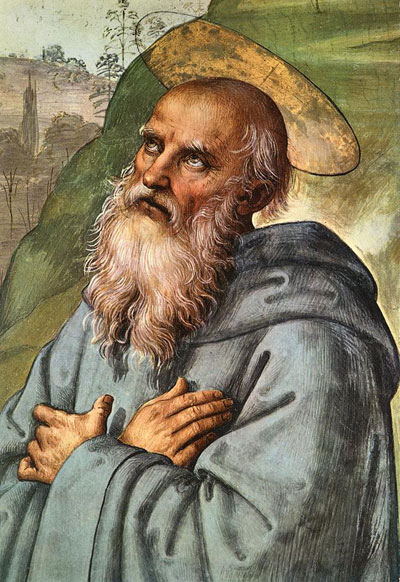
    It is with great fondness that I observe this feast of St. Benedict the abbot, and father of western monasticism.  My Benedictine roots stem from my college days at Benedictine University in Lisle (then called Illinois Benedictine College), and I have a deep fondness for the monks of St. Procopius Abbey, who staffed the college, and in whose monastery I made my Priesthood retreat before I was ordained.  Every now and then I go there for a few days of prayer.  The motto Saint Benedict chose for his order was “Ora et Labora” – Prayer and Work — and for me it is a constant reminder of the balance we are called to have in life.

    A wonderful source of inspiration to me while I was working in the corporate world, and still today, is reading from The Rule of St. Benedict, which is a great reflection on the balance we are called to in life.  It was also one of the most groundbreaking works of spirituality and monastic rule at that time.  It remains a spiritual classic today.  Recently, I read a quote from the rule that spoke of something the abbot of a monastery should bear in mind.  My reflection on it got me to thinking it was also extremely wise counsel for pastors of parishes, and even fathers – and mothers – of families.  It’s from the second chapter of the rule and it goes like this:

    Above all, the abbot should not bear greater solicitude for things that are passing, earthly, and perishable, thereby ignoring or paying little attention to the salvation of the souls entrusted to him. Instead, may he always note that he has undertaken the governance of souls, for which, moreover, an account will have to be rendered. And if perhaps he pleads as an excuse a lack of wealth, then he should remember what is written: ‘First seek the kingdom of God and his justice, and all these things will be added unto you’ (Mt 6:33), and again: ‘Nothing is lacking to those who fear him’ (Ps 34:10).

    This is the same kind of instruction Jesus gave to his Apostles in the Gospel reading today. The Apostles were to preach the Gospel and proclaim the Kingdom, and do everything they could to bring many souls with them.  They were not to take a money bag, or extra things, but instead to depend on God to take care of them as they cared for the souls of those they encountered. It’s good advice for all of us.  Earthly things are always passing; things of the Spirit endure forever.  Seek first the kingdom, proclaim the kingdom, witness to the Gospel, and, as Saint Benedict also wrote, “And may he bring us all together to life everlasting!” (RB 72)

  • The Fourteenth Sunday in Ordinary Time

    The Fourteenth Sunday in Ordinary Time

    Today’s readings

    I often wonder how people get through the hard times of their lives if they don’t have faith. We can all probably think of a time (or several) in our lives when we were sorely tested, when our lives were turned upside-down, and, looking back, we can’t figure out how we lived through it except for the grace of our faith and the abiding presence of God. During the course of my priesthood, I have been present to a lot of people who were going through times like that: whether it be illness or death of a loved one, relationship struggles, job issues, or financial struggles, or a host of other maladies. Some of them had faith, and some of them didn’t. It was always inspirational to see how people with faith lived through their hard times, and very sad to see how many who didn’t have faith just broken when their lives stopped going well.

    That’s the experience that today’s Liturgy of the Word puts before us, I think. Let’s look at the context. In last week’s Gospel, Jesus has cured two people miraculously. He actually raised Jairus’s twelve-year-old daughter from the dead, and he cured the hemorrhagic woman, who had been suffering for twelve years. So both stories had occurrences of the number twelve, reminiscent of the twelve tribes of Abraham, and later the Twelve Apostles, both of which signify the outreach of God’s presence into the whole world. So those two miraculous healings last week reminded us that Jesus was healing the whole world.

    But this week, we see the exception. This week, Jesus is in his hometown, where he is unable to do much in the way of miracles except for a few minor healings. Why? Because the people lacked faith. And this is in stark contrast to last week’s healings where Jairus handed his daughter over to Jesus in faith, and the hemorrhagic woman had faith that just grasping on to the garments of Jesus would give her healing. Faith can be very healing, and a lack of it can be stifling, leading eventually to the destruction of life.

    We see that clearly in the first two readings today. First Ezekiel is told that the people he would be ministering to would not change, because they were obstinate. But at least they’d know a prophet had been among them. Contrast that with Saint Paul’s unyielding faith in the second reading to the Corinthian Church. Even though he begged the Lord three times to relieve him of whatever it was that was his thorn in the flesh, he would not stop believing in God’s goodness. Much has been said about what Saint Paul could possibly mean by this “thorn.” Was it an illness or infirmity? Was it a pattern of sin or at least a temptation that would not leave him alone? We don’t know for sure, but this “thorn” makes Saint Paul’s story all the more compelling for us who have to deal with our own “thorns” in our own lives. Saint Paul’s faith led him to be content with whatever weakness or hardship befell him, and he came to know that in his weakness, God could do more and thus make him stronger than he could be on his own. That assurance gives us hope of the same grace in our own struggles.

    We people of faith will be tested sometimes; that’s when the rubber hits the road for our faith. Knowing of God’s providence, we can be sure that he will lead us to whatever is best. And our faith can help us to make sense of the struggles and know God’s presence in the dark places of our lives. People of faith are tested by the storms and tempests of the world, but are never abandoned by our God. Never abandoned.

    Let’s pray with this notion today. Take a moment to quiet yourself, close your eyes if that works for you…

    Take a moment now to think of whatever thorn is in your side. Maybe it’s illness or infirmity, or a temptation that won’t go away, an uneasiness about something going on in your life, worry about yourself or a family member. Whatever that is, bring that to mind and tell Jesus about it. Yes, he knows your needs, but he wants to hear you say it and put it in his merciful hands…

    Now picture putting that need, that thorn, in Jesus’ hands. Give it up and stop holding on to it. Let go of whatever hold that thorn has on you…

    Take a moment now to pray to Jesus in your heart, using your own words. Tell him that you trust him to make of this thorn whatever he wants it to be. Tell him that you trust in his healing, and that you will stop holding on to the way you want it to work out. Ask him to take the burden from you and promise not to take it back…

    Repeat this after me: Jesus, I trust in you. Jesus, I give you my burdens. Jesus, I will accept healing in the way you want it for me. Jesus, I trust in you.

  • Independence Day

    Independence Day

    Today’s readings: Isaiah 57:15-19 | Psalm 85:9-14 | Philippians 4:6-9 | John 14:23-29

    We hold these truths to be self-evident, that all men are created equal, that they are endowed by their Creator with certain unalienable Rights, that among these are Life, Liberty and the pursuit of Happiness.

    That to secure these rights, Governments are instituted among Men, deriving their just powers from the consent of the governed…

    So begins our nation’s Declaration of Independence, a document of inestimable worth, authored by passionate men. The independence that document brought came at the price of many lives, and so that independence and the rights it brought forth, must always be vigorously defended and steadfastly maintained. Almost 200 years later, the bishops of the Church, gathered in synod for the second Vatican Council, spoke boldly of the specific liberty of religious freedom. They wrote:

    This Vatican Council declares that the human person has a right to religious freedom. This freedom means that all are to be immune from coercion on the part of individuals or of social groups and of any human power, in such wise that no one is to be forced to act in a manner contrary to his own beliefs, whether privately or publicly, whether alone or in association with others, within due limits.

    The council further declares that the right to religious freedom has its foundation in the very dignity of the human person as this dignity is known through the revealed word of God and by reason itself. This right of the human person to religious freedom is to be recognized in the constitutional law whereby society is governed and thus it is to become a civil right. (Dignitatis Humanae, 2.)

    So the Church teaches that the right to free practice of religion belongs to each person as part of their fundamental human dignity. A person’s right to form a relationship with, worship, and live in accord with the God who created her or him is foundational to all civil liberties. And while having this right in a nation’s constitution is important, actually putting it into practice is another matter entirely.

    In our nation, the free practice of religion was so important that those passionate men took the radical step of breaking ties with the country of their patrimony, and forging a new nation. Because of that, we have inherited the freedom they fought hard to arrange. But again, we have to be vigilant to protect that freedom, or it can become just words on paper.

    Freedom of religion was never intended to be freedom from religion, a notion that well-meaning agnostics, atheists and secularists have sought diligently to popularize. The Church teaches that true freedom isn’t some misguided notion of being able to do whatever on earth we want, regardless of the needs and rights of others: our own freedoms are never meant to impinge on the freedom of another. As Saint John Paul said, “Freedom consists not in doing what we like, but in having the right to do what we ought.”

    So it is important on this Independence Day, to take a stand for freedom that is truly free, to defend the freedom to which our Founding Fathers dedicated their lives, and to insist that our freedoms are not just freedoms on paper, but instead, true freedoms, extended to every person. Because it is that freedom that leads us to our God.

    In today’s Gospel, Jesus gives to his Apostles, and to us, the peace that comes from the abiding presence of the Holy Spirit in our lives. That Spirit leads us to truth and peace and ultimately into the presence of God himself. Blessed are we, free are we, when we put aside everything that gets in the way of the Spirit’s action in our lives and impinges on our true freedom to walk with our God.

    In the last line of the Declaration of Independence, our forefathers pledged themselves to the great task of building a nation based on freedom: “And for the support of this Declaration, with a firm reliance on the protection of divine Providence, we mutually pledge to each other our Lives, our Fortunes and our sacred Honor.” They gave everything so that we might all be free. May we always make the same pledge that our nation may always be great.

  • Tuesday of the Thirteenth Week of Ordinary Time

    Tuesday of the Thirteenth Week of Ordinary Time

    Today’s readings

    You probably remember, maybe not fondly, the readings we had from the Books of Kings the last couple of weeks. The names were hard to pronounce, and their deeds were hard to hear. Each and every one of the kings was worse than the one who had preceded him. How often did we hear the ancient historian write “and he did evil in the sight of the Lord?” What makes it doubly hard to hear, I think, is that Israel’s sordid history is in some ways our own. How often do we too turn away from the Lord and his mercy and his plan for our lives? Our deeds, hopefully, are not as murderous as those of the ancient kings, but they are still lacking, of course, in the sight of God.

    And so the Lord has sent Amos to call those Israelites – and us, too – to conversion. Amos is tough sometimes, because he calls a situation the way it is. He doesn’t beat around the bush or soft-pedal his prophecy. You know exactly what’s on his mind. And poor Amos can’t do anything less. He tells us in today’s first reading:

    The lion roars—
    who will not be afraid!
    The Lord GOD speaks—
    who will not prophesy!

    For Amos, not to say what God is calling him to say is as fearful as facing the roaring lion. And so, we are called to hear, and to reform our lives, and to follow the Lord once again.

    As Amos expresses the Lord’s displeasure, it is the Psalmist who expresses the Lord’s mercy:

    But I, because of your abundant mercy,
    will enter your house…

    We cannot make up for our sinfulness all on our own. We need our Savior, the one who calms the storms, despite our lack of faith. When we have messed up our lives so that we cannot see past the storm, we know that we can depend on our God who loves us back into relationship with him. Even the violent winds and stormy seas of our own lives obey the one who gave his life for us.

  • The Thirteenth Sunday of Ordinary Time

    The Thirteenth Sunday of Ordinary Time

    Today’s readings

    My absolute favorite line from this Gospel reading is, “Then he put them all out.” I can just imagine Jesus going into the house, encountering the mourners, seeing the lack of faith in all of them, and saying “Go on! Get outta here! I’ve got work to do!” Or maybe that’s just how I’d say it!

    It might be a funny little line, but I think it makes a significant point, and sums up the point made by the Liturgy of the Word we have for today. Faith is necessary in our relationship with God and in receiving God’s blessings and in living the life for which he has created us. Those incredulous mourners were symptomatic of a people who had abandoned hope of God’s interest in them. They were so abused by the scrupulous religious establishment, that they didn’t really even know God, nor did they believe that God cared about them. So all that was left for them was to mourn, because, as far as they knew, there was nothing for which to look forward. The only thing Jesus could do, then, was to put them out of the house, so that he could respond to the faith of Jairus, the synagogue official, the father of the girl, who had faith enough that he called Jesus to come heal her.

    That’s not so different from the situation with the woman who somewhat detained Jesus on the way to Jairus’s house. This poor woman had placed her faith in “many doctors,” who apparently did nothing but increase her suffering. Just an aside here, but as wonderful as health care is for the most part, as I get older I’m getting the significance of having to see “many doctors.” Two cardiologists, a sleep doctor, my primary care physician, and the list goes on and on. Maybe some of you can resonate with this too. Now this woman seems to have had a stirring of faith, or maybe it was even a last ditch effort, a “Hail Mary,” if you will, and that leads her to touch the garment of Jesus as he passes by. She makes an act of faith: “If I but touch his clothes, I shall be cured.” And in this humble act of faith, in which she undoubtedly hopes to go unnoticed, she finds that no act of faith is ever unnoticed by Our Lord. Even though the disciples laugh at him for wanting to know who in the pressing crowd touched him, Jesus, who surely already knew who it was, acknowledges this woman of faith and responds to that act of faith.

    “God did not make death,” as the wisdom author in our first reading tells us. And because he did not make death, he has given us faith as a remedy for its effects on our lives. Maybe we won’t be miraculously cured like the hemorrhagic woman, and maybe we won’t be raised from the dead like the daughter of Jairus. But we absolutely will experience resurrection and new life when we join ourselves to Christ who has triumphed over death. That experience requires faith, and we must make it our constant care to exercise that faith, live that faith, and to “put out” of our lives any negativity, any dependence on worldly remedies, anything, really, that interferes with that faith. Each of us must be absolutely willing to “put them all out” and react in faith to all that God wants to do in our lives. Because our lives depend on it. They really do.

  • Saints Peter and Paul, Apostles

    Saints Peter and Paul, Apostles

    Today’s readings

    Today we celebrate a feast of great importance to our Church. Saint Peter, the apostle to the Jews, and St. Paul, the apostle to the Gentiles, come together to show how the Church is truly universal, that is, truly catholic. There are similarities between the two men. Simon’s name is changed to Peter after he professes belief in the Lord Jesus, and Saul’s name is changed to Paul after he is converted. Both men started out as failures as far as living the Christian life goes. Peter denied his Lord by the fire and swore that he didn’t even know the man who was his friend. Paul’s early life was taken up with persecuting Christians and participating in their murder. And both men were given second chances, which they received with great enthusiasm, and lived a life of faith that has given birth to our Church.

    In today’s Gospel, Peter and the others are asked “Who do people say that the Son of Man is?” Both Peter and Paul were committed to the truth about who Christ was. They had too much at stake to get it wrong. Having both failed on this early on, they knew the danger of falling into the trap. So for them Jesus could never be just another guy, even a holy man – that was inadequate. And both of them proclaimed with all of their life straight through to their death that Jesus Christ is Lord. We too on this day must repent of the mediocrity we sometimes settle for in our relationship with Christ. He has to be Lord of our lives and we must proclaim him to be that Lord to our dying breath.

    Both Peter and Paul kept the faith, as Paul says in today’s second reading. If they hadn’t, one wonders how the faith, how the Church, might look today. But because they kept the faith, we have it today, and we must be careful to keep the faith ourselves. Too many competing voices in our world today would have us bracket faith in favor of reason, or tolerance, or success, or whatever. But we can never allow that, we can never break faith with Saints Peter and Paul, who preserved that faith at considerable personal cost.

    Perhaps Saints Peter and Paul can inspire our own apostolic zeal. The political climate in our nation is depressing; we must be willing to be good leaders of our own families in order to inspire young people to be good leaders wherever they are called. There are wars all over the world – Gaza, Ukraine, Sudan and many more – we must be peaceful people who insist that taking care of people and living the Gospel is the way that peace takes root in our world. There is crime in every city and right in our own town; we must be people of integrity who insist that righteousness starts at home.

    Then, as we bear witness to the fact that Jesus is Lord of our lives and of all the earth, we can bring a world that has settled for the mediocre to look for something better, holier, more fulfilling. Perhaps in our renewed apostolic zeal we can bring justice to the oppressed, right judgment to the wayward, love to the forgotten and the lonely, and faith to a world that has lost sight of anything worth believing in. Now is the time for the Church to be released from its chains and burst forth to give witness in the Holy Spirit that Jesus Christ is Lord, to the glory of God the Father.

  • Saint Irenaeus, Bishop and Martyr

    Saint Irenaeus, Bishop and Martyr

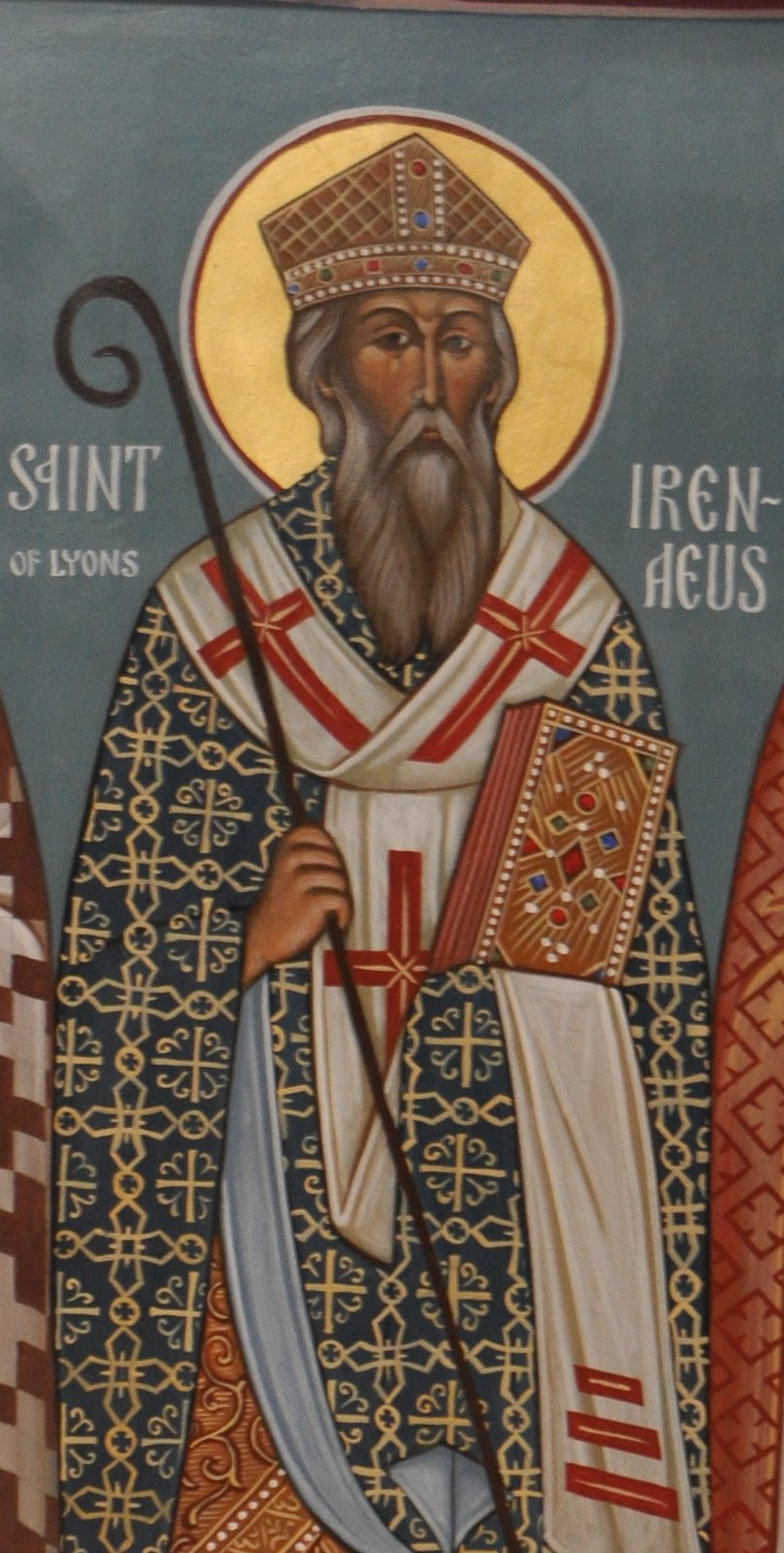
    Saint Irenaeus was a student who had great patience in investigating truth and falsehood, and was tremendously protective of apostolic teaching But his purpose was not to prove people wrong, but instead to win over his opponents and foster their faith. Irenaeus did major work in responding to the Gnostic heresy. The Gnostics claimed access to secret knowledge imparted by Jesus to only a few disciples, and their teaching was attracting and confusing many Christians. After thoroughly investigating the various Gnostic sects and their so-called “secret,” Irenaeus showed to what logical conclusions their tenets led. These he contrasted with the teaching of the apostles and the text of Holy Scripture, giving us, in five books, a system of theology of great importance to subsequent times. Moreover, his work, widely used and translated into Latin and Armenian in his day, gradually ended the influence of the Gnostics.

    Saint Irenaeus was concerned with protecting the truth. But more than that, he was zealous about teaching the truth so that people would turn away from harmful errors and remain close to Christ. All of us are expected to stand up for the truth too, in our own way, among those people God has placed us. The simplest way to do that is to live the truth and to be people of integrity and mercy. Treat others as Christ, forgive as we have been forgiven, teach what we have come to know by the way we live our lives. Our witness goes a long way to teaching the truth and winning people over to the Gospel, which is way more important than simply proving others wrong and making them look foolish. Through the intercession of Saint Irenaeus, may we all gain many souls for the glory of the Kingdom of God.

  • Thursday of the Twelfth Week of Ordinary Time

    Thursday of the Twelfth Week of Ordinary Time

    Today’s readings

    Have you accepted Jesus as your personal Savior? I’m sure you’ve heard this question, perhaps someone even asked you that question. They teach that all you have to do is make that one-time decision and you’re saved. Not so fast.

    If salvation were something magical that came about as the result of just saying a simple prayer, once and for all, then why wouldn’t everyone do that? The fact is, salvation is hard work. It was purchased at an incredible price by Jesus on the cross. And for us to make it relevant in our lives, to live it in our lives, we have work to do too. Not the kind of work that earns salvation, because salvation is not earned, but the kind of work that appropriates it into our lives and makes it meaningful.

    People who are saved behave in a specific way. They are people who take the Gospel seriously and live it every day. They are people of integrity that stand up for what’s right in every situation, no matter what it personally costs. They are people of justice who will not tolerate the sexist or racist joke, let alone tolerate a lack of concern for the poor and the oppressed. They are people of deep prayer, whose lives are wrapped up in the Eucharist and the sacraments, people who confront their own sinfulness by examination of conscience and sacramental Penance. They are people who live lightly in this world, not getting caught up in its excess and distraction, knowing they are citizens of a heaven where such things have no permanence. Saved people live in a way that is often hard, but always joyful.

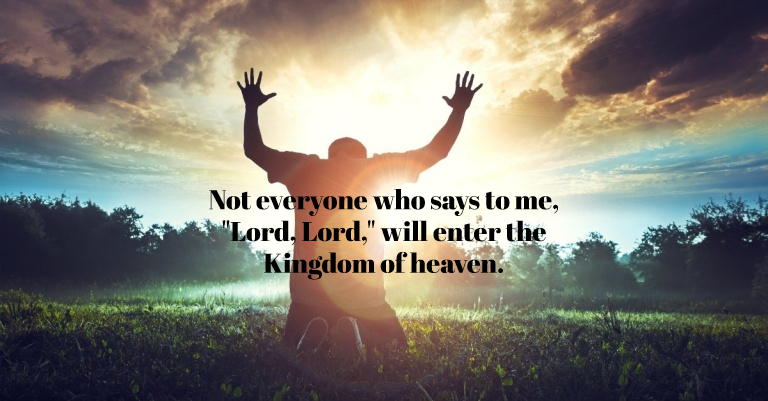
    Not everyone who claims Jesus as a personal Savior, not everyone who cries out “Lord, Lord,” will enter the kingdom of heaven. That’s what Jesus tells us today. We have to build our spiritual houses on the solid rock of Jesus Christ, living as he lived, following his commandments, and clinging to him in prayer and sacrament as if our very life depended on it. Because it does. It does.

  • The Twelfth Sunday of Ordinary Time

    The Twelfth Sunday of Ordinary Time

    Today’s readings

    What on earth do you do when everything comes crashing down around you?

    That’s a question that, quite frankly, all of us have to deal with at some time or another in our lives. Some people get more than their share of sadness, but really all of us have a heap of frustration delivered to our doorstep at some point. And it does seem to pour when it rains. Bad circumstances pile up and are mixed with frustration, anger, sadness, humiliation, and a whole host of other emotions that only make bad circumstances worse.

    So what on earth do you do when everything comes crashing down around you?

    Job had quite the storm on his hands. He was a just man and his righteousness had earned him the favor of God and the esteem of all those who knew him. He had a large and powerful family and a thriving business, and it seemed that things couldn’t be going better. Except when everything came crashing down around him. The devil didn’t like how just and upright Job was, and how much God took pride in him. And so, as the devil will do, he made plans to upset the apple cart. God allowed it, as he allows the things that befall us, because not to do so would violate our free will, which he gave us out of love.

    Job does okay for a while, but when everything piled on, Job couldn’t take it any more. His friends are no help, and they even blame him for the things that have happened. His wife tells him to “curse God and die” (2:9). Twenty-nine chapters of this has him blaming God, only to be rebuked by his friends. And in the passage we have today, God sets things right, and points out to Job that he can’t know all that God has in mind and he has no idea how the balance of good and evil in the world work. But in all of this, God has not forgotten Job, so when Job repents a few chapters later, God restores Job’s fortunes many more times greater than he had in the past.

    But what are you going to do when everything comes crashing down around you?

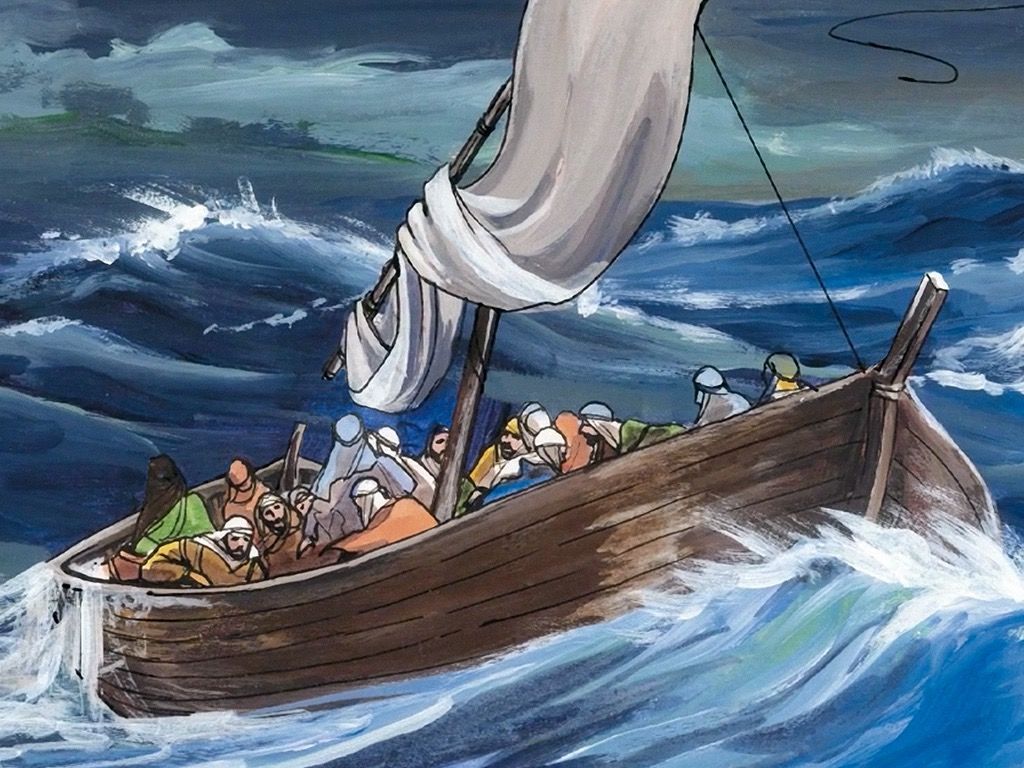
    The disciples of Jesus in the Gospel reading today certainly thought that moment had come. They had been following Jesus now, and while they were drawn to him, he clearly was not the kind of Messiah they had been expecting. Far from being a heroic military leader destined to return Israel to its place of prominence in the world at that time, Jesus was asleep on a cushion in the stern of a boat, while a violent squall threatened to dump them into the sea. Didn’t he get it? Doesn’t he know this is the kind of thing a Messiah takes care of? Couldn’t he be expected to lead them through the storm?

    Well, he does, of course. With just a few words, he rebukes the wind and the sea and tells them to be still, and the wind and the sea obey. They are astounded. And Jesus expects them to expect the astounding: “Why are you terrified? Do you not yet have faith?”

    And here we come to what is, I think, the crux of today’s Liturgy of the Word. And that is faith. You know, we have talked about this before: it’s easy to have faith when things are going well, as they were for Job in the early part of that book. But when everything crashes down around you, when everyone you know is killed, and all of your fortune destroyed, when the wind and the waves threaten to dump you into the sea, well, it’s hard to have faith then, isn’t it?

    But in those moments, those moments when everything is crashing down around you, when the world seems to be coming to a horrible end, those, friends, are the times when we need our faith the most. “Do you not yet have faith?” Jesus asks the disciples in the boat that question, but he could well enough ask us too, right? He could well ask us disciples that same question:

    • when you’re at the bedside of a loved one who went home way too soon.
    • when your job comes to an end and you have no idea what is coming next.
    • when your children can’t see what’s best for them and want to go their own way.
    • when your spouse doesn’t seem interested in your relationship any more.
    • when you’ve just received a difficult diagnosis, and you’re not sure you can withstand the medical treatment.
    • when you have no one to go home to, and the loneliness seems like a never-ending abyss.
    • when you’re listening to the news and you feel powerless to withstand the evil in the world, let alone to confront it.

    When everything is crashing down around us, do we have our faith in those moments? Because if we don’t, we’ll never be able to see Jesus in the stern of the boat, we will never be able to withstand the violent squall. There have been days where, absent my faith, I wouldn’t still be functional. But thanks be to God, I have God in my life and my faith sustains me through my hardest days.

    But that doesn’t mean it just happens. There isn’t a way to press a button and be in “faith mode” when everything comes crashing down around you. There has to be a pre-existing faith to engage. We get through tough times not by waving a magic wand, but instead by placing the storm at the foot of the Cross that we have learned to adore, and by accepting the will of Our Lord who we have learned to follow in love. The trust that we have in the Lord in whom we have put our faith is the salvation from the wind and the storm and the sea and everything crashing around us. If even the wind and the sea obey Jesus, then we have to also. And we have to do it before the storm catches us unprepared.

    “What are you going to do when everything comes crashing down around you?” isn’t really the most important question. The real question is, how are you going to build the faith that you need for when that happens?