Tag: witness

  • Thursday of the Twenty-fourth Week of Ordinary Time

    Thursday of the Twenty-fourth Week of Ordinary Time

    Today’s readings

    It’s been a while now since I was thought of as “too young.” I remember on my ordination as a deacon, on my way to priesthood, the first reading was from the prophet Jeremiah in which he protests to the Lord that he is too young to prophesy. Bishop Kaffer, of happy memory, in his homily basically said, “you’re not too young at all; it’s about time we are here ordaining you!” So when I hear today’s letter from Saint Paul to Saint Timothy, I think it’s interesting that he enjoins him not to let anyone look down on his youth.

    Now for those of us who don’t have that problem, maybe we have another. Maybe we let people look down on our age, or our experience, or whatever. Maybe we come up with all sorts of excuses as to why people wouldn’t listen to us anyway, so why bother trying to teach them? Since we have all been gifted by the Lord in some way, we have to use that gift, and not worry about people dismissing us because we aren’t the same as they are. God works in all of us, and we have to persevere in our task, so that we will save both ourselves and others.

  • Friday of the Fourteenth Week of Ordinary Time

    Friday of the Fourteenth Week of Ordinary Time

    Today’s readings

    Our God never promises that the life of faith and discipleship will be an easy one; only that it will be blessed. One thing is certain: that life will certainly entail hardship, even suffering. That’s pretty evident in today’s Gospel reading. Faithful disciples have to worry about being betrayed by even their closest family members.

    None of this is a surprise to anyone who has tried to live the faith. Perhaps at times the hardest people to evangelize are the members of one’s own family. I’m sure we all can think of people close to us who have abandoned the faith or practice it rarely. Maybe the ones who receive the Church’s teachings least are those we would hope would get it and be partners with us as we journey to the kingdom. It happens all the time – in your family and in mine.

    These are trying times. It is hard to give witness to the Truth when the culture around us wants to make its own truth. And it’s painful to see our brothers and sisters fall for the lie hook, line and sinker. So how do we stand for the Truth when our loved ones tune it out? What do we do when our loved ones reject what we’ve tried to give them to bring them to eternal life?

    Our Gospel tells us that what we do is persevere: we continue to live the Truth and witness to our faith. If those close to us tune out our words, then we have to be all the more attentive to our actions, to our lived witness, so that they can see that we live what we preach and believe. We have to depend on God to give us the right words and help us to do the right things so that we won’t be a stumbling block. And then we have to trust in God to work it all out in his time.

    None of this is going to be easy, but Jesus tells us that the one who endures to the end will be saved.

  • Friday of the Eleventh Week of Ordinary Time

    Friday of the Eleventh Week of Ordinary Time

    Today’s readings

    It amazes me when I think about all that the early Church had to go through and put up with. Saint Paul writes that he put up with persecution from all sides: from his own people as well as the Gentiles. He was beaten often, endured hazardous journeys and perilous weather, as well as every kind of deprivation. His experience was definitely extreme, but others who lived the faith in those days were also subject to persecution, torture and death. Our experience isn’t like that, is it? I mean, here we sit in this air-conditioned church and relatively comfortable surroundings. We came here freely to Mass this morning and it is unlikely that anyone will openly persecute us or torture us or put us to death for worshipping our God, although as we saw in the news yesterday, it does happen.

    But there is a subtle kind of persecution that we must endure. We know that even if our society is not openly hostile to living the Gospel, it is certainly just one step short of that. Life is not respected in our society: babies are aborted, the elderly are not respected or given adequate care, children are not raised in nurturing families, people are hated because of their race, color or creed. Faith is ridiculed as the crutch of the weak. Hope is crushed by those who abuse power. Love is overshadowed by sexual perversion and self-interest. Living the Gospel is dangerous to anyone who would want to be taken seriously in our culture.

    To all of us who come to this holy place to worship this morning and who hope to work out our salvation by living the Gospel, Saint Paul speaks eloquently. We know that he, as well as all of the communion of saints, is there to intercede for us and show us the way. He says to us today, “Who is weak, and I am not weak? Who is led to sin, and I am not indignant?” He points us to our Lord Jesus who paid the ultimate price for the Gospel, and reminds us that in living that Gospel, regardless of its cost, we store up for ourselves incredible treasures in heaven, because it is in heaven that our heart resides.

  • Saint Justin, Martyr

    Saint Justin, Martyr

    Today’s readings

    The greatest men and women who have ever lived have followed the example of our Lord Jesus Christ in that they have been willing to give their lives for the truth, for what they believed in, for what is right. In our first reading, Tobit risks his life in order to give a fallen kinsman a proper burial. Tobit and his family had been exiled to Ninevah, and the people there were hostile to the Israelites. Their hostility was so noteworthy, that in another book, Jonah famously refuses to go there and instead gets swallowed up by a large fish. So Tobit has previously narrowly escaped execution for showing charity to his fellows in exile, and he ignores the obvious lesson in order to do what is right.

    For Saint Justin, whose feast we celebrate today, he chose to stand up for the truth. He was born a pagan, and spent a good deal of his youth studying pagan philosophy, principally that of Plato. But he eventually found that Christianity answered the great questions of life and existence better than did the pagan philosophers, so he converted. He wrote famous apologies, defenses of the Christian faith, to the Roman emperor and to the senate. Because of his unwavering dedication to his faith, he was beheaded in Rome in the year 165.

    “The just one shall be an everlasting remembrance,” says the Psalmist today. All of us are called to live our faith with conviction, as did Tobit and Saint Justin. We might never be in the dire straits in which they found themselves, but we too are called to give our lives, our comforts, our standing in the community, our reputation among our peers, for the faith. Today we pray for the grace to live what we believe and to be an everlasting remembrance.

  • The Solemnity of Pentecost

    The Solemnity of Pentecost

    Today’s readings

    No one can say “Jesus is Lord” except by the Holy Spirit. That line from Saint Paul’s first letter to the Corinthians at the beginning of our second reading today says more about the Holy Spirit than we might catch at first.

    Words contain a lot of power. We know that well, because lots of times we say the wrong things and we see how it upsets people we love. And equally we experience the power of someone saying just the right thing at the right time and we see how that expression of love changes everything. Words can convey a range of emotions from love to hate, and everything in between. Words can start an argument, but the right words can diffuse a really bad situation. We’ve seen it thousands of times.

    Most of us receive the gift of speech at birth, and come into it during our childhood. We develop the gift of speech throughout our lives, perhaps learning foreign languages, or become skilled speakers. Speech is crucial to living in society.

    But it is the Holy Spirit who enables us to say anything really good. The only way that we can say “Jesus is Lord,” as Saint Paul tells us, is by the Holy Spirit. The only way that we can witness to the faith, is by the Holy Spirit. That was true of the first Apostles. Remember what happened to them right after the events of Good Friday. They scattered. When they did speak, they put their foot in their mouths. Peter used his gift of speech to deny that he even knew the Lord, let alone witness to the Lord’s power to save. At that time, the Apostles couldn’t even wrap words around what was going on in their own minds, so they were never going to be able to spread the Gospel.

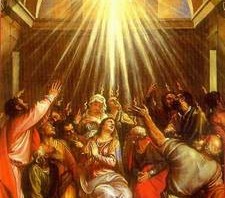
    Until Pentecost. Receiving the gift of the promised Holy Spirit, the Advocate that Jesus promised to send them, they are able not only to preach the Gospel, but to preach it in a way that people who spoke different languages were all able to understand it. The outpouring of the Holy Spirit brings everything together for them, and now, only now, are they able to say that Jesus is Lord!

    The absence of the Holy Spirit is unparalleled sadness. We can’t say – or do – anything really good without the advocacy of the Holy Spirit to inspire – literally breath into us – the goodness for which we were created. The sequence today proclaimed it well:

    Where you are not, we have naught,
    Nothing good in deed or thought,
    Nothing free from taint of ill.

    So when we receive the Holy Spirit, we are inspired to say and do good things too. The Holy Spirit will inspire us to speak many kinds of words in many situations. We can depend on the Spirit to give us the words when we don’t have them. Saint Paul teaches that the Spirit even prays in us when we can’t pray, expressing our needs in groanings when we can’t find the words to say. So the Holy Spirit will inspire us to speak…

    • Words of comfort to those who are going through difficult times. Maybe just by being with them and saying nothing at all.
    • Words of challenge when we are in a situation that is veering off course, and others are urging us to go the wrong way.
    • Words of correction when a child is acting out or not living up to their full potential.
    • Words of reconciliation when we seek to heal a broken relationship.
    • Words of vision when we are part of a group that is seeking to do something new.
    • Words of healing when we comfort another person who has been wronged by others.
    • Words of change when we stand up for what is right in a society that wants to do what it wants to do.
    • Words of mercy when we let go of a grudge, or forgive someone who has hurt us.

    The Holy Spirit will give us the right words for all of this at the right time, and we will be able to speak them in a way that everyone who needs to understand them can understand them. We may never be able to speak multiple languages – God knows I can’t! – but in the Holy Spirit we will be able to proclaim that Jesus is Lord in our words and actions and no one will be able to miss the significance of that – everyone will understand it.
  • The Ascension of Our Lord

    The Ascension of Our Lord

    Today’s readings

    When I was on my pastoral internship in seminary, my supervisor and I talked about the fact that our Liturgy is very wordy. Think about it: all of the prayers and readings and songs – it’s a lot of words to take in in an hour or less, but we do it all the time. So once in a while, I like to reflect on what are the important words in the Mass. We have the words of institution of the Eucharist – those are extremely important. The proclamation of the Scriptures, especially the Gospel, well we can’t discount those either. And let’s not forget the Creed, the words of which were the cause of many arguments and literally fights over the centuries – those words are very carefully chosen.

    But there is one word that I think is the most important, and I bet it’s going to surprise you. Because that word is “GO.” Go: we have to wait all the way to the end of Mass to hear the deacon or priest say it. “Go in peace.” Because it’s way at the end of Mass, I wonder if some people ever get to hear it. But whether we hear it or not, it’s kind of a throw-away, or it seems so. But it’s not. It’s not just a word of dismissal kind of like “you don’t have to go home but you can’t stay here.” It’s not just a word to get us out of the church and on to the next thing in life.

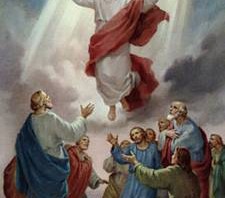
    I think it’s a word of mission. We’re singing a hymn with “Go” in the title today, and I think it catches the spirit of what the word “Go” means in our Liturgy. And we hear that spirit in our Gospel today. Jesus tells the disciples: “Go into the whole world and proclaim the gospel to every creature.” That was what the disciples were to do. They weren’t supposed to just stand there staring up into the sky: they were supposed to GO and do the work of salvation until Jesus returned in glory.

    Obviously, the command that was given to those first disciples is one that we are supposed to get as well. We are supposed to GO and preach the gospel in what we say and what we do. We are supposed to GO and baptize people by leading them to the faith in our witness. We are supposed to GO in peace, glorifying the Lord by our lives. We are supposed to GO and announce the gospel of the Lord. We do that by volunteering at the parish, looking in on a sick or elderly neighbor, living lives of integrity in the workplace. We do that by striving to be Christ-like to every person we meet.

    So I hope that you’ll hear that word “GO” at the end of Mass differently now than perhaps you have before. I hope that you’ll hear it as a calling, as a challenge, and as a sacred duty. I hope you’ll take up the call to GO and make the world into the Kingdom of God among us.

  • Saturday of the Fifth Week of Easter

    Saturday of the Fifth Week of Easter

    Today’s readings

    Just in case we thought living the Christian life of discipleship was going to be a rosy celebration of joy every single day, our Lord gives us a dose of reality today. He points out that if we find ourselves hated by the world, we have to remember that the world hated him first. If the world hates our Lord, then those of us who purport to follow after him have to expect that the world will hate us too.

    In fact, one might say that being hated by the world was a kind of litmus test of discipleship. If we are not actually hated by the world, one might wonder if we are truly living the Gospel, witnessing to the Truth and worshipping rightly. Because all of those hallmarks of discipleship necessarily cost something, and if we’re not paying the price, we’re not doing it right.

    So for us, being hated by the world might look like being passed over for a promotion or some other honor because we value time with our family over endless hours at work. It might look like being the object of unkind gossip because we value Sunday as a day of worship and family rest instead of having our children involved in all kinds of sports or artistic endeavors on the Lord’s day. It might look like skipping the latest gadget or the glitzier car so that we can be kind to the poor. The world will hate us because our commitment to Jesus will challenge their commitment to selfishness.

    We Christians live in the world, but we do not belong to the world. Our witness, our living, has to be at a different level. If we find ourselves fitting in nicely, it might just be that we’re doing it wrong.

  • Thursday of the Fifth Week of Easter

    Thursday of the Fifth Week of Easter

    Today’s readings

    In our first reading this morning, we have from the Acts of the Apostles a rather defining moment for the early Church. Jesus hadn’t given them a precise rule book of how to make the Church develop: he simply sent them out to baptize. But he also told them to make disciples of all the nations, and that’s what’s at stake in today’s reading. Because the nations didn’t observe all the laws that the Jews did. And so admitting non-Jews to the Church meant deciding whether they had to be circumcised, and whether they had to observe all the other laws of the Old Testament.

    Well, obviously, this little mini-council, swayed by the great stories of Paul and Barnabas, decided that the Spirit could call anyone to be disciples, and they shouldn’t get in the way. So they decide to impose very little upon them, outside of avoiding idol worship and unlawful marriage. And then the Psalmist’s prophecy, “Proclaim God’s marvelous deeds to all the nations” came to pass. If it weren’t for this little council, we wouldn’t be Christians today. Praise God for the movement of the Spirit.

    And now the command comes to us: we have to be the ones to proclaim God’s deeds to everyone, and not to make distinctions that marginalize other people. God’s will is not fulfilled until every heart has the opportunity to respond to his love.

  • The Third Sunday of Easter

    The Third Sunday of Easter

    Today’s readings

    “You are witnesses of these things.”

    That is what Jesus tells the disciples at the close of today’s Gospel reading. He is almost ready to ascend to the Father, and so he takes care to make sure that the disciples are ready for the mission. They are the ones who will have to testify to the death and resurrection of Christ, and to preach forgiveness of sins in his name to every person on earth.

    And we can see that the disciples did indeed take up this mission. In the first reading from Acts, Peter speaks to the Jews and tells them what Christ suffered for all of us. He emphatically urges them to repent and to believe in the Gospel. Far from the frightened, panic-stricken deserters they were on Holy Thursday, they have become the Apostles they were called to be. Peter says it very clearly, echoing Jesus’ words at the end of the Gospel:

    “Of this, we are witnesses.”

    And so we are the hearers of the message now. We too, brothers and sisters in Christ, are witnesses of these things. We may not have seen the events unfold in front of us, but we have seen them in the Liturgy, and we believe that our celebration of the Liturgy is not some simple re-enactment of the events of our salvation, but in a very real sense is a participation in the death and resurrection of Christ in our own day.

    We are the witnesses now. And people have to see us preaching with the way that we live our lives. We have to preach it by going to Mass faithfully, by keeping the commandments, by being people of integrity and fairness at our jobs or in our schools, by reaching out to those who are poor, needy and marginalized, by giving ourselves to others whenever, wherever, and however we can.

    We are witnesses of these things. The question is, will others witness Christ in us?

  • The Fifth Sunday of Lent (Cycle B)

    The Fifth Sunday of Lent (Cycle B)

    Today’s readings

    “The hour has come for the Son of Man to be glorified.”

    Bill had worked for the company for twenty-seven years, and he loved his job: it was energizing, he worked with great people, he worked for great people. It was a family business, and they treated the people who worked for them like family. They were paid well, had good benefits, and they all worked hard – it was an ideal situation. But, over the years, the brothers who ran the company retired, and sold the company to another in the same business. They were taken over a few years ago by still another company, so it was hard sometimes to remember who they even worked for. It wasn’t family any more –profits were most important, and the quality of work and product wasn’t so important as was the next big presentation for the stockholders. Everyone was trying to get ahead, and they were cutting corners to do it.

    Eventually he became aware that something was really off. What they were billing their biggest clients for, and what they were providing, were two different things. He’d seen the invoices and the sales orders and they didn’t match. And these were government contracts. He checked and re-checked, and there was no getting around it, the disparity was clear. As time went on, he knew he couldn’t live with what was going on. But if he blew the whistle, who was going to have his back? He had a family and needed the job and its benefits. But his faith had informed his conscience and he knew he couldn’t just look the other way.

    His hour had come.

    Many of us have to face our own “hours.” A teenager says his friends are constantly getting drunk and he does not want to join them. As a result he loses those friends. A parent objects to athletic practices for her children on Sunday morning. As a result, her child does not make the team. Our hour comes whenever our identity is on the line, when we are called on to make sacrifice, when we must make a decision that will cost us. The “hour” often puts our choices at odds with others and we must decide if we will live out and, in a way, die for what we believe.

    And so, maybe we can relate a bit to Jesus today. His hour had come, the hour for him to be glorified, sure, but it was also an hour that would lead first to his death. He knew this very well. In John’s Gospel, none of this is a surprise for Jesus – he is not dragged to the cross, there is no Garden of Gethsemane moment where he begs for the cup to be taken from him. Instead, John’s Gospel has Jesus in full control. He knows why he came, he knows that the hour is at hand, and he freely lays down his life for all of us.

    We are in the “homestretch” of Lent right now. Maybe this would be a good time to look back on our own “hours” and see how we’ve handled them. Have we stood for what we believe and died a little in the process? Or have we given in to the world and gone with the flow and lost our faith in the process? Chances are we are all somewhere on that journey, and now is a good time for us to return if we’ve gotten off track. Go to confession, maybe during our mission this week, and make plans to live our faith anew. It would be great if we could enter into the glory of Easter, knowing that we have made decisions that make our lives new.

    The hour has come for the Son of Man to be glorified. We know how he responded and what he gave for us. What are we willing to give for him?