Tag: witness

  • Saturday of the Seventeenth Week of Ordinary Time

    Saturday of the Seventeenth Week of Ordinary Time

    Today’s readings

    It’s dangerous to be a prophet.  It’s dangerous because nobody wants to really hear the truth.  Both Jeremiah and Saint John the Baptist find that out very clearly in today’s Scripture readings.  Both of them insisted on proclaiming the truth, and both of them ultimately paid for it with their lives, although Jeremiah was protected in today’s first reading.

    The thing we need to take with us this morning is that we are all called to be prophets.  We are all called to speak the truth.  And usually that truth won’t be welcome.  But we have to be people of integrity and say what the Lord puts on our hearts.  Maybe it will be received and maybe it won’t, but we will have at least fulfilled the call we received at baptism when we, like our Lord, were anointed as priest, prophet and king.

    It may be difficult to speak the truth, but God is faithful.  If we do what he asks us to do, he will walk with us and never leave us alone.  Being prophets is a dangerous business, but as the Psalmist tells us today, “For the LORD hears the poor, and his own who are in bonds he spurns not.”

  • Thursday of the Fourteenth Week of Ordinary Time

    Thursday of the Fourteenth Week of Ordinary Time

    Today’s readings

    Today’s Gospel is an impetus for the third Luminous Mystery of the Rosary: the proclamation of the Kingdom of God with its call to repentance.  Jesus charges his Apostles to go out and proclaim that the Kingdom is at hand, with all its accompanying signs and wonders.  We have to understand that this is the Church’s main job in every time and place.  We are now the ones who have to proclaim the Kingdom of God and call people to repentance by the witness of our lives.

    We are now the ones called to drive out demons, cure the sick, and all the rest.  We do this by being Christ’s presence in a world that is sorely in need of it.  We drive out demons by casting the glorious light of Christ into every dark corner.  We cure the sick by reaching out to those who are ill, looking in on them, caring for them, bringing the Eucharist to them.

    We also have to understand, though, that sometimes our efforts won’t prove fruitful.  Sometimes our peace won’t be received because the other person is not peaceful.  All we can do is do our best, offer Christ, and move on if that’s not accepted.  And we have to trust that God will give us everything we need on our journey.

  • Tuesday of the Fourteenth Week of Ordinary Time

    Tuesday of the Fourteenth Week of Ordinary Time

    Today’s readings

    Today’s Gospel underlines the failure of the Jewish leaders of the time.  Jesus was casting out demons from many people, which was what they were supposed to do but could not.  So instead of checking what was lacking in their faith, they accuse Jesus of being in league with the devil.  Jesus sees the vast number of people who long for spiritual care but are not getting it, and laments the lack of laborers for the harvest.

    The lack of laborers for the harvest is a real issue, now as much as then.  The needs aren’t different: people need to know God loves for them and is present to them; they need to see the value of living a Christian life.  It’s up to all of us disciples to make that life real and attractive, so that they can come to know the Lord.  You might be the Jesus that someone needs to see today.  You might be the laborer God is sending into some situation today.  Don’t be afraid to follow the Master of the harvest!

  • The Nativity of the Lord: Mass During the Night and Mass During the Day

    The Nativity of the Lord: Mass During the Night and Mass During the Day

    Sometimes I wrestle with the question of what is the greatest feast of the Church year.  Easter comes to mind, and probably Good Friday, because it is through the events those feasts commemorate that we were saved from our sins and the possibility of eternal life in the Kingdom of God became real for us.  Lots of Church people would argue that Holy Week is the greatest time of the Church year for that very reason.  And I’m inclined to agree, except for one detail: and that detail is the feast that we celebrate tonight (today).

    Today we celebrate the mystery of the Incarnation.  It’s a great and holy mystery that tells us that God loved us so much, he couldn’t bear to live without us.  When we had gone our own way and wandered far away from him, he pursued us to bring us back.  He went so far as to become one of us: the Great and Almighty One, who is higher than the heavens and more glorious than all the heavenly hosts, this God of ours took on our frail human flesh to walk among us and touch us and bring us back to himself.  He so perfectly assumed our humanity that although he never sinned, he willingly laid down his life for us, paying the price for our sins, the price of a tortuous, ignominious death on a cross.  And far from letting death have the last word, God raised him up, gloriously throwing open the gates of the Kingdom for all to enter in.

    This, brothers and sisters, is truly a great and wonderful feast!  It’s no wonder the angels sang on that glorious night!  If it weren’t for the incarnation – Jesus’ taking on our mortal flesh – there could never be a Good Friday or an Easter, there could never be salvation, never be hope for us.  But there is.  That’s the good news that we celebrate tonight (today) and every day of our lives.

    Knowing God’s love in this way is the whole reason the Church exists.  That people would not know God’s love and not experience his friendship was so unthinkable to the early followers of Jesus that they went forth everywhere preaching the Good News of God’s love and grace.

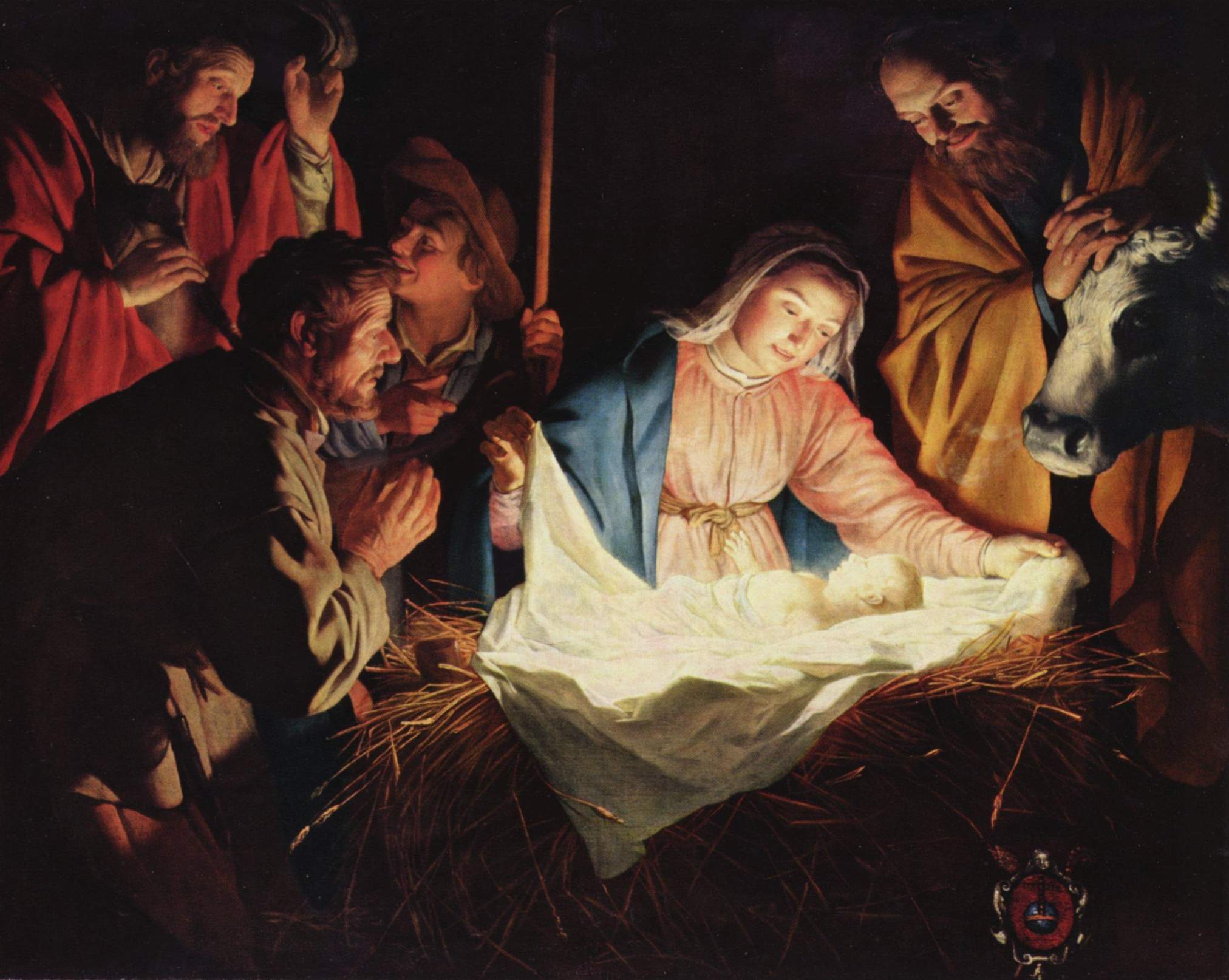
    So we come to this holy place tonight, gathered together to gaze on the gift of Christ in our Manger.  The message of this peaceful scene is that God wants to save the world.  He created us in love and for love, so he greatly desired in his grand plan that we would all come back to him one day and live forever with him in the kingdom.  But he knew that, steeped in sin as our world can be, fallen and flawed, as we individually can be, that we could never really return to him on our own.  We were – and are – too caught up in things that are not God and that are not ultimately going to bring us happiness.  So he knew that the only thing that he could do was to enter our history in a decisive way.

    And he could have done that in any way that he pleased – he is God after all: all-powerful, all-knowing and present everywhere.  John’s Gospel, though, tells us just exactly how God chose to enter our history: “And the Word became flesh and made his dwelling among us.”  He chose not just to visit us, but instead to become one of us, taking upon himself all of our weaknesses, our pain, and our sorrows.  He was born a baby: the all-powerful One taking on the least powerful stage of our existence.  He was born to a poor family and announced to an unwed mother.  The one who created the riches of the world and who himself was clothed in the splendor of the Almighty turned aside from all of it so that he could become one with his people.  Because he chose to take upon himself all that we must go through and then some, he is the way to salvation for all of us.

    The only way that the full brokenness of our human form could be redeemed was for Jesus to take on all of it when he came to save us.  That’s why his birth was so messy, why he had to be born in a manger with all the farm animals, that’s why he never had a place to lay his head in all his life.  What is amazing is that, as wretched as our earthly lives can be sometimes, God never considered himself above it all, never hesitated for a moment to take it on and fill it with grace.

    God didn’t take on our form so that he could become less, he took on our form so that we could become more.  So, yes, God becomes one of us and takes on all of our infirmities and weaknesses.  But in doing that, we ourselves become more than we could ever be on our own.  Our lowliness is filled with grace, our sadness is filled with rejoicing.  That was always the plan God had for us.

    That’s our story.  It’s really important that we don’t forget it, even more important that we tell it to everyone we can.  It’s the best and really only reason for us to celebrate so joyfully every December the 25th.  Our story is what makes us who we are, what defines us as a Church and as a people.  The story of Christ’s Incarnation is what makes us a living sign of God’s love in the world.  That is who we really are, despite the world’s attempts to define us as something less.  The great gift of God’s love shines glorious light into every dark corner of our world and of our lives and calls us broken ones to redemption and healing and joy.

    It’s crucial for us to live that story and not accept what others want to make us.  If you’re joining us for the first time tonight, or if you’re visiting family, or if you came here looking for something more for Christmas, then we welcome you and we hope that you experience Christ’s presence among us.  We hope that you find in your time with us and with the Lord tonight (today) a desire to go deeper in life and find the meaning of it all.  Please know that we would be glad to help you in that journey, and see our bulletin, or one of us, to point you in the right direction.  If you’re an active member of our parish family, then I hope the message that you receive tonight and your encounter with Christ tonight leads you to a desire to share Christ’s presence with others.

    The Incarnation – the birth and personhood of Jesus Christ – along with his Passion, death and Resurrection, changes everything.  When we all rediscover Christ, the Incarnation can change us too, so that we may then go out and change the world around us.  When that happens in us, the angels will sing just as joyfully now as they did on that most holy night.  Glory to God in the highest, and on earth peace to people of good will!

  • The Fourteenth Sunday of Ordinary Time

    The Fourteenth Sunday of Ordinary Time

    Today’s readings

    One of the parts of the Liturgy that I love most in these summer months is the development of the theme of discipleship that unfolds in the Gospel readings.  We all know that, by our baptism, we are called to be disciples of Christ, those who follow him and live the Gospel and minister and witness in his Name.  But that’s easy to say.  Just how do you do that?  Well, that’s what these readings address.

    Today’s Gospel reading has Jesus sending the seventy-two out, in pairs, on mission to preach the Gospel and heal the sick.  It’s the third Luminous Mystery of the Rosary: the preaching of the Kingdom with its call to repentance.  Jesus sent them out to villages he himself intended to visit, more or less preparing the way.  It’s a moving story about how Jesus was able to accomplish much through the ministry of the seventy-two, even without being physically present with them.  But it’s not just a moving story, right?  You know as well as I do that the reason we all got to hear that story today is because we’re being sent out on mission too.  When the time comes for us to “go in peace, glorifying the Lord by [our lives],” we have to be like the seventy-two, preparing hearts and lives for Jesus, preaching the Gospel, healing the sick.

    Before they head out, Jesus provides instruction for them.  They learn it won’t be an easy task, but that they will be able to rely on God for their strength.  In this pre-mission instruction, he gives his disciples, which includes all of us, some tools for use in witness and ministry.  We can’t let them escape our attention, because we will need them if we are to be successful.

    So the first tool he gives us is the wisdom not to rely on ourselves. Listen to the instructions Jesus gives the seventy-two before they leave: “Carry no money bag, no sack, no sandals…” Now that all seems pretty impractical to those of us who have to travel in the twenty-first century, doesn’t it?  We need a wallet or money bag to carry what we’d need to pay tolls and buy fuel and pay for what we need on the journey, and certainly we’d need a sack to carry identification as well as just basic things we’d need along the way.  Here’s the point, though: If we were able to foresee every possibility and pack for every possible need, we would certainly not need Jesus, would we?  Jesus is telling the seventy-two, and us as well, to stop worrying and start following.  Rely on Jesus because he is trustworthy.  Experience the joy of letting Jesus worry about the small stuff while he is doing big things in and through us.

    The second discipleship tool is to “greet no one along the way.”  That sounds pretty unfriendly, doesn’t it?  We would think he’d want us to greet everyone we can, but that’s not what’s at stake here.  The point is, along the way, we can easily be derailed from the mission.  Other things can seem to be important, other people can try to get us off track, Satan can make so many other things seem important along the way.  The point here is that there is urgency to the mission.  People have to hear that Jesus is Lord and that God loves them now, not later, when it may be too late.  We have to get the show on the road, and the time is now.

    The third tool is to go in peace.  Jesus says to the seventy-two: “Into whatever house you enter, first say, ‘Peace to this household.’  If a peaceful person lives there, your peace will rest on him; but if not, it will return to you.”  Those disciples were sent out with the peace of Christ, and were told to expect to be received in peace.  The source of the peace they were sent out in was, of course, Jesus himself.  The peace he is offering is not just the absence of conflict.  In fact, their journeys may indeed involve quite a bit of conflict: conflict with demons, conflict with illness, conflict with those who may not receive them or want to hear the Gospel.  Instead, the peace he sends the seventy-two out with is a peace that they receive from knowing they are doing God’s will and that souls are coming back to God.  It is a peace that says that everyone and everything is in right relationship, the way things are supposed to be.  The disciples are told to enter a place and say “Peace to this household.”  So we too must also offer this greeting of peace to those we come to work with.  There are a lot of ways to make this greeting, though.  We could say it in those words, or perhaps through our actions: in not returning violence with violence; doing our best to diffuse anger and hatred; treating all people equally; respecting the rights of both the well-established and the newcomer; working to make neighborhoods and communities less violent; protecting the abused and the ridiculed.  This peace is a peace that is authentic and that really works.

    The fourth tool pertains to sustenance and it is “eat and drink what is set before you.”  This is again a trust issue.  The seventy-two are to trust that since the laborer deserves his payment, the Lord will provide for what they need.  But there’s a bit more to it, I think.  Eating and drinking what is set before them also meant that if they were to be given ministry that is difficult, they needed to stay with it, because that’s what was set before them.  If they have been received in peace, then they need to know that they are in the right place.  That doesn’t mean that the mission would be easy, though, and they need to take what’s given to them.  We too have to know that our mission may not be easy, but if we have been given it in peace, we have to accept the mission we have.  We are called to accept people and situations as they are and trust God to perfect our efforts.

    The final tool is this: do not move from one house to another.  It’s not that Jesus doesn’t want us to spread the Good News.  The discipline Jesus is teaching here is that we have to be focused in our ministry.  Once we have been given the mission, we have to stay with it, and not be blown about like the wind.  We are called to stay with a person or a situation until what God wants to happen happens.  When it’s time to move on, God will let us know, and we will come to know that time through prayer and discernment.

    So we’ve received an awful lot as we come here for worship today.  We will be fed on the most excellent Body and Blood of our Lord which will give us strength to tend to the piece of the Kingdom that God has entrusted to us.  We have been instructed with some basic tools for doing the work of God.  If we use these tools and are faithful to the mission, I think we’ll be as overjoyed as were those disciples.  And then, we can rejoice with them that our names are written in heaven.
  • Monday of the Third Week of Easter

    Monday of the Third Week of Easter

    Today’s readings

    So they drag Saint Stephen before the Sanhedrin, and make all sorts of false claims against him.  Sounds familiar, doesn’t it?  We heard a story just like this during Holy Week!  In fact, Stephen is in good company.  He is brought to the same place where his Lord Jesus, and later Peter and the apostles, have gone before him.  And just like all of them, even with all the lies and accusations flying around him, he is at peace.  The source of his peace, is of course, his Lord who has gone before him, that same Lord who now fills him, as the first line of the reading says, with “grace and power.”  The peace that fills the martyrs is remarkable, and indicates that they have indeed been called to that kind of witness and are empowered to withstand it by their God.

    We too, will be tested in this life because of our faith.  It’s the mark, really, of authentic faith.  We too, can rely on that same grace and power if we unite ourselves to our Risen Lord.  Maybe we won’t be called on to actually give up our lives, but we will are all called at one time or another to suffer in some way when we give that true witness to our faith.  Like Stephen and the martyrs, that is our calling, it’s what disciples do, and we can rely on the help of the Lord to get us through it.

  • Easter Thursday

    Easter Thursday

    Today’s readings

    To understand how significant the Resurrection event was, I think it’s helpful to try and put together a picture of how the disciples had to be feeling at this point.  So prior to today’s Gospel selection, the women found the empty tomb, Peter has seen the Lord, and the two disciples had experienced him in the breaking of the bread on the way to Emmaus.  Their minds were most likely reeling with excitement; trying to get a grip on the things he had said to them while he was still with them.  I’m sure they were trying to figure out what all this meant, what they needed to do next.

    Maybe that’s why the Lord’s initial words to them are “Peace be with you.”  Unfortunately, though, it doesn’t seem to work, because the disciples think they’re seeing a ghost.  After Jesus eats some fish and speaks to them of the Scriptures, he sends them on mission with the very poignant words: “You are witnesses of these things.”

    The peace that Jesus gives them is certainly not the absence of conflict.  That they will be witnesses to the fulfillment of the Scriptures will be anything but peaceful for them.  They will have to make sacrifices – sacrifices of their very lives – to witness as Jesus calls them to, but there is no other choice.  They are now beginning to understand the significance of what has happened among them, and they must go forward to do what they had been chosen to do.

    When we have to make the decision to follow God’s call in our lives, we too will have to sacrifice.  Not our lives, probably, but we will have to sacrifice our own comfort, our control over our own lives, our own point of view.  But just like the disciples, we must remember what we have been chosen to do, and follow where we are being led.

    We are witnesses of these things too, we are called to live and proclaim the Gospel.  May we too receive the peace of Christ that we might focus on our call.

  • Thursday after Epiphany

    Thursday after Epiphany

    Today’s readings

    The feast of Epiphany is a celebration of the fact that Christian life looks like something.  Because Jesus has appeared on the earth and taken our own human form, because he has walked among us and lived our life and died our death, we know what the Christian Way looks like.  We know that the Christian life consists of embracing our humanity, with all its weaknesses and imperfections.  We know that it consists of living our own lives well, mindful of the needs of others, forgiving as we have been forgiven, and spreading the light of the Gospel wherever it is that God puts us.  The Galileans in the synagogue in today’s Gospel were amazed at Jesus’ speaking words of grace.  We too are called to do this so that all will recognize in us the presence of Christ.

    Because Christ is still manifest among us.  Every encounter with someone else is an opportunity for Epiphany.  It is an opportunity for us to look for the presence of Christ in that other person, and for them to see Christ at work in us.  How we do that depends on the situation, certainly, but it must always be our top priority if we are eager to be called Christians.  John’s words in the first reading are clear, and are words of indictment on those times we forget to be the Epiphany to others: “If anyone says, ‘I love God,’ but hates his brother, he is a liar; for whoever does not love a brother whom he has seen cannot love God whom he has not seen.”

    Christ is made manifest in all of us and among all of us.  In the ordinariness of our lives, we can find Christ’s grace abundantly blessing us, or we can reject it.  If we make it our priority to be Christ’s presence in the world in every encounter with a brother or sister, we may find that we are blessed with epiphany upon epiphany, constantly growing in God’s grace.  This is all part of our faith, of course, and it is this faith, as John tells us, that conquers the world.

  • Saturday of the Twenty-eighth Week of Ordinary Time: Day of Service

    Saturday of the Twenty-eighth Week of Ordinary Time: Day of Service

    Today’s readings

    Our Gospel today warns us of coming persecutions.  At some point, we will all be dragged before synagogues and rulers and authorities of some sort, and we will have to give an account of what we believe.  Now for us, it’s not going to be so literal, obviously.  But we may have to give an account of why we believe in Christ or why we follow a religion that inconveniently speaks out against threats to life and family.  We may have to tell others why it is that we would give up some of the first non-rainy day in the last few to sort food for the food pantry or dig a trench outside the church or clean the pews.

    Living our faith is always going to cost us something and that something is likely to be status or popularity, or at least the wondering glance from people who aren’t ready to accept the faith.  But the volumes that we speak by living our faith anyway might just lay the groundwork for conversion and become a conduit of grace.  We are told that we don’t have to hammer out all the words we want to say; that the Holy Spirit will give us eloquence that we can only dream of.  And it’s true, if we trust God, if we live our faith when it’s popular or unpopular, we will have the Spirit and the words.  God only knows what can be accomplished in those grace-filled moments!

  • Monday of the Third Week of Easter

    Monday of the Third Week of Easter

    Today’s readings

    Well, it doesn’t take long.  Just on Saturday at Mass, we heard about the selection of the first deacons of the Church, including Saint Stephen.  And now, today we hear of his persecution and impending death sentence.  The life of faith certainly has its ups and downs, doesn’t it?  I am sure we can all relate to that at some point or another in our lives.

    So they drag Saint Stephen before the Sanhedrin, and make all sorts of false claims against him.  Actually, Stephen is in good company.  He is brought to the same place where his Lord Jesus, and later Peter and the apostles, have gone before him.  And just like all of them, even with all the lies and accusations flying around him, he is at peace.  The source of his peace, is of course, his Lord who has already traveled the Way of the Cross, that same Lord who now fills him, as the first line of the reading says, with “grace and power.”

    We too, will be tested in this life because of our faith.  It can and will get us into trouble if we let it.  But we too can rely on that same grace and power if we unite ourselves to our Risen Lord.  As the Psalmist says today, “Blessed are they who follow the law of the Lord.”